Foram encontradas 110 questões.
Observe a figura a seguir.
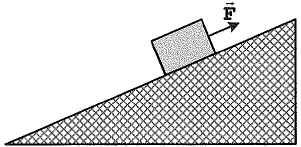
Um caixote pesando 50N, no instante t=Q, se encontra em repouso sobre um plano muito longo e inclinado de 30° em relação à horizontal. Entre o caixote e o plano inclinado, o coeficiente de atrito estático é 0,20 e o cinético é 0,10. Sabe-se que a força !$ \vec{F} !$, paralela ao plano inclinado, conforme indica a figura acima, tem intensidade igual a 36N. No instante t=9s, qual o módulo, em newtons, da força de atrito entre o caixote e o plano? Nesse mesmo instante, o bloco estará subindo, descendo ou permanece em repouso sobre o plano inclinado?
Dados: !$ sen 30^{ \circ} = 0,5\\\,\,cos30^{ \circ} = 0,9 !$
Provas
Questão presente nas seguintes provas

Based on the text below, answer question.
American Students Test Well in problem Solving, but Trail Foreign
Counterparts
Counterparts
Fifteen-year-olds in the United States scored above the average of those in the developed world on exams assessing problem-sol ving skills, but they trailed several countries in Asia and Europe as well as Canada, according to international standardized tests results released on Tuesday.
The American students who took the problem-solving tests in 2012, the first time they were administered, did better on these exams than on reading, math and science tests, suggesting that students in the United States are better able to apply knowledge to real-life situations than perform straightforward academic tasks.
Still, students who took the problem-solving tests in countries including Singapore, South Korea, Japan, several provinces of China, Canada, Australia, Finland and Britain alI outperformed American students.
"The good news is that problem solving still remains a relatively strong suit for American students," said Bob Wise, former governor of West Virginia and president of the Alliance for Excellent Education, a national policy and advocacy group focused on improving high schools. "The challenge is that a lot of other nations are now developing this and even moving ahead. So where we used to, in an earlier era, dominate in what we called the deeper learning skills creative thinking, criticaI thinking and the ability to solve problems - in terms of producing the workers that are increasingly needed in this area, other nations are coming on strong and in some cases surpassing us."
The new problem-sol ving exams were administered to a subset of 15-year-olds in 28 countries who sat for the program for International Student Assessment, a set of tests every three years commonly known as PISA and given by the Organization for Economic Cooperation and Development, a Paris-based group whose mernbers include the world' s wealthiest nations. Almost 1,275 American students took the exams.
Critics of the rankings on international tests have tended to characterize the high performance of Asian countries in particular as demonstrating the rote learning of facts and formulas. But the problem-solving results showed that students in the highest-perforrning nations were also able to think flexibly. Even on interactive tasks, the American students' strength, alI the Asian countries that participated in this round of exams outperformed the United States.
"To understand how to navigate a complex problem and exercise abstract reasoning is actually a very strong point for the Asian countries," said Francesco Avvisati, an analyst on the PISA team at the O.E.C.D.
(Adapted from http://www.nytimes.com)
Say if the statements are T (true) or F (false) and choose the best alternative.
( ) American students outscored students of developed countries in alI kinds of tests.
( ) Results suggest American students are good at problem-solving tests.
( ) American students have outstanding resul ts in problem-sol ving tasks and in academic subjects like reading, math and science.
( ) American educational authorities are concerned about the performance of students from other countries.
( ) Asian students only perform better when it comes to memorizing facts and formulas.
( ) Results suggest American students are good at problem-solving tests.
( ) American students have outstanding resul ts in problem-sol ving tasks and in academic subjects like reading, math and science.
( ) American educational authorities are concerned about the performance of students from other countries.
( ) Asian students only perform better when it comes to memorizing facts and formulas.
Provas
Questão presente nas seguintes provas
A concentração de um certo remédio no sangue, t horas após sua administração, é dada pela fórmula !$ y (t) = { \Large { 10 t \over ( t + 1)^2}} !$, !$ t \ge 0 !$. Em qual dos intervalos abaixo a função !$ y(t) !$ é crescente?
Provas
Questão presente nas seguintes provas
Considere a função real de variável real !$ f ( x ) = x + \sqrt{ \mid x \mid } !$. Para que valores da constante real k, a equação !$ f (x ) = K !$ possui exatamente 3 raízes reais?
Provas
Questão presente nas seguintes provas
Sabendo que a é uma constante real e que !$ \underset { \times \rightarrow + \infty} { \lim} \left ( { \Large { \times + a \over \times - a}} \right)^{ \times} = e !$ então o valor da constante !$ a !$ é
Provas
Questão presente nas seguintes provas
O gráfico que melhor representa a função real de variável real !$ f ( \times) = { \begin{vmatrix} { \Large { In \times + 1 \over In \times - 1}} \end{vmatrix}} !$ é
Provas
Questão presente nas seguintes provas
Based on the text below, answer question.
American Students Test Well in problem Solving, but Trail Foreign
Counterparts
Counterparts
Fifteen-year-olds in the United States scored above the average of those in the developed world on exams assessing problem-sol ving skills, but they trailed several countries in Asia and Europe as well as Canada, according to international standardized tests results released on Tuesday.
The American students who took the problem-solving tests in 2012, the first time they were administered, did better on these exams than on reading, math and science tests, suggesting that students in the United States are better able to apply knowledge to real-life situations than perform straightforward academic tasks.
Still, students who took the problem-solving tests in countries including Singapore, South Korea, Japan, several provinces of China, Canada, Australia, Finland and Britain alI outperformed American students.
"The good news is that problem solving still remains a relatively strong suit for American students," said Bob Wise, former governor of West Virginia and president of the Alliance for Excellent Education, a national policy and advocacy group focused on improving high schools. "The challenge is that a lot of other nations are now developing this and even moving ahead. So where we used to, in an earlier era, dominate in what we called the deeper learning skills creative thinking, criticaI thinking and the ability to solve problems - in terms of producing the workers that are increasingly needed in this area, other nations are coming on strong and in some cases surpassing us."
The new problem-sol ving exams were administered to a subset of 15-year-olds in 28 countries who sat for the program for International Student Assessment, a set of tests every three years commonly known as PISA and given by the Organization for Economic Cooperation and Development, a Paris-based group whose mernbers include the world' s wealthiest nations. Almost 1,275 American students took the exams.
Critics of the rankings on international tests have tended to characterize the high performance of Asian countries in particular as demonstrating the rote learning of facts and formulas. But the problem-solving results showed that students in the highest-perforrning nations were also able to think flexibly. Even on interactive tasks, the American students' strength, alI the Asian countries that participated in this round of exams outperformed the United States.
"To understand how to navigate a complex problem and exercise abstract reasoning is actually a very strong point for the Asian countries," said Francesco Avvisati, an analyst on the PISA team at the O.E.C.D.
(Adapted from http://www.nytimes.com)
Considering the text, the words "trailed" and "outperformed" mean respecti vely "followed " and "did ".
Provas
Questão presente nas seguintes provas
Which is the correct option to complete the paragraph below?
The construction of means to control maritime are as will focus the strategic are as mari time access Brazil. Two coastal areas will continue to deserve special attention: the strip that goes Santos Vitória, and the area around the mouth of the Amazon River.
(Adapted from http://www.globalsecurity.org)
Provas
Questão presente nas seguintes provas
Considere a sequência !$ x_1 = { \Large { 1 \over 2}};\,\,x_2 = { \Large { 1 + 2 \over 1 + 2}};\,\, x_3 = { \Large { 1 + 2 + 3 \over 1 + 2 + 4}};\,\, x_4 = { \Large { 1 + 4 + 3 + 4 \over 1 + 2 + 4 + 8}}; \cdots !$, O valor de x n é
Provas
Questão presente nas seguintes provas
Considere a função real de variável real !$ f ( \times) = \times^2 e^{ \times} !$. A que intervalo pertence à abscissa do ponto de máximo local de f em !$ \left ] - \infty, + \infty \right [ !$ ?
Provas
Questão presente nas seguintes provas
Cadernos
Caderno Container