Foram encontradas 40 questões.
311533
Ano: 2010
Disciplina: Direito Educacional e Tecnológico
Banca: PUC-PR
Orgão: Pref. Curitiba-PR
Disciplina: Direito Educacional e Tecnológico
Banca: PUC-PR
Orgão: Pref. Curitiba-PR
De acordo com os Parâmetros Curriculares Nacionais (1998), ao longo dos quatro anos do Ensino Fundamental, do 6º ao 9º ano, espera-se, com o ensino de Língua Estrangeira, que o aluno seja capaz de:
I. Perceber que ele é parte integrante de um mundo plurilíngue.
II. Reconhecer que o aprendizado de uma ou mais línguas lhe possibilita o acesso a bens culturais da humanidade.
III. Utilizar as quatro habilidades comunicativas de modo a poder atuar com proficiência em situações diversas.
IV. Construir conhecimento sistêmico sobre a organização textual e sobre como e quando utilizar a linguagem nas situações de comunicação.
Escolha a alternativa CORRETA:
Provas
Questão presente nas seguintes provas

BABY BRINGS MINERS HOPE AND REBIRTH
Copiapo, Chile (CNN) -- For one trapped miner in a collapsed mine in Chile, "Hope" weighs only 7 pounds. Esperanza, which means hope in Spanish, is the name of Ariel Ticona's baby girl. She is also believed to be the first child born to any of the 33 miners during their nightmarish weeks buried underground.
Esperanza was born Tuesday in a hospital about an hour's drive down a winding mountain road from the mine where her father is trapped.Ticona and his wife, Elizabeth Segovia, learned they were having a girl the day before the mine cave-in. They had planned to call her Carolina.
The girl's birth was not just a celebration for Ticona, his father said. "Immediately it gave all the miners there a lot of excitement," Hector Ticona said. "They were all very happy about her birth and that she will be called Esperanza."
The story of the baby's birth has been reported as far away as New Zealand, Germany and Singapore, and Esperanza has become a symbol that life continues for the miners despite their underground imprisonment.
The decision to change her name arrived to Ticona in the mine's depths. "He said, 'What if we call her Hope?'" Hector Ticona recalled. "Hope for the camp backing us, hope for getting us out of here, hope to keep fighting for my daughter, hope to unite my family.' "Ticona's wife agreed to the new name.
Before the mine collapse, Ticona promised Segovia he would be in the room when she gave birth. The wife decided to have the birth of their daughter videotaped. Over a video conference system that is one of their links to the outside world, Ticona was shown the birth of his daughter, deep in the mine.
Adapted from http://edition.cnn.com/2010/WORLD/americas/09/18/chile.mine.baby/index.html September, 2010.
In the text the sentence “Over a video conference system that is one of their links to the outside world, Ticona was shown the birth of his daughter, deep in the mine.” The pronoun “their” refers to:
Provas
Questão presente nas seguintes provas
BABY BRINGS MINERS HOPE AND REBIRTH
Copiapo, Chile (CNN) -- For one trapped miner in a collapsed mine in Chile, "Hope" weighs only 7 pounds. Esperanza, which means hope in Spanish, is the name of Ariel Ticona's baby girl. She is also believed to be the first child born to any of the 33 miners during their nightmarish weeks buried underground.
Esperanza was born Tuesday in a hospital about an hour's drive down a winding mountain road from the mine where her father is trapped.Ticona and his wife, Elizabeth Segovia, learned they were having a girl the day before the mine cave-in. They had planned to call her Carolina.
The girl's birth was not just a celebration for Ticona, his father said. "Immediately it gave all the miners there a lot of excitement," Hector Ticona said. "They were all very happy about her birth and that she will be called Esperanza."
The story of the baby's birth has been reported as far away as New Zealand, Germany and Singapore, and Esperanza has become a symbol that life continues for the miners despite their underground imprisonment.
The decision to change her name arrived to Ticona in the mine's depths. "He said, 'What if we call her Hope?'" Hector Ticona recalled. "Hope for the camp backing us, hope for getting us out of here, hope to keep fighting for my daughter, hope to unite my family.' "Ticona's wife agreed to the new name.
Before the mine collapse, Ticona promised Segovia he would be in the room when she gave birth. The wife decided to have the birth of their daughter videotaped. Over a video conference system that is one of their links to the outside world, Ticona was shown the birth of his daughter, deep in the mine.
Adapted from http://edition.cnn.com/2010/WORLD/americas/09/18/chile.mine.baby/index.html September, 2010.
In the sentence “She is also believed to be the first child born to any of the 33 miners during their nightmarish weeks buried underground”, the word “nightmarish” is the same as:
Provas
Questão presente nas seguintes provas
Read the cartoon and answer question basedon it.

http://www.satyamag.com/sept05/piraro.html September, 2010
The expression “by the millions” in the cartoon could be replaced by:
Provas
Questão presente nas seguintes provas
Ao abordar aspectos da Inclusão, Carneiro (2007) propõe a descontaminação dos conceitos, para evitar confusões semânticas, tendo em vista a tentativa de delimitar a significação de algumas palavras e expressões habitualmente utilizadas nesse campo do conhecimento.
Corresponda a 1ª coluna de acordo com a segunda buscando o significado dos termos:
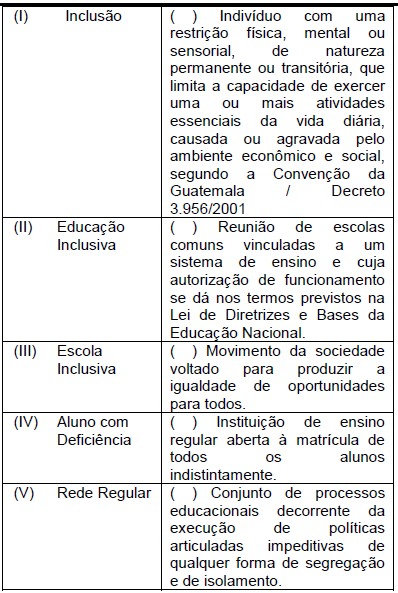
A ordem CORRETA da dos itens da 2ª coluna é:
Provas
Questão presente nas seguintes provas
Based on the cartoon, it is possible to infer about the English language that:
I. “kill” is an action verb.
II. “feel” and “think” are non-action verbs in this context.
III. Non-action verbs cannot be used in the present participle.
II. “feel” and “think” are non-action verbs in this context.
III. Non-action verbs cannot be used in the present participle.
IV. Action verbs are always used in the present participle.
Provas
Questão presente nas seguintes provas
BABY BRINGS MINERS HOPE AND REBIRTH
Copiapo, Chile (CNN) -- For one trapped miner in a collapsed mine in Chile, "Hope" weighs only 7 pounds. Esperanza, which means hope in Spanish, is the name of Ariel Ticona's baby girl. She is also believed to be the first child born to any of the 33 miners during their nightmarish weeks buried underground.
Esperanza was born Tuesday in a hospital about an hour's drive down a winding mountain road from the mine where her father is trapped.Ticona and his wife, Elizabeth Segovia, learned they were having a girl the day before the mine cave-in. They had planned to call her Carolina.
The girl's birth was not just a celebration for Ticona, his father said. "Immediately it gave all the miners there a lot of excitement," Hector Ticona said. "They were all very happy about her birth and that she will be called Esperanza."
The story of the baby's birth has been reported as far away as New Zealand, Germany and Singapore, and Esperanza has become a symbol that life continues for the miners despite their underground imprisonment.
The decision to change her name arrived to Ticona in the mine's depths. "He said, 'What if we call her Hope?'" Hector Ticona recalled. "Hope for the camp backing us, hope for getting us out of here, hope to keep fighting for my daughter, hope to unite my family.' "Ticona's wife agreed to the new name.
Before the mine collapse, Ticona promised Segovia he would be in the room when she gave birth. The wife decided to have the birth of their daughter videotaped. Over a video conference system that is one of their links to the outside world, Ticona was shown the birth of his daughter, deep in the mine.
Adapted from http://edition.cnn.com/2010/WORLD/americas/09/18/chile.mine.baby/index.html September, 2010.
Which of the following sentences best summarizes the main idea of the article?
Provas
Questão presente nas seguintes provas
O Método Áudio-oral é uma abordagem de ensino de língua estrangeira que surgiu durante a Segunda Guerra Mundial nos Estados Unidos. Dada a necessidade de formar soldados falantes de outras línguas, o exército americano solicitou a linguístas que elaborassem um método de aprendizagem de línguas eficaz e curto. O método do exército não durou mais do que dois anos, porém despertou interesse nos meios educacionais e no público em geral. Segundo J. P. B. Allen (1983:27, apud Germain, 1993:146), o Método Áudio-oral funciona bem nos estágios iniciais, no entanto suas práticas ficam ineficazes e entediantes nos níveis intermediários e avançados. Outra limitação do método apontada por Wilga Rivers (1964) é a transferência - o aluno não consegue transferir o que aprendeu para a prática de uso do idioma na vida real.
Adaptado de: Silveira, M. I. M. (1999). Línguas estrangeiras -
Uma visão histórica das abordagens, métodos e técnicas de ensino. (p. 63 a 65). Edições Catavento, São Paulo.
São características do Método Áudio-Oral:
I. Reforço imediato das respostas corretas.
II. O aluno recebe muitas explicações gramaticais.
III. Inicia-se o uso efetivo do laboratório de línguas no ensino aprendizagem das línguas estrangeiras.
IV. As atividades enfocam primeiramente a leitura e a escrita, depois o ouvir e, em seguida, o falar.
II. O aluno recebe muitas explicações gramaticais.
III. Inicia-se o uso efetivo do laboratório de línguas no ensino aprendizagem das línguas estrangeiras.
IV. As atividades enfocam primeiramente a leitura e a escrita, depois o ouvir e, em seguida, o falar.
Provas
Questão presente nas seguintes provas
THE SWEET NOTHINGNESS OF HOLIDAYS…
I just love it. There’s nothing better than waking up at 11am, making your way downstairs still in PJs, getting a bowl of cereal and then thinking: “I ain’t got a single thing to do today!”
If I look back, I wonder where the day went. Got up at 11, watched a couple of humour shows on the telly, played PS3. Just lazed on the sofa and listened to music. Chatted to my friend on Skype.
Well. I’ll enjoy the freedom and laziness while it lasts, cause I realise there ain’t gonna be much more of it in the next months.
Adapted from http://www.ateenblogs.com/
Blogs tend to present rather informal language. Mark the options which are present in the text.
I. An informal word for television.
II. An informal word for pyjamas.
III. Informal forms of auxiliary verbs.
IV. Omission of subject pronoun.
II. An informal word for pyjamas.
III. Informal forms of auxiliary verbs.
IV. Omission of subject pronoun.
Provas
Questão presente nas seguintes provas
Answer question based on the cartoon below.

http://www.cartoonstock.com/ September, 2010.
About the Imperative, it is true to affirm that:
I. It is used to give commands.
II. It is used to give instructions.
III. The verb is used in the base form.
IV. Its negative form requires ‘do not’ or ‘don’t’.
II. It is used to give instructions.
III. The verb is used in the base form.
IV. Its negative form requires ‘do not’ or ‘don’t’.
Provas
Questão presente nas seguintes provas
Cadernos
Caderno Container