Text 1A5-II
Below is a description of the procedure for manual leukocyte counting in a laboratory.
I Dilute the blood 1:20 in diluting and lysis fluid and incubate the vial under rotation for 5 minutes for erythrocyte lysis.
II Apply the fluid containing cells to the counting chamber, just enough to fill the space beneath the cover glass.
III Allow the cells to settle for 5 minutes and verify uniform cell distribution under the microscope.
IV Count the leukocytes using the condenser diaphragm of the microscope partially closed and a 10x objective lens. The leukocytes are counted in each of the four large (1 mm2) corner squares (A, B, C, and D shown in the figure below). A total of eight large corner squares from two sides of a chamber are counted.
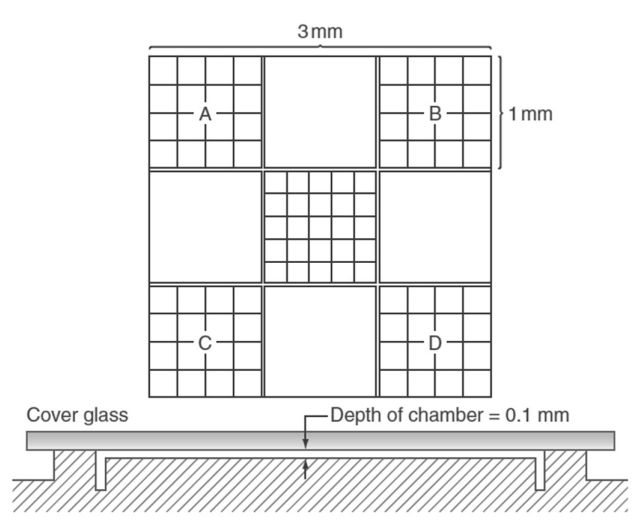
Each large square encloses a volume of 1/10 mm3, and a general formula is as follows.
Leukocyte count (cells/mm3) = (cc/lsc) × d ×10, where cc is the total number of cells counted, d is the dilution factor, 10 is the factor transforming value over one large square (1/10 mm3) to the volume in mm3 , and lsc is the number of large squares counted.
Suppose that a given blood sample, prepared according to the procedure described in text 1A5-II, yielded 300 cells as the total number of cells counted in the eight squares of a chamber. In this case, the number of cells/L in the blood tested was