TEXT I
Alexa, What Is There to Know about Love?
Brian Bilston
Alexa, what is there to know about love?
What is there to know about love?
A glove is a garment that covers the hand
for protection from the cold or dirt and –
5
Alexa, how does a human heart work?
How does a human heart work?
Blood is first received in the right atrium via
two veins, the vena cava superior and inferior –
10
Alexa, where do we go to when we die?
Where do we go to when we die?
Activating Google Maps. Completed activation.
Would you like to start from your current location?
15
Alexa, what does it mean to be alone?
What does it mean to be alone?
It is the silence left by words unsaid,
the cold expanse of half a bed.
20 undefined It is the endless stretching of the hours,
the needless tending of plastic flowers.
It is an echo unanswered in a cave,
the fateful ping of the microwave.
It is the fraying of a worn shirt cuff,
25 undefined and the howl – Stop, Alexa. That’s enough.
Available on: https://brianbilston.com/2018/07/23/alexa-what-is-there-toknow-about-love/. Accessed on February 24th, 2025
TEXT II
AI won’t take your job if you know about IA
Intelligence augmentation shows that human + AI is an ideal partnership – and the future of white-collar work
The less exciting but more likely reality is that the
changes AI brings to the workplace will entail upskilling —
when workers learn new skills — not reskilling or complete
replacement. And upskilling is not about surrendering to AI
5 but instead about mastering intelligence augmentation, or
IA, which is what happens when humans and AI work
together to accomplish more as a team than either could
flying solo. That collaboration is based on the distinction
between two concepts: reckoning and judgment.
10
Reckoning vs. Judgment
A critical difference between AI and humans is our
primary mode of operation. AI operates through what is
15 often referred to as “reckoning,” such as calculative
prediction. By that, we mean AI’s true capabilities are
grounded in facts and historical knowledge - data that can
be calculated, memorized, and repeated. It makes
predictions based on what it knows.
20 By contrast, humans operate through judgment or
practical wisdom. We understand things AI can’t possibly
know. That’s because we humans have lived experiences
that continually inform how we see the world. It’s the
intangible factors, like ethical considerations and
25 empathetic responses, that make humans better equipped
than AI to make complex decisions about human affairs.
This practical wisdom is one reason humans must
keep creating new things for IA to advance. Imagine
what would happen if humans stopped writing original content.
30 The current model of AI could never pass a certain point
because it would never encounter new, innovative ideas.
Eventually, AI would run out of new ideas to share, and our
collective knowledge would stagnate. AI is like moonlight;
its ideas come from the reflected sunlight of human insights.
35 Now, it’s essential to recognize that this contrast
between AI and humans is nothing to fear. Instead, it shows
us why “human + AI” is an ideal work partnership. AI can
perform massive calculations in the blink of an eye at a pace
far superior to even the most intelligent human on the
40 planet. When paired with a human capable of making quick
decisions based on lived experience, judgment, and
practical wisdom, it’s an immensely more powerful tool than
it is on its own.
Adapted from MCCOOL, Chris Dede and David. AI Won’t Take Your Job if You Know About IA. Harvard Graduate School of Education. Available on: https://www.gse.harvard.edu/ideas/news/24/02/ai-wont-take-your-job-ifyou-know-about-ai. Accessed on March 10 th, 2025.
TEXT III
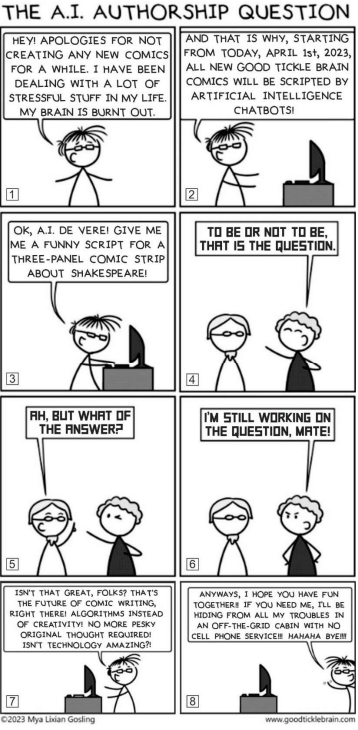
Good Tickle Brain. The A.I. Authorship Question. Available on: https://goodticklebrain. com/home/2023/3/31/the-ai-authorship-question. Accessed on March 20th, 2025.
Directions: Read texts I, II and III and answer question 44.
It is possible to say that
