Foram encontradas 64 questões.
Um êmbolo móvel, situado a uma altura de 15 cm da base de um cilindro de paredes adiabáticas e de raio R = 10 cm, confina uma porção de um gás ideal monoatômico, conforme indicado na figura a seguir.
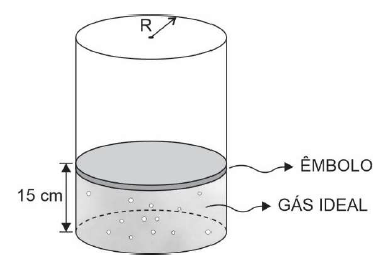
Inicialmente, o gás está à temperatura ambiente e sob a pressão de 1 ∙ 105 Pa. Mantendo-se a pressão constante, uma quantidade de calor Q é fornecida ao gás que expande de forma lenta e constante, enquanto sua temperatura é elevada. Imediatamente após retirar a fonte externa de calor, verificase que a temperatura do gás aumenta e o êmbolo fica posicionado a uma altura de 25 cm. Sob essas condições, a quantidade de calor, em joules, fornecida ao gás foi igual a
Provas

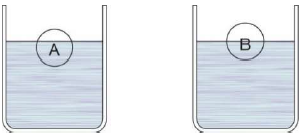
Duas esferas maciças, A e B, de mesmo volume, são colocadas, sucessivamente, dentro de um recipiente contendo certo líquido. Em condições de equilíbrio hidrostático observase que a esfera A fica com 2/3 de seu volume submerso, enquanto a B, por sua vez, fica com 1/2 de seu volume submerso, como representado nas figuras a seguir.
Em outro momento, essas mesmas esferas, A e B, se comportam como partículas que se movimentam inicialmente em sentidos opostos, sobre um plano liso e horizontal, conforme figura a seguir, e sofrem uma colisão frontal parcialmente elástica, com coeficiente de restituição igual a 1/3.
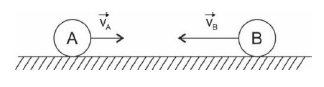
Considerando que antes da colisão a razão entre os módulos das velocidades de B e A valia 2, \( {\large{V_B \over V_A}}=2 \), tem-se que, após a colisão, a razão entre as velocidades de B e A, \( \large{V'_B \over V'_A} \), será igual a
Provas
Sobre um plano, inicialmente na direção horizontal, é apoiado um bloco de massa 1 kg e de dimensões desprezíveis, conforme figura 1.

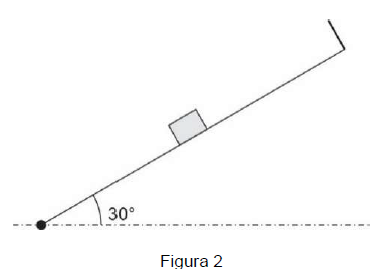
Em seguida, o plano é inclinado para 30°, conforme figura 2; sendo que, nesse momento o bloco fica na iminência de descer ao longo do plano.
Posteriormente, uma mola ideal é presa ao topo do plano inclinado; deforma-se de 5 cm essa mola e prende-se a outra extremidade dela ao bloco, conforme figura 3.
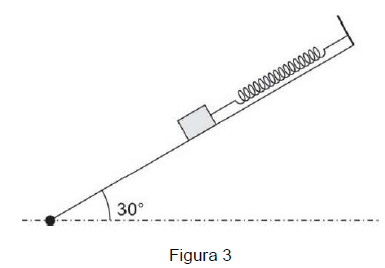
Observa-se, então, que o bloco permanece em repouso, porém, agora na iminência de subir ao longo do plano inclinado.
Nessas condições, a constante elástica da mola, em N/m, vale
Provas
Um plano, perfeitamente liso, é inclinado em relação à horizontal. Em t = 0, duas partículas, A e B, de massas iguais, são colocadas, respectivamente, na base e no topo desse plano, e passam a se movimentar de acordo com as funções horárias SA = - 2 + 6t - 2,5t2 e SB = 4 - 2,5t2, escritas em relação à origem dos espaços (0), e em unidades do SI, conforme ilustra a figura a seguir.
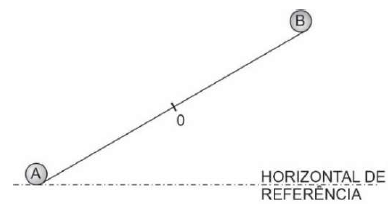
Em determinado instante A e B sofrem uma colisão perfeitamente elástica. Após essa colisão, B atinge uma altura vertical máxima, medida em metros e em relação à horizontal de referência, igual a
Provas
Duas partículas A e B se deslocam ao longo de eixos retilíneos paralelos tendo suas posições, em função do tempo, dadas pelo gráfico a seguir.
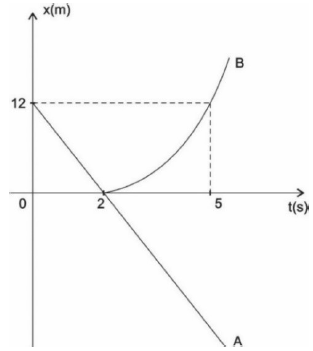
Observa-se que a partícula A se encontra em movimento uniforme desde t = 0 e que a partícula B só inicia seu movimento uniformemente variado a partir do repouso, em t = 2,0 s.
Nessas condições, a distância, em metros, que separa as duas partículas, A e B, no instante t = 8,0 s, vale
Provas
Read text III to answer question.
TEXT III
On Children – Kalil Gibran
And a woman who held a babe against her bosom said,
Speak to us of Children.
And he said:
Your children are not your children.
They are the sons and daughters of Life’s longing for itself.
They come through you but not fromB) you,
And though they are with you and yet they belong not to
you.
You may give them your love but not your thoughts.
For they have their own thoughts.
You may house their bodies but not their souls,
For their souls dwell in the house of tomorrow, which you
cannot visit, not even in your dreams.
You mayD) strive to be like them, but seek not make them like
you.
ForA) life goes not backward nor tarries withC) yesterday.
You are the bows from which your children as living arrows
are sent forth.
The archer sees the mark upon the path of the infinite, and
He bends you with His might that His arrows may go swift and far.
Let your bending in the archer’s hand be for gladness;
For even He loves the arrow that flies, so He loves also the
bow that is stable.
From The Prophet (Knopf, 1923). This poem is in Public Domain. Avalible on http:poets.org/poem/children-1. Accessed on June 10th, 2024.
Concerning the use of words in the text, it is correct to say that
Provas
Read text III to answer question.
TEXT III
On Children – Kalil Gibran
And a woman who held a babe against her bosom said,
Speak to us of Children.
And he said:
Your children are not your children.
They are the sons and daughters of Life’s longing for itself.
They come through you but not from you,
And though they are with you and yet they belong not to
you.
You may give them your love but not your thoughts.
For they have their own thoughts.
You may house their bodies but not their souls,
For their souls dwell in the house of tomorrow, which you
cannot visit, not even in your dreams.
You may strive to be like them, but seek not make them like
you.
For life goes not backward nor tarries with yesterday.
You are the bows from which your children as living arrows
are sent forth.
The archer sees the mark upon the path of the infinite, and
He bends you with His might that His arrows may go swift and far.
Let your bending in the archer’s hand be for gladness;
For even He loves the arrow that flies, so He loves also the
bow that is stable.
From The Prophet (Knopf, 1923). This poem is in Public Domain. Avalible on http:poets.org/poem/children-1. Accessed on June 10th, 2024.
Check the sentence that best explains the passage:
“You may house their bodies but not their souls, For their souls dwell in the house of tomorrow, which you cannot visit, not even in your dreams.”
Provas
Read text III to answer question.
TEXT III
On Children – Kalil Gibran
And a woman who held a babe against her bosom said,
Speak to us of Children.
And he said:
Your children are not your children.
They are the sons and daughters of Life’s longing for itself.
They come through you but not from you,
And though they are with you and yet they belong not to
you.
You may give them your love but not your thoughts.
For they have their own thoughts.
You may house their bodies but not their souls,
For their souls dwell in the house of tomorrow, which you
cannot visit, not even in your dreams.
You may strive to be like them, but seek not make them like
you.
For life goes not backward nor tarries with yesterday.
You are the bows from which your children as living arrows
are sent forth.
The archer sees the mark upon the path of the infinite, and
He bends you with His might that His arrows may go swift and far.
Let your bending in the archer’s hand be for gladness;
For even He loves the arrow that flies, so He loves also the
bow that is stable.
From The Prophet (Knopf, 1923). This poem is in Public Domain. Avalible on http:poets.org/poem/children-1. Accessed on June 10th, 2024.
It is possible to understand that kids
Provas
Read text II to answer question.
TEXT II
Generational conflict
(...)
The generations are turning over faster than ever before. While the Silent generation (1925 to 1945) was a strech of 21 years, the Millennial generation (1980 – 1994) ended just 15 years after it began. As technological change accelerates, people born a mere ten years apart can be released into an utterly different environment. A person born into the era of the smartphone, for example, will exhibit different behaviours to one who predates it, helping explain those teenagers lip-syncing pop songs and pacing out dance trots in supermarkets and carparks. Technology, like the television, the internet, and the smartphone, have a marked effect on not only how we live but on our values and beliefs.
(...)
In his 2020 book Fault Lines: Fractured Families and How to Mend Them, Karl Pillemar surveyed 1,340 Americans aged 18 and over, asking them the question: “Do you have any family members from whom you are currently estranged? He discovered that more than a quarter of Americans, surveyed, or 27 per cent, reported being estranged from a family member – a parent, grandparent, sibling, child, and so on. Extrapolated to the US adult population, that amounts to some 67 million people who are estranged from a family member. Pillemar found that ten per cent are estranged from a parent or child and eight per cent are no longer talking to a sibling. Some in the media are calling it a “silent epidemic” of family break-ups.
“When we meet people, it’s devastating to tell the truth,” Skye Ferrero laments, a mother quoted in Pillemar’s book. “We deal with it by being straightforward: ‘Oh, there are problems... we don’t see each other’.” Five years ago, Skye and her husband were cut off from their daughter and nothing they have done since has brought the couple any closer to her. “I’ve been approached by former neighbours and they say, ‘Well, you seem like such nice people. How come it’s like this? We’ve been labelled with this black cloud.” Skye thinks the issue is more widespread than it appears, it’s just that people don’t wish to talk it. “This is happening in many families,” she says.
Family estrangement can happen for any number of reasons, notwithstanding highly justifiable ones for why someone may wish to cut contact. But such serious offenses aside, fissures in the nuclear family can also happen as family members squabble over rival ideologies: politics, Brexit, vaccinations, conspiracy theories, pronouns, and any number of headline-grabbing social issues. Nasty comments on social media can inflame grievances, prompting one member to declare, “I’m done. I never want to see or speak to them again.”
Adapted from: https://www.newphilosopher.com/articles/generationalconflict accessed on March 21st, 2024.
Regarding the text choose the correct option:
Provas
Read text II to answer question.
TEXT II
Generational conflict
(...)
The generations are turning over faster than ever before. While the Silent generation (1925 to 1945) was a strech of 21 years, the Millennial generation (1980 – 1994) ended just 15 years after it began. As technological change accelerates, people born a mere ten years apart can be released into an utterly different environment. A person born into the era of the smartphone, for example, will exhibit different behaviours to one who predates it, helping explain those teenagers lip-syncing pop songs and pacing out dance trots in supermarkets and carparks. Technology, like the television, the internet, and the smartphone, have a marked effect on not only how we live but on our values and beliefs.
(...)
In his 2020 book Fault Lines: Fractured Families and How to Mend Them, Karl Pillemar surveyed 1,340 Americans aged 18 and over, asking them the question: “Do you have any family members from whom you are currently estranged? He discovered that more than a quarter of Americans, surveyed, or 27 per cent, reported being estranged from a family member – a parent, grandparent, sibling, child, and so on. Extrapolated to the US adult population, that amounts to some 67 million people who are estranged from a family member. Pillemar found that ten per cent are estranged from a parent or child and eight per cent are no longer talking to a sibling. Some in the media are calling it a “silent epidemic” of family break-ups.
“When we meet people, it’s devastating to tell the truth,” Skye Ferrero laments, a mother quoted in Pillemar’s book. “We deal with it by being straightforward: ‘Oh, there are problems... we don’t see each other’.” Five years ago, Skye and her husband were cut off from their daughter and nothing they have done since has brought the couple any closer to her. “I’ve been approached by former neighbours and they say, ‘Well, you seem like such nice people. How come it’s like this? We’ve been labelled with this black cloud.” Skye thinks the issue is more widespread than it appears, it’s just that people don’t wish to talk it. “This is happening in many families,” she says.
Family estrangement can happen for any number of reasons, notwithstanding highly justifiable ones for why someone may wish to cut contact. But such serious offenses aside, fissures in the nuclear family can also happen as family members squabble over rival ideologies: politics, Brexit, vaccinations, conspiracy theories, pronouns, and any number of headline-grabbing social issues. Nasty comments on social media can inflame grievances, prompting one member to declare, “I’m done. I never want to see or speak to them again.”
Adapted from: https://www.newphilosopher.com/articles/generationalconflict accessed on March 21st, 2024.
According to the author’s persperctive, it can be concluded that
Provas
Caderno Container