Foram encontradas 110 questões.
This text refer to item.
Japan and Korea are outstanding markets in terms of the world’s advances in cellular telephony, where multimedia applications have surged into feverish popularity. Users in these countries have demanded velocity and high quality data transmission — such as images, videos and sounds — as the principal distinctive features for the cellular telephone. Although the industry in Brazil is not yet experiencing the same phase as in the Asian countries, innovative third generation services, aligned with world-class technology, are already present, with data transmission speeds of up to 2.4 Mbps.
In fact, in some cases, Brazil has held multimedia application launches simultaneously with the United States, tremendously increasing the economic and digital inclusion that cellular telephony has fomented in recent years. The heavy impact of mobile communication on Brazilian society can be measured by the expansion of the customer base, which has been growing at historic rates of 30% a year and now serves over 50 million customers. In other words, four out of every ten Brazilians have a cellular telephone.
The importance of mobile telephony has already surpassed that of the traditional fixed telephone system, because the cell phone actually fulfills the function of taking communication to all levels of the population. Its widespread network has opened gateways to regions that formerly had not been benefited by the implementation of a fixed telephone system, such as, for example, many rural areas that are now mobile telephone customers.
The responsibility that cellular telephony carries as an instrument for transforming people’s lives tends to increase enormously in the short term. In Brazil, third generation CDMA 3G EVDO service is already offered and is able to provide handheld resources, similar to CD, DVD and TV, anywhere and at any time, based on Qualcomm's cutting edge CDMA technology.
Internet: <www.wirtel.co.uk> (with adaptations).
Based on the text above, judge the following item.The mobile phone system aims at reaching every Brazilian social class.
Provas

This text refer to item.
Japan and Korea are outstanding markets in terms of the world’s advances in cellular telephony, where multimedia applications have surged into feverish popularity. Users in these countries have demanded velocity and high quality data transmission — such as images, videos and sounds — as the principal distinctive features for the cellular telephone. Although the industry in Brazil is not yet experiencing the same phase as in the Asian countries, innovative third generation services, aligned with world-class technology, are already present, with data transmission speeds of up to 2.4 Mbps.
In fact, in some cases, Brazil has held multimedia application launches simultaneously with the United States, tremendously increasing the economic and digital inclusion that cellular telephony has fomented in recent years. The heavy impact of mobile communication on Brazilian society can be measured by the expansion of the customer base, which has been growing at historic rates of 30% a year and now serves over 50 million customers. In other words, four out of every ten Brazilians have a cellular telephone.
The importance of mobile telephony has already surpassed that of the traditional fixed telephone system, because the cell phone actually fulfills the function of taking communication to all levels of the population. Its widespread network has opened gateways to regions that formerly had not been benefited by the implementation of a fixed telephone system, such as, for example, many rural areas that are now mobile telephone customers.
The responsibility that cellular telephony carries as an instrument for transforming people’s lives tends to increase enormously in the short term. In Brazil, third generation CDMA 3G EVDO service is already offered and is able to provide handheld resources, similar to CD, DVD and TV, anywhere and at any time, based on Qualcomm's cutting edge CDMA technology.
Internet: <www.wirtel.co.uk> (with adaptations).
Based on the text above, judge the following item.There are cases when Brazil and USA have launched multimedia applications at the same time.
Provas
Folha — O sr. concorda que muitas das restrições impostas pelo Estado são impostas por pensamentos “puritanos” de parte da sociedade?
Giannetti — A opinião pública pode, sim, se tornar uma força tirânica e muito cerceadora, tanto quanto a regulamentação estatal. São dois mecanismos diferentes de coerção e de cerceamento.
Na verdade, o que estamos aprendendo hoje é que o cérebro humano é modular. Esses módulos do cérebro têm motivações diferentes, e há um processo permanente de negociação entre áreas do cérebro que nos motivam a fazer coisas diferentes. O indivíduo está permanentemente e internamente cindido, renegociando consigo mesmo o que ele faz. E essa negociação é escorregadia.
O que acontece é que, muitas vezes ciente dessa dificuldade de agir tal como ele preferiria, pede que alguma força de fora, o Estado, defina para ele os termos da transação. Ele está tentando fazer um contrato com ele mesmo, por meio do Estado.
Folha de S. Paulo, 23/10/2005. Trecho da entrevista concedida pelo economista Eduardo Giannetti (com adaptações).
Com relação a aspectos morfossintáticos do trecho de entrevista apresentado no texto acima, julgue o próximo item.
O trecho inicial da resposta apresentada pelo entrevistado assim pode ser mencionado, de forma correta e fidedigna: O economista, Giannetti, afirmou que, apesar de serem instrumentos distintos de coerção e cerceamento da liberdade, pode a opinião pública, tal como a regulamentação estatal, força tirânica e muito cerceadora, impor restrições a conduta da sociedade.
Provas
This text refer to item.
Japan and Korea are outstanding markets in terms of the world’s advances in cellular telephony, where multimedia applications have surged into feverish popularity. Users in these countries have demanded velocity and high quality data transmission — such as images, videos and sounds — as the principal distinctive features for the cellular telephone. Although the industry in Brazil is not yet experiencing the same phase as in the Asian countries, innovative third generation services, aligned with world-class technology, are already present, with data transmission speeds of up to 2.4 Mbps.
In fact, in some cases, Brazil has held multimedia application launches simultaneously with the United States, tremendously increasing the economic and digital inclusion that cellular telephony has fomented in recent years. The heavy impact of mobile communication on Brazilian society can be measured by the expansion of the customer base, which has been growing at historic rates of 30% a year and now serves over 50 million customers. In other words, four out of every ten Brazilians have a cellular telephone.
The importance of mobile telephony has already surpassed that of the traditional fixed telephone system, because the cell phone actually fulfills the function of taking communication to all levels of the population. Its widespread network has opened gateways to regions that formerly had not been benefited by the implementation of a fixed telephone system, such as, for example, many rural areas that are now mobile telephone customers.
The responsibility that cellular telephony carries as an instrument for transforming people’s lives tends to increase enormously in the short term. In Brazil, third generation CDMA 3G EVDO service is already offered and is able to provide handheld resources, similar to CD, DVD and TV, anywhere and at any time, based on Qualcomm's cutting edge CDMA technology.
Internet: <www.wirtel.co.uk> (with adaptations).
Based on the text above, judge the following item.In terms of cellular telephony, Brazil is far behind the two Asian countries mentioned in the text.
Provas
This text refer to item.
Japan and Korea are outstanding markets in terms of the world’s advances in cellular telephony, where multimedia applications have surged into feverish popularity. Users in these countries have demanded velocity and high quality data transmission — such as images, videos and sounds — as the principal distinctive features for the cellular telephone. Although the industry in Brazil is not yet experiencing the same phase as in the Asian countries, innovative third generation services, aligned with world-class technology, are already present, with data transmission speeds of up to 2.4 Mbps.
In fact, in some cases, Brazil has held multimedia application launches simultaneously with the United States, tremendously increasing the economic and digital inclusion that cellular telephony has fomented in recent years. The heavy impact of mobile communication on Brazilian society can be measured by the expansion of the customer base, which has been growing at historic rates of 30% a year and now serves over 50 million customers. In other words, four out of every ten Brazilians have a cellular telephone.
The importance of mobile telephony has already surpassed that of the traditional fixed telephone system, because the cell phone actually fulfills the function of taking communication to all levels of the population. Its widespread network has opened gateways to regions that formerly had not been benefited by the implementation of a fixed telephone system, such as, for example, many rural areas that are now mobile telephone customers.
The responsibility that cellular telephony carries as an instrument for transforming people’s lives tends to increase enormously in the short term. In Brazil, third generation CDMA 3G EVDO service is already offered and is able to provide handheld resources, similar to CD, DVD and TV, anywhere and at any time, based on Qualcomm's cutting edge CDMA technology.
Internet: <www.wirtel.co.uk> (with adaptations).
Based on the text above, judge the following item.All that Japanese and Korean peoples request in cellular telephony are images, video and sound.
Provas
Folha — O sr. concorda que muitas das restrições impostas pelo Estado são impostas por pensamentos “puritanos” de parte da sociedade?
Giannetti — A opinião pública pode, sim, se tornar uma força tirânica e muito cerceadora, tanto quanto a regulamentação estatal. São dois mecanismos diferentes de coerção e de cerceamento.
Na verdade, o que estamos aprendendo hoje é que o cérebro humano é modular. Esses módulos do cérebro têm motivações diferentes, e há um processo permanente de negociação entre áreas do cérebro que nos motivam a fazer coisas diferentes. O indivíduo está permanentemente e internamente cindido, renegociando consigo mesmo o que ele faz. E essa negociação é escorregadia.
O que acontece é que, muitas vezes ciente dessa dificuldade de agir tal como ele preferiria, pede que alguma força de fora, o Estado, defina para ele os termos da transação. Ele está tentando fazer um contrato com ele mesmo, por meio do Estado.
Folha de S. Paulo, 23/10/2005. Trecho da entrevista concedida pelo economista Eduardo Giannetti (com adaptações).
Com relação a aspectos morfossintáticos do trecho de entrevista apresentado no texto acima, julgue o próximo item.
Atenderia às regras prescritas pela gramática a seguinte formulação da pergunta feita ao entrevistado: O senhor concorda com a idéia de que, entre as restrições estabelecidas pelo Estado, muitas são impostas por pensamentos “puritanos” de parte da sociedade?
Provas
- SintaxeConectivos
- MorfologiaConjunçõesRelações de Causa e Consequência
- SemânticaSinônimos e Antônimos
- Interpretação de Textos
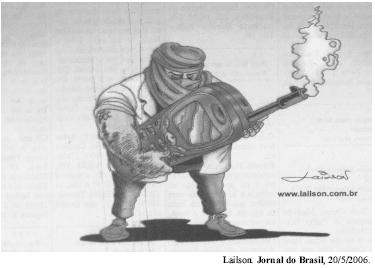
Só falta agora proibir as canetas
1 O celular é uma arma. A frase tem sido repetida à
exaustão. Logo, a solução é bloqueá-lo ou desligar as antenas
transmissoras nas proximidades dos presídios, mesmo que a
4 medida isole e prejudique centenas de milhares de cidadãos
inocentes, como já ocorre em São Paulo. Em breve,
raciocínio idêntico deverá valer para a Internet, também
7 usada por bandidos, pedófilos e fraudadores cibernéticos.
Ou para automóveis, pois eles matam milhares de pessoas
por ano no Brasil. Ou para a gasolina, porque ela pode
ser 10 usada na fabricação de coquetéis molotov. Ou, ainda, por
absurdo, para as canetas, instrumentos usados para preencher
cheques sem fundos.
13 O grande vilão não é o celular, mas a situação do
sistema penitenciário e a falta de prioridade das questões de
segurança pública no Brasil. Falta quase tudo nos presídios
16 brasileiros: pessoal qualificado, infra-estrutura adequada,
recursos tecnológicos mínimos e fiscalização rigorosa. A
justiça sequer classifica como falta grave o uso do celular
19 pelos presos.
O desligamento das estações retransmissoras mais
próximas é medida precária e vulnerável, porque qualquer
22 delinqüente pode reorientar uma antena remota, até
5 quilômetros de distância, direcionando o sinal do celular
para os presídios. Um único telefone celular GSM de alta
25 sensibilidade permitirá que, dentro do presídio, os presos
captem até o mais tênue sinal e repassem esse aparelho de
mão em mão, usando diferentes chips (SIM cards).
28 Além de pouco eficaz no combate ao crime, esse
tipo de guerra contra o celular está prejudicando mais de
200.000 usuários que moram, trabalham ou transitam nos
31 bairros próximos aos presídios até alguns quilômetros de
distância. Ethevaldo Siqueira. Veja, 31/5/2006 (com adaptações).
Julgue o item a seguir com base no texto ao lado - "Só falta agora proibir as canetas".
Provas
- EscritórioMicrosoft OfficeWordVersões do WordWord 2003 e Anteriores
- EscritórioLibreOffice, BrOffice e OpenOfficeWriter
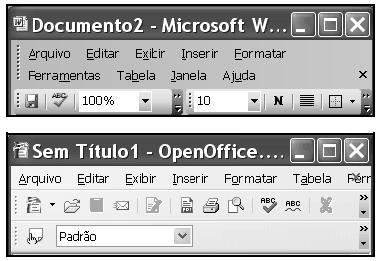
As figuras acima ilustram parte das janelas dos aplicativos Word 2003 e OpenOffice.org Write, que estão sendo executadas em um computador cujo sistema operacional é o Windows XP. Considerando essas figuras e que esses aplicativos estejam em uso para a elaboração de um documento, julgue os itens subseqüentes.
 do Word 2003. Nessa lista, existe recurso que permite abrir um arquivo PDF (portable document format) armazenado no disco rígido do computador e converter esse arquivo para um documento do tipo Word. O Write não tem esse recurso, mas permite salvar um documento que esteja em edição no formato PDF.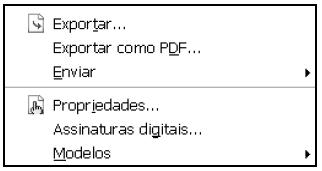
Provas
Provas
Com base no texto acima, julgue os itens a seguir.
Na situação descrita no texto, a pessoa jurídica ou o consórcio de empresas que participarem da licitação devem demonstrar capacidade para a realização da obra, por sua conta e risco, de forma que o investimento a ser feito pela concessionária seja remunerado e amortizado no curso da exploração do serviço por prazo determinado.
Provas
Caderno Container