Foram encontradas 60 questões.
A soma dos desvios ao quadrado de um grupo de medidas em relação à média dividido pelo total de valores, é igual :
Provas
Questão presente nas seguintes provas

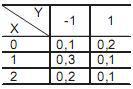
Considere a seguinte distribuição conjunta de probabilidades, onde (X;Y) é uma variável bidimensional discreta.Calcule a covariância entre X eY.
Provas
Questão presente nas seguintes provas
O nível de significância de um teste de hipóteses é a probabilidade de:
Provas
Questão presente nas seguintes provas
A instabilidade dos coeficientes estimados em uma regressão e de seus erros-padrão, os quais, particularmente, tornam-se muito grandes, é um sintoma de um determinado problema ao estimar uma regressão.Trata-se:
Provas
Questão presente nas seguintes provas
Considere a seguinte distribuição de freqüência relativa acumulada. Considere 100 anos como a idade máxima da distribuição. Com base na tabela responda à questão.
|
Idade (em anos) |
Freqüência relativa acumulada |
|
16 \( \dashv \) 26 |
0,05 |
|
26 \( \dashv \) 34 |
0,15 |
|
34 \( \dashv \) 43 |
0,35 |
|
43 \( \dashv \) 52 |
0,55 |
|
52 \( \dashv \) 61 |
0,85 |
|
61 \( \dashv \) 70 |
0,95 |
|
> 70 |
1,00 |
A idade média é aproximadamente:
Provas
Questão presente nas seguintes provas
Se X tem distribuição normal multivariada, é possível observar as propriedades:
I . Combinações lineares das componentes de X são normalmente distribuídas;
II . Todos os subconjuntos das componentes de X têm distribuição normal;
III. Covariância nula entre componentes implica que estas são independentemente distribuídas;
IV . A distribuição condicional das componentes é normal multivariada.
Das propriedades acima:
I . Combinações lineares das componentes de X são normalmente distribuídas;
II . Todos os subconjuntos das componentes de X têm distribuição normal;
III. Covariância nula entre componentes implica que estas são independentemente distribuídas;
IV . A distribuição condicional das componentes é normal multivariada.
Das propriedades acima:
Provas
Questão presente nas seguintes provas
Sejam V (verdadeiro) e F (falso) os valores lógicos associados às proposições compostas a seguir.
I. O cachorro é mamífero ou vaca voa. ( )
II. Se cachorro é mamífero, então vaca voa. ( )
III. O cachorro é mamífero e vaca voa . ( )
IV. O cachorro é mamífero, se e somente se vaca voa. ( )
A seqüência ordenada dos valores lógicos obtidos é:
I. O cachorro é mamífero ou vaca voa. ( )
II. Se cachorro é mamífero, então vaca voa. ( )
III. O cachorro é mamífero e vaca voa . ( )
IV. O cachorro é mamífero, se e somente se vaca voa. ( )
A seqüência ordenada dos valores lógicos obtidos é:
Provas
Questão presente nas seguintes provas
- Gramática - Língua InglesaPreposições | Prepositions
- Gramática - Língua InglesaVerbos | VerbsPresente simples | Simple present
GadgetDesigners Push the Limits of Size, Safety
By Brian X. Chen, August 28, 2008
Just as small, fast-moving mammals replaced lumbering
dinosaurs, pocketable gadgets are evolving to fill niches that
larger, deskbound computers can't reach. But as they shrink,
these gadgets are faced with problems mammals face, too,
such as efficiently dissipating heat.
The recent example of Apple's first-generation iPod nanos
causing fires in Japan raises the question of whether
increasingly innovative product designs are impinging on
safety. The nano incident illustrates how risk can increase as
devices decrease in size, says Roger Kay, an analyst at
EndpointTechnologies.
"As [gadgets] get smaller, the tradeoffs become more difficult,
the balance becomes more critical and there's less room for
error," Kay said. "I'm not surprised it's happening to the nano
because that's the small one. You're asking it to do a lot in a
very, very small package and that's pushing the envelope.”
There's no question that industrial designers' jobs have
become much more difficult as the industry demands ever
more powerful and smaller gadgets. With paper-thin
subnotebooks, ultrasmall MP3 players, and pinkie finger-
sized Bluetooth headsets becoming increasingly popular, it's
questionable where exactly designers draw the line between
innovation and safety.
Robots have the brains to "intelligently and autonomously search objects" their own.By Brian X. Chen, August 28, 2008
Just as small, fast-moving mammals replaced lumbering
dinosaurs, pocketable gadgets are evolving to fill niches that
larger, deskbound computers can't reach. But as they shrink,
these gadgets are faced with problems mammals face, too,
such as efficiently dissipating heat.
The recent example of Apple's first-generation iPod nanos
causing fires in Japan raises the question of whether
increasingly innovative product designs are impinging on
safety. The nano incident illustrates how risk can increase as
devices decrease in size, says Roger Kay, an analyst at
EndpointTechnologies.
"As [gadgets] get smaller, the tradeoffs become more difficult,
the balance becomes more critical and there's less room for
error," Kay said. "I'm not surprised it's happening to the nano
because that's the small one. You're asking it to do a lot in a
very, very small package and that's pushing the envelope.”
There's no question that industrial designers' jobs have
become much more difficult as the industry demands ever
more powerful and smaller gadgets. With paper-thin
subnotebooks, ultrasmall MP3 players, and pinkie finger-
sized Bluetooth headsets becoming increasingly popular, it's
questionable where exactly designers draw the line between
innovation and safety.
Provas
Questão presente nas seguintes provas
GadgetDesigners Push the Limits of Size, Safety
By Brian X. Chen, August 28, 2008
Just as small, fast-moving mammals replaced lumbering
dinosaurs, pocketable gadgets are evolving to fill niches that
larger, deskbound computers can't reach. But as they shrink,
these gadgets are faced with problems mammals face, too,
such as efficiently dissipating heat.
The recent example of Apple's first-generation iPod nanos
causing fires in Japan raises the question of whether
increasingly innovative product designs are impinging on
safety. The nano incident illustrates how risk can increase as
devices decrease in size, says Roger Kay, an analyst at
EndpointTechnologies.
"As [gadgets] get smaller, the tradeoffs become more difficult,
the balance becomes more critical and there's less room for
error," Kay said. "I'm not surprised it's happening to the nano
because that's the small one. You're asking it to do a lot in a
very, very small package and that's pushing the envelope.”
There's no question that industrial designers' jobs have
become much more difficult as the industry demands ever
more powerful and smaller gadgets. With paper-thin
subnotebooks, ultrasmall MP3 players, and pinkie finger-
sized Bluetooth headsets becoming increasingly popular, it's
questionable where exactly designers draw the line between
innovation and safety.
The title of the text let us know that there must be a close relation between…By Brian X. Chen, August 28, 2008
Just as small, fast-moving mammals replaced lumbering
dinosaurs, pocketable gadgets are evolving to fill niches that
larger, deskbound computers can't reach. But as they shrink,
these gadgets are faced with problems mammals face, too,
such as efficiently dissipating heat.
The recent example of Apple's first-generation iPod nanos
causing fires in Japan raises the question of whether
increasingly innovative product designs are impinging on
safety. The nano incident illustrates how risk can increase as
devices decrease in size, says Roger Kay, an analyst at
EndpointTechnologies.
"As [gadgets] get smaller, the tradeoffs become more difficult,
the balance becomes more critical and there's less room for
error," Kay said. "I'm not surprised it's happening to the nano
because that's the small one. You're asking it to do a lot in a
very, very small package and that's pushing the envelope.”
There's no question that industrial designers' jobs have
become much more difficult as the industry demands ever
more powerful and smaller gadgets. With paper-thin
subnotebooks, ultrasmall MP3 players, and pinkie finger-
sized Bluetooth headsets becoming increasingly popular, it's
questionable where exactly designers draw the line between
innovation and safety.
Provas
Questão presente nas seguintes provas
GadgetDesigners Push the Limits of Size, Safety
By Brian X. Chen, August 28, 2008
Just as small, fast-moving mammals replaced lumbering
dinosaurs, pocketable gadgets are evolving to fill niches that
larger, deskbound computers can't reach. But as they shrink,
these gadgets are faced with problems mammals face, too,
such as efficiently dissipating heat.
The recent example of Apple's first-generation iPod nanos
causing fires in Japan raises the question of whether
increasingly innovative product designs are impinging on
safety. The nano incident illustrates how risk can increase as
devices decrease in size, says Roger Kay, an analyst at
EndpointTechnologies.
"As [gadgets] get smaller, the tradeoffs become more difficult,
the balance becomes more critical and there's less room for
error," Kay said. "I'm not surprised it's happening to the nano
because that's the small one. You're asking it to do a lot in a
very, very small package and that's pushing the envelope.”
There's no question that industrial designers' jobs have
become much more difficult as the industry demands ever
more powerful and smaller gadgets. With paper-thin
subnotebooks, ultrasmall MP3 players, and pinkie finger-
sized Bluetooth headsets becoming increasingly popular, it's
questionable where exactly designers draw the line between
innovation and safety.
The reason given in the third paragraph of the text for the problemwith smaller gadgets is that…By Brian X. Chen, August 28, 2008
Just as small, fast-moving mammals replaced lumbering
dinosaurs, pocketable gadgets are evolving to fill niches that
larger, deskbound computers can't reach. But as they shrink,
these gadgets are faced with problems mammals face, too,
such as efficiently dissipating heat.
The recent example of Apple's first-generation iPod nanos
causing fires in Japan raises the question of whether
increasingly innovative product designs are impinging on
safety. The nano incident illustrates how risk can increase as
devices decrease in size, says Roger Kay, an analyst at
EndpointTechnologies.
"As [gadgets] get smaller, the tradeoffs become more difficult,
the balance becomes more critical and there's less room for
error," Kay said. "I'm not surprised it's happening to the nano
because that's the small one. You're asking it to do a lot in a
very, very small package and that's pushing the envelope.”
There's no question that industrial designers' jobs have
become much more difficult as the industry demands ever
more powerful and smaller gadgets. With paper-thin
subnotebooks, ultrasmall MP3 players, and pinkie finger-
sized Bluetooth headsets becoming increasingly popular, it's
questionable where exactly designers draw the line between
innovation and safety.
Provas
Questão presente nas seguintes provas
Cadernos
Caderno Container