Foram encontradas 50 questões.
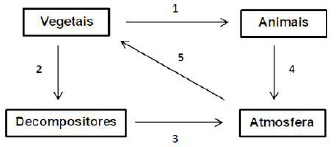
O esquema representa, de forma parcial, a circulação do carbono pelo ambiente onde estão indicados processos biológicos – 1, 2, 3, 4, 5 – envolvidos na transferência desse elemento ao longo do ciclo.
Com base na imagem e nos conhecimentos sobre ciclos biogeoquímicos, é correto afirmar:
Provas

Cada objeto potencial de seleção passa por vários processos: mutação, reestruturação de cromossomo na meiose, movimento aleatório de cromossomos até diferentes células-filhas na divisão redutiva e os aspectos aleatórios do encontro dos dois gametas. Nessa primeira etapa, tudo é acaso e aleatoriedade. A segunda etapa da evolução é o destino do novo zigoto, de sua formação até sua reprodução bem sucedida.
Nesta etapa, a seleção é o fator dominante, mesmo com o acaso ainda desempenhando um papel considerável.
MAYR, Ernst. Biologia, ciência única. Sp: Companhia das Letras, 2005, p. 152.
Com base nas informações do texto e considerando-se que o processo evolutivo é um evento delineado por duas etapas integradas, é correto afirmar:
Provas
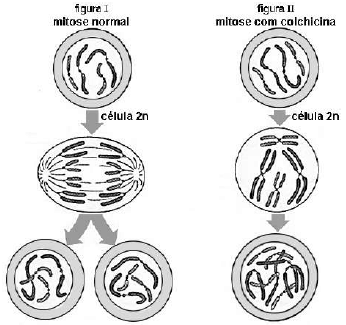
AMABIS & MARTHO, Biologia das populações. v. 3. São Paulo: Moderna, e. 2, 2004, p. 215.
A ilustração representa, nas figuras I e II, respectivamente, as diferenças existentes em uma célula durante a divisão celular por mitose sem acréscimo da colchicina e com acréscimo da colchicina, uma substância inibidora do encaixe de microtúbulos.
Com base nessa informação e nos conhecimentos sobre divisão celular, é correto afirmar:
Provas
A atual epidemia de obesidade que atinge a infância e os adolescentes tem provocado aumento assustador de Diabetes Mellitus do tipo 2 nessas faixas etárias, anteriormente consideradas resistentes a tal forma da doença. É importante lembrar que um adolescente com excesso de peso tem 70% de chance de mantê-lo ou de se tornar obeso na vida adulta. Se um de seus pais sofrer de obesidade, a probabilidade então sobe para 80%.
VARELA, Drauzio. Borboletas da alma: escritos sobre ciência e saúde. São Paulo: Companhia das Letras, 2006, p. 238.
Uma das justificativas utilizadas para melhor explicar de que forma a obesidade interfere no desenvolvimento do Diabetes Melitus tipo 2 no organismo, é que
Provas
A radiação ultravioleta foi a primeira fonte de mutação do DNA a ser estudada e, devido ao seu poder germicida, vem sendo amplamente empregada para causar danos letais em micro-organismos em condições laboratoriais. Ela é usada para matar bactérias e fungos, tornando o espaço de manipulação do material genético mais puro e esterilizado.
VANZELA, André L. Laforga; SOUZA, Rogério Fernandes. Avanços da Biologia Celular e da Genética Molecular. São Paulo: Unesp, 2009, p.42.
Considerando-se as vantagens mencionadas na utilização da radiação ultravioleta em ambientes de pesquisa, pode-se afirmar:
Provas
No trabalho iniciado, silenciosamente, nos anos de 1960 e que só deu frutos dez anos depois, Carl Woese selecionou uma única estrutura para comparar espécies. Obviamente, a estrutura tinha de estar presente em todas as espécies. E mais, tinha de servir ao mesmo propósito. Esse propósito tinha de ser fundamental e tão importante para a célula que até leves mudanças na sua função seriam penalizadas pela seleção natural. Isto é necessário se quisermos comparar as diferenças que se acumulam entre espécies ao longo de, literalmente, bilhões de anos, para construírem uma grande árvore da vida, desde o início. Essa foi a escala da ambição de Woese ao propor uma classificação com base em Domínios.
LANE, Nick. Questão Vital: porque a vida é como é? e.1. Rio de Janeiro: Rocco, 2017, p.17.
O texto menciona uma estrutura selecionada pelo pesquisador Carl Woese, durante a montagem de sua classificação dos seres vivos por Domínios. Esta estrutura apresenta uma função ou propósito essencial para a manutenção da vida. Desta forma, pode-se afirmar que a função biológica citada está associada diretamente à
Provas

A new study published in Current Biology is investigating why you get poor sleep in unfamiliar places. It suggests that when people sleep in an unfamiliar place, one hemisphere of the brain stays more awake as a way to keep watch for potential danger possibly a remnant of the days when Homo sapiens had to guard their territory every night.
This phenomenon is known as unihemispheric slow-wave sleep, and it’s seen in marine animals and some birds. This is the first study to suggest that the human brain may also be hard-wired to function in a similar way, although on a smaller scale. Humans, unlike sparrows, don’t usually sleep with one eye open. However, when in new surroundings, one hemisphere of the brain may stay at least a little bit awake – great for waking quickly if an intruder shows up, but with a resulting groggy feeling the next morning.
The group of researchers recruited sleep study participants, and conducted neuroimaging along with polysomnography, a standard test used in sleep labs to monitor brain waves, oxygen level in blood, heart rate, breathing, and eye and leg movements. They discovered that only the brain’s right hemisphere was consistently engaged in slow-wave, or deep, sleep. The left hemisphere – the side responsible for logical thinking and reasoning – had what the researchers called “enhanced vigilance”, which also made the entire brain more responsive to sound.
The researchers tried a test where they targeted sounds to the left and right ear. They found that on the first night, 80 percent of the arousals from deep sleep occurred when sound was made to target the right ear (the brain’s left hemisphere). On day two, that number dropped to about 50 percent.
FIRGER, Jessica. Disponível em: <http://www.newsweek.com/authors/ jessica-figer>. Acesso em: set. 2018. Adaptado.
The word or expression from the text has not been correctly defined in
Provas
A new study published in Current Biology is investigating why you get poor sleep in unfamiliar places. It suggests that when people sleep in an unfamiliar place, one hemisphere of the brain stays more awake as a way to keep watch for potential danger possibly a remnant of the days when Homo sapiens had to guard their territory every night.
This phenomenon is known as unihemispheric slow-wave sleep, and it’s seen in marine animals and some birds. This is the first study to suggest that the human brain may also be hard-wired to function in a similar way, although on a smaller scale. Humans, unlike sparrows, don’t usually sleep with one eye open. However, when in new surroundings, one hemisphere of the brain may stay at least a little bit awake – great for waking quickly if an intruder shows up, but with a resulting groggy feeling the next morning.
The group of researchers recruited sleep study participants, and conducted neuroimaging along with polysomnography, a standard test used in sleep labs to monitor brain waves, oxygen level in blood, heart rate, breathing, and eye and leg movements. They discovered that only the brain’s right hemisphere was consistently engaged in slow-wave, or deep, sleep. The left hemisphere – the side responsible for logical thinking and reasoning – had what the researchers called “enhanced vigilance”, which also made the entire brain more responsive to sound.
The researchers tried a test where they targeted sounds to the left and right ear. They found that on the first night, 80 percent of the arousals from deep sleep occurred when sound was made to target the right ear (the brain’s left hemisphere). On day two, that number dropped to about 50 percent.
FIRGER, Jessica. Disponível em: <http://www.newsweek.com/authors/ jessica-figer>. Acesso em: set. 2018. Adaptado.
The scientists found out that
Provas
A new study published in Current Biology is investigating why you get poor sleep in unfamiliar places. It suggests that when people sleep in an unfamiliar place, one hemisphere of the brain stays more awake as a way to keep watch for potential danger possibly a remnant of the days when Homo sapiens had to guard their territory every night.
This phenomenon is known as unihemispheric slow-wave sleep, and it’s seen in marine animals and some birds. This is the first study to suggest that the human brain may also be hard-wired to function in a similar way, although on a smaller scale. Humans, unlike sparrows, don’t usually sleep with one eye open. However, when in new surroundings, one hemisphere of the brain may stay at least a little bit awake – great for waking quickly if an intruder shows up, but with a resulting groggy feeling the next morning.
The group of researchers recruited sleep study participants, and conducted neuroimaging along with polysomnography, a standard test used in sleep labs to monitor brain waves, oxygen level in blood, heart rate, breathing, and eye and leg movements. They discovered that only the brain’s right hemisphere was consistently engaged in slow-wave, or deep, sleep. The left hemisphere – the side responsible for logical thinking and reasoning – had what the researchers called “enhanced vigilance”, which also made the entire brain more responsive to sound.
The researchers tried a test where they targeted sounds to the left and right ear. They found that on the first night, 80 percent of the arousals from deep sleep occurred when sound was made to target the right ear (the brain’s left hemisphere). On day two, that number dropped to about 50 percent.
FIRGER, Jessica. Disponível em: <http://www.newsweek.com/authors/ jessica-figer>. Acesso em: set. 2018. Adaptado.
In order to monitor the participants’ brains, the researchers
Provas
A new study published in Current Biology is investigating why you get poor sleep in unfamiliar places. It suggests that when people sleep in an unfamiliar place, one hemisphere of the brain stays more awake as a way to keep watch for potential danger possibly a remnant of the days when Homo sapiens had to guard their territory every night.
This phenomenon is known as unihemispheric slow-wave sleep, and it’s seen in marine animals and some birds. This is the first study to suggest that the human brain may also be hard-wired to function in a similar way, although on a smaller scale. Humans, unlike sparrows, don’t usually sleep with one eye open. However, when in new surroundings, one hemisphere of the brain may stay at least a little bit awake – great for waking quickly if an intruder shows up, but with a resulting groggy feeling the next morning.
The group of researchers recruited sleep study participants, and conducted neuroimaging along with polysomnography, a standard test used in sleep labs to monitor brain waves, oxygen level in blood, heart rate, breathing, and eye and leg movements. They discovered that only the brain’s right hemisphere was consistently engaged in slow-wave, or deep, sleep. The left hemisphere – the side responsible for logical thinking and reasoning – had what the researchers called “enhanced vigilance”, which also made the entire brain more responsive to sound.
The researchers tried a test where they targeted sounds to the left and right ear. They found that on the first night, 80 percent of the arousals from deep sleep occurred when sound was made to target the right ear (the brain’s left hemisphere). On day two, that number dropped to about 50 percent.
FIRGER, Jessica. Disponível em: <http://www.newsweek.com/authors/ jessica-figer>. Acesso em: set. 2018. Adaptado.
According to the text, fill in the parentheses with T (True) or F (False). The study mentioned in the text says that, when we sleep in a new location,
( ) half of our brain may remain alert.
( ) we behave exactly like sparrows.
( ) the left hemisphere of our brain is less asleep than the right.
( ) our brain’s vigilance is a way to protect us from unknown dangers.
The correct sequence, from top to bottom, is
Provas
Caderno Container