Foram encontradas 110 questões.
WHAT’S IN A NAME
People from cultures around the globe have always believed names have magical powers, and that just by giving a certain name, you can instill positive qualities in your baby. It is such “magical” or even sub-conscious thinking that may have been behind names such as Faith, Hope, and Charity, which were popular many years ago in the U.S.
Astrological names, for example, are chosen according to the time of birth, in the hopes that such names will be lucky and work with harmony under the stars. A child born under the sign of Leo might be given a name that means lion – the zodiac symbol of Leo. Oriental astrologers believe there must be a balance of the basic elements – earth, fire, metal, water, air and wood – to have a smooth course in life. When a baby’s horoscope is read, if there appears to be too much of one element, metal for example, the baby might be given a name which means “Earth” to balance the elements in his/her life.
Names are chosen for a variety of reasons. Sometimes, names have deep personal meaning for the parents, or they have traditionally been names given to children in their families. Some names have religious significance for the parents, and others are chosen simply because the parents like the sound of the name. Whatever the reason, it is important for parents to remember that, like it or not, others will form opinions about their child according to their name. Research has shown that people are often stereotyped as successful, plain, popular or otherwise all because of their name.
All the statements below are true, except:
Provas

All of the characteristics of spoken language listed below make listening difficult, except:
Provas
The diagram below describes the elements of language competence. Choose the alternative which contains the components to complete it.
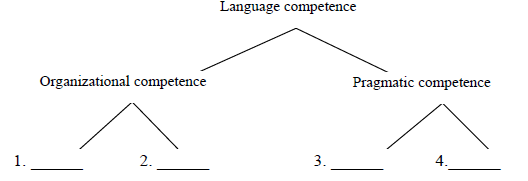
Provas
The concept of social distance consists of the following parameters:
Provas
Choose the option which correctly describes an overt response that indicates reading comprehension.
Provas
When writing a test, teachers should consider three main testing concepts:
Provas
The article a can be appropriately used in:
Provas
Choose the alternative that presents the best possible planning solution for the following classroom problem.
PROBLEM: Young teenagers are working in pairs, doing role-plays of job interviews. They are having problems with thinking of what to ask and answer.
Provas
Choose the correct sentence.
Provas
Which adjective is used in a predicative position?
Provas
Caderno Container