Foram encontradas 70 questões.
Thought-in-Action Links
It is important to recognize that methods link thoughts and actions, because teaching is not entirely about one or the other. As a teacher of language, you have thoughts about your subject matter – what language is, what culture is – and about your students – who they are as learners and how it is they learn. You also have thoughts about yourself as a teacher and what you can do to help your students to learn. Many of your thoughts have been formed by your own experience as a language learner. With this awareness, you are able to examine why you do what you do and perhaps choose to think about or do things differently.
As an example, let us relate an anecdote about a teacher with whom Diane Larsen-Freeman was working some time ago. From her study of methods in Stevick (1980), Heather (not her real name ) became interested in how to work with teacher control and student initiative in her teaching. She determined that during her student teaching internship, she would exercise less control of the lesson in order to encourage her students to take more initiative, and have them impose the questions in the classroom, since so often it is the teacher who asks all the questions, not the students.
However, she felt that the students were not taking the initiative, but she could not see what was wrong. When Diane Larsen Freeman, who was her supervisor, visited her class, she observed the following:
HEATHER: Juan, ask Anna what she is wearing.
JÜAN: What are you wearing?
ANNA: I am wearing a dress.
HEATHER: Anna, ask Muriel what she is writing.
ANNA: What are you writing?
MÜRIEL: I am writing a letter.
This pattern continued for some time. It was clear to see that Heather had successfully avoided the common problem of the teacher asking all the questions in the class. The teacher was not asking the questions – the students were. However, Heather had not achieved her goal of encouraging student initiative.
(Larsen-Freeman, D. 2000. Adaptado)
Sometimes, the user of the foreign language is uncertain about what verb to choose in a particular situation. Learning collocations may be helpful. Mark the alternative in which the collocation with common verbs needs to be corrected.
Provas
Questão presente nas seguintes provas

Considerando a lei que estabelece as diretrizes e bases da educação nacional (Lei nº 9.394, de 20.12.1996), assinale a alternativa que apresenta as categorias administrativas nas quais as instituições de ensino são classificadas.
Provas
Questão presente nas seguintes provas
O projeto empreendido pelos portugueses de colonização do território que viria a se chamar Brasil se deu, primeiramente, pela implementação das conhecidas capitanias hereditárias, a partir de 1532. Segundo Boris Fausto:
“O Brasil foi dividido em quinze quinhões, por uma série de linhas paralelas ao Equador que iam do litoral até o meridiano de Tordesilhas, sendo os quinhões entregues aos chamados capitães donatários. Eles constituíam um grupo diversificado onde havia gente da pequena nobreza, burocratas e comerciantes, tendo em comum
suas ligações com a coroa portuguesa”.
suas ligações com a coroa portuguesa”.
(Boris Fausto. História do Brasil. São Paulo: Editora da Universidade de São Paulo/Fundação para o Desenvolvimento da Educação, 2000)
É consenso na historiografia brasileira que o fracasso das capitanias hereditárias se deveu a diversos fatores conjugados, tendo destaque
Provas
Questão presente nas seguintes provas
An international student who majors in engineering drops by the engineering department office and asks the secretary, “Can you tell me where the English department is?” The secretary smiles and responds, “I don’t know, actually. It’s probably somewhere in the Humanities Building. Do you have a campus map?” The student turns around and leaves. The secretary is taken aback and feels slightly uncomfortable. She wonders why the student left so abruptly.
(...)
People who interact with ESL students have commented that some seem to express gratitude excessively for small considerations, even to the point of embarrassing the person they are speaking. Others seem downright rude because they do not say thank you when they are expected to.
(Celce-Murcia, M. 2001.)
Harmer, J. (2007) e Celce-Murcia, M. (2001) descrevem diferentes tipos de testes, cada qual com seus objetivos. Um “achievement test”, por exemplo, será capaz de verificar
Provas
Questão presente nas seguintes provas
Thought-in-Action Links
It is important to recognize that methods link thoughts and actions, because teaching is not entirely about one or the other. As a teacher of language, you have thoughts about your subject matter – what language is, what culture is – and about your students – who they are as learners and how it is they learn. You also have thoughts about yourself as a teacher and what you can do to help your students to learn. Many of your thoughts have been formed by your own experience as a language learner. With this awareness, you are able to examine why you do what you do and perhaps choose to think about or do things differently.
As an example, let us relate an anecdote about a teacher with whom Diane Larsen-Freeman was working some time ago. From her study of methods in Stevick (1980), Heather (not her real name ) became interested in how to work with teacher control and student initiative in her teaching. She determined that during her student teaching internship, she would exercise less control of the lesson in order to encourage her students to take more initiative, and have them impose the questions in the classroom, since so often it is the teacher who asks all the questions, not the students.
However, she felt that the students were not taking the initiative, but she could not see what was wrong. When Diane Larsen Freeman, who was her supervisor, visited her class, she observed the following:
HEATHER: Juan, ask Anna what she is wearing.
JÜAN: What are you wearing?
ANNA: I am wearing a dress.
HEATHER: Anna, ask Muriel what she is writing.
ANNA: What are you writing?
MÜRIEL: I am writing a letter.
This pattern continued for some time. It was clear to see that Heather had successfully avoided the common problem of the teacher asking all the questions in the class. The teacher was not asking the questions – the students were. However, Heather had not achieved her goal of encouraging student initiative.
(Larsen-Freeman, D. 2000. Adaptado)
The fragment from the last paragraph “who was her supervisor” is an example of an adjective clause. Mark the alternative in which the deletion of the relative pronoun (and only the relative pronoun) is possible.
Provas
Questão presente nas seguintes provas
De acordo com o livro Projeto-político pedagógico da escola: uma construção possível, organizado por Ilma Veiga, é correto afirmar que o projeto político-pedagógico
Provas
Questão presente nas seguintes provas
Thought-in-Action Links
It is important to recognize that methods link thoughts and actions, because teaching is not entirely about one or the other. As a teacher of language, you have thoughts about your subject matter – what language is, what culture is – and about your students – who they are as learners and how it is they learn. You also have thoughts about yourself as a teacher and what you can do to help your students to learn. Many of your thoughts have been formed by your own experience as a language learner. With this awareness, you are able to examine why you do what you do and perhaps choose to think about or do things differently.
As an example, let us relate an anecdote about a teacher with whom Diane Larsen-Freeman was working some time ago. From her study of methods in Stevick (1980), Heather (not her real name ) became interested in how to work with teacher control and student initiative in her teaching. She determined that during her student teaching internship, she would exercise less control of the lesson in order to encourage her students to take more initiative, and have them impose the questions in the classroom, since so often it is the teacher who asks all the questions, not the students.
However, she felt that the students were not taking the initiative, but she could not see what was wrong. When Diane Larsen Freeman, who was her supervisor, visited her class, she observed the following:
HEATHER: Juan, ask Anna what she is wearing.
JÜAN: What are you wearing?
ANNA: I am wearing a dress.
HEATHER: Anna, ask Muriel what she is writing.
ANNA: What are you writing?
MÜRIEL: I am writing a letter.
This pattern continued for some time. It was clear to see that Heather had successfully avoided the common problem of the teacher asking all the questions in the class. The teacher was not asking the questions – the students were. However, Heather had not achieved her goal of encouraging student initiative.
(Larsen-Freeman, D. 2000. Adaptado)
Heather might have improved the classroom situation if she had
Provas
Questão presente nas seguintes provas
Qual é o papel de um museu que conta histórias de vida?
O Museu da Pessoa foi criado em 1991 com o objetivo de registrar e preservar histórias de vida de todo e qualquer indivíduo. A ideia é valorizar essas memórias e torná-las uma fonte de compreensão, conhecimento e conexão entre as pessoas, dos narradores aos visitantes que a instituição atrai.
O Museu da Pessoa é colaborativo, ou seja, qualquer pessoa pode se voluntariar para contar sua história. Todas as pessoas que se dispõem a falar são entrevistadas por colaboradores da instituição, que durante longas conversas buscam estimular os participantes a lembrar os detalhes de sua trajetória. É possível encontrar nos arquivos histórias de professores, poetas, comerciantes e trabalhadores rurais, de variadas idades e regiões do país.
A curadora e fundadora do Museu da Pessoa, Karen Worcman, teve a ideia de criar a instituição no fim dos anos 1980, quando participou de um projeto de entrevistas com imigrantes no Rio e percebeu que os depoimentos ouvidos ajudavam a contar a história mais ampla do país. Mais de 25 anos depois da fundação do museu, Worcman pensa o mesmo. “A história de cada pessoa é uma perspectiva única sobre a história comum que todos nós vivemos como sociedade”, disse a curadora ao jornal Nexo.
Para Worcman, as narrativas do acervo podem fazer o público do museu não só conhecer a vida de outras pessoas mas também “aprender sobre o mundo e a sociedade com o olhar do outro”. Abertas a outros pontos de vista, as pessoas transformam seu modo de ver o mundo e criam uma sociedade mais justa e igualitária.
(Mariana Vick, Nexo Jornal, 29 de junho de 2020. Adaptado)
Considere as passagens do texto:
I. O Museu da Pessoa é colaborativo, ou seja, qualquer pessoa pode se voluntariar para contar sua história.
II. A curadora e fundadora do Museu da Pessoa, Karen Worcman, teve a ideia de criar a instituição no fim dos anos 1980.
III. Mais de 25 anos depois da fundação do museu, Worcman pensa o mesmo.
Com base nas regras de pontuação descritas por Celso Luft (1998), é correto afirmar que as vírgulas presentes nos trechos indicam o uso de:
Provas
Questão presente nas seguintes provas
Já observamos que, de 1929 ao ponto mais baixo da depressão, a renda monetária no Brasil se reduziu entre 25 e 30 por cento. Nesse mesmo período, o índice de preços dos produtos importados subiu 33 por cento. Compreende-se, assim, que a redução no quantum das importações tenha sido superior a 60 por cento.
Depreende-se facilmente a importância crescente que, como elemento dinâmico, irá logrando a procura interna nessa etapa de depressão. Ao manter-se a procura interna com maior firmeza que a externa, o setor que produzia para o mercado interno passa a oferecer melhores oportunidades de inversão que o setor exportador. Cria-se, em consequência, uma situação praticamente nova na economia brasileira.
(Celso Furtado. Formação econômica do Brasil. São Paulo: Companhia das Letras, 2007. Adaptado)
A “situação praticamente nova na economia brasileira”, segundo Furtado, refere-se
Provas
Questão presente nas seguintes provas
Observe o mapa temático.
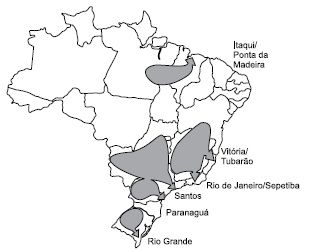
(H. Théry e N. A. Mello-Théry. Atlas do Brasil: disparidades e dinâmicas do território. São Paulo: Edusp, 2018. Adaptado)
A cartografia destacada no mapa representa espacialmente
Provas
Questão presente nas seguintes provas
Cadernos
Caderno Container