Foram encontradas 50 questões.
Read the text below and answer question.
TEXT II
TITLE: Asteroid probe snaps rare images of Martian Moon
March 13,2025 3:29 PM
By Agence France-Press
Paris -
On the way to investigate the scene of a historic asteroid collision, a European spacecraft swung by Mars and captured rare images of the red planet's mysterious small moon Deimos, the European Space Agency said Thursday.
Europe's HERA mission is aiming to find out how much of an impact a NASA spacecraft made when it deliberately smashed into an asteroid in 2022 in the first test of our planetary defenses.
But HERA will not reach the asteroid - which is 11 million kilometers from Earth in the asteroid belt between Mars and Jupiter - until late 2026.
On the long voyage there, the spacecraft swung around Mars on Wednesday.
The spacecraft used the planet's gravity to get a “kick” that also changed its direction and saved fuel, mission analyst Pablo Munoz told a press conference.
For an hour, HERA flew as close as 5,600 kilometers from the Martian surface, at a speed of 33,480 kilometers an hour.
It used the opportunity to test some of its scientific instruments, snapping around 600 pictures, including rare ones of Deimos.
The lumpy, 12.5-kilometer-wide moon is the smaller and less well-known of the two moons of Mars.
Exactly how Deimos and the bigger Phobos were formed remains a matter of debate.
Some scientists believe they were once asteroids that were captured in the gravity of Mars, while others think they could have been shot from a massive impact on the surface.
The new images add “another piece of the puzzle” to efforts to determine their origin, Marcel Popescu of the Astronomical Institute of the Romanian Academy said.
There are hopes that data from HERA's "HyperScout" and thermal infrared imagers - which observe colors beyond the limits of the human eye - will shed light on this mystery by discovering more about the moon's composition.
Those infrared imagers are why the red planet appears blue in some of the photos.
Next, HERA will turn its focus back to asteroid Dimorphos. When NASA's DART mission smashed into Dimorphos in 2022, it shortened the 160-meter-wide asteroid's orbit around its big brother Didymos by 33 minutes.
Although Dimorphos itself posed no threat to Earth, HERA intends to discover whether this technique could be an effective way for Earth to defend itself against possibly existence-threatening asteroids in the future.
Space agencies have been working to ramp up Earth's planetary defences, monitoring for potential threats so they can be dealt with as soon as possible.
Earlier this year, a newly discovered asteroid capable of destroying a city was briefly given a more than 3% chance of hitting Earth in 2032.
However further observations sent the chances of a direct hit back down to nearly zero.
Richard Moissl, head of the ESA's planetary defense office, said that asteroid, 2024 YR, followed a pattern that will become more common.
As we get better at scanning the skies, “we will discover asteroids at a higher rate," he said.
The ESA is developing a secondary planetary defense mission to observe the 350-meter-wide asteroid Apophis, which will fly just 32,000 kilometers from Earth on April 13, 2029.
If approved by the ESA's ministerial council, the Ramses mission will launch in 2028, reaching the asteroid two months before it approaches Earth.
Mark the correct option that presents a paraphrase to the following extract: “The spacecraft used the planet's gravity to get a kick.”
Provas

Read the text below and answer question.
TEXT II
TITLE: Asteroid probe snaps rare images of Martian Moon
March 13,2025 3:29 PM
By Agence France-Press
Paris -
On the way to investigate the scene of a historic asteroid collision, a European spacecraft swung by Mars and captured rare images of the red planet's mysterious small moon Deimos, the European Space Agency said Thursday.
Europe's HERA mission is aiming to find out how much of an impact a NASA spacecraft made when it deliberately smashed into an asteroid in 2022 in the first test of our planetary defenses.
But HERA will not reach the asteroid - which is 11 million kilometers from Earth in the asteroid belt between Mars and Jupiter - until late 2026.
On the long voyage there, the spacecraft swung around Mars on Wednesday.
The spacecraft used the planet's gravity to get a “kick” that also changed its direction and saved fuel, mission analyst Pablo Munoz told a press conference.
For an hour, HERA flew as close as 5,600 kilometers from the Martian surface, at a speed of 33,480 kilometers an hour.
It used the opportunity to test some of its scientific instruments, snapping around 600 pictures, including rare ones of Deimos.
The lumpy, 12.5-kilometer-wide moon is the smaller and less well-known of the two moons of Mars.
Exactly how Deimos and the bigger Phobos were formed remains a matter of debate.
Some scientists believe they were once asteroids that were captured in the gravity of Mars, while others think they could have been shot from a massive impact on the surface.
The new images add “another piece of the puzzle” to efforts to determine their origin, Marcel Popescu of the Astronomical Institute of the Romanian Academy said.
There are hopes that data from HERA's "HyperScout" and thermal infrared imagers - which observe colors beyond the limits of the human eye - will shed light on this mystery by discovering more about the moon's composition.
Those infrared imagers are why the red planet appears blue in some of the photos.
Next, HERA will turn its focus back to asteroid Dimorphos. When NASA's DART mission smashed into Dimorphos in 2022, it shortened the 160-meter-wide asteroid's orbit around its big brother Didymos by 33 minutes.
Although Dimorphos itself posed no threat to Earth, HERA intends to discover whether this technique could be an effective way for Earth to defend itself against possibly existence-threatening asteroids in the future.
Space agencies have been working to ramp up Earth's planetary defences, monitoring for potential threats so they can be dealt with as soon as possible.
Earlier this year, a newly discovered asteroid capable of destroying a city was briefly given a more than 3% chance of hitting Earth in 2032.
However further observations sent the chances of a direct hit back down to nearly zero.
Richard Moissl, head of the ESA's planetary defense office, said that asteroid, 2024 YR, followed a pattern that will become more common.
As we get better at scanning the skies, “we will discover asteroids at a higher rate," he said.
The ESA is developing a secondary planetary defense mission to observe the 350-meter-wide asteroid Apophis, which will fly just 32,000 kilometers from Earth on April 13, 2029.
If approved by the ESA's ministerial council, the Ramses mission will launch in 2028, reaching the asteroid two months before it approaches Earth.
Mark the correct option that presents a paraphrase for the following extract: “If approved by the ESA's ministerial council, the Ramses mission will launch in 2028”.
Provas
Read the text below and answer question.
TEXT II
TITLE: Asteroid probe snaps rare images of Martian Moon
March 13,2025 3:29 PM
By Agence France-Press
Paris -
On the way to investigate the scene of a historic asteroid collision, a European spacecraft swung by Mars and captured rare images of the red planet's mysterious small moon Deimos, the European Space Agency said Thursday.
Europe's HERA mission is aiming to find out how much of an impact a NASA spacecraft made when it deliberately smashed into an asteroid in 2022 in the first test of our planetary defenses.
But HERA will not reach the asteroid - which is 11 million kilometers from Earth in the asteroid belt between Mars and Jupiter - until late 2026.
On the long voyage there, the spacecraft swung around Mars on Wednesday.
The spacecraft used the planet's gravity to get a “kick” that also changed its direction and saved fuel, mission analyst Pablo Munoz told a press conference.
For an hour, HERA flew as close as 5,600 kilometers from the Martian surface, at a speed of 33,480 kilometers an hour.
It used the opportunity to test some of its scientific instruments, snapping around 600 pictures, including rare ones of Deimos.
The lumpy, 12.5-kilometer-wide moon is the smaller and less well-known of the two moons of Mars.
Exactly how Deimos and the bigger Phobos were formed remains a matter of debate.
Some scientists believe they were once asteroids that were captured in the gravity of Mars, while others think they could have been shot from a massive impact on the surface.
The new images add “another piece of the puzzle” to efforts to determine their origin, Marcel Popescu of the Astronomical Institute of the Romanian Academy said.
There are hopes that data from HERA's "HyperScout" and thermal infrared imagers - which observe colors beyond the limits of the human eye - will shed light on this mystery by discovering more about the moon's composition.
Those infrared imagers are why the red planet appears blue in some of the photos.
Next, HERA will turn its focus back to asteroid Dimorphos. When NASA's DART mission smashed into Dimorphos in 2022, it shortened the 160-meter-wide asteroid's orbit around its big brother Didymos by 33 minutes.
Although Dimorphos itself posed no threat to Earth, HERA intends to discover whether this technique could be an effective way for Earth to defend itself against possibly existence-threatening asteroids in the future.
Space agencies have been working to ramp up Earth's planetary defences, monitoring for potential threats so they can be dealt with as soon as possible.
Earlier this year, a newly discovered asteroid capable of destroying a city was briefly given a more than 3% chance of hitting Earth in 2032.
However further observations sent the chances of a direct hit back down to nearly zero.
Richard Moissl, head of the ESA's planetary defense office, said that asteroid, 2024 YR, followed a pattern that will become more common.
As we get better at scanning the skies, “we will discover asteroids at a higher rate," he said.
The ESA is developing a secondary planetary defense mission to observe the 350-meter-wide asteroid Apophis, which will fly just 32,000 kilometers from Earth on April 13, 2029.
If approved by the ESA's ministerial council, the Ramses mission will launch in 2028, reaching the asteroid two months before it approaches Earth.
In the extract; “... HERA intends to discover whether this technique could be an effective way for Earth to defend itself...”, the word WHETHER conveys the idea of:
Provas
Read the text below and answer question.
TEXT I
The world's strongest ocean current should be getting faster - instead, it is at risk of failing.
Antarctica's remote and mysterious current has a profound influence on the climate, food systems and Antarctic ecosystems. Can we stop it weakening by 2050? The Antarctic Circumpolar Current is the strongest ocean current on the planet. It's five times stronger than the Gulf Stream and more than 100 times stronger than the Amazon River. It forms part of the global ocean "conveyor belt" connecting the Pacific, Atlantic and Indian oceans. The system regulates Earth's climate and pumps water, heat and nutrients around the globe. But fresh, cool water from melting Antarctic ice is diluting the salty water of the ocean, potentially disrupting the vital ocean current.
he Antarctic Circumpolar Current is like a moat around the icy continent. The current helps to keep warm water at bay, protecting vulnerable ice sheets. It also acts as a barrier to invasive species such as southem bull kelp and any animals hitching a ride on these rafts, spreading them out as they drift towards the continent. It also plays a big part in regulating the Earth's climate.
The influence of climate change:
Ocean currents respond to changes in temperature, salt levels, wind patterns and sea ice extent. So the global ocean conveyor belt is vulnerable to climate change on multiple fronts. Previous research suggested one vital part of this conveyor belt could be headed for a catastrophic collapse. Theoretically, warming water around Antarctica should speed up the current. This is because density changes and winds around Antarctica dictate the strength of the current. Warm water is less dense (or heavy) and this should be enough to speed up the current.
Far-reaching consequences:
The consequences of a weaker Antarctic Circumpolar Current are profound and far-reaching. As the main current that circulates nutrient-rich waters around Antarctica, it plays a crucial role in the Antarctic ecosystem. Weakening of the current could reduce biodiversity and decrease the productivity of fisheries that many coastal communities rely on. It could also aid the entry of invasive species such as southern bull kelp to Antarctica, disrupting local ecosystems and food webs.
By reading the text: “[...] spreading them out as they drift towards the continent.”, it is correct to infer that the meaning of the underlined term is similar to:
Provas
Read the text below and answer question.
TEXT I
The world's strongest ocean current should be getting faster - instead, it is at risk of failing.
Antarctica's remote and mysterious current has a profound influence on the climate, food systems and Antarctic ecosystems. Can we stop it weakening by 2050? The Antarctic Circumpolar Current is the strongest ocean current on the planet. It's five times stronger than the Gulf Stream and more than 100 times stronger than the Amazon River. It forms part of the global ocean "conveyor belt" connecting the Pacific, Atlantic and Indian oceans. The system regulates Earth's climate and pumps water, heat and nutrients around the globe. But fresh, cool water from melting Antarctic ice is diluting the salty water of the ocean, potentially disrupting the vital ocean current.
he Antarctic Circumpolar Current is like a moat around the icy continent. The current helps to keep warm water at bay, protecting vulnerable ice sheets. It also acts as a barrier to invasive species such as southem bull kelp and any animals hitching a ride on these rafts, spreading them out as they drift towards the continent. It also plays a big part in regulating the Earth's climate.
The influence of climate change:
Ocean currents respond to changes in temperature, salt levels, wind patterns and sea ice extent. So the global ocean conveyor belt is vulnerable to climate change on multiple fronts. Previous research suggested one vital part of this conveyor belt could be headed for a catastrophic collapse. Theoretically, warming water around Antarctica should speed up the current. This is because density changes and winds around Antarctica dictate the strength of the current. Warm water is less dense (or heavy) and this should be enough to speed up the current.
Far-reaching consequences:
The consequences of a weaker Antarctic Circumpolar Current are profound and far-reaching. As the main current that circulates nutrient-rich waters around Antarctica, it plays a crucial role in the Antarctic ecosystem. Weakening of the current could reduce biodiversity and decrease the productivity of fisheries that many coastal communities rely on. It could also aid the entry of invasive species such as southern bull kelp to Antarctica, disrupting local ecosystems and food webs.
Mark the option that presents an INCORRECT use of a modal verb.
Provas
Read the text below and answer question.
TEXT I
The world's strongest ocean current should be getting faster - instead, it is at risk of failing.
Antarctica's remote and mysterious current has a profound influence on the climate, food systems and Antarctic ecosystems. Can we stop it weakening by 2050? The Antarctic Circumpolar Current is the strongest ocean current on the planet. It's five times stronger than the Gulf Stream and more than 100 times stronger than the Amazon River. It forms part of the global ocean "conveyor belt" connecting the Pacific, Atlantic and Indian oceans. The system regulates Earth's climate and pumps water, heat and nutrients around the globe. But fresh, cool water from melting Antarctic ice is diluting the salty water of the ocean, potentially disrupting the vital ocean current.
he Antarctic Circumpolar Current is like a moat around the icy continent. The current helps to keep warm water at bay, protecting vulnerable ice sheets. It also acts as a barrier to invasive species such as southem bull kelp and any animals hitching a ride on these rafts, spreading them out as they drift towards the continent. It also plays a big part in regulating the Earth's climate.
The influence of climate change:
Ocean currents respond to changes in temperature, salt levels, wind patterns and sea ice extent. So the global ocean conveyor belt is vulnerable to climate change on multiple fronts. Previous research suggested one vital part of this conveyor belt could be headed for a catastrophic collapse. Theoretically, warming water around Antarctica should speed up the current. This is because density changes and winds around Antarctica dictate the strength of the current. Warm water is less dense (or heavy) and this should be enough to speed up the current.
Far-reaching consequences:
The consequences of a weaker Antarctic Circumpolar Current are profound and far-reaching. As the main current that circulates nutrient-rich waters around Antarctica, it plays a crucial role in the Antarctic ecosystem. Weakening of the current could reduce biodiversity and decrease the productivity of fisheries that many coastal communities rely on. It could also aid the entry of invasive species such as southern bull kelp to Antarctica, disrupting local ecosystems and food webs.
The preposition in English plays an important role, to. connect words and it might express different meanings, as noticed in “Can we stop it; weakening by 2050?”
Mark the statement which presents the correct use of prepositions.
Provas
Read the text below and answer question.
TEXT I
The world's strongest ocean current should be getting faster - instead, it is at risk of failing.
Antarctica's remote and mysterious current has a profound influence on the climate, food systems and Antarctic ecosystems. Can we stop it weakening by 2050? The Antarctic Circumpolar Current is the strongest ocean current on the planet. It's five times stronger than the Gulf Stream and more than 100 times stronger than the Amazon River. It forms part of the global ocean "conveyor belt" connecting the Pacific, Atlantic and Indian oceans. The system regulates Earth's climate and pumps water, heat and nutrients around the globe. But fresh, cool water from melting Antarctic ice is diluting the salty water of the ocean, potentially disrupting the vital ocean current.
he Antarctic Circumpolar Current is like a moat around the icy continent. The current helps to keep warm water at bay, protecting vulnerable ice sheets. It also acts as a barrier to invasive species such as southem bull kelp and any animals hitching a ride on these rafts, spreading them out as they drift towards the continent. It also plays a big part in regulating the Earth's climate.
The influence of climate change:
Ocean currents respond to changes in temperature, salt levels, wind patterns and sea ice extent. So the global ocean conveyor belt is vulnerable to climate change on multiple fronts. Previous research suggested one vital part of this conveyor belt could be headed for a catastrophic collapse. Theoretically, warming water around Antarctica should speed up the current. This is because density changes and winds around Antarctica dictate the strength of the current. Warm water is less dense (or heavy) and this should be enough to speed up the current.
Far-reaching consequences:
The consequences of a weaker Antarctic Circumpolar Current are profound and far-reaching. As the main current that circulates nutrient-rich waters around Antarctica, it plays a crucial role in the Antarctic ecosystem. Weakening of the current could reduce biodiversity and decrease the productivity of fisheries that many coastal communities rely on. It could also aid the entry of invasive species such as southern bull kelp to Antarctica, disrupting local ecosystems and food webs.
Read the excerpts about the Text I and establish if the statements are true or false and mark the correct answer.
( ) The Antarctic Circumpolar Current is the strongest on the planet and it's stronger than the Gulf Stream and the Amazon River.
( ) The current helps to keep warm water at bay, protecting even vulnerable ice sheets, as also acts as a kind of barrier to invasive species.
( ) It forms part of the global ocean "conveyor belt" a specie of continuous movement and connecting only Pacific and Indian oceans.
( ) There is a complex concern about the consequences of a weaker Antarctic Circumpolar Current, because it plays a crucial role in the Antarctic ecosystem.
Provas
Read the text below and answer question.
TEXT I
The world's strongest ocean current should be getting faster - instead, it is at risk of failing.
Antarctica's remote and mysterious current has a profound influence on the climate, food systems and Antarctic ecosystems. Can we stop it weakening by 2050? The Antarctic Circumpolar Current is the strongest ocean current on the planet. It's five times stronger than the Gulf Stream and more than 100 times stronger than the Amazon River. It forms part of the global ocean "conveyor belt" connecting the Pacific, Atlantic and Indian oceans. The system regulates Earth's climate and pumps water, heat and nutrients around the globe. But fresh, cool water from melting Antarctic ice is diluting the salty water of the ocean, potentially disrupting the vital ocean current.
he Antarctic Circumpolar Current is like a moat around the icy continent. The current helps to keep warm water at bay, protecting vulnerable ice sheets. It also acts as a barrier to invasive species such as southem bull kelp and any animals hitching a ride on these rafts, spreading them out as they drift towards the continent. It also plays a big part in regulating the Earth's climate.
The influence of climate change:
Ocean currents respond to changes in temperature, salt levels, wind patterns and sea ice extent. So the global ocean conveyor belt is vulnerable to climate change on multiple fronts. Previous research suggested one vital part of this conveyor belt could be headed for a catastrophic collapse. Theoretically, warming water around Antarctica should speed up the current. This is because density changes and winds around Antarctica dictate the strength of the current. Warm water is less dense (or heavy) and this should be enough to speed up the current.
Far-reaching consequences:
The consequences of a weaker Antarctic Circumpolar Current are profound and far-reaching. As the main current that circulates nutrient-rich waters around Antarctica, it plays a crucial role in the Antarctic ecosystem. Weakening of the current could reduce biodiversity and decrease the productivity of fisheries that many coastal communities rely on. It could also aid the entry of invasive species such as southern bull kelp to Antarctica, disrupting local ecosystems and food webs.
According to the excerpt below mark the correct conjunction that can be replaced for another, without changing the meaning of the text.
“But fresh, cool water from melting Antarctic ice is diluting the salty water of the ocean, potentially disrupting the vital ocean current.”
Provas
Observe a figura abaixo.
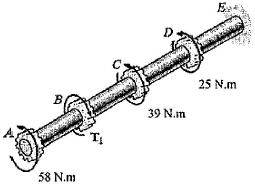
O eixo maciço de alumínio tem diâmetro de 20 mm. Determine a tensão de cisalhamento máxima absoluta no eixo, considerando T1= 20Nm e o Momento Polar de Inércia: \( J={\large{\pi r^4 \over 2}} \), e assinale a opção correta.
Provas
Read the text below and answer question.
TEXT II
TITLE: Asteroid probe snaps rare images of Martian Moon
March 13,2025 3:29 PM
By Agence France-Press
Paris -
On the way to investigate the scene of a historic asteroid collision, a European spacecraft swung by Mars and captured rare images of the red planet's mysterious small moon Deimos, the European Space Agency said Thursday.
Europe's HERA mission is aiming to find out how much of an impact a NASA spacecraft made when it deliberately smashed into an asteroid in 2022 in the first test of our planetary defenses.
But HERA will not reach the asteroid - which is 11 million kilometers from Earth in the asteroid belt between Mars and Jupiter - until late 2026.
On the long voyage there, the spacecraft swung around Mars on Wednesday.
The spacecraft used the planet's gravity to get a “kick” that also changed its direction and saved fuel, mission analyst Pablo Munoz told a press conference.
For an hour, HERA flew as close as 5,600 kilometers from the Martian surface, at a speed of 33,480 kilometers an hour.
It used the opportunity to test some of its scientific instruments, snapping around 600 pictures, including rare ones of Deimos.
The lumpy, 12.5-kilometer-wide moon is the smaller and less well-known of the two moons of Mars.
Exactly how Deimos and the bigger Phobos were formed remains a matter of debate.
Some scientists believe they were once asteroids that were captured in the gravity of Mars, while others think they could have been shot from a massive impact on the surface.
The new images add “another piece of the puzzle” to efforts to determine their origin, Marcel Popescu of the Astronomical Institute of the Romanian Academy said.
There are hopes that data from HERA's "HyperScout" and thermal infrared imagers - which observe colors beyond the limits of the human eye - will shed light on this mystery by discovering more about the moon's composition.
Those infrared imagers are why the red planet appears blue in some of the photos.
Next, HERA will turn its focus back to asteroid Dimorphos. When NASA's DART mission smashed into Dimorphos in 2022, it shortened the 160-meter-wide asteroid's orbit around its big brother Didymos by 33 minutes.
Although Dimorphos itself posed no threat to Earth, HERA intends to discover whether this technique could be an effective way for Earth to defend itself against possibly existence-threatening asteroids in the future.
Space agencies have been working to ramp up Earth's planetary defences, monitoring for potential threats so they can be dealt with as soon as possible.
Earlier this year, a newly discovered asteroid capable of destroying a city was briefly given a more than 3% chance of hitting Earth in 2032.
However further observations sent the chances of a direct hit back down to nearly zero.
Richard Moissl, head of the ESA's planetary defense office, said that asteroid, 2024 YR, followed a pattern that will become more common.
As we get better at scanning the skies, “we will discover asteroids at a higher rate," he said.
The ESA is developing a secondary planetary defense mission to observe the 350-meter-wide asteroid Apophis, which will fly just 32,000 kilometers from Earth on April 13, 2029.
If approved by the ESA's ministerial council, the Ramses mission will launch in 2028, reaching the asteroid two months before it approaches Earth.
HERA, DART and RAMSES are proper nouns used to identify:
Provas
Caderno Container