Foram encontradas 80 questões.
TEXT I
How music is the real language of political diplomacy
Forget guns and bombs, it is the power of melody that has changed the world
Marie Zawisza
Saturday 31 October 2015 10.00 GMT
Last modified on Tuesday 10 November 201513.19 GMT

An old man plays his cello at the foot of a crumbling wall. The notes of the sarabande of Bach’s Suite No 2 rise in the cold air, praising God for the “miracle” of the fall of the Berlin Wall, as Mstislav Rostropovich later put it. The photograph is seen around the world. The date is 11 November 1989, and the Russian virtuoso is marching to the beat of history.
Publicity stunt or political act? No doubt a bit of both – and proof, in any case, that music can have a political dimension. Yo-Yo Ma showed as much in September when the cellist opened the new season of the Philharmonie de Paris with the Boston Symphony Orchestra. As a “messenger of peace” for the United Nations, the Chinese American is the founder of Silk Road Project, which trains young musicians from a variety of cultures to listen to and improvise with each other and develop a common repertoire. “In this way, musicians create a dialogue and arrive at common policies,” says analyst Frédéric Ramel, a professor at the Institut d’Études Politiques in Paris. By having music take the place of speeches and peace talks, the hope is that it will succeed where diplomacy has failed.[…]
Curiously, the study of the role of music in international relations is still in its infancy. “Historians must have long seen it as something fanciful, because history has long been dominated by interpretations that stress economic, social and political factors,” says Anaïs Fléchet, a lecturer in contemporary history at the Université de Versailles-St-Quentin and co-editor of a book about music and globalisation.
“As for musicologists,” she adds, “until quite recently they were more interested in analysing musical scores than the actual context in which these were produced and how they were received.” In the 1990s came a cultural shift. Scholars were no longer interested solely in “hard power” – that is, in the balance of powers and in geopolitics – but also in “soft power”, where political issues are resolved by mutual support rather than force. […]
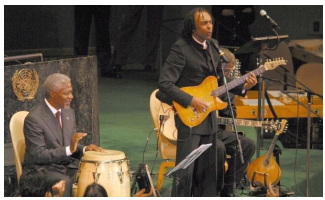
Gilberto Gil sings while then UN secretary general Kofi Annan plays percussion at a September 2003 concert at the UN headquarters honouring those killed by a bomb at a UN office in Baghdad a month earlier. Photograph: Zuma/Alamy
Since then, every embassy has a cultural attaché. The US engages in “audio diplomacy” by financing hip-hop festivals in the Middle East. China promotes opera in neighbouring states to project an image of harmony. Brazil has invested in culture to assert itself as a leader in Latin America, notably by establishing close collaboration between its ministries of foreign affairs and culture; musician Gilberto Gil was culture minister during Luiz Inácio Lula da Silva's presidency from 2003 to 2008. He was involved in France’s Year of Brazil. As Fléchet recalls, “the free concert he gave on 13 July, 2005 at the Place de la Bastille was the pinnacle. That day, he sang La Marseillaise in the presence of presidents Lula and Jacques Chirac.” Two years earlier, in September 2003, Gil sang at the UN in honour of the victims of the 19 August bombing of the UN headquartes in Baghdad. He was delivering a message of peace, criticising the war on Iraq by the US: “There is no point in preaching security without giving a thought to respecting others,” he told his audience. Closing the concert, he invited then UN secretary general Kofi Annan on stage for a surprise appearance as a percussionist. “This highly symbolic image, which highlighted the conviction that culture can play a role in bringing people together, shows how music can become a political language,” Fléchet says.
(adapted from http://www.theguardian.com/music/2015/oct/31 /music-language-human-rights-political-diplomacy)
Provas

TEXT I
How music is the real language of political diplomacy
Forget guns and bombs, it is the power of melody that has changed the world
Marie Zawisza
Saturday 31 October 2015 10.00 GMT
Last modified on Tuesday 10 November 201513.19 GMT
An old man plays his cello at the foot of a crumbling wall. The notes of the sarabande of Bach’s Suite No 2 rise in the cold air, praising God for the “miracle” of the fall of the Berlin Wall, as Mstislav Rostropovich later put it. The photograph is seen around the world. The date is 11 November 1989, and the Russian virtuoso is marching to the beat of history.
Publicity stunt or political act? No doubt a bit of both – and proof, in any case, that music can have a political dimension. Yo-Yo Ma showed as much in September when the cellist opened the new season of the Philharmonie de Paris with the Boston Symphony Orchestra. As a “messenger of peace” for the United Nations, the Chinese American is the founder of Silk Road Project, which trains young musicians from a variety of cultures to listen to and improvise with each other and develop a common repertoire. “In this way, musicians create a dialogue and arrive at common policies,” says analyst Frédéric Ramel, a professor at the Institut d’Études Politiques in Paris. By having music take the place of speeches and peace talks, the hope is that it will succeed where diplomacy has failed.[…]
Curiously, the study of the role of music in international relations is still in its infancy. “Historians must have long seen it as something fanciful, because history has long been dominated by interpretations that stress economic, social and political factors,” says Anaïs Fléchet, a lecturer in contemporary history at the Université de Versailles-St-Quentin and co-editor of a book about music and globalisation.
“As for musicologists,” she adds, “until quite recently they were more interested in analysing musical scores than the actual context in which these were produced and how they were received.” In the 1990s came a cultural shift. Scholars were no longer interested solely in “hard power” – that is, in the balance of powers and in geopolitics – but also in “soft power”, where political issues are resolved by mutual support rather than force. […]
Gilberto Gil sings while then UN secretary general Kofi Annan plays percussion at a September 2003 concert at the UN headquarters honouring those killed by a bomb at a UN office in Baghdad a month earlier. Photograph: Zuma/Alamy
Since then, every embassy has a cultural attaché. The US engages in “audio diplomacy” by financing hip-hop festivals in the Middle East. China promotes opera in neighbouring states to project an image of harmony. Brazil has invested in culture to assert itself as a leader in Latin America, notably by establishing close collaboration between its ministries of foreign affairs and culture; musician Gilberto Gil was culture minister during Luiz Inácio Lula da Silva's presidency from 2003 to 2008. He was involved in France’s Year of Brazil. As Fléchet recalls, “the free concert he gave on 13 July, 2005 at the Place de la Bastille was the pinnacle. That day, he sang La Marseillaise in the presence of presidents Lula and Jacques Chirac.” Two years earlier, in September 2003, Gil sang at the UN in honour of the victims of the 19 August bombing of the UN headquartes in Baghdad. He was delivering a message of peace, criticising the war on Iraq by the US: “There is no point in preaching security without giving a thought to respecting others,” he told his audience. Closing the concert, he invited then UN secretary general Kofi Annan on stage for a surprise appearance as a percussionist. “This highly symbolic image, which highlighted the conviction that culture can play a role in bringing people together, shows how music can become a political language,” Fléchet says.
(adapted from http://www.theguardian.com/music/2015/oct/31 /music-language-human-rights-political-diplomacy)
Provas
TEXT I
How music is the real language of political diplomacy
Forget guns and bombs, it is the power of melody that has changed the world
Marie Zawisza
Saturday 31 October 2015 10.00 GMT
Last modified on Tuesday 10 November 201513.19 GMT
An old man plays his cello at the foot of a crumbling wall. The notes of the sarabande of Bach’s Suite No 2 rise in the cold air, praising God for the “miracle” of the fall of the Berlin Wall, as Mstislav Rostropovich later put it. The photograph is seen around the world. The date is 11 November 1989, and the Russian virtuoso is marching to the beat of history.
Publicity stunt or political act? No doubt a bit of both – and proof, in any case, that music can have a political dimension. Yo-Yo Ma showed as much in September when the cellist opened the new season of the Philharmonie de Paris with the Boston Symphony Orchestra. As a “messenger of peace” for the United Nations, the Chinese American is the founder of Silk Road Project, which trains young musicians from a variety of cultures to listen to and improvise with each other and develop a common repertoire. “In this way, musicians create a dialogue and arrive at common policies,” says analyst Frédéric Ramel, a professor at the Institut d’Études Politiques in Paris. By having music take the place of speeches and peace talks, the hope is that it will succeed where diplomacy has failed.[…]
Curiously, the study of the role of music in international relations is still in its infancy. “Historians must have long seen it as something fanciful, because history has long been dominated by interpretations that stress economic, social and political factors,” says Anaïs Fléchet, a lecturer in contemporary history at the Université de Versailles-St-Quentin and co-editor of a book about music and globalisation.
“As for musicologists,” she adds, “until quite recently they were more interested in analysing musical scores than the actual context in which these were produced and how they were received.” In the 1990s came a cultural shift. Scholars were no longer interested solely in “hard power” – that is, in the balance of powers and in geopolitics – but also in “soft power”, where political issues are resolved by mutual support rather than force. […]
Gilberto Gil sings while then UN secretary general Kofi Annan plays percussion at a September 2003 concert at the UN headquarters honouring those killed by a bomb at a UN office in Baghdad a month earlier. Photograph: Zuma/Alamy
Since then, every embassy has a cultural attaché. The US engages in “audio diplomacy” by financing hip-hop festivals in the Middle East. China promotes opera in neighbouring states to project an image of harmony. Brazil has invested in culture to assert itself as a leader in Latin America, notably by establishing close collaboration between its ministries of foreign affairs and culture; musician Gilberto Gil was culture minister during Luiz Inácio Lula da Silva's presidency from 2003 to 2008. He was involved in France’s Year of Brazil. As Fléchet recalls, “the free concert he gave on 13 July, 2005 at the Place de la Bastille was the pinnacle. That day, he sang La Marseillaise in the presence of presidents Lula and Jacques Chirac.” Two years earlier, in September 2003, Gil sang at the UN in honour of the victims of the 19 August bombing of the UN headquartes in Baghdad. He was delivering a message of peace, criticising the war on Iraq by the US: “There is no point in preaching security without giving a thought to respecting others,” he told his audience. Closing the concert, he invited then UN secretary general Kofi Annan on stage for a surprise appearance as a percussionist. “This highly symbolic image, which highlighted the conviction that culture can play a role in bringing people together, shows how music can become a political language,” Fléchet says.
(adapted from http://www.theguardian.com/music/2015/oct/31 /music-language-human-rights-political-diplomacy)
I. The study of the role music plays in diplomacy is now full-fledged.
II. For many years historians have considered music evidencebased practice.
III. Only a short time ago, musicologists started to move away from the sheet to the setting.
IV. Musicians may promote contexts where dialogue can be established.
Choose the correct answer:
Provas
TEXT III
Use of language in diplomacy
What language should one use when speaking to diplomats, or what language should diplomats use? Or, to be more precise, what language/languages should a (young) diplomat try to learn to be more successful in his profession?
The term "language in diplomacy" obviously can be interpreted in several ways. First, as tongue ("mother" tongue or an acquired one), the speech "used by one nation, tribe, or other similar large group of people"; in this sense we can say, for example, that French used to be the predominant diplomatic language in the first half of the 20th century. Second, as a special way of expressing the subtle needs of the diplomatic profession; in this way it can be said, for example, that the delegate of such-andsuch a country spoke of the given subject in totally nondiplomatic language. Also, the term can refer to the particular form, style, manner or tone of expression; such as the minister formulated his conditions in unusually strong language. It may mean as well the verbal or non-verbal expression of thoughts or feelings: sending the gunships is a language that everybody understands.
All of these meanings - and probably several others - can be utilised in both oral and written practice. In any of these senses, the use of language in diplomacy is of major importance, since language is not a simple tool, vehicle for transmission of thoughts, or instrument of communication, but very often the very essence of the diplomatic vocation, and that has been so from the early beginnings of our profession. That is why from early times the first envoys of the Egyptian pharaohs, Roman legates, mediaeval Dubrovnik consuls, etc., had to be educated and trained people, well-spoken and polyglots.
Let us first look into different aspects of diplomatic language in its basic meaning - that of a tongue. Obviously, the first problem to solve is finding a common tongue. Diplomats only exceptionally find themselves in the situation to be able to communicate in one language, common to all participants. This may be done between, for example, Germans and Austrians, or Portuguese and Brazilians, or representatives of different Arab countries, or British and Americans, etc. Not only are such occasions rare, but very often there is a serious difference between the same language used in one country and another.
There are several ways to overcome the problem of communication between people who speak different mother tongues. None of these ways is ideal. One solution, obviously, is that one of the interlocutors speaks the language of the other. Problems may arise: the knowledge of the language may not be adequate, one side is making a concession and the other has an immediate and significant advantage, there are possible political implications, it may be difficult to apply in multilateral diplomacy, etc. A second possibility is that both sides use a third, neutral, language. A potential problem may be that neither side possesses full linguistic knowledge and control, leading to possible bad misunderstandings. Nevertheless, this method is frequently applied in international practice because of its political advantages. A third formula, using interpreters, is also very widely used, particularly in multilateral diplomacy or for negotiations at a very high political level - not only for reasons of equity, but because politicians and statesmen often do not speak foreign languages. This method also has disadvantages: it is time consuming, costly, and sometimes inadequate or straightforwardly incorrect. […] Finally, there is the possibility of using one international synthetic, artificial language, such as Esperanto; this solution would have many advantages, but unfortunately is not likely to be implemented soon, mostly because of the opposition of factors that dominate in the international political - and therefore also cultural and linguistic - scene.
So, which language is the diplomatic one? The answer is not simple at all […].
Words are bricks from which sentences are made. Each sentence should be a wound-up thought. If one wants to be clear, and particularly when using a language which he does not master perfectly, it is better to use short, simple sentences. On the contrary, if one wishes to camouflage his thoughts or even not say anything specific, it can be well achieved by using a more complicated style, complex sentences, digressions, interrupting one's own flow of thought and introducing new topics. One may leave the impression of being a little confused, but the basic purpose of withholding the real answer can be accomplished.
(adapted from http://www.diplomacy.edu/books/language_and_ diplomacy/texts/pdf/nick.PDF)
Provas
TEXT III
Use of language in diplomacy
What language should one use when speaking to diplomats, or what language should diplomats use? Or, to be more precise, what language/languages should a (young) diplomat try to learn to be more successful in his profession?
The term "language in diplomacy" obviously can be interpreted in several ways. First, as tongue ("mother" tongue or an acquired one), the speech "used by one nation, tribe, or other similar large group of people"; in this sense we can say, for example, that French used to be the predominant diplomatic language in the first half of the 20th century. Second, as a special way of expressing the subtle needs of the diplomatic profession; in this way it can be said, for example, that the delegate of such-andsuch a country spoke of the given subject in totally nondiplomatic language. Also, the term can refer to the particular form, style, manner or tone of expression; such as the minister formulated his conditions in unusually strong language. It may mean as well the verbal or non-verbal expression of thoughts or feelings: sending the gunships is a language that everybody understands.
All of these meanings - and probably several others - can be utilised in both oral and written practice. In any of these senses, the use of language in diplomacy is of major importance, since language is not a simple tool, vehicle for transmission of thoughts, or instrument of communication, but very often the very essence of the diplomatic vocation, and that has been so from the early beginnings of our profession. That is why from early times the first envoys of the Egyptian pharaohs, Roman legates, mediaeval Dubrovnik consuls, etc., had to be educated and trained people, well-spoken and polyglots.
Let us first look into different aspects of diplomatic language in its basic meaning - that of a tongue. Obviously, the first problem to solve is finding a common tongue. Diplomats only exceptionally find themselves in the situation to be able to communicate in one language, common to all participants. This may be done between, for example, Germans and Austrians, or Portuguese and Brazilians, or representatives of different Arab countries, or British and Americans, etc. Not only are such occasions rare, but very often there is a serious difference between the same language used in one country and another.
There are several ways to overcome the problem of communication between people who speak different mother tongues. None of these ways is ideal. One solution, obviously, is that one of the interlocutors speaks the language of the other. Problems may arise: the knowledge of the language may not be adequate, one side is making a concession and the other has an immediate and significant advantage, there are possible political implications, it may be difficult to apply in multilateral diplomacy, etc. A second possibility is that both sides use a third, neutral, language. A potential problem may be that neither side possesses full linguistic knowledge and control, leading to possible bad misunderstandings. Nevertheless, this method is frequently applied in international practice because of its political advantages. A third formula, using interpreters, is also very widely used, particularly in multilateral diplomacy or for negotiations at a very high political level - not only for reasons of equity, but because politicians and statesmen often do not speak foreign languages. This method also has disadvantages: it is time consuming, costly, and sometimes inadequate or straightforwardly incorrect. […] Finally, there is the possibility of using one international synthetic, artificial language, such as Esperanto; this solution would have many advantages, but unfortunately is not likely to be implemented soon, mostly because of the opposition of factors that dominate in the international political - and therefore also cultural and linguistic - scene.
So, which language is the diplomatic one? The answer is not simple at all […].
Words are bricks from which sentences are made. Each sentence should be a wound-up thought. If one wants to be clear, and particularly when using a language which he does not master perfectly, it is better to use short, simple sentences. On the contrary, if one wishes to camouflage his thoughts or even not say anything specific, it can be well achieved by using a more complicated style, complex sentences, digressions, interrupting one's own flow of thought and introducing new topics. One may leave the impression of being a little confused, but the basic purpose of withholding the real answer can be accomplished.
(adapted from http://www.diplomacy.edu/books/language_and_ diplomacy/texts/pdf/nick.PDF)
( ) Diplomats are often in situations where a common language is spoken.
( ) Using an interpreter as mediator is a flawless alternative for diplomatic meetings.
( ) Despite the efforts to do away with problems in communication, the ideal solution has not been found yet.
The correct sequence is:
Provas
TEXT III
Use of language in diplomacy
What language should one use when speaking to diplomats, or what language should diplomats use? Or, to be more precise, what language/languages should a (young) diplomat try to learn to be more successful in his profession?
The term "language in diplomacy" obviously can be interpreted in several ways. First, as tongue ("mother" tongue or an acquired one), the speech "used by one nation, tribe, or other similar large group of people"; in this sense we can say, for example, that French used to be the predominant diplomatic language in the first half of the 20th century. Second, as a special way of expressing the subtle needs of the diplomatic profession; in this way it can be said, for example, that the delegate of such-andsuch a country spoke of the given subject in totally nondiplomatic language. Also, the term can refer to the particular form, style, manner or tone of expression; such as the minister formulated his conditions in unusually strong language. It may mean as well the verbal or non-verbal expression of thoughts or feelings: sending the gunships is a language that everybody understands.
All of these meanings - and probably several others - can be utilised in both oral and written practice. In any of these senses, the use of language in diplomacy is of major importance, since language is not a simple tool, vehicle for transmission of thoughts, or instrument of communication, but very often the very essence of the diplomatic vocation, and that has been so from the early beginnings of our profession. That is why from early times the first envoys of the Egyptian pharaohs, Roman legates, mediaeval Dubrovnik consuls, etc., had to be educated and trained people, well-spoken and polyglots.
Let us first look into different aspects of diplomatic language in its basic meaning - that of a tongue. Obviously, the first problem to solve is finding a common tongue. Diplomats only exceptionally find themselves in the situation to be able to communicate in one language, common to all participants. This may be done between, for example, Germans and Austrians, or Portuguese and Brazilians, or representatives of different Arab countries, or British and Americans, etc. Not only are such occasions rare, but very often there is a serious difference between the same language used in one country and another.
There are several ways to overcome the problem of communication between people who speak different mother tongues. None of these ways is ideal. One solution, obviously, is that one of the interlocutors speaks the language of the other. Problems may arise: the knowledge of the language may not be adequate, one side is making a concession and the other has an immediate and significant advantage, there are possible political implications, it may be difficult to apply in multilateral diplomacy, etc. A second possibility is that both sides use a third, neutral, language. A potential problem may be that neither side possesses full linguistic knowledge and control, leading to possible bad misunderstandings. Nevertheless, this method is frequently applied in international practice because of its political advantages. A third formula, using interpreters, is also very widely used, particularly in multilateral diplomacy or for negotiations at a very high political level - not only for reasons of equity, but because politicians and statesmen often do not speak foreign languages. This method also has disadvantages: it is time consuming, costly, and sometimes inadequate or straightforwardly incorrect. […] Finally, there is the possibility of using one international synthetic, artificial language, such as Esperanto; this solution would have many advantages, but unfortunately is not likely to be implemented soon, mostly because of the opposition of factors that dominate in the international political - and therefore also cultural and linguistic - scene.
So, which language is the diplomatic one? The answer is not simple at all […].
Words are bricks from which sentences are made. Each sentence should be a wound-up thought. If one wants to be clear, and particularly when using a language which he does not master perfectly, it is better to use short, simple sentences. On the contrary, if one wishes to camouflage his thoughts or even not say anything specific, it can be well achieved by using a more complicated style, complex sentences, digressions, interrupting one's own flow of thought and introducing new topics. One may leave the impression of being a little confused, but the basic purpose of withholding the real answer can be accomplished.
(adapted from http://www.diplomacy.edu/books/language_and_ diplomacy/texts/pdf/nick.PDF)
Provas
TEXT III
Use of language in diplomacy
What language should one use when speaking to diplomats, or what language should diplomats use? Or, to be more precise, what language/languages should a (young) diplomat try to learn to be more successful in his profession?
The term "language in diplomacy" obviously can be interpreted in several ways. First, as tongue ("mother" tongue or an acquired one), the speech "used by one nation, tribe, or other similar large group of people"; in this sense we can say, for example, that French used to be the predominant diplomatic language in the first half of the 20th century. Second, as a special way of expressing the subtle needs of the diplomatic profession; in this way it can be said, for example, that the delegate of such-andsuch a country spoke of the given subject in totally nondiplomatic language. Also, the term can refer to the particular form, style, manner or tone of expression; such as the minister formulated his conditions in unusually strong language. It may mean as well the verbal or non-verbal expression of thoughts or feelings: sending the gunships is a language that everybody understands.
All of these meanings - and probably several others - can be utilised in both oral and written practice. In any of these senses, the use of language in diplomacy is of major importance, since language is not a simple tool, vehicle for transmission of thoughts, or instrument of communication, but very often the very essence of the diplomatic vocation, and that has been so from the early beginnings of our profession. That is why from early times the first envoys of the Egyptian pharaohs, Roman legates, mediaeval Dubrovnik consuls, etc., had to be educated and trained people, well-spoken and polyglots.
Let us first look into different aspects of diplomatic language in its basic meaning - that of a tongue. Obviously, the first problem to solve is finding a common tongue. Diplomats only exceptionally find themselves in the situation to be able to communicate in one language, common to all participants. This may be done between, for example, Germans and Austrians, or Portuguese and Brazilians, or representatives of different Arab countries, or British and Americans, etc. Not only are such occasions rare, but very often there is a serious difference between the same language used in one country and another.
There are several ways to overcome the problem of communication between people who speak different mother tongues. None of these ways is ideal. One solution, obviously, is that one of the interlocutors speaks the language of the other. Problems may arise: the knowledge of the language may not be adequate, one side is making a concession and the other has an immediate and significant advantage, there are possible political implications, it may be difficult to apply in multilateral diplomacy, etc. A second possibility is that both sides use a third, neutral, language. A potential problem may be that neither side possesses full linguistic knowledge and control, leading to possible bad misunderstandings. Nevertheless, this method is frequently applied in international practice because of its political advantages. A third formula, using interpreters, is also very widely used, particularly in multilateral diplomacy or for negotiations at a very high political level - not only for reasons of equity, but because politicians and statesmen often do not speak foreign languages. This method also has disadvantages: it is time consuming, costly, and sometimes inadequate or straightforwardly incorrect. […] Finally, there is the possibility of using one international synthetic, artificial language, such as Esperanto; this solution would have many advantages, but unfortunately is not likely to be implemented soon, mostly because of the opposition of factors that dominate in the international political - and therefore also cultural and linguistic - scene.
So, which language is the diplomatic one? The answer is not simple at all […].
Words are bricks from which sentences are made. Each sentence should be a wound-up thought. If one wants to be clear, and particularly when using a language which he does not master perfectly, it is better to use short, simple sentences. On the contrary, if one wishes to camouflage his thoughts or even not say anything specific, it can be well achieved by using a more complicated style, complex sentences, digressions, interrupting one's own flow of thought and introducing new topics. One may leave the impression of being a little confused, but the basic purpose of withholding the real answer can be accomplished.
(adapted from http://www.diplomacy.edu/books/language_and_ diplomacy/texts/pdf/nick.PDF)
Provas
TEXT III
Use of language in diplomacy
What language should one use when speaking to diplomats, or what language should diplomats use? Or, to be more precise, what language/languages should a (young) diplomat try to learn to be more successful in his profession?
The term "language in diplomacy" obviously can be interpreted in several ways. First, as tongue ("mother" tongue or an acquired one), the speech "used by one nation, tribe, or other similar large group of people"; in this sense we can say, for example, that French used to be the predominant diplomatic language in the first half of the 20th century. Second, as a special way of expressing the subtle needs of the diplomatic profession; in this way it can be said, for example, that the delegate of such-andsuch a country spoke of the given subject in totally nondiplomatic language. Also, the term can refer to the particular form, style, manner or tone of expression; such as the minister formulated his conditions in unusually strong language. It may mean as well the verbal or non-verbal expression of thoughts or feelings: sending the gunships is a language that everybody understands.
All of these meanings - and probably several others - can be utilised in both oral and written practice. In any of these senses, the use of language in diplomacy is of major importance, since language is not a simple tool, vehicle for transmission of thoughts, or instrument of communication, but very often the very essence of the diplomatic vocation, and that has been so from the early beginnings of our profession. That is why from early times the first envoys of the Egyptian pharaohs, Roman legates, mediaeval Dubrovnik consuls, etc., had to be educated and trained people, well-spoken and polyglots.
Let us first look into different aspects of diplomatic language in its basic meaning - that of a tongue. Obviously, the first problem to solve is finding a common tongue. Diplomats only exceptionally find themselves in the situation to be able to communicate in one language, common to all participants. This may be done between, for example, Germans and Austrians, or Portuguese and Brazilians, or representatives of different Arab countries, or British and Americans, etc. Not only are such occasions rare, but very often there is a serious difference between the same language used in one country and another.
There are several ways to overcome the problem of communication between people who speak different mother tongues. None of these ways is ideal. One solution, obviously, is that one of the interlocutors speaks the language of the other. Problems may arise: the knowledge of the language may not be adequate, one side is making a concession and the other has an immediate and significant advantage, there are possible political implications, it may be difficult to apply in multilateral diplomacy, etc. A second possibility is that both sides use a third, neutral, language. A potential problem may be that neither side possesses full linguistic knowledge and control, leading to possible bad misunderstandings. Nevertheless, this method is frequently applied in international practice because of its political advantages. A third formula, using interpreters, is also very widely used, particularly in multilateral diplomacy or for negotiations at a very high political level - not only for reasons of equity, but because politicians and statesmen often do not speak foreign languages. This method also has disadvantages: it is time consuming, costly, and sometimes inadequate or straightforwardly incorrect. […] Finally, there is the possibility of using one international synthetic, artificial language, such as Esperanto; this solution would have many advantages, but unfortunately is not likely to be implemented soon, mostly because of the opposition of factors that dominate in the international political - and therefore also cultural and linguistic - scene.
So, which language is the diplomatic one? The answer is not simple at all […].
Words are bricks from which sentences are made. Each sentence should be a wound-up thought. If one wants to be clear, and particularly when using a language which he does not master perfectly, it is better to use short, simple sentences. On the contrary, if one wishes to camouflage his thoughts or even not say anything specific, it can be well achieved by using a more complicated style, complex sentences, digressions, interrupting one's own flow of thought and introducing new topics. One may leave the impression of being a little confused, but the basic purpose of withholding the real answer can be accomplished.
(adapted from http://www.diplomacy.edu/books/language_and_ diplomacy/texts/pdf/nick.PDF)
Provas
- Gramática - Língua InglesaSubstantivos e compostos | Nouns and compoundsSubstantivos contáveis e incontáveis | Countable and uncountable
- Gramática - Língua InglesaSubstantivos e compostos | Nouns and compoundsPlural dos substantivos | Plural of nouns
TEXT III
Use of language in diplomacy
What language should one use when speaking to diplomats, or what language should diplomats use? Or, to be more precise, what language/languages should a (young) diplomat try to learn to be more successful in his profession?
The term "language in diplomacy" obviously can be interpreted in several ways. First, as tongue ("mother" tongue or an acquired one), the speech "used by one nation, tribe, or other similar large group of people"; in this sense we can say, for example, that French used to be the predominant diplomatic language in the first half of the 20th century. Second, as a special way of expressing the subtle needs of the diplomatic profession; in this way it can be said, for example, that the delegate of such-andsuch a country spoke of the given subject in totally nondiplomatic language. Also, the term can refer to the particular form, style, manner or tone of expression; such as the minister formulated his conditions in unusually strong language. It may mean as well the verbal or non-verbal expression of thoughts or feelings: sending the gunships is a language that everybody understands.
All of these meanings - and probably several others - can be utilised in both oral and written practice. In any of these senses, the use of language in diplomacy is of major importance, since language is not a simple tool, vehicle for transmission of thoughts, or instrument of communication, but very often the very essence of the diplomatic vocation, and that has been so from the early beginnings of our profession. That is why from early times the first envoys of the Egyptian pharaohs, Roman legates, mediaeval Dubrovnik consuls, etc., had to be educated and trained people, well-spoken and polyglots.
Let us first look into different aspects of diplomatic language in its basic meaning - that of a tongue. Obviously, the first problem to solve is finding a common tongue. Diplomats only exceptionally find themselves in the situation to be able to communicate in one language, common to all participants. This may be done between, for example, Germans and Austrians, or Portuguese and Brazilians, or representatives of different Arab countries, or British and Americans, etc. Not only are such occasions rare, but very often there is a serious difference between the same language used in one country and another.
There are several ways to overcome the problem of communication between people who speak different mother tongues. None of these ways is ideal. One solution, obviously, is that one of the interlocutors speaks the language of the other. Problems may arise: the knowledge of the language may not be adequate, one side is making a concession and the other has an immediate and significant advantage, there are possible political implications, it may be difficult to apply in multilateral diplomacy, etc. A second possibility is that both sides use a third, neutral, language. A potential problem may be that neither side possesses full linguistic knowledge and control, leading to possible bad misunderstandings. Nevertheless, this method is frequently applied in international practice because of its political advantages. A third formula, using interpreters, is also very widely used, particularly in multilateral diplomacy or for negotiations at a very high political level - not only for reasons of equity, but because politicians and statesmen often do not speak foreign languages. This method also has disadvantages: it is time consuming, costly, and sometimes inadequate or straightforwardly incorrect. […] Finally, there is the possibility of using one international synthetic, artificial language, such as Esperanto; this solution would have many advantages, but unfortunately is not likely to be implemented soon, mostly because of the opposition of factors that dominate in the international political - and therefore also cultural and linguistic - scene.
So, which language is the diplomatic one? The answer is not simple at all […].
Words are bricks from which sentences are made. Each sentence should be a wound-up thought. If one wants to be clear, and particularly when using a language which he does not master perfectly, it is better to use short, simple sentences. On the contrary, if one wishes to camouflage his thoughts or even not say anything specific, it can be well achieved by using a more complicated style, complex sentences, digressions, interrupting one's own flow of thought and introducing new topics. One may leave the impression of being a little confused, but the basic purpose of withholding the real answer can be accomplished.
(adapted from http://www.diplomacy.edu/books/language_and_ diplomacy/texts/pdf/nick.PDF)
Provas
Texto 2 – No começo era o pé
Sim, no começo era o pé. Se está provado, por descobertas arqueológicas, que há sete mil anos estes brasis já eram habitados, pensai nestas legiões e legiões de pés que palmilharam nosso território. E pensai nestes passos, primeiro sem destinos, machados de pedra abrindo as iniciais picadas na floresta. E nos pés dos que subiam às rochas distantes, já feitos pedra também, e nos que se enfeitaram de penas e receberam as primeiras botas dos conquistadores e as primeiras sandálias dos pregadores; pés barrentos, nus, ou enrolados de panos dos caminheiros, pés sobre-humanos dos bandeirantes que alargaram um império, quase sempre arrastando passos e mais passos em chãos desconhecidos, dos marinheiros dos barcos primitivos e dos que subiram aos mastros das grandes naus. Depois o Brasil se fez sedentário numa parte de seu povo. Houve os pés descalços que carregaram os pés calçados, pelas estradas. A moleza das sinhazinhas de pequeninos pés redondos, quase dispensáveis pela falta de exercício. E depois das cadeirinhas, das carruagens, das redes carregadas por escravos, as primeiras grandes estradas já com postos de montaria organizados, o pedágio de vinténs estabelecido já no século XVIII. Mas além da abertura dos portos, depois da primeira etapa da industrialização, com os navios a vapor, as estradas de ferro, o pé de sete milênios da terra do Brasil ainda faz seu caminho.
(Dinah Silveira de Queiroz)
habitados, / pensai nestas legiões e legiões de pés que palmilharam nosso território".
A afirmação inadequada sobre esse período do texto 2 é:
Provas
Caderno Container