Foram encontradas 275 questões.
INSTRUCTION: Read the following text to answer question.
Communicative Language Teaching
By Judson Wright
Introduction
The teacher as model
In some approaches to teaching English, the teacher’s main role is to pass on knowledge to students through explanations. In Communicative Language Teaching, the role of the teacher is rather different, although providing clear explanations of language points is still an important part of it. First of all, the teacher acts as a model of good communication skills. This involves asking clear questions, providing clear answers, and giving clear instructions to students. The teacher also models active listening skills, which include making eye contact, listening carefully to what people are saying, checking that listeners understand what’s being said, and responding appropriately. It is the teacher who sets the expectation that these and other communication skills, such as taking turns appropriately in a conversation, are the classroom norm.
Classroom interaction
As in many other classrooms, some of the interaction in the CLT classroom consists of the teacher talking to the whole class while the students listen or respond to the teacher’s questions, particularly when the teacher is explaining a language point. However, CLT is based on the idea that in order to improve students’ communication skills, most of the interaction that teachers need to provide for their students should be classroom tasks that require and develop communication skills. In particular, CLT makes use of roleplays, pair work and group work tasks. These forms of interaction provide some important benefits.
One benefit is that students usually find these forms of interaction motivating and engaging. Pair and group work provide opportunities to focus more on fluency and on content than on accuracy, which often means that students are able to speak more freely than when they are asked to respond to direct questions from the teacher in front of the whole class. These interactions provide a safer space to practise communication skills. The teacher has an important part to play here, ensuring that students avoid focusing on form too much during tasks as well as bringing their students’ focus back onto the content of the interaction rather than correcting each other’s English while carrying out the task
Another benefit is a better use of time. When students are divided into pairs or groups and given a task that each pair or group carries out at the same time, it is a far more efficient and effective use of classroom time than other forms of classroom interaction. It means that all students can be engaged and active at the same time, rather than merely listening to other students respond to the teacher’s questions or prompts, which is a typical interaction in some classrooms. Through pair and group work, each individual student spends far more time using English and practising their communication skills.
Meaningful communication
In order for the interactions to be effective, we need to ensure that successfully completing a task depends on meaningful communication. In other words, each pair and group work task are designed so that there is a real purpose for the interaction, mirroring communicative interactions in the real world. This real purpose might involve a student communicating something about their own life which another student doesn’t know, such as information about their family, or their own opinions on a subject. It might also involve creating an information gap between the students which requires the use of different communication skills. Let’s consider a couple of examples at different levels of English ability that illustrate the idea of meaningful communication.
Imagine a teacher is working with students at an elementary level of English who are learning or practising the names of colours. The teacher produces sheets of paper with perhaps four or five coloured circles on them. Most sheets are different from each other, but each sheet has at least one other that matches it exactly. Each student receives a sheet and is asked not to let other people see their sheet. The task is for each student to find another student whose sheet exactly matches their own. Armed with a simple structure, such as Do you have a … circle?, students mingle around the classroom, asking and answering each other’s questions, until they have each found a matching partner. This type of task can be easily adapted to focus on shapes, body parts, and a range of other lexical sets. Contrast this with a situation where a teacher indicates different objects that the whole class can see and asks questions such as What colour is this? and expects students to respond with the correct colour. In that case, no meaningful communication takes place since all students already know the answer.
[…]
Assessment and correction
During the task, the students’ focus should be on achieving the communicative aim, whether that’s finding someone in the class with matching information, reconstructing a text, or successfully completing a roleplay. The teacher’s role is to employ ongoing informal assessment by monitoring the interactions and making sure that each pair and group stays on task and does not get distracted by trying to correct each other’s use of language. It’s worth making the importance of completing the task explicit at the start of any communicative task. As teachers monitor the students, they should make a note of any errors that they want to focus on after the activity. This is usually most effective when the teacher selects errors that more than one student makes since focusing on these is likely to be of use to more students. While the teacher may choose to ignore most other errors, it is sometimes worth using ‘hot correction’ with individual students. With hot correction, the teacher quickly makes a note of the correct form on a slip of paper and simply places it on the table in front of the student, without interrupting the interaction.
Conclusion
Communicative Language Teaching prepares students for communicative demands outside the classroom using techniques that develop communication skills. In its pure form, some teachers may feel that there is not enough focus on accuracy and language structure to meet their needs and the needs of their students. However, introducing elements of the approach into your classroom and reconsidering your role as a teacher and the types of tasks you ask your students to take part in will motivate and engage your students while developing their communication skills.
Available at: https://www.onestopenglish.com/methodology-theworld-of-elt/communicative-language-teaching/1000116.article. Accessed on: Jan 23rd, 2024.
Concerning assessment in the Communicative Approach, a teacher is encouraged
Provas

INSTRUCTION: Read the following text to answer question.
Communicative Language Teaching
By Judson Wright
Introduction
The teacher as model
In some approaches to teaching English, the teacher’s main role is to pass on knowledge to students through explanations. In Communicative Language Teaching, the role of the teacher is rather different, although providing clear explanations of language points is still an important part of it. First of all, the teacher acts as a model of good communication skills. This involves asking clear questions, providing clear answers, and giving clear instructions to students. The teacher also models active listening skills, which include making eye contact, listening carefully to what people are saying, checking that listeners understand what’s being said, and responding appropriately. It is the teacher who sets the expectation that these and other communication skills, such as taking turns appropriately in a conversation, are the classroom norm.
Classroom interaction
As in many other classrooms, some of the interaction in the CLT classroom consists of the teacher talking to the whole class while the students listen or respond to the teacher’s questions, particularly when the teacher is explaining a language point. However, CLT is based on the idea that in order to improve students’ communication skills, most of the interaction that teachers need to provide for their students should be classroom tasks that require and develop communication skills. In particular, CLT makes use of roleplays, pair work and group work tasks. These forms of interaction provide some important benefits.
One benefit is that students usually find these forms of interaction motivating and engaging. Pair and group work provide opportunities to focus more on fluency and on content than on accuracy, which often means that students are able to speak more freely than when they are asked to respond to direct questions from the teacher in front of the whole class. These interactions provide a safer space to practise communication skills. The teacher has an important part to play here, ensuring that students avoid focusing on form too much during tasks as well as bringing their students’ focus back onto the content of the interaction rather than correcting each other’s English while carrying out the task
Another benefit is a better use of time. When students are divided into pairs or groups and given a task that each pair or group carries out at the same time, it is a far more efficient and effective use of classroom time than other forms of classroom interaction. It means that all students can be engaged and active at the same time, rather than merely listening to other students respond to the teacher’s questions or prompts, which is a typical interaction in some classrooms. Through pair and group work, each individual student spends far more time using English and practising their communication skills.
Meaningful communication
In order for the interactions to be effective, we need to ensure that successfully completing a task depends on meaningful communication. In other words, each pair and group work task are designed so that there is a real purpose for the interaction, mirroring communicative interactions in the real world. This real purpose might involve a student communicating something about their own life which another student doesn’t know, such as information about their family, or their own opinions on a subject. It might also involve creating an information gap between the students which requires the use of different communication skills. Let’s consider a couple of examples at different levels of English ability that illustrate the idea of meaningful communication.
Imagine a teacher is working with students at an elementary level of English who are learning or practising the names of colours. The teacher produces sheets of paper with perhaps four or five coloured circles on them. Most sheets are different from each other, but each sheet has at least one other that matches it exactly. Each student receives a sheet and is asked not to let other people see their sheet. The task is for each student to find another student whose sheet exactly matches their own. Armed with a simple structure, such as Do you have a … circle?, students mingle around the classroom, asking and answering each other’s questions, until they have each found a matching partner. This type of task can be easily adapted to focus on shapes, body parts, and a range of other lexical sets. Contrast this with a situation where a teacher indicates different objects that the whole class can see and asks questions such as What colour is this? and expects students to respond with the correct colour. In that case, no meaningful communication takes place since all students already know the answer.
[…]
Assessment and correction
During the task, the students’ focus should be on achieving the communicative aim, whether that’s finding someone in the class with matching information, reconstructing a text, or successfully completing a roleplay. The teacher’s role is to employ ongoing informal assessment by monitoring the interactions and making sure that each pair and group stays on task and does not get distracted by trying to correct each other’s use of language. It’s worth making the importance of completing the task explicit at the start of any communicative task. As teachers monitor the students, they should make a note of any errors that they want to focus on after the activity. This is usually most effective when the teacher selects errors that more than one student makes since focusing on these is likely to be of use to more students. While the teacher may choose to ignore most other errors, it is sometimes worth using ‘hot correction’ with individual students. With hot correction, the teacher quickly makes a note of the correct form on a slip of paper and simply places it on the table in front of the student, without interrupting the interaction.
Conclusion
Communicative Language Teaching prepares students for communicative demands outside the classroom using techniques that develop communication skills. In its pure form, some teachers may feel that there is not enough focus on accuracy and language structure to meet their needs and the needs of their students. However, introducing elements of the approach into your classroom and reconsidering your role as a teacher and the types of tasks you ask your students to take part in will motivate and engage your students while developing their communication skills.
Available at: https://www.onestopenglish.com/methodology-theworld-of-elt/communicative-language-teaching/1000116.article. Accessed on: Jan 23rd, 2024.
The aim of Communicative Language Teaching is
Provas
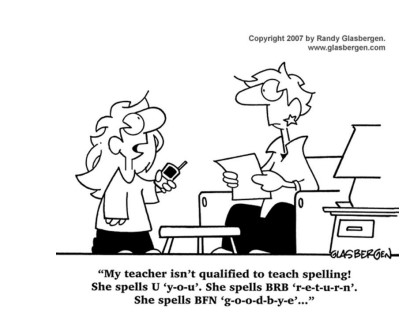
Available at: https://www.glasbergen.com/education-cartoons/language-grammar/. Accessed on: Jan 23rd, 2024.
An essential feature of cartoons is humor. The cartoonist is making fun of the fact that
Provas
Learning goals, which are referred to in version 3 of the BNCC as abilities, are intended to list the basic knowledge to be acquired by students, and to serve as a reference for drafting and updating the regional, state and municipal curricula.
[…]
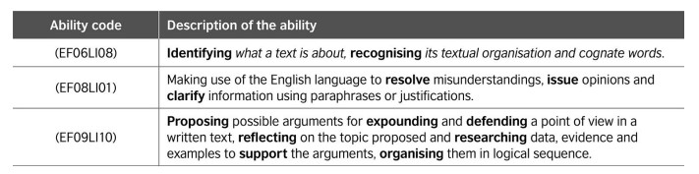
Available at: https://www.britishcouncil.org.br/sites/default/files/leitura_critica_bncc_-_en_-_v4_final.pdf. Accessed on: Jan 23rd, 2024. [Fragment]
To develop the BNCC ability EF06LI08, which includes identifying what a text is about, an English teacher should provide students with learning opportunities to
Provas
O professor de História pode ensinar ao aluno a adquirir as ferramentas de trabalho possíveis; o saber fazer, o saber fazer bem, lançar os germes do histórico. Ele é responsável por ensinar o aluno a captar e a valorizar a diversidade dos pontos de vista. Ao professor cabe ensinar ao aluno a levantar problemas e a reintegrá-los num conjunto mais vasto de outros problemas, procurando transformar, em cada aula de História, temas em problemas.
BITTENCOURT, Circe Maria Fernandes. O saber histórico na sala de aula. São Paulo: Contexto, 1998. p. 57.
Com uma prática pedagógica racionalmente orientada, conforme retratado, o ensino de História deve ser baseado na seguinte concepção:
Provas
O conceito mais abrangente de patrimônio cultural abre perspectivas de adoção de políticas de preservação patrimonial. O compromisso do setor educacional articula-se a uma educação patrimonial para as gerações atuais e futuras, centrada no pluralismo cultural [...]. O compromisso educacional orienta-se por objetivos associados à pluralidade de nossas raízes e matrizes étnicas e deve ser inserido no currículo real em todos os níveis de ensino. Várias atividades de campo apresentam essa preocupação e são constituídas em práticas iniciadas a partir do processo de alfabetização.
BITTENCOURT, Circe Maria Fernandes. Ensino de História: fundamentos e métodos. São Paulo: Cortez, 2005. p. 278.
Essa abordagem sobre patrimônio histórico, apresentada na obra de Bittencourt, dialoga com as propostas da Base Nacional Comum Curricular (BNCC).
Nesse sentido, ao planejar uma atividade de campo sobre tal tema, o professor de História deve articular uma prática pedagógica que tenha como princípio
Provas
- Ensino das DisciplinasHistória
- Planejamento na EducaçãoNíveis e tipos de planejamentoPlanejamento Educacional
- Temas Educacionais Pedagógicos
- Elaboração do Planejamento de Ensino
Deve-se buscar uma transformação pedagógica onde o papel do professor supere a compreensão e prática sobre sua disciplina, abrangendo uma reflexão sobre os conteúdos e valores a ele associados, ampliando a responsabilidade do educador com a formação dos alunos. Ou seja, com base nos temas transversais propostos e na necessidade de cada realidade escolar, o professor deve aproximar seus conteúdos e sua prática escolar para o desenvolvimento da capacidade do aluno ler e interpretar a realidade, contextualizando-a, aprendendo a aprender.
NETO, José Alves de Freitas; KARNAL, Leandro (organizador). História na Sala de Aula: conceitos, práticas e propostas. São Paulo: Contexto, 2003. p. 62.
O texto apresentado oferece reflexões e orientações sobre o ensino de História. A partir dessa linha pedagógica, em um planejamento de aula deve ser considerado(a)
Provas
Nessa época não era incomum assistir a procissões, participar de rituais, cerimônias emocionais em teatros de corte ou de manifestações pelo fim da escravidão, que perdiam em eficácia e facilidades. Por mais que o governo tentasse recorrer a uma estratégia “reformista” — como a promulgação da Lei dos Sexagenários —, o resultado começou a ser o oposto. E os ataques vieram de todo lado, isso sem falar das rebeliões escravas que estouravam nos quatro cantos do país. “Medo” era uma palavra e um sentimento que se socializava [...]. Os senhores, impedindo o fim do regime, e tendo boa parte de seu capital imobilizado em escravos, passando-lhes a exigência de uma jornada ainda mais carregada de trabalho. As consequências foram fugas constantes, ataques e assassinatos de fazendeiros e feitores, protestos de forros e populares; movimento paralelo, diga-se de passagem, ao aumento do recurso aos castigos e sevícias [...]. Para conter o pânico, uma política atuosa ao lado dos senhores, prendendo escravos considerados indisciplinados, descaracterizando denúncias de maus-tratos e reprimindo atos de abolicionistas. Mas a indisciplina tornava-se coletiva, e os crimes cada vez mais violentos, rompendo-se assim um dos tabus de uma escravista: o monopólio do castigo corporal e da violência por parte dos brancos.
SCHWARCZ, Lilia Moritz; STARLING, Heloisa Murgel. Brasil: uma biografia. São Paulo: Companhia das Letras, 2015. p. 420-421.
No contexto apresentado no texto, diversas lutas e eventos moldaram a transição para um regime de trabalho livre no Brasil. Ao trabalhar com esses dados em sala de aula, e considerar os estudos mais atualizados sobre essa transição, o professor de História pode
Provas
Há mais de uma década no ramo da moda, a estilista Dayana Molina almeja um maior protagonismo para os criativos indígenas. Criada em Niterói (RJ), tem família originária da aldeia indígena Fulni-ó, em Pernambuco. Day é dona da marca NALIMO, que, comprometida com a responsabilidade ambiental, conta com peças próximas ao estilo minimalista e com códigos ancestrais. A estilista foi uma das convidadas do Baile da Vogue de 2022, “uma mulher indígena descolonizando esse espaço embranquecido e tradicionalmente elitista, é ato político”, disse em seu Instagram.
Disponível em: https://portalbrasilcriativo.com.br/4586/. Acesso em: 11 jan. 2024.
O trabalho em sala de aula sobre a temática apresentada no texto é um dos meios de atender à proposta da Base Nacional Comum Curricular (BNCC) para o ensino e a aprendizagem da História e da cultura indígena, uma vez que a
Provas
No basquetebol, durante o jogo, quem causa a saída da bola da quadra é o último jogador que toca a bola ou é tocado por ela, antes de ela sair da quadra, mesmo que a bola, em seguida, saia da quadra por tocar algo que não seja um jogador.
Analise as afirmativas a seguir relativas à corrida da bola lateral no jogo de basquetebol.
I. Uma substituição ocorre quando uma bola é passada para dentro da quadra de jogo por um jogador que está fora da quadra, efetuando uma reposição.
II. O jogador que está fazendo a ordem não poderá levar mais que cinco segundos para soltar a bola, e nem pisar na quadra de jogo enquanto tiver a bola em sua(s) mão(s).
III. Ao jogador que está fazendo uma ordem é permitido mover-se diretamente para trás da linha limítrofe, quando as situações assim o permitirem.
Estão corretas as afirmativas
Provas
Caderno Container