Foram encontradas 495 questões.
Disciplina: Agronomia (Engenharia Agronômica)
Banca: UEPB
Orgão: Pref. Monte Horebe-PB
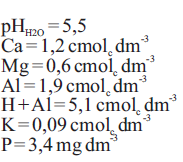
Qual a Necessidade de Calagem (NC), em t !$ ha^{-1} !$ de !$ CaCO_3 !$, para se conseguir uma Saturação de Bases (V%) de 70%.
Assinale a alternativa CORRETA.
Provas

Disciplina: Agronomia (Engenharia Agronômica)
Banca: UEPB
Orgão: Pref. Monte Horebe-PB
Calcule a Saturação de bases (V%).
Assinale a alternativa CORRETA.
Provas
Disciplina: Agronomia (Engenharia Agronômica)
Banca: UEPB
Orgão: Pref. Monte Horebe-PB
A família botânica das leguminosas é uma das maiores e mais variadas do reino vegetal. A característica típica dessas plantas é a ocorrência de vagem. Além de excelente fonte nutricional, funcionam como adubos verdes, contribuindo para a manutenção da qualidade do solo, garantindo a sustentabilidade dos sistemas de produção agrícolas.
Assinale a alternativa que apresenta APENAS exemplos de espécies leguminosas.
Provas
Disciplina: Agronomia (Engenharia Agronômica)
Banca: UEPB
Orgão: Pref. Monte Horebe-PB
Os adubos ou fertilizantes minerais são insumos agrícolas que têm por finalidade fornecer nutrientes às plantas e aumentar, de modo geral, a produtividade das culturas. Uma análise do solo estabelece, pelos teores de macronutrientes, a recomendação para a cultura do milho (Zea mays), de 20 kg !$ ha^{-1} !$, 80 kg !$ ha^{-1} !$ e 40 kg !$ ha^{-1} !$, de Nitrogênio, Fósforo e Potássio, respectivamente. Calcule a quantidade em quilogramas (kg) do adubo formulado 04-16-08 necessário para suprir a necessidade nutricional de 01 hectare da cultura do milho. Assinale a alternativa CORRETA.
Provas
Disciplina: Agronomia (Engenharia Agronômica)
Banca: UEPB
Orgão: Pref. Monte Horebe-PB
A olericultura é uma área da horticultura que estuda e explora racionalmente as hortaliças, além de ser uma atividade agrícola de grande importância social e econômica. Sobre esta prática agrícola, a coluna da esquerda apresenta o nome científico das principais hortaliças produzidas comercialmente no Brasil e a da direita, o nome popular pelo qual é conhecida.
Associe a coluna da direita de acordo com a da esquerda.
A. Lycopersicon esculentum Mill.
B. Daucus carota L
C. Allium cepa L.
D. Capsicum annuum L.
E. Sechium edule Sw.
( ) Cebola.
( ) Chuchu.
( ) Tomate.
( ) Cenoura.
( ) Pimentão.
Marque a alternativa que corresponda a sequência CORRETA.
Provas
Disciplina: Inglês (Língua Inglesa)
Banca: UEPB
Orgão: Pref. Monte Horebe-PB
Which of the following statements is CORRECT?
Provas
Disciplina: Inglês (Língua Inglesa)
Banca: UEPB
Orgão: Pref. Monte Horebe-PB

Source: AZCENTRAL Daily Comics http://comics.azcentral.com/slideshow?comic=Dustin&feature_id=Dustin
According to the comics, it is CORRECT to say that:
Provas
Disciplina: Inglês (Língua Inglesa)
Banca: UEPB
Orgão: Pref. Monte Horebe-PB
BABIES CAN LINK LANGUAGE AND ETHNICITY
A recent study from Canada's University of British Columbia (UBC) suggests that eleven-month-old infants can learn to associate the language they hear with ethnicity.
The research, published by Developmental Psychobiology, found that 11-month-old infants looked more at the faces of people of Asian descent compared to those of Caucasian descent when hearing Cantonese but not when hearing Spanish.
“Our findings suggest that by 11 months, infants are making connections between languages and ethnicities based on the individuals they encounter in their environments. In learning about language, infants are doing more than picking up sounds and sentences—they also learn about the speakers of language,” said Lillian May, a psychology lecturer at UBC who was lead author of the study.
The research was done in Vancouver, where approximately nine percent of the population can speak Cantonese.
The researchers played English-learning infants of Caucasian ancestry sentences in both English and Cantonese and showed them pictures of people of Caucasian descent, and of Asian descent. When the infants heard Cantonese, they looked more at the Asian faces than when they were hearing English. When they heard English, they looked equally to Asian and Caucasian faces.
“This indicates that they have already learned that in Vancouver, both Caucasians and Asians are likely to speak English, but only Asians are likely to speak Cantonese,” noted UBC psychology professor Janet Werker, the study's senior author.
The researchers showed the same pictures to the infants while playing Spanish, to see whether they were inclined to associate any unfamiliar language with any unfamiliar ethnicity. However, in that test the infants looked equally to Asian and Caucasian faces. This suggests young infants pick up on specific language-ethnicity pairings based on the faces and languages they encounter.
“Babies are learning so much about language—even about its social use—long before they produce their first word,” said Werker. “The link between speaker characteristics and language is something no one has to teach babies. They learn it all on their own.” “The ability to link language and ethnicity might help babies with language acquisition. We are now probing this possibility. For example, does a bilingual Chinese-English baby expect Chinese words from a Southeast Asian speaker and English words from a Caucasian speaker? Our preliminary results indicate that indeed, babies are using their expectations about language and ethnicity as another source of information in language learning,” added Werker.
Source: “Babies can link language and ethnicity”.
Language Magazine <https://www.languagemagazine.com/2019/06/28/babiescan- link-language-and-ethnicity/> Language Magazine, June 28, 2019
“ However, in that test the infants looked equally to Asian and Caucasian faces.” What is the meaning of the expression however?
Provas
Disciplina: Inglês (Língua Inglesa)
Banca: UEPB
Orgão: Pref. Monte Horebe-PB
BABIES CAN LINK LANGUAGE AND ETHNICITY
A recent study from Canada's University of British Columbia (UBC) suggests that eleven-month-old infants can learn to associate the language they hear with ethnicity.
The research, published by Developmental Psychobiology, found that 11-month-old infants looked more at the faces of people of Asian descent compared to those of Caucasian descent when hearing Cantonese but not when hearing Spanish.
“Our findings suggest that by 11 months, infants are making connections between languages and ethnicities based on the individuals they encounter in their environments. In learning about language, infants are doing more than picking up sounds and sentences—they also learn about the speakers of language,” said Lillian May, a psychology lecturer at UBC who was lead author of the study.
The research was done in Vancouver, where approximately nine percent of the population can speak Cantonese.
The researchers played English-learning infants of Caucasian ancestry sentences in both English and Cantonese and showed them pictures of people of Caucasian descent, and of Asian descent. When the infants heard Cantonese, they looked more at the Asian faces than when they were hearing English. When they heard English, they looked equally to Asian and Caucasian faces.
“This indicates that they have already learned that in Vancouver, both Caucasians and Asians are likely to speak English, but only Asians are likely to speak Cantonese,” noted UBC psychology professor Janet Werker, the study's senior author.
The researchers showed the same pictures to the infants while playing Spanish, to see whether they were inclined to associate any unfamiliar language with any unfamiliar ethnicity. However, in that test the infants looked equally to Asian and Caucasian faces. This suggests young infants pick up on specific language-ethnicity pairings based on the faces and languages they encounter.
“Babies are learning so much about language—even about its social use—long before they produce their first word,” said Werker. “The link between speaker characteristics and language is something no one has to teach babies. They learn it all on their own.” “The ability to link language and ethnicity might help babies with language acquisition. We are now probing this possibility. For example, does a bilingual Chinese-English baby expect Chinese words from a Southeast Asian speaker and English words from a Caucasian speaker? Our preliminary results indicate that indeed, babies are using their expectations about language and ethnicity as another source of information in language learning,” added Werker.
Source: “Babies can link language and ethnicity”.
Language Magazine <https://www.languagemagazine.com/2019/06/28/babiescan- link-language-and-ethnicity/> Language Magazine, June 28, 2019
According to the text, which of the following statements is TRUE?
Provas
Disciplina: Inglês (Língua Inglesa)
Banca: UEPB
Orgão: Pref. Monte Horebe-PB
LEARNING LANGUAGE: NEW INSIGHTS INTO HOW BRAIN FUNCTIONS
For most native English-speakers, learning the Mandarin Chinese language from scratch is no easy task.
Learning it in a class that essentially compresses a one-semester college course into a single month of intensive instruction -- and agreeing to have your brain scanned before and after -- might seem even more daunting.
But the 24 Americans who did just that have enabled University of Delaware cognitive neuroscientist Zhenghan Qi and her colleagues to make new discoveries about how adults learn a foreign language.
The study, published in May in the journal NeuroImage, focused on the roles of the brain's left and right hemispheres in language acquisition. The findings could lead to instructional methods that potentially improve students' success in learning a new language.
"The left hemisphere is known as the language-learning part of the brain, but we found that it was the right hemisphere that determined the eventual success" in learning Mandarin, said Qi, assistant professor of linguistics and cognitive science.
"This was new," she said. "For decades, everyone has focused on the left hemisphere, and the right hemisphere has been largely overlooked."
The left hemisphere is undoubtedly important in language learning, Qi said, noting that clinical research on individuals with speech disorders has indicated that the left side of the brain is in many ways the hub of language processing.
But, she said, before any individuals -- infants learning their native language or adults learning a second language -- begin processing such aspects of the new language as vocabulary and grammar, they must first learn to identify its basic sounds or phonological elements.
It's during that process of distinguishing "acoustic details" of sounds where the right side of the brain is key, according to the new findings.
Researchers began by exposing the 24 participants in the study to pairs of sounds that were similar but began with different consonants, such as "bah" and "nah," and having them describe the tones, Qi said.
"We asked: Were the tones of those two sounds similar or different?" she said. "We used the brain activation patterns during this task to predict who would be the most successful learners" of the new language.
The study continued by teaching the participants in a setting designed to replicate a college language class, although the usual semester was condensed into four weeks of instruction. Students attended class for three and a half hours a day, five days a week, completed homework assignments and took tests.
"Our research is the first to look at attainment and long-term retention of real-world language learned in a classroom setting, which is how most people learn a new language," Qi said.
By scanning each participant's brain with functional MRI (magnetic resonance imaging) at the beginning and end of the project, the scientists were able to see which part of the brain was most engaged while processing basic sound elements in Mandarin. To their surprise, they found that -- although, as expected, the left hemisphere showed a substantial increase of activation later in the learning process -- the right hemisphere in the most successful learners was most active in the early, sound-recognition stage.
"It turns out that the right hemisphere is very important in processing foreign speech sounds at the beginning of learning," Qi said. She added that the right hemisphere's role then seems to diminish in those successful learners as they continue learning the language.
Additional research will investigate whether the findings apply to those learning other languages, not just Mandarin. The eventual goal is to explore whether someone can practice sound recognition early in the process of learning a new language to potentially improve their success.
"We found that the more active the right hemisphere is, the more sensitive the listener is to acoustic differences in sound," Qi said. "Everyone has different levels of activation, but even if you don't have that sensitivity to begin with, you can still learn successfully if your brain is plastic enough."
Researchers can't say for certain how to apply these findings to real-life learning, but when it comes down to it, "Adults are trainable," Qi said. "They can train themselves to become more sensitive to foreign speech sounds."
( S o u r c e : U n i v e r s i t y o f D e l a w a r e . " L e a r n i n g l a n g u a g e : N e w i n s i g h t s i n t o h o w b r a i n f u n c t i o n s . " S c i e n c e D a i l y . <www.sciencedaily.com/releases/2019/05/190508093716.htm> ScienceDaily, 8 May 2019).
“Learning it in a class that essentially compresses a one-semester college course into a single month of intensive instruction -- and agreeing to have your brain scanned before and after -- might seem even more daunting.” The word daunting can be substituted by
Provas
Caderno Container