Foram encontradas 70 questões.
TEXT IV
Throughout the last 15 years our society has undergone two major changes: Firstly, there has been a steady rise of cultural and linguistic diversity, due to migration, multiculturalism and global economic integration; secondly, there has been the rapid development of technological devices and the world-wide expansion of new communications media. These changes directly affect the lives of our pupils at home and at school and thus have an important impact on curricular development, teaching objectives, contents and methodologies – starting as early as in primary school.
[…]
While traditionally being literate solely referred to the ability to read and write in a standardized form of one language, literate practices today incorporate multimodal, critical, cultural, and media competencies next to traditional-functional language skills, like reading, writing, speaking, mediating, and listening in many languages.
One major aspect in this context is the changing nature of texts that has developed from advances in technology. Language learners today need to be able to cope with different kinds of texts, including multimodal, interactive, linear, and nonlinear texts, texts in different languages, texts with several possible meanings, texts being delivered on paper, screens, or live, and texts that comprise one or more semiotic system.
In order to prepare students to actively engage in a socially diverse, globalized, and technological world, teachers need to find new forms of teaching and learning and provide opportunities for their pupils to explore, learn about, and critically engage with a broad variety of texts and differing literate practices. Still, the question remains open as to how these principles and objectives of a multiliteracies pedagogy translate into examples of good practice in school settings.
(Source: adapted from ELSNER, D. Developing multiliteracies, plurilingual awareness & critical thinking in the primary language classroom with multilingual virtual talking books. Encuentro 20, 2011, pp. 27- 38.https://archive.org/details/ERIC_ED530011)
Provas

TEXT IV
Throughout the last 15 years our society has undergone two major changes: Firstly, there has been a steady rise of cultural and linguistic diversity, due to migration, multiculturalism and global economic integration; secondly, there has been the rapid development of technological devices and the world-wide expansion of new communications media. These changes directly affect the lives of our pupils at home and at school and thus have an important impact on curricular development, teaching objectives, contents and methodologies – starting as early as in primary school.
[…]
While traditionally being literate solely referred to the ability to read and write in a standardized form of one language, literate practices today incorporate multimodal, critical, cultural, and media competencies next to traditional-functional language skills, like reading, writing, speaking, mediating, and listening in many languages.
One major aspect in this context is the changing nature of texts that has developed from advances in technology. Language learners today need to be able to cope with different kinds of texts, including multimodal, interactive, linear, and nonlinear texts, texts in different languages, texts with several possible meanings, texts being delivered on paper, screens, or live, and texts that comprise one or more semiotic system.
In order to prepare students to actively engage in a socially diverse, globalized, and technological world, teachers need to find new forms of teaching and learning and provide opportunities for their pupils to explore, learn about, and critically engage with a broad variety of texts and differing literate practices. Still, the question remains open as to how these principles and objectives of a multiliteracies pedagogy translate into examples of good practice in school settings.
(Source: adapted from ELSNER, D. Developing multiliteracies, plurilingual awareness & critical thinking in the primary language classroom with multilingual virtual talking books. Encuentro 20, 2011, pp. 27- 38.https://archive.org/details/ERIC_ED530011)
Provas
TEXT II
What to Know About the Controversy Surrounding the Movie Green Book
Depending on who you ask, Green Book is either the pinnacle of movie magic or a whitewashing sham.
The film, which took home the prize for Best Picture at the 91st Academy Awards, as well as honors for Mahershala Ali as Best Supporting Actor and Nick Vallelonga, Brian Currie and Peter Farrelly for Best Original Screenplay, depicts the burgeoning friendship between a black classical pianist and his ItalianAmerican driver as they travel the 1960s segregated South on a concert tour. But while Green Book was an awards frontrunner all season, its road to Oscar night was riddled with missteps and controversies over its authenticity and racial politics.
Green Book is about the relationship between two real-life people: Donald Shirley and Tony “Lip” Vallelonga. Shirley was born in 1927 and grew up in a well-off black family in Florida, where he emerged as a classical piano prodigy: he possessed virtuosic technique and a firm grasp of both classical and pop repertoire. He went on to perform regularly at Carnegie Hall— right below his regal apartment—and work with many prestigious orchestras, like the Chicago Symphony and the New York Philharmonic. But at a time when prominent black classical musicians were few and far between due to racist power structures, he never secured a spot in the upper echelons of the classical world. (African Americans still only make up 1.8 percent of musicians playing in orchestras nationwide, according to a recent study.)
Vallelonga was born in 1930 to working-class Italian parents and grew up in the Bronx. As an adult he worked as a bouncer, a maître d’ and a chauffeur, and he was hired in 1962 to drive Shirley on a concert tour through the Jim Crow South. The mismatched pair spent one and a half years together on the road — though it’s condensed to just a couple of months in the film — wriggling out of perilous situations and learning about each other’s worlds. Vallelonga would later become an actor and land a recurring role on The Sopranos.
In the 1980s, Vallelonga’s son, Nick, approached his father and Shirley about making a movie about their friendship. For reasons that are now contested, Shirley rebuffed these requests at the time. […]
(Source: from http://time.com/5527806/green-book-movie-controversy/)
Provas
Complete o quadro a seguir.
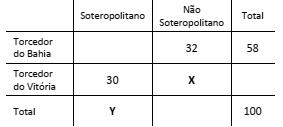
O valor de X + Y é
Provas
Os recipientes X, Y e Z contêm, respectivamente, 120, 136 e 98 mililitros de água. Maria manipulou os três recipientes de forma conveniente, para que eles ficassem com as mesmas quantidades de água.
Sobre o fato narrado, assinale a afirmativa correta.
Provas
Júlia está em uma fila que tem, ao todo, 37 pessoas. O número de pessoas à frente de Júlia é o dobro do número de pessoas atrás dela. O tempo máximo de atendimento de cada pessoa da fila é de 3 minutos.
Tomando como referência o início do atendimento, Júlia será atendida, no máximo, em
Provas
“A solução para a questão da violência no Brasil envolve os mais diversos setores da sociedade, não só a segurança pública e um judiciário eficiente, mas também demanda com urgência, profundidade e extensão a melhoria do sistema educacional, de saúde, habitacional, oportunidades de emprego, dentre outros fatores.”
Considerando-se o texto de uma redação de caráter dissertativo-argumentativo padrão, o fragmento acima corresponde à
Provas
Provas
“A banalização das artes e da literatura, o triunfo do jornalismo sensacionalista e a frivolidade da política são sintomas de um mal maior que afeta a sociedade contemporânea: a ideia temerária de converter em bem supremo nossa natural propensão a nos divertirmos”.
Mário Vargas Llosa, A civilização do espetáculo.
Assinale a opção em que se indica corretamente uma inferência desse pequeno texto de apresentação de um livro.
Provas

Dê força para quem já está fazendo!
Tem uma galera que reclama, tem outra que faz, tem aquela que ajuda a fazer. Qual delas é você?
Os dizeres do cartaz empregam a linguagem coloquial a fim de tornar-se mais comunicativo. Assinale a opção em que não se faz uso dessa variedade de linguagem.
Provas
Caderno Container