Foram encontradas 654 questões.
Text 4
Hope is the thing with feathers
(Emily Dickinson 1830 –1886)
Hope is the thing with feathers
That perches in the soul,
And sings the tune without the words,
And never stops at all,
And sweetest in the gale is heard;
And sore must be the storm
That could abash the little bird
That kept so many warm.
I've heard it in the chillest land,
And on the strangest sea;
Yet, never, in extremity,
It asked a crumb of me.
* This poem is in the public domain. Available in:< https://poets.org/poem/hope-thing-feathers-254>
Provas

Text 4
Hope is the thing with feathers
(Emily Dickinson 1830 –1886)
Hope is the thing with feathers
That perches in the soul,
And sings the tune without the words,
And never stops at all,
And sweetest in the gale is heard;
And sore must be the storm
That could abash the little bird
That kept so many warm.
I've heard it in the chillest land,
And on the strangest sea;
Yet, never, in extremity,
It asked a crumb of me.
* This poem is in the public domain. Available in:< https://poets.org/poem/hope-thing-feathers-254>
Provas
Text 4
Hope is the thing with feathers
(Emily Dickinson 1830 –1886)
Hope is the thing with feathers
That perches in the soul,
And sings the tune without the words,
And never stops at all,
And sweetest in the gale is heard;
And sore must be the storm
That could abash the little bird
That kept so many warm.
I've heard it in the chillest land,
And on the strangest sea;
Yet, never, in extremity,
It asked a crumb of me.
* This poem is in the public domain. Available in:< https://poets.org/poem/hope-thing-feathers-254>
Provas
- Gramática - Língua InglesaVerbos | VerbsPassado progressivo | Past continuous
- Gramática - Língua InglesaVerbos | VerbsPassado perfeito | Past perfect
I. “Emily Dickinson was born on December 10, 1830, in Amherst, Massachusetts.” is in the past simple tense.
II. “While she was extremely prolific as a poet and regularly enclosed poems in letters to friends, she was not publicly recognized during her lifetime.” is in the past continuous tense.
III. “She died in Amherst in 1886, and the first volume of her work was published posthumously in 1890.” is in the past perfect and simple past tenses.
IV. “The Manuscript Books of Emily Dickinson (Belknap Press, 1981) is the only volume that keeps the order intact.” is in the simple present tense.
Which ones are incorrect?
Provas
Provas
Text 3
Desuggestopedia; the application of the study of suggestion to pedagogy, has been developed to help students eliminate the feeling that they cannot be successful or the negative association they may have toward studying and, thus, to help them overcome the barriers to learning. One of the ways th e students' mental reserves are stimulated is through integration of the fine arts, an importante contribution to the method made by Lozanov's colleague Evclyna Carcva.
LARSEN-FREEMAN, Diane. Techniques and Principles in Language Teaching. 3rd ed. Oxford ; New York: Oxford University Press, 2011.
Provas
Text 2
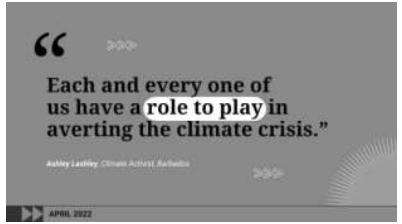
Available
in:<https://www.un.org/en/climatechange/voices-of-change-ashley-lashley>
Provas
Text 2
Available
in:<https://www.un.org/en/climatechange/voices-of-change-ashley-lashley>
Provas
Text 2
Available
in:<https://www.un.org/en/climatechange/voices-of-change-ashley-lashley>
Provas
- Gramática - Língua InglesaAdjetivos | Adjectives
- Gramática - Língua InglesaAdvérbios e conjunções | Adverbs and conjunctions
Text 1
The Courage to Be Imperfect
Perfectionism, self-examination and the kissing of frogs
Michael J. Formica
Posted July 9, 2009
Someone once said that there are two kinds of people in the world - those who are right... And nowhere are we more inclined to want to be right than with regard to ourselves. In fact, more often than not, we want to be perfect. What this striving for perfection often leads to is a kind of social paralysis.
If we are constantly focused on making the right decision, we will sometimes find ourselves in a place ranging from morbid indecision to outright fear. Getting it right, making the good choice and avoiding the faux pas endorse in us a rigidity of character and action that is limiting and, in derailing our momentum, deflects our potential evolution.
The willingness to be wrong or, as more properly suggested here, the courage to be imperfect, allows us the opportunity to discover many things about ourselves. Without exercising this courage, we put ourselves into a straightjacket of sorts, setting our thoughts and actions in a dismally fettered pattern.
This line of thinking was prompted by a conversation that I had with a client yesterday where in she had come to the conclusion that she was a bit of a perfectionist. What she had puzzled out for herself was that her perfectionism, rather than serving her, was actually hindering her ability to be flexible, open to new possibilities and clear about what she wanted for herself and her life.
At some point, I suggested that the fairy tale about the princess kissing frogs to find the prince was a good metaphor for stepping outside of one's comfort zone and "trying something on for size' without an overly self-conscious regard for the potential consequences of the choice. She mentioned that a few days earlier she had seen the trailer for a movie in which the princess kissed a frog and turned into a frog herself. Brilliant.
If we are unwilling to kiss a few frogs - to explore the possibilities that are presented to us in anticipation of finding something unexpected - then we, ourselves, may turn into frogs. That is, become stuck in our place and condemned to something that is not us. We can, without the willingness to be open to making mistakes, limit ourselves right into a state of personal inauthenticity.
Available
in:<https://www.psychologytoday.com/intl/blog/enlightened-living/200907/the-courage-be-imperfect>
The underlined words above “unwilling”, “then”, “unwillingness” and “into”, in the text, are respectively:
Provas
Caderno Container