Foram encontradas 120 questões.
Proposições são frases para as quais se pode atribuir uma valoração verdadeira (V) ou falsa (F). Por exemplo, a frase “O planeta Terra é uma imensa planície” é uma proposição porque a ela é possível atribuir a valoração falsa (F), e a frase “Onde fica a Antártica?” não é proposição porque é uma pergunta e, portanto, não faz sentido ser valorada como V ou F.
Considere que P e Q sejam proposições e as seguintes notações:
¬P é a negação de P; P\( \vee \)Q representa “P ou Q”; P\( \land \)Q representa “P e Q”. Uma proposição da forma P \( \rightarrow \) Q é lida como “se P, então Q”. Define-se que P \( \rightarrow \) Q é F se a proposição P for V e a proposição Q for F, caso contrário, é V. Define-se P\( \vee \)Q como F se P e Q forem F, caso contrário, é considerada V. Define-se P\( \land \)Q como V se P e Q forem V, caso contrário, é considerada F. Duas proposições são consideradas equivalentes quando elas têm exatamente as mesmas valorações V e F. Quando proposições da forma P e da forma P \( \rightarrow \) Q são V, e estão presentes em uma argumentação — seqüência finita de proposições —, então Q pode ser inferida como V, e a argumentação está correta. Com base nessas informações e considerando as proposições
P: “Gabriel não é culpado”, e
Q: “A promotoria não condenará Gabriel”,
julgue o item seguinte.
A proposição ¬P\( \vee \)¬Q tem mais de uma possibilidade de ter valoração F.
Provas

Proposições são frases para as quais se pode atribuir uma valoração verdadeira (V) ou falsa (F). Por exemplo, a frase “O planeta Terra é uma imensa planície” é uma proposição porque a ela é possível atribuir a valoração falsa (F), e a frase “Onde fica a Antártica?” não é proposição porque é uma pergunta e, portanto, não faz sentido ser valorada como V ou F.
Considere que P e Q sejam proposições e as seguintes notações:
¬P é a negação de P; P\( \vee \)Q representa “P ou Q”; P\( \land \)Q representa “P e Q”. Uma proposição da forma P \( \rightarrow \) Q é lida como “se P, então Q”. Define-se que P \( \rightarrow \) Q é F se a proposição P for V e a proposição Q for F, caso contrário, é V. Define-se P\( \vee \)Q como F se P e Q forem F, caso contrário, é considerada V. Define-se P\( \land \)Q como V se P e Q forem V, caso contrário, é considerada F. Duas proposições são consideradas equivalentes quando elas têm exatamente as mesmas valorações V e F. Quando proposições da forma P e da forma P \( \rightarrow \) Q são V, e estão presentes em uma argumentação — seqüência finita de proposições —, então Q pode ser inferida como V, e a argumentação está correta. Com base nessas informações e considerando as proposições
P: “Gabriel não é culpado”, e
Q: “A promotoria não condenará Gabriel”,
julgue o item seguinte.
Há exatamente duas possibilidades para que a proposição ¬(P\( \vee \)Q)\( \land \)(P\( \vee \)Q) tenha valoração F.
Provas
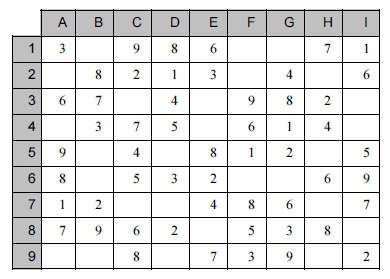
Um quebra-cabeças que se tornou bastante popular é o chamado SUDOKU. Para preenchê-lo, basta um pouco de raciocínio lógico. Na tabela acima, que ilustra esse jogo, cada célula é identificada por uma letra, que se refere à coluna, e por um algarismo, que se refere à respectiva linha. Após preencher as células em branco com os algarismos de 1 a 9, de modo que cada algarismo apareça uma única vez em cada linha e em cada coluna, julgue os itens a seguir.
As três células vazias do cruzamento das linhas 1, 2 e 3 com as colunas G, H e I devem ser preenchidas com os algarismos 5, 9 e 3, respectivamente.
Provas
Um quebra-cabeças que se tornou bastante popular é o chamado SUDOKU. Para preenchê-lo, basta um pouco de raciocínio lógico. Na tabela acima, que ilustra esse jogo, cada célula é identificada por uma letra, que se refere à coluna, e por um algarismo, que se refere à respectiva linha. Após preencher as células em branco com os algarismos de 1 a 9, de modo que cada algarismo apareça uma única vez em cada linha e em cada coluna, julgue os itens a seguir.
Os algarismos 5 e 6 são os que preenchem as células B9 e D9, respectivamente.
Provas
Um quebra-cabeças que se tornou bastante popular é o chamado SUDOKU. Para preenchê-lo, basta um pouco de raciocínio lógico. Na tabela acima, que ilustra esse jogo, cada célula é identificada por uma letra, que se refere à coluna, e por um algarismo, que se refere à respectiva linha. Após preencher as células em branco com os algarismos de 1 a 9, de modo que cada algarismo apareça uma única vez em cada linha e em cada coluna, julgue os itens a seguir.
Está correto preencher com o algarismo 4 a célula B6.
Provas
Disciplina: Inglês (Língua Inglesa)
Banca: CESPE / CEBRASPE
Orgão: PRODEST-ES
For millennia, social development was tantamount
to social survival: the daily goal of people, with the
exception of a tiny ruling minority, was to get by, make a
family, and steal a few moments of joy out of the harshness
of the human condition. This is still the lot of many. Yet over
the last two centuries, with the advent of the industrial age,
social development came to involve the goal of improving
people’s livelihood. Capital accumulation and investment,
technological development geared towards material
production, and massive inputs of labor and natural resources
were the generators of wealth, both under capitalism and
under statism. Social struggles and political reform or
revolution took care of diffusing the harvest of productivity
within society at large, albeit2 with the shortcomings of a
world divided between North and South, and organized in
class societies that tended to reproduce themselves.
There is something new in the information age. It
can be empirically argued that at the source of productivity
and competitiveness (that jointly determine the generation of
wealth and its differential appropriation by economic units),
there is the capacity to generate new knowledge and to
process relevant information efficiently. To be sure,
information and knowledge have always been essential
factors in power and production. Yet it is only when new
information and communication technologies empower
humankind with the ability incessantly to feed knowledge
back into knowledge, experience into experience, that there
is, at the same time, unprecedented productivity potential,
and an especially close link between the activity of the mind,
on the one hand, and material production, be it of goods or
services, on the other.
tantamount – being almost the same or having the same effect;
albeit – used to reduce to strength and effect of what has just been said,
although.
UNRISD Discussion Paper n.º 114 (with adaptations).
In the text,
“Yet” (l.24) is the same as despite that.
Provas
Disciplina: Inglês (Língua Inglesa)
Banca: CESPE / CEBRASPE
Orgão: PRODEST-ES
For millennia, social development was tantamount
to social survival: the daily goal of people, with the
exception of a tiny ruling minority, was to get by, make a
family, and steal a few moments of joy out of the harshness
of the human condition. This is still the lot of many. Yet over
the last two centuries, with the advent of the industrial age,
social development came to involve the goal of improving
people’s livelihood. Capital accumulation and investment,
technological development geared towards material
production, and massive inputs of labor and natural resources
were the generators of wealth, both under capitalism and
under statism. Social struggles and political reform or
revolution took care of diffusing the harvest of productivity
within society at large, albeit2 with the shortcomings of a
world divided between North and South, and organized in
class societies that tended to reproduce themselves.
There is something new in the information age. It
can be empirically argued that at the source of productivity
and competitiveness (that jointly determine the generation of
wealth and its differential appropriation by economic units),
there is the capacity to generate new knowledge and to
process relevant information efficiently. To be sure,
information and knowledge have always been essential
factors in power and production. Yet it is only when new
information and communication technologies empower
humankind with the ability incessantly to feed knowledge
back into knowledge, experience into experience, that there
is, at the same time, unprecedented productivity potential,
and an especially close link between the activity of the mind,
on the one hand, and material production, be it of goods or
services, on the other.
tantamount – being almost the same or having the same effect;
albeit – used to reduce to strength and effect of what has just been said,
although.
UNRISD Discussion Paper n.º 114 (with adaptations).
In the text,
“get by” (l.3) means manage to pay for the unnecessary things in life.
Provas
Disciplina: Inglês (Língua Inglesa)
Banca: CESPE / CEBRASPE
Orgão: PRODEST-ES
For millennia, social development was tantamount
to social survival: the daily goal of people, with the
exception of a tiny ruling minority, was to get by, make a
family, and steal a few moments of joy out of the harshness
of the human condition. This is still the lot of many. Yet over
the last two centuries, with the advent of the industrial age,
social development came to involve the goal of improving
people’s livelihood. Capital accumulation and investment,
technological development geared towards material
production, and massive inputs of labor and natural resources
were the generators of wealth, both under capitalism and
under statism. Social struggles and political reform or
revolution took care of diffusing the harvest of productivity
within society at large, albeit2 with the shortcomings of a
world divided between North and South, and organized in
class societies that tended to reproduce themselves.
There is something new in the information age. It
can be empirically argued that at the source of productivity
and competitiveness (that jointly determine the generation of
wealth and its differential appropriation by economic units),
there is the capacity to generate new knowledge and to
process relevant information efficiently. To be sure,
information and knowledge have always been essential
factors in power and production. Yet it is only when new
information and communication technologies empower
humankind with the ability incessantly to feed knowledge
back into knowledge, experience into experience, that there
is, at the same time, unprecedented productivity potential,
and an especially close link between the activity of the mind,
on the one hand, and material production, be it of goods or
services, on the other.
tantamount – being almost the same or having the same effect;
albeit – used to reduce to strength and effect of what has just been said,
although.
UNRISD Discussion Paper n.º 114 (with adaptations).
From the text, it can be inferred that
only nowadays information and knowledge are considered important factors in power and production.
Provas
Disciplina: Inglês (Língua Inglesa)
Banca: CESPE / CEBRASPE
Orgão: PRODEST-ES
For millennia, social development was tantamount
to social survival: the daily goal of people, with the
exception of a tiny ruling minority, was to get by, make a
family, and steal a few moments of joy out of the harshness
of the human condition. This is still the lot of many. Yet over
the last two centuries, with the advent of the industrial age,
social development came to involve the goal of improving
people’s livelihood. Capital accumulation and investment,
technological development geared towards material
production, and massive inputs of labor and natural resources
were the generators of wealth, both under capitalism and
under statism. Social struggles and political reform or
revolution took care of diffusing the harvest of productivity
within society at large, albeit2 with the shortcomings of a
world divided between North and South, and organized in
class societies that tended to reproduce themselves.
There is something new in the information age. It
can be empirically argued that at the source of productivity
and competitiveness (that jointly determine the generation of
wealth and its differential appropriation by economic units),
there is the capacity to generate new knowledge and to
process relevant information efficiently. To be sure,
information and knowledge have always been essential
factors in power and production. Yet it is only when new
information and communication technologies empower
humankind with the ability incessantly to feed knowledge
back into knowledge, experience into experience, that there
is, at the same time, unprecedented productivity potential,
and an especially close link between the activity of the mind,
on the one hand, and material production, be it of goods or
services, on the other.
tantamount – being almost the same or having the same effect;
albeit – used to reduce to strength and effect of what has just been said,
although.
UNRISD Discussion Paper n.º 114 (with adaptations).
From the text, it can be inferred that
power and production surely depend upon information and knowledge.
Provas
Disciplina: Inglês (Língua Inglesa)
Banca: CESPE / CEBRASPE
Orgão: PRODEST-ES
For millennia, social development was tantamount
to social survival: the daily goal of people, with the
exception of a tiny ruling minority, was to get by, make a
family, and steal a few moments of joy out of the harshness
of the human condition. This is still the lot of many. Yet over
the last two centuries, with the advent of the industrial age,
social development came to involve the goal of improving
people’s livelihood. Capital accumulation and investment,
technological development geared towards material
production, and massive inputs of labor and natural resources
were the generators of wealth, both under capitalism and
under statism. Social struggles and political reform or
revolution took care of diffusing the harvest of productivity
within society at large, albeit2 with the shortcomings of a
world divided between North and South, and organized in
class societies that tended to reproduce themselves.
There is something new in the information age. It
can be empirically argued that at the source of productivity
and competitiveness (that jointly determine the generation of
wealth and its differential appropriation by economic units),
there is the capacity to generate new knowledge and to
process relevant information efficiently. To be sure,
information and knowledge have always been essential
factors in power and production. Yet it is only when new
information and communication technologies empower
humankind with the ability incessantly to feed knowledge
back into knowledge, experience into experience, that there
is, at the same time, unprecedented productivity potential,
and an especially close link between the activity of the mind,
on the one hand, and material production, be it of goods or
services, on the other.
tantamount – being almost the same or having the same effect;
albeit – used to reduce to strength and effect of what has just been said,
although.
UNRISD Discussion Paper n.º 114 (with adaptations).
From the text, it can be inferred that
never before has important information been processed so efficiently.
Provas
Caderno Container