Magna Concursos

Foram encontradas 60 questões.

A professora Eugênia foi procurada pelos pais de um de seus alunos relatando a seguinte situação: recentemente transferidos de outro país, eles não concordam com a classificação do filho no 3º ano do ensino fundamental, sob o argumento de que o domínio da língua portuguesa precisa ser aprimorado e que, por isso, temem que o filho se sinta defasado em relação à turma.

A professora, munida de um correto entendimento do parágrafo 1º do artigo 23 da Lei nº 9.394/1996, explicou aos pais do aluno que a escola pode reclassificar os alunos, inclusive quando se trata de transferências entre estabelecimentos situados no País e no exterior, tendo como base


Provas

Questão presente nas seguintes provas

O artigo 225 da Constituição da República Federativa do Brasil, de 1988, estabelece que todos têm direito ao meio ambiente ecologicamente equilibrado, impondo-se ao Poder Público e à coletividade o dever de defendê-lo e preservá-lo para as presentes e as futuras gerações. O parágrafo 1º do referido artigo lista incumbências do Poder Público para efetivar esse direito, sendo uma delas promover a educação ambiental em todos os ________________ e a conscientização pública para a preservação do meio ambiente.

Assinale a alternativa que preenche corretamente a lacuna, conforme o texto constitucional.


Provas

Questão presente nas seguintes provas
3748393 Ano: 2025
Disciplina: Inglês (Língua Inglesa)
Banca: VUNESP
Orgão: SEDUC-SP
Leia a citação a seguir:

“Never make fun of someone who doesn’t speak English proper. They already be speaking another language.”
Anonymous

The teacher who praises this attempt at communication is one who follows the concepts of the
 

Provas

Questão presente nas seguintes provas
3748392 Ano: 2025
Disciplina: Inglês (Língua Inglesa)
Banca: VUNESP
Orgão: SEDUC-SP
This is the name of a site which discusses the post-method era in language teaching and learning.

eNglIsh lANguAge TeAChINg IN The POsT-MeThOd erA

Its representation is consistent with the following comment:
 

Provas
Questão presente nas seguintes provas
3748391 Ano: 2025
Disciplina: Inglês (Língua Inglesa)
Banca: VUNESP
Orgão: SEDUC-SP
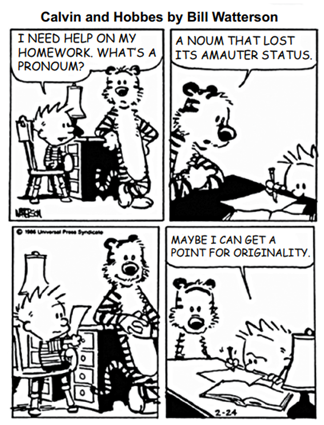
Read the comic strip about Calvin (the boy) and Hobbes (the tiger), and answer question.
Enunciado 3748391-1
(https://www.gocomics.com/search/calvinandhobbes?utf8=%E2%9C%93&ter ms=what+is+a+pronoun%3F)
The boy’s words and the face expressions allow us to infer that
 

Provas

Questão presente nas seguintes provas
3748390 Ano: 2025
Disciplina: Inglês (Língua Inglesa)
Banca: VUNESP
Orgão: SEDUC-SP
Read the text to answer question.
    Our world is changing rapidly and so are the needs and wants of our learners. Mobile phones and social media have become staples in students’ daily lives. Many work from home and value flexibility in when and where they learn. English has become an essential tool for international communication, and so have many transferable skills that are crucial to our learners’ employability in a landscape where new jobs and tasks are constantly being created.
    It can be tricky to define ‘innovation’ and often, when we talk about innovations, it is easy to only focus on technological innovations. However, innovations go beyond technological advancements. In the world of English language teaching (ELT), innovation introduces new and original elements in methodology, design, content, and, of course, in technology. However innovative, technology shouldn’t be used for the sake of using the latest technology because innovation is about addressing and solving current challenges and offering fresh solutions. It is about adapting to changing needs and contexts and enhancing learning outcomes. It is about reimagining old ways of teaching and learning and attempting new pedagogies. In other words, innovation is about moving forward with the way we do things because it can make things more effective and more efficient for the educator and the learner.
(https://www.britishcouncil.org/voices-magazine/2024)
No Currículo Paulista, lemos que, entre as competências específicas de língua inglesa para o ensino fundamental, é esperado:

“Utilizar novas tecnologias, com novas linguagens e modos de interação, para pesquisar, selecionar, compartilhar, posicionar-se e produzir sentidos em práticas de letramento na língua inglesa, de forma ética, crítica e responsável.”

O trecho do texto do British Council que vai ao encontro dessa proposta é
 

Provas

Questão presente nas seguintes provas
3748389 Ano: 2025
Disciplina: Inglês (Língua Inglesa)
Banca: VUNESP
Orgão: SEDUC-SP
Read the text to answer question.
    Our world is changing rapidly and so are the needs and wants of our learners. Mobile phones and social media have become staples in students’ daily lives. Many work from home and value flexibility in when and where they learn. English has become an essential tool for international communication, and so have many transferable skills that are crucial to our learners’ employability in a landscape where new jobs and tasks are constantly being created.
    It can be tricky to define ‘innovation’ and often, when we talk about innovations, it is easy to only focus on technological innovations. However, innovations go beyond technological advancements. In the world of English language teaching (ELT), innovation introduces new and original elements in methodology, design, content, and, of course, in technology. However innovative, technology shouldn’t be used for the sake of using the latest technology because innovation is about addressing and solving current challenges and offering fresh solutions. It is about adapting to changing needs and contexts and enhancing learning outcomes. It is about reimagining old ways of teaching and learning and attempting new pedagogies. In other words, innovation is about moving forward with the way we do things because it can make things more effective and more efficient for the educator and the learner.
(https://www.britishcouncil.org/voices-magazine/2024)
No trecho retirado do segundo parágrafo do texto “innovation is about moving forward with the way we do things because it can make things more effective”, há exemplo de dois verbos – do e make – que causam dificuldade para aprendizes de inglês falantes nativos de português por conta de “collocations”, ou “groups of two or more words that are frequently used together”.

Assinale a alternativa em que a expressão em negrito foi empregada corretamente.
 

Provas

Questão presente nas seguintes provas
3748388 Ano: 2025
Disciplina: Inglês (Língua Inglesa)
Banca: VUNESP
Orgão: SEDUC-SP
Read the text to answer question.
    Our world is changing rapidly and so are the needs and wants of our learners. Mobile phones and social media have become staples in students’ daily lives. Many work from home and value flexibility in when and where they learn. English has become an essential tool for international communication, and so have many transferable skills that are crucial to our learners’ employability in a landscape where new jobs and tasks are constantly being created.
    It can be tricky to define ‘innovation’ and often, when we talk about innovations, it is easy to only focus on technological innovations. However, innovations go beyond technological advancements. In the world of English language teaching (ELT), innovation introduces new and original elements in methodology, design, content, and, of course, in technology. However innovative, technology shouldn’t be used for the sake of using the latest technology because innovation is about addressing and solving current challenges and offering fresh solutions. It is about adapting to changing needs and contexts and enhancing learning outcomes. It is about reimagining old ways of teaching and learning and attempting new pedagogies. In other words, innovation is about moving forward with the way we do things because it can make things more effective and more efficient for the educator and the learner.
(https://www.britishcouncil.org/voices-magazine/2024)
The excerpt from the text “It can be tricky to define ‘innovation’ and often, when we talk about innovations, it is easy to only focus on technological innovations” shows two instances of the use of an ambient “it” or empty “it”. Unlike the common pronoun it, empty it does not refer to anything; it simply serves a grammatical function. In other words, empty it has a grammatical meaning, but no lexical meaning.

Mark the alternative in which it has a lexical meaning.
 

Provas

Questão presente nas seguintes provas
3748387 Ano: 2025
Disciplina: Inglês (Língua Inglesa)
Banca: VUNESP
Orgão: SEDUC-SP
Read the text to answer question.
    Our world is changing rapidly and so are the needs and wants of our learners. Mobile phones and social media have become staples in students’ daily lives. Many work from home and value flexibility in when and where they learn. English has become an essential tool for international communication, and so have many transferable skills that are crucial to our learners’ employability in a landscape where new jobs and tasks are constantly being created.
    It can be tricky to define ‘innovation’ and often, when we talk about innovations, it is easy to only focus on technological innovations. However, innovations go beyond technological advancements. In the world of English language teaching (ELT), innovation introduces new and original elements in methodology, design, content, and, of course, in technology. However innovative, technology shouldn’t be used for the sake of using the latest technology because innovation is about addressing and solving current challenges and offering fresh solutions. It is about adapting to changing needs and contexts and enhancing learning outcomes. It is about reimagining old ways of teaching and learning and attempting new pedagogies. In other words, innovation is about moving forward with the way we do things because it can make things more effective and more efficient for the educator and the learner.
(https://www.britishcouncil.org/voices-magazine/2024)
According to the authors, the reason for not using the latest technology with the sole objective of using it is that
 

Provas

Questão presente nas seguintes provas
3748386 Ano: 2025
Disciplina: Inglês (Língua Inglesa)
Banca: VUNESP
Orgão: SEDUC-SP
Read the text to answer question.
    Our world is changing rapidly and so are the needs and wants of our learners. Mobile phones and social media have become staples in students’ daily lives. Many work from home and value flexibility in when and where they learn. English has become an essential tool for international communication, and so have many transferable skills that are crucial to our learners’ employability in a landscape where new jobs and tasks are constantly being created.
    It can be tricky to define ‘innovation’ and often, when we talk about innovations, it is easy to only focus on technological innovations. However, innovations go beyond technological advancements. In the world of English language teaching (ELT), innovation introduces new and original elements in methodology, design, content, and, of course, in technology. However innovative, technology shouldn’t be used for the sake of using the latest technology because innovation is about addressing and solving current challenges and offering fresh solutions. It is about adapting to changing needs and contexts and enhancing learning outcomes. It is about reimagining old ways of teaching and learning and attempting new pedagogies. In other words, innovation is about moving forward with the way we do things because it can make things more effective and more efficient for the educator and the learner.
(https://www.britishcouncil.org/voices-magazine/2024)
The sentence “Mobile phones and social media have become staples in students’ daily lives” means
 

Provas

Questão presente nas seguintes provas