Foram encontradas 70 questões.
João, Antônio e Pedro travaram intenso debate em relação à participação do Poder Legislativo nas nomeações de ocupantes de cargos públicos realizadas pelo Presidente da República. João defendia que tanto a Câmara dos Deputados como o Senado Federal receberam a incumbência de aprovar as nomeações para certos cargos, conforme rol não exaustivo previsto na Constituição da República, que pode ser ampliado. Antônio, por sua vez, defendia que essa incumbência foi outorgada ao Senado Federal, não sendo possível que a lei ordinária amplie o rol de nomeações a serem previamente aprovadas.
Por fim, Pedro, embora reconhecesse que essa incumbência foi atribuída ao Senado Federal, tendo a ordem constitucional contemplado um rol não exaustivo de nomeações a serem aprovadas, passível de ser ampliado pela lei ordinária, ressaltava que a aprovação somente era necessária em relação a certas autoridades do Poder Executivo e do Poder Judiciário.
Considerando os balizamentos estabelecidos pela ordem constitucional, é possível afirmar que
Provas

Maria, servidora pública ocupante de cargo de provimento efetivo no Município Alfa, logrou ser eleita vereadora no Município Beta, situado em caráter contíguo a Alfa.
Nesse caso, à luz da sistemática constitucional, é correto afirmar que Maria
Provas
O Prefeito do Município Beta editou o Decreto nº XX dispondo que a Lei Federal nº XX, que estabelecia normas de proteção ao meio ambiente, não deveria ser executada pela Administração Pública municipal. Em sua justificativa, argumentava que as normas eram muito rigorosas, dificultando sobremaneira a ocupação do solo do Município Beta, pois boa parte do seu território era formado por florestas.
Ao tomar conhecimento dos fatos, o Partido Político Alfa consultou o seu advogado a respeito da possibilidade de ser decretada intervenção no Município Beta, sendo-lhe corretamente respondido que
Provas
- Direitos e Garantias FundamentaisDireitos e Deveres Individuais e ColetivosRemédios ConstitucionaisAção Popular
Ana, brasileira e moradora do Município Alfa, tomou conhecimento de que uma indústria localizada no Município Beta vinha despejando grande quantidade de resíduos sólidos no principal rio da região. Embora tivesse vinte e cinco anos de idade, sequer havia tirado o seu título de eleitor, permanecendo alheia a todos os eventos de interesse da coletividade, o que desejava mudar a partir de agora.
À luz desse quadro, Ana consultou um advogado a respeito da existência de alguma ação constitucional, que ela própria pudesse ajuizar, para obstar a continuidade dos despejos realizados no principal rio da região e para que a indústria fosse condenada à reparação dos danos causados.
Foi corretamente informado a Ana que
Provas
Read Text II and answer the following question.
Text II
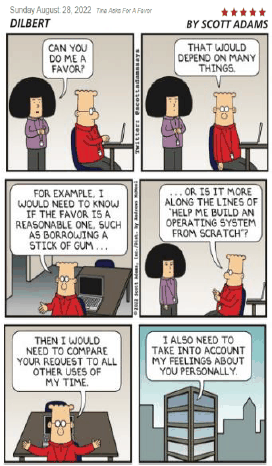
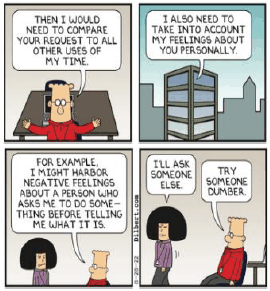
https://dilbert.com/strip/2022-08-28Lawyer Burnout Is Still An Issue in 2021
The main verb in “I might harbor negative feelings” is similar in meaning to
Provas
Read Text II and answer the following question.
Text II
https://dilbert.com/strip/2022-08-28Lawyer Burnout Is Still An Issue in 2021
The gist of this comic strip is the fact that
Provas
Read Text I and answer the question that follows.
Text I
Empowering the workforce of tomorrow: The role of business in tackling the skills mismatch among youth
The future of work is changing fast. Technology, socio-economic trends, and developments and crises like COVID-19 are changing the world of work and the demand for skills at a pace and depth that poses serious challenges to people, business, and society. Young people and future generations, especially when they are from disadvantaged groups, are disproportionately affected by these disruptions.
A key challenge to shaping a sustainable future of work is addressing the skills mismatch among youth. Despite young people around the world being more educated than ever before, hundreds of millions of individuals are coming of age and finding themselves unemployed and unemployable, lacking the right skills to take up the jobs available today and, even more, the skills that will be needed in the future. Neglecting the skills mismatch among youth can result in young people feeling disenfranchised and disillusioned about their prospects in the labor market, fueling social unrest, stunting economic growth and ultimately creating a more volatile operating environment for business.
In contrast, by equipping youth with relevant skills, businesses can empower young people, support their access to employment opportunities and enable them to thrive personally, professionally and as active members of society. Investing in the skills of young people has an essential role to play in helping to realize the ambitions of the Sustainable Development Goals (SDGs) and the World Business Council for Sustainable Development’s (WBCSD) Vision2050, which aims to create a world where over 9 billion people live well and within planetary boundaries by mid-century.
From: https://www.unicef.org/media/103176/file/ Empowering%20the%20workforce%20of%20tomorrow.pdf
“Despite” in “Despite young people around the world being more educated” can be replaced without change in meaning by
Provas
Read Text I and answer the question that follows.
Text I
Empowering the workforce of tomorrow: The role of business in tackling the skills mismatch among youth
The future of work is changing fast. Technology, socio-economic trends, and developments and crises like COVID-19 are changing the world of work and the demand for skills at a pace and depth that poses serious challenges to people, business, and society. Young people and future generations, especially when they are from disadvantaged groups, are disproportionately affected by these disruptions.
A key challenge to shaping a sustainable future of work is addressing the skills mismatch among youth. Despite young people around the world being more educated than ever before, hundreds of millions of individuals are coming of age and finding themselves unemployed and unemployable, lacking the right skills to take up the jobs available today and, even more, the skills that will be needed in the future. Neglecting the skills mismatch among youth can result in young people feeling disenfranchised and disillusioned about their prospects in the labor market, fueling social unrest, stunting economic growth and ultimately creating a more volatile operating environment for business.
In contrast, by equipping youth with relevant skills, businesses can empower young people, support their access to employment opportunities and enable them to thrive personally, professionally and as active members of society. Investing in the skills of young people has an essential role to play in helping to realize the ambitions of the Sustainable Development Goals (SDGs) and the World Business Council for Sustainable Development’s (WBCSD) Vision2050, which aims to create a world where over 9 billion people live well and within planetary boundaries by mid-century.
From: https://www.unicef.org/media/103176/file/ Empowering%20the%20workforce%20of%20tomorrow.pdf
The extract “stunting economic growth” (2nd paragraph) implies
Provas
Read Text I and answer the question that follows.
Text I
Empowering the workforce of tomorrow: The role of business in tackling the skills mismatch among youth
The future of work is changing fast. Technology, socio-economic trends, and developments and crises like COVID-19 are changing the world of work and the demand for skills at a pace and depth that poses serious challenges to people, business, and society. Young people and future generations, especially when they are from disadvantaged groups, are disproportionately affected by these disruptions.
A key challenge to shaping a sustainable future of work is addressing the skills mismatch among youth. Despite young people around the world being more educated than ever before, hundreds of millions of individuals are coming of age and finding themselves unemployed and unemployable, lacking the right skills to take up the jobs available today and, even more, the skills that will be needed in the future. Neglecting the skills mismatch among youth can result in young people feeling disenfranchised and disillusioned about their prospects in the labor market, fueling social unrest, stunting economic growth and ultimately creating a more volatile operating environment for business.
In contrast, by equipping youth with relevant skills, businesses can empower young people, support their access to employment opportunities and enable them to thrive personally, professionally and as active members of society. Investing in the skills of young people has an essential role to play in helping to realize the ambitions of the Sustainable Development Goals (SDGs) and the World Business Council for Sustainable Development’s (WBCSD) Vision2050, which aims to create a world where over 9 billion people live well and within planetary boundaries by mid-century.
From: https://www.unicef.org/media/103176/file/ Empowering%20the%20workforce%20of%20tomorrow.pdf
The phrase “skills mismatch” indicates that there is a(n)
Provas
Read Text I and answer the question that follows.
Text I
Empowering the workforce of tomorrow: The role of business in tackling the skills mismatch among youth
The future of work is changing fast. Technology, socio-economic trends, and developments and crises like COVID-19 are changing the world of work and the demand for skills at a pace and depth that poses serious challenges to people, business, and society. Young people and future generations, especially when they are from disadvantaged groups, are disproportionately affected by these disruptions.
A key challenge to shaping a sustainable future of work is addressing the skills mismatch among youth. Despite young people around the world being more educated than ever before, hundreds of millions of individuals are coming of age and finding themselves unemployed and unemployable, lacking the right skills to take up the jobs available today and, even more, the skills that will be needed in the future. Neglecting the skills mismatch among youth can result in young people feeling disenfranchised and disillusioned about their prospects in the labor market, fueling social unrest, stunting economic growth and ultimately creating a more volatile operating environment for business.
In contrast, by equipping youth with relevant skills, businesses can empower young people, support their access to employment opportunities and enable them to thrive personally, professionally and as active members of society. Investing in the skills of young people has an essential role to play in helping to realize the ambitions of the Sustainable Development Goals (SDGs) and the World Business Council for Sustainable Development’s (WBCSD) Vision2050, which aims to create a world where over 9 billion people live well and within planetary boundaries by mid-century.
From: https://www.unicef.org/media/103176/file/ Empowering%20the%20workforce%20of%20tomorrow.pdf
In the title, “tackling” implies that this is an issue businesses should be
Provas
Caderno Container