Foram encontradas 120 questões.
In Brazil, federal and state court systems have used
technology in the last years, but the experience and coverage is
mixed. In the early 1990s, one of the major initiatives of the federal
judiciary has been the computerization of electoral courts. This
experience and other reforms have motivated some states judiciaries
to advance court automation in different jurisdictions, in aspects
such as public information, case management, and document
archiving. Studies indicate that the needs for information technology
and communications use are rising as many state court systems lag1
behind in investments.
The modernization of the documentary archives of the
federal judiciary is a fairly recent initiative that has been motivated
by a growing concern for the preservation of the country's historical
archive, and by the need to manage the exponential growth of current
archives. Paper archives constitute an enormous investment in terms
of time and space, documents deteriorate or are lost, and information
retrieval can be laborious. The modernization of archives involves
not only the rationalization of existing resources and collections, but
also the introduction of new technologies for the electronic storage
and retrieval of current documents.
In May 1998, the Supreme Federal Tribunal initiated a
project of reform, and in early 2000 carried out a survey to identify
the problem areas relating to infrastructure, access, archiving policy,
training and management strategies. The survey results constitute an
important first step in the development of a long-term technical and
administrative policy for the management of judicial archives.
Follow on work has so far collected information from all the archiveholding
judicial institutions in the area of the capital, Brasília.
There are on average 4 archivists per institution, which
means one archivist for every 751 meters of documents. The
technical equipment is for the most part antiquated, with only 37%
of archives equipped with computer terminals. Most of the judicial
archives do not, therefore, have either the technical or personnel
resources necessary for the efficient management, storage and
retrieval of documents.
 - a delay between two things happening.

Based on the passage above, it is correct to say that
in the late 1990s, the Supreme Federal Tribunal began a survey to pinpoint problems concerning several areas that include archiving policy.technology in the last years, but the experience and coverage is
mixed. In the early 1990s, one of the major initiatives of the federal
judiciary has been the computerization of electoral courts. This
experience and other reforms have motivated some states judiciaries
to advance court automation in different jurisdictions, in aspects
such as public information, case management, and document
archiving. Studies indicate that the needs for information technology
and communications use are rising as many state court systems lag1
behind in investments.
The modernization of the documentary archives of the
federal judiciary is a fairly recent initiative that has been motivated
by a growing concern for the preservation of the country's historical
archive, and by the need to manage the exponential growth of current
archives. Paper archives constitute an enormous investment in terms
of time and space, documents deteriorate or are lost, and information
retrieval can be laborious. The modernization of archives involves
not only the rationalization of existing resources and collections, but
also the introduction of new technologies for the electronic storage
and retrieval of current documents.
In May 1998, the Supreme Federal Tribunal initiated a
project of reform, and in early 2000 carried out a survey to identify
the problem areas relating to infrastructure, access, archiving policy,
training and management strategies. The survey results constitute an
important first step in the development of a long-term technical and
administrative policy for the management of judicial archives.
Follow on work has so far collected information from all the archiveholding
judicial institutions in the area of the capital, Brasília.
There are on average 4 archivists per institution, which
means one archivist for every 751 meters of documents. The
technical equipment is for the most part antiquated, with only 37%
of archives equipped with computer terminals. Most of the judicial
archives do not, therefore, have either the technical or personnel
resources necessary for the efficient management, storage and
retrieval of documents.
- a delay between two things happening.Based on the passage above, it is correct to say that
Provas
Questão presente nas seguintes provas

In Brazil, federal and state court systems have used
technology in the last years, but the experience and coverage is
mixed. In the early 1990s, one of the major initiatives of the federal
judiciary has been the computerization of electoral courts. This
experience and other reforms have motivated some states judiciaries
to advance court automation in different jurisdictions, in aspects
such as public information, case management, and document
archiving. Studies indicate that the needs for information technology
and communications use are rising as many state court systems lag1
behind in investments.
The modernization of the documentary archives of the
federal judiciary is a fairly recent initiative that has been motivated
by a growing concern for the preservation of the country's historical
archive, and by the need to manage the exponential growth of current
archives. Paper archives constitute an enormous investment in terms
of time and space, documents deteriorate or are lost, and information
retrieval can be laborious. The modernization of archives involves
not only the rationalization of existing resources and collections, but
also the introduction of new technologies for the electronic storage
and retrieval of current documents.
In May 1998, the Supreme Federal Tribunal initiated a
project of reform, and in early 2000 carried out a survey to identify
the problem areas relating to infrastructure, access, archiving policy,
training and management strategies. The survey results constitute an
important first step in the development of a long-term technical and
administrative policy for the management of judicial archives.
Follow on work has so far collected information from all the archiveholding
judicial institutions in the area of the capital, Brasília.
There are on average 4 archivists per institution, which
means one archivist for every 751 meters of documents. The
technical equipment is for the most part antiquated, with only 37%
of archives equipped with computer terminals. Most of the judicial
archives do not, therefore, have either the technical or personnel
resources necessary for the efficient management, storage and
retrieval of documents.
- a delay between two things happening.
Based on the passage above, it is correct to say that
to prevent paper archives from deteriorating, all that is required is to go through a process of storing information in a huge computer.technology in the last years, but the experience and coverage is
mixed. In the early 1990s, one of the major initiatives of the federal
judiciary has been the computerization of electoral courts. This
experience and other reforms have motivated some states judiciaries
to advance court automation in different jurisdictions, in aspects
such as public information, case management, and document
archiving. Studies indicate that the needs for information technology
and communications use are rising as many state court systems lag1
behind in investments.
The modernization of the documentary archives of the
federal judiciary is a fairly recent initiative that has been motivated
by a growing concern for the preservation of the country's historical
archive, and by the need to manage the exponential growth of current
archives. Paper archives constitute an enormous investment in terms
of time and space, documents deteriorate or are lost, and information
retrieval can be laborious. The modernization of archives involves
not only the rationalization of existing resources and collections, but
also the introduction of new technologies for the electronic storage
and retrieval of current documents.
In May 1998, the Supreme Federal Tribunal initiated a
project of reform, and in early 2000 carried out a survey to identify
the problem areas relating to infrastructure, access, archiving policy,
training and management strategies. The survey results constitute an
important first step in the development of a long-term technical and
administrative policy for the management of judicial archives.
Follow on work has so far collected information from all the archiveholding
judicial institutions in the area of the capital, Brasília.
There are on average 4 archivists per institution, which
means one archivist for every 751 meters of documents. The
technical equipment is for the most part antiquated, with only 37%
of archives equipped with computer terminals. Most of the judicial
archives do not, therefore, have either the technical or personnel
resources necessary for the efficient management, storage and
retrieval of documents.
- a delay between two things happening.Based on the passage above, it is correct to say that
Provas
Questão presente nas seguintes provas
In Brazil, federal and state court systems have used
technology in the last years, but the experience and coverage is
mixed. In the early 1990s, one of the major initiatives of the federal
judiciary has been the computerization of electoral courts. This
experience and other reforms have motivated some states judiciaries
to advance court automation in different jurisdictions, in aspects
such as public information, case management, and document
archiving. Studies indicate that the needs for information technology
and communications use are rising as many state court systems lag1
behind in investments.
The modernization of the documentary archives of the
federal judiciary is a fairly recent initiative that has been motivated
by a growing concern for the preservation of the country's historical
archive, and by the need to manage the exponential growth of current
archives. Paper archives constitute an enormous investment in terms
of time and space, documents deteriorate or are lost, and information
retrieval can be laborious. The modernization of archives involves
not only the rationalization of existing resources and collections, but
also the introduction of new technologies for the electronic storage
and retrieval of current documents.
In May 1998, the Supreme Federal Tribunal initiated a
project of reform, and in early 2000 carried out a survey to identify
the problem areas relating to infrastructure, access, archiving policy,
training and management strategies. The survey results constitute an
important first step in the development of a long-term technical and
administrative policy for the management of judicial archives.
Follow on work has so far collected information from all the archiveholding
judicial institutions in the area of the capital, Brasília.
There are on average 4 archivists per institution, which
means one archivist for every 751 meters of documents. The
technical equipment is for the most part antiquated, with only 37%
of archives equipped with computer terminals. Most of the judicial
archives do not, therefore, have either the technical or personnel
resources necessary for the efficient management, storage and
retrieval of documents.
- a delay between two things happening.
Based on the passage above, it is correct to say that
the fast increase of present archives has brought about the necessity to embark upon a modernization program of the documentary archives.technology in the last years, but the experience and coverage is
mixed. In the early 1990s, one of the major initiatives of the federal
judiciary has been the computerization of electoral courts. This
experience and other reforms have motivated some states judiciaries
to advance court automation in different jurisdictions, in aspects
such as public information, case management, and document
archiving. Studies indicate that the needs for information technology
and communications use are rising as many state court systems lag1
behind in investments.
The modernization of the documentary archives of the
federal judiciary is a fairly recent initiative that has been motivated
by a growing concern for the preservation of the country's historical
archive, and by the need to manage the exponential growth of current
archives. Paper archives constitute an enormous investment in terms
of time and space, documents deteriorate or are lost, and information
retrieval can be laborious. The modernization of archives involves
not only the rationalization of existing resources and collections, but
also the introduction of new technologies for the electronic storage
and retrieval of current documents.
In May 1998, the Supreme Federal Tribunal initiated a
project of reform, and in early 2000 carried out a survey to identify
the problem areas relating to infrastructure, access, archiving policy,
training and management strategies. The survey results constitute an
important first step in the development of a long-term technical and
administrative policy for the management of judicial archives.
Follow on work has so far collected information from all the archiveholding
judicial institutions in the area of the capital, Brasília.
There are on average 4 archivists per institution, which
means one archivist for every 751 meters of documents. The
technical equipment is for the most part antiquated, with only 37%
of archives equipped with computer terminals. Most of the judicial
archives do not, therefore, have either the technical or personnel
resources necessary for the efficient management, storage and
retrieval of documents.
- a delay between two things happening.Based on the passage above, it is correct to say that
Provas
Questão presente nas seguintes provas
In Brazil, federal and state court systems have used
technology in the last years, but the experience and coverage is
mixed. In the early 1990s, one of the major initiatives of the federal
judiciary has been the computerization of electoral courts. This
experience and other reforms have motivated some states judiciaries
to advance court automation in different jurisdictions, in aspects
such as public information, case management, and document
archiving. Studies indicate that the needs for information technology
and communications use are rising as many state court systems lag1
behind in investments.
The modernization of the documentary archives of the
federal judiciary is a fairly recent initiative that has been motivated
by a growing concern for the preservation of the country's historical
archive, and by the need to manage the exponential growth of current
archives. Paper archives constitute an enormous investment in terms
of time and space, documents deteriorate or are lost, and information
retrieval can be laborious. The modernization of archives involves
not only the rationalization of existing resources and collections, but
also the introduction of new technologies for the electronic storage
and retrieval of current documents.
In May 1998, the Supreme Federal Tribunal initiated a
project of reform, and in early 2000 carried out a survey to identify
the problem areas relating to infrastructure, access, archiving policy,
training and management strategies. The survey results constitute an
important first step in the development of a long-term technical and
administrative policy for the management of judicial archives.
Follow on work has so far collected information from all the archiveholding
judicial institutions in the area of the capital, Brasília.
There are on average 4 archivists per institution, which
means one archivist for every 751 meters of documents. The
technical equipment is for the most part antiquated, with only 37%
of archives equipped with computer terminals. Most of the judicial
archives do not, therefore, have either the technical or personnel
resources necessary for the efficient management, storage and
retrieval of documents.
- a delay between two things happening.
Based on the passage above, it is correct to say that
the computerization of electoral courts favored the introduction of court automation solely in three different areas.technology in the last years, but the experience and coverage is
mixed. In the early 1990s, one of the major initiatives of the federal
judiciary has been the computerization of electoral courts. This
experience and other reforms have motivated some states judiciaries
to advance court automation in different jurisdictions, in aspects
such as public information, case management, and document
archiving. Studies indicate that the needs for information technology
and communications use are rising as many state court systems lag1
behind in investments.
The modernization of the documentary archives of the
federal judiciary is a fairly recent initiative that has been motivated
by a growing concern for the preservation of the country's historical
archive, and by the need to manage the exponential growth of current
archives. Paper archives constitute an enormous investment in terms
of time and space, documents deteriorate or are lost, and information
retrieval can be laborious. The modernization of archives involves
not only the rationalization of existing resources and collections, but
also the introduction of new technologies for the electronic storage
and retrieval of current documents.
In May 1998, the Supreme Federal Tribunal initiated a
project of reform, and in early 2000 carried out a survey to identify
the problem areas relating to infrastructure, access, archiving policy,
training and management strategies. The survey results constitute an
important first step in the development of a long-term technical and
administrative policy for the management of judicial archives.
Follow on work has so far collected information from all the archiveholding
judicial institutions in the area of the capital, Brasília.
There are on average 4 archivists per institution, which
means one archivist for every 751 meters of documents. The
technical equipment is for the most part antiquated, with only 37%
of archives equipped with computer terminals. Most of the judicial
archives do not, therefore, have either the technical or personnel
resources necessary for the efficient management, storage and
retrieval of documents.
- a delay between two things happening.Based on the passage above, it is correct to say that
Provas
Questão presente nas seguintes provas
In Brazil, federal and state court systems have used
technology in the last years, but the experience and coverage is
mixed. In the early 1990s, one of the major initiatives of the federal
judiciary has been the computerization of electoral courts. This
experience and other reforms have motivated some states judiciaries
to advance court automation in different jurisdictions, in aspects
such as public information, case management, and document
archiving. Studies indicate that the needs for information technology
and communications use are rising as many state court systems lag1
behind in investments.
The modernization of the documentary archives of the
federal judiciary is a fairly recent initiative that has been motivated
by a growing concern for the preservation of the country's historical
archive, and by the need to manage the exponential growth of current
archives. Paper archives constitute an enormous investment in terms
of time and space, documents deteriorate or are lost, and information
retrieval can be laborious. The modernization of archives involves
not only the rationalization of existing resources and collections, but
also the introduction of new technologies for the electronic storage
and retrieval of current documents.
In May 1998, the Supreme Federal Tribunal initiated a
project of reform, and in early 2000 carried out a survey to identify
the problem areas relating to infrastructure, access, archiving policy,
training and management strategies. The survey results constitute an
important first step in the development of a long-term technical and
administrative policy for the management of judicial archives.
Follow on work has so far collected information from all the archiveholding
judicial institutions in the area of the capital, Brasília.
There are on average 4 archivists per institution, which
means one archivist for every 751 meters of documents. The
technical equipment is for the most part antiquated, with only 37%
of archives equipped with computer terminals. Most of the judicial
archives do not, therefore, have either the technical or personnel
resources necessary for the efficient management, storage and
retrieval of documents.
- a delay between two things happening.
Based on the passage above, it is correct to say that
the computerization of electoral courts dates back to the last century.technology in the last years, but the experience and coverage is
mixed. In the early 1990s, one of the major initiatives of the federal
judiciary has been the computerization of electoral courts. This
experience and other reforms have motivated some states judiciaries
to advance court automation in different jurisdictions, in aspects
such as public information, case management, and document
archiving. Studies indicate that the needs for information technology
and communications use are rising as many state court systems lag1
behind in investments.
The modernization of the documentary archives of the
federal judiciary is a fairly recent initiative that has been motivated
by a growing concern for the preservation of the country's historical
archive, and by the need to manage the exponential growth of current
archives. Paper archives constitute an enormous investment in terms
of time and space, documents deteriorate or are lost, and information
retrieval can be laborious. The modernization of archives involves
not only the rationalization of existing resources and collections, but
also the introduction of new technologies for the electronic storage
and retrieval of current documents.
In May 1998, the Supreme Federal Tribunal initiated a
project of reform, and in early 2000 carried out a survey to identify
the problem areas relating to infrastructure, access, archiving policy,
training and management strategies. The survey results constitute an
important first step in the development of a long-term technical and
administrative policy for the management of judicial archives.
Follow on work has so far collected information from all the archiveholding
judicial institutions in the area of the capital, Brasília.
There are on average 4 archivists per institution, which
means one archivist for every 751 meters of documents. The
technical equipment is for the most part antiquated, with only 37%
of archives equipped with computer terminals. Most of the judicial
archives do not, therefore, have either the technical or personnel
resources necessary for the efficient management, storage and
retrieval of documents.
- a delay between two things happening.Based on the passage above, it is correct to say that
Provas
Questão presente nas seguintes provas
In Brazil, federal and state court systems have used
technology in the last years, but the experience and coverage is
mixed. In the early 1990s, one of the major initiatives of the federal
judiciary has been the computerization of electoral courts. This
experience and other reforms have motivated some states judiciaries
to advance court automation in different jurisdictions, in aspects
such as public information, case management, and document
archiving. Studies indicate that the needs for information technology
and communications use are rising as many state court systems lag1
behind in investments.
The modernization of the documentary archives of the
federal judiciary is a fairly recent initiative that has been motivated
by a growing concern for the preservation of the country's historical
archive, and by the need to manage the exponential growth of current
archives. Paper archives constitute an enormous investment in terms
of time and space, documents deteriorate or are lost, and information
retrieval can be laborious. The modernization of archives involves
not only the rationalization of existing resources and collections, but
also the introduction of new technologies for the electronic storage
and retrieval of current documents.
In May 1998, the Supreme Federal Tribunal initiated a
project of reform, and in early 2000 carried out a survey to identify
the problem areas relating to infrastructure, access, archiving policy,
training and management strategies. The survey results constitute an
important first step in the development of a long-term technical and
administrative policy for the management of judicial archives.
Follow on work has so far collected information from all the archiveholding
judicial institutions in the area of the capital, Brasília.
There are on average 4 archivists per institution, which
means one archivist for every 751 meters of documents. The
technical equipment is for the most part antiquated, with only 37%
of archives equipped with computer terminals. Most of the judicial
archives do not, therefore, have either the technical or personnel
resources necessary for the efficient management, storage and
retrieval of documents.
- a delay between two things happening.
Based on the passage above, it is correct to say that
only most recently has the use of technology by both federal and state court systems been used.technology in the last years, but the experience and coverage is
mixed. In the early 1990s, one of the major initiatives of the federal
judiciary has been the computerization of electoral courts. This
experience and other reforms have motivated some states judiciaries
to advance court automation in different jurisdictions, in aspects
such as public information, case management, and document
archiving. Studies indicate that the needs for information technology
and communications use are rising as many state court systems lag1
behind in investments.
The modernization of the documentary archives of the
federal judiciary is a fairly recent initiative that has been motivated
by a growing concern for the preservation of the country's historical
archive, and by the need to manage the exponential growth of current
archives. Paper archives constitute an enormous investment in terms
of time and space, documents deteriorate or are lost, and information
retrieval can be laborious. The modernization of archives involves
not only the rationalization of existing resources and collections, but
also the introduction of new technologies for the electronic storage
and retrieval of current documents.
In May 1998, the Supreme Federal Tribunal initiated a
project of reform, and in early 2000 carried out a survey to identify
the problem areas relating to infrastructure, access, archiving policy,
training and management strategies. The survey results constitute an
important first step in the development of a long-term technical and
administrative policy for the management of judicial archives.
Follow on work has so far collected information from all the archiveholding
judicial institutions in the area of the capital, Brasília.
There are on average 4 archivists per institution, which
means one archivist for every 751 meters of documents. The
technical equipment is for the most part antiquated, with only 37%
of archives equipped with computer terminals. Most of the judicial
archives do not, therefore, have either the technical or personnel
resources necessary for the efficient management, storage and
retrieval of documents.
- a delay between two things happening.Based on the passage above, it is correct to say that
Provas
Questão presente nas seguintes provas
Estaríamos entrando na era dos autocratas? É certamente
tentador pensar assim depois de ver a recente surra dada pela
Rússia na Geórgia. Essa invasão marca com clareza uma nova
fase na política mundial, mas seria um erro pensar que o futuro
pertence à mão pesada do russo Vladimir Putin e aos seus colegas
déspotas.
Estou pessoalmente interessado em discernir o formato
do novo momento internacional, porque em 1989 escrevi um
ensaio intitulado O Fim da História? Nele, eu argumentava que
as idéias liberais haviam triunfado de maneira conclusiva com o
fim da Guerra Fria. Mas, hoje, o predomínio dos Estados Unidos
da América sobre o sistema mundial está fraquejando; Rússia
e China se oferecem como modelos, exibindo uma combinação
de autoritarismo e modernização que claramente desafia a
democracia liberal. Eles parecem ter grande número de
imitadores.
Francis Fukuyama. Democracia resiste a novo autoritarismo.
In: O Estado de S.Paulo, 31/8/2008, p. A24 (com adaptações).
Tendo o texto acima como referência inicial e considerando
aspectos marcantes da realidade mundial contemporânea, julgue
os itens que se seguem.
Infere-se do texto que o episódio militar citado no primeiro parágrafo circunscreve-se à região em que se situou, o Cáucaso, sendo irrelevante para a compreensão do atual cenário internacionaltentador pensar assim depois de ver a recente surra dada pela
Rússia na Geórgia. Essa invasão marca com clareza uma nova
fase na política mundial, mas seria um erro pensar que o futuro
pertence à mão pesada do russo Vladimir Putin e aos seus colegas
déspotas.
Estou pessoalmente interessado em discernir o formato
do novo momento internacional, porque em 1989 escrevi um
ensaio intitulado O Fim da História? Nele, eu argumentava que
as idéias liberais haviam triunfado de maneira conclusiva com o
fim da Guerra Fria. Mas, hoje, o predomínio dos Estados Unidos
da América sobre o sistema mundial está fraquejando; Rússia
e China se oferecem como modelos, exibindo uma combinação
de autoritarismo e modernização que claramente desafia a
democracia liberal. Eles parecem ter grande número de
imitadores.
Francis Fukuyama. Democracia resiste a novo autoritarismo.
In: O Estado de S.Paulo, 31/8/2008, p. A24 (com adaptações).
Tendo o texto acima como referência inicial e considerando
aspectos marcantes da realidade mundial contemporânea, julgue
os itens que se seguem.
Provas
Questão presente nas seguintes provas
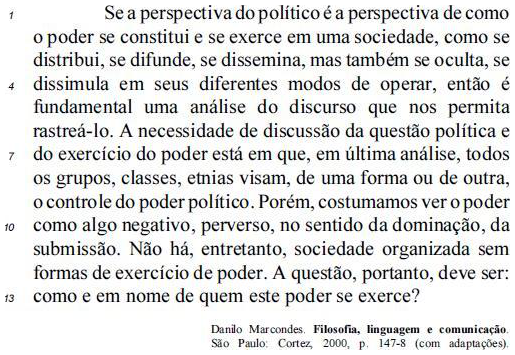
Em relação às idéias e às estruturas lingüísticas do texto acima,
julgue os itens a seguir.
Provas
Questão presente nas seguintes provas
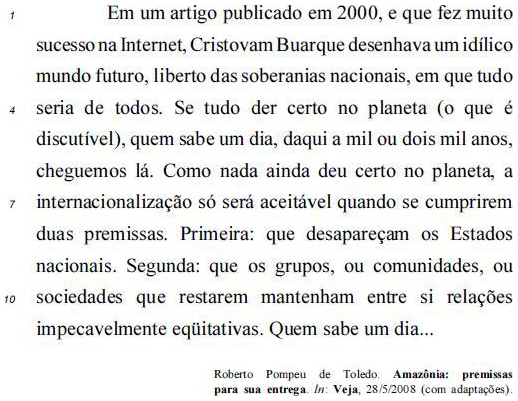
Julgue os seguintes itens, a respeito da organização das idéias do
texto acima.
 .7) por forem cumpridas.
Provas
Questão presente nas seguintes provas
Estaríamos entrando na era dos autocratas? É certamente
tentador pensar assim depois de ver a recente surra dada pela
Rússia na Geórgia. Essa invasão marca com clareza uma nova
fase na política mundial, mas seria um erro pensar que o futuro
pertence à mão pesada do russo Vladimir Putin e aos seus colegas
déspotas.
Estou pessoalmente interessado em discernir o formato
do novo momento internacional, porque em 1989 escrevi um
ensaio intitulado O Fim da História? Nele, eu argumentava que
as idéias liberais haviam triunfado de maneira conclusiva com o
fim da Guerra Fria. Mas, hoje, o predomínio dos Estados Unidos
da América sobre o sistema mundial está fraquejando; Rússia
e China se oferecem como modelos, exibindo uma combinação
de autoritarismo e modernização que claramente desafia a
democracia liberal. Eles parecem ter grande número de
imitadores.
Francis Fukuyama. Democracia resiste a novo autoritarismo.
In: O Estado de S.Paulo, 31/8/2008, p. A24 (com adaptações).
Tendo o texto acima como referência inicial e considerando
aspectos marcantes da realidade mundial contemporânea, julgue
os itens que se seguem.
O autor reconhece que, na atualidade, o poder mundial norte-americano não se manifesta de maneira inequívoca e emite sinais de algum tipo de fragilidade.tentador pensar assim depois de ver a recente surra dada pela
Rússia na Geórgia. Essa invasão marca com clareza uma nova
fase na política mundial, mas seria um erro pensar que o futuro
pertence à mão pesada do russo Vladimir Putin e aos seus colegas
déspotas.
Estou pessoalmente interessado em discernir o formato
do novo momento internacional, porque em 1989 escrevi um
ensaio intitulado O Fim da História? Nele, eu argumentava que
as idéias liberais haviam triunfado de maneira conclusiva com o
fim da Guerra Fria. Mas, hoje, o predomínio dos Estados Unidos
da América sobre o sistema mundial está fraquejando; Rússia
e China se oferecem como modelos, exibindo uma combinação
de autoritarismo e modernização que claramente desafia a
democracia liberal. Eles parecem ter grande número de
imitadores.
Francis Fukuyama. Democracia resiste a novo autoritarismo.
In: O Estado de S.Paulo, 31/8/2008, p. A24 (com adaptações).
Tendo o texto acima como referência inicial e considerando
aspectos marcantes da realidade mundial contemporânea, julgue
os itens que se seguem.
Provas
Questão presente nas seguintes provas
Cadernos
Caderno Container