Foram encontradas 40 questões.
O levantamento das dependências funcionais existentes entre os atributos de um banco de dados relacional é importante na fase de normalização do esquema. Entretanto, a forma normal que independe desse levantamento é a:
Provas

Índices são largamente utilizados em bancos de dados como estruturas de dados auxiliares cujo objetivo é, em geral, acelerar o acesso a determinados registros. Das técnicas mostradas, a que apresenta melhores tempos de acesso na busca individual de registros a partir de chaves numéricas é:
Provas
- Conceitos e FundamentosConceitos Fundamentais de Banco de Dados
- Arquitetura de de Banco de DadosArquitetura ANSI/SPARCIndependência de Dados (Lógica e Física)
A expressão independência de dados no âmbito de sistemas gerenciadores de bancos de dados é melhor caracterizada como a possibilidade de:
Provas
Considere um banco de dados simplificado formado por duas tabelas que armazenam dados sobre provas e suas questões como ilustrado abaixo.
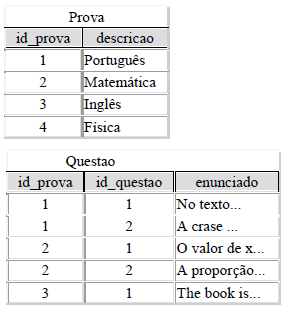
Cada prova tem um conjunto de zero ou mais questões, numeradas seqüencialmente a partir de 1. O número de questões de cada prova é variável. A provas também são numeradas seqüencialmente a partir de 1. Não há duas provas com a mesma descrição.
A questão baseia-se neste exemplo.
Supondo-se que as instâncias das tabelas relacionais sejam as que foram mostradas, o comando SQL
select descricao
from prova p left join questao q
on p.id_prova = q.id_prova
where q.id_questao is null
produz um resultado que, além do título, possui:
Provas
Considere um banco de dados simplificado formado por duas tabelas que armazenam dados sobre provas e suas questões como ilustrado abaixo.
Cada prova tem um conjunto de zero ou mais questões, numeradas seqüencialmente a partir de 1. O número de questões de cada prova é variável. A provas também são numeradas seqüencialmente a partir de 1. Não há duas provas com a mesma descrição.
A questão baseia-se neste exemplo.
Os comandos SQL mais adequados para a criação das referidas tabelas é:
Provas
Doubts About Nuclear Energy
Your article “Re-energized”, about the French nuclear-energy company Areva [Nov. 14], noted that there may be a comeback for nuclear power. Even if there is evidence of a “nuclear renaissance”, as Areva's head, Anne Lauvergeon, put it, I can't see nuclear power plants becoming popular in most of Europe. There are still serious problems with handling the drainage of reactor coolant into rivers, and there is the major concern of how to dispose of nuclear waste. Long-distance transport of such material is highly dangerous, especially with the threat of terrorist attacks. And can we place on future generations the burden of coping with tons of hazardous radioactive substances? The reasons for the sudden return of nuclear energy – spiking oil prices and the effect of greenhouse gases – also call for investment in alternative-energy technologies. Wind, solar or water energy could help stop the progress of global warming and make us independent of fossil fuels. Alternative energies would save us money in the long run without the immense drawbacks of nuclear energy.
LISA JANK Augsburg, Germany
(Time, December 19, 2005, p. 10)
The word spiking in “spiking oil prices” suggests a movement that:
Provas
Doubts About Nuclear Energy
Your article “Re-energized”, about the French nuclear-energy company Areva [Nov. 14], noted that there may be a comeback for nuclear power. Even if there is evidence of a “nuclear renaissance”, as Areva's head, Anne Lauvergeon, put it, I can't see nuclear power plants becoming popular in most of Europe. There are still serious problems with handling the drainage of reactor coolant into rivers, and there is the major concern of how to dispose of nuclear waste. Long-distance transport of such material is highly dangerous, especially with the threat of terrorist attacks. And can we place on future generations the burden of coping with tons of hazardous radioactive substances? The reasons for the sudden return of nuclear energy – spiking oil prices and the effect of greenhouse gases – also call for investment in alternative-energy technologies. Wind, solar or water energy could help stop the progress of global warming and make us independent of fossil fuels. Alternative energies would save us money in the long run without the immense drawbacks of nuclear energy.
LISA JANK Augsburg, Germany
(Time, December 19, 2005, p. 10)
The underlined expression in “Alternative energies would save us money in the long run “ means:
Provas
Doubts About Nuclear Energy
Your article “Re-energized”, about the French nuclear-energy company Areva [Nov. 14], noted that there may be a comeback for nuclear power. Even if there is evidence of a “nuclear renaissance”, as Areva's head, Anne Lauvergeon, put it, I can't see nuclear power plants becoming popular in most of Europe. There are still serious problems with handling the drainage of reactor coolant into rivers, and there is the major concern of how to dispose of nuclear waste. Long-distance transport of such material is highly dangerous, especially with the threat of terrorist attacks. And can we place on future generations the burden of coping with tons of hazardous radioactive substances? The reasons for the sudden return of nuclear energy – spiking oil prices and the effect of greenhouse gases – also call for investment in alternative-energy technologies. Wind, solar or water energy could help stop the progress of global warming and make us independent of fossil fuels. Alternative energies would save us money in the long run without the immense drawbacks of nuclear energy.
LISA JANK Augsburg, Germany
(Time, December 19, 2005, p. 10)
When the writer refers to “the burden of coping”, she implies, among other issues, that future generations will have to:
Provas
Doubts About Nuclear Energy
Your article “Re-energized”, about the French nuclear-energy company Areva [Nov. 14], noted that there may be a comeback for nuclear power. Even if there is evidence of a “nuclear renaissance”, as Areva's head, Anne Lauvergeon, put it, I can't see nuclear power plants becoming popular in most of Europe. There are still serious problems with handling the drainage of reactor coolant into rivers, and there is the major concern of how to dispose of nuclear waste. Long-distance transport of such material is highly dangerous, especially with the threat of terrorist attacks. And can we place on future generations the burden of coping with tons of hazardous radioactive substances? The reasons for the sudden return of nuclear energy – spiking oil prices and the effect of greenhouse gases – also call for investment in alternative-energy technologies. Wind, solar or water energy could help stop the progress of global warming and make us independent of fossil fuels. Alternative energies would save us money in the long run without the immense drawbacks of nuclear energy.
LISA JANK
Augsburg, Germany
(Time, December 19, 2005, p. 10)
The author of this letter considers the revival of nuclear energy:
Provas
Here is the beginning of a piece of news:
A group of U.S. Senators visited Brazil in August
to take a look at the country’s ethanol industry.
“It was a real eye-opener. I was just amazed what
we learned,” said Sen. Mel Martinez ( R-Fla).
What most impressed the delegation was the
choice Brazilians have at the pump. Since the
1973 oil embargo, Brazil has battled to achieve
energy independence, replacing gasoline with
ethanol, an alcohol distilled from sugarcane…
In Brazil ethanol, or ‘alcool” as it is called, costs
only $2 at the pump, compared to $4 for a gasoline-
ethanol blend ( Brazil no longer sells regular
unblended gasoline). And while ethanol-powered
cars consume 25% to 30% more fuel per mile than
gasoline cars, the average motorist can save about
$820 a year by switching to ethanol.
(from www.forbes.com/2005/11/15/energy-ethanol-
brazil_ cx_1116energy_adams)
while in “while ethanol-powered cars consume 25% to 30% more fuel per mile than gasoline cars, “ is used in the same way as in:
Provas
Caderno Container