Foram encontradas 46.760 questões.
A new scholarship aimed at developing the next generation of artificial intelligence “pioneers” will open to applicants in spring 2026, with the first cohort beginning studies the following autumn.
The Sparck AI scholarships, named after pioneering British computer scientist Karen Sparck Jones, will give master’s degree university students access to industry-leading firms as the Government looks to boost the UK’s AI credentials.
The University of Bristol will be one of nine universities to offer the fully-funded Government scholarship, alongside faculties in Newcastle, Manchester and Edinburgh.
The scheme has been developed in line with the Government’s “AI Opportunities Action Plan”, receiving more than £17 million of funding from Westminster, with the grant covering both students’ tuition and living costs.
Alongside master’s places, 100 scholars will receive placements in leading AI companies, as well as mentorship from industry experts. It is hoped the scholarships will give students “unparalleled access” to the fast-moving industry.
Vice-Chancellor Evelyn Welch said the scholarships would give Bristol the chance to “explore bold new ideas and nurture exceptional talent.” Technology Secretary Peter Kyle MP said he believed the scheme would help students secure “highly skilled jobs” and build “a workforce fit for the future.” AI talent acquisition firm Beamery said the scholarships would help their goal to create “equal access to work” and connect “talent to opportunity”.
Internet: <www.bbc.com> (adapted).
About the ideas and the linguistic aspects of the previous text, judge the following items.
According to the text, one of the anticipated outcomes of the scholarship initiative is helping scholars obtain stable, specialised jobs.
Provas

A new scholarship aimed at developing the next generation of artificial intelligence “pioneers” will open to applicants in spring 2026, with the first cohort beginning studies the following autumn.
The Sparck AI scholarships, named after pioneering British computer scientist Karen Sparck Jones, will give master’s degree university students access to industry-leading firms as the Government looks to boost the UK’s AI credentials.
The University of Bristol will be one of nine universities to offer the fully-funded Government scholarship, alongside faculties in Newcastle, Manchester and Edinburgh.
The scheme has been developed in line with the Government’s “AI Opportunities Action Plan”, receiving more than £17 million of funding from Westminster, with the grant covering both students’ tuition and living costs.
Alongside master’s places, 100 scholars will receive placements in leading AI companies, as well as mentorship from industry experts. It is hoped the scholarships will give students “unparalleled access” to the fast-moving industry.
Vice-Chancellor Evelyn Welch said the scholarships would give Bristol the chance to “explore bold new ideas and nurture exceptional talent.” Technology Secretary Peter Kyle MP said he believed the scheme would help students secure “highly skilled jobs” and build “a workforce fit for the future.” AI talent acquisition firm Beamery said the scholarships would help their goal to create “equal access to work” and connect “talent to opportunity”.
Internet: <www.bbc.com> (adapted).
About the ideas and the linguistic aspects of the previous text, judge the following items.
The phrase “industry-leading firms” (second paragraph) could appropriately be replaced with leading industrial companies, as both convey equivalent meanings.
Provas
A new scholarship aimed at developing the next generation of artificial intelligence “pioneers” will open to applicants in spring 2026, with the first cohort beginning studies the following autumn.
The Sparck AI scholarships, named after pioneering British computer scientist Karen Sparck Jones, will give master’s degree university students access to industry-leading firms as the Government looks to boost the UK’s AI credentials.
The University of Bristol will be one of nine universities to offer the fully-funded Government scholarship, alongside faculties in Newcastle, Manchester and Edinburgh.
The scheme has been developed in line with the Government’s “AI Opportunities Action Plan”, receiving more than £17 million of funding from Westminster, with the grant covering both students’ tuition and living costs.
Alongside master’s places, 100 scholars will receive placements in leading AI companies, as well as mentorship from industry experts. It is hoped the scholarships will give students “unparalleled access” to the fast-moving industry.
Vice-Chancellor Evelyn Welch said the scholarships would give Bristol the chance to “explore bold new ideas and nurture exceptional talent.” Technology Secretary Peter Kyle MP said he believed the scheme would help students secure “highly skilled jobs” and build “a workforce fit for the future.” AI talent acquisition firm Beamery said the scholarships would help their goal to create “equal access to work” and connect “talent to opportunity”.
Internet: <www.bbc.com> (adapted).
About the ideas and the linguistic aspects of the previous text, judge the following items.
The text suggests that the scholarship scheme will ultimately pave the way for strengthening links between academic research and practical applications.
Provas
The speech “Don’t try to sneak a water bottle past security this time” implies that the character in the cartoon
Provas
Text II

From: https://www.cartoonmovement.com/cartoon/facial-recognition-0
The cartoon criticizes the fact that face recognition can be
Provas
Text I
Understanding bias in facial recognition technologies
Over the past couple of years, the growing debate around automated facial recognition has reached a boiling point. As developers have continued to swiftly expand the scope of these kinds of technologies into an almost unbounded range of applications, an increasingly strident chorus of critical voices has sounded concerns about the injurious effects of the proliferation of such systems on impacted individuals and communities. Critics argue that the irresponsible design and use of facial detection and recognition technologies (FDRTs) threaten to violate civil liberties, infringe on basic human rights and further entrench structural racism and systemic marginalisation. In addition, they argue that the gradual creep of face surveillance infrastructures into every domain of lived experience may eventually eradicate the modern democratic forms of life that have long provided cherished means to individual flourishing, social solidarity and human self-creation.
Defenders, by contrast, emphasise the gains in public safety, security and efficiency that digitally streamlined capacities for facial identification, identity verification and trait characterisation may bring. These proponents point to potential real-world benefits like the added security of facial recognition enhanced border control, the increased efficacy of missing children or criminal suspect searches that are driven by the application of brute force facial analysis to largescale databases and the many added conveniences of facial verification in the business of everyday life.
Whatever side of the debate on which one lands, it would appear that FDRTs are here to stay.
Adapted from: understanding_bias_in_facial_recognition_technology.pdf
The word “like” in “like the added security of facial recognition” (2nd paragraph, in green) introduces a(n)
Provas
Text I
Understanding bias in facial recognition technologies
Over the past couple of years, the growing debate around automated facial recognition has reached a boiling point. As developers have continued to swiftly expand the scope of these kinds of technologies into an almost unbounded range of applications, an increasingly strident chorus of critical voices has sounded concerns about the injurious effects of the proliferation of such systems on impacted individuals and communities. Critics argue that the irresponsible design and use of facial detection and recognition technologies (FDRTs) threaten to violate civil liberties, infringe on basic human rights and further entrench structural racism and systemic marginalisation. In addition, they argue that the gradual creep of face surveillance infrastructures into every domain of lived experience may eventually eradicate the modern democratic forms of life that have long provided cherished means to individual flourishing, social solidarity and human self-creation.
Defenders, by contrast, emphasise the gains in public safety, security and efficiency that digitally streamlined capacities for facial identification, identity verification and trait characterisation may bring. These proponents point to potential real-world benefits like the added security of facial recognition enhanced border control, the increased efficacy of missing children or criminal suspect searches that are driven by the application of brute force facial analysis to largescale databases and the many added conveniences of facial verification in the business of everyday life.
Whatever side of the debate on which one lands, it would appear that FDRTs are here to stay.
Adapted from: understanding_bias_in_facial_recognition_technology.pdf
In the first sentence, when the author says that the debate “has reached a boiling point”, he means that the debate is
Provas
Text I
Understanding bias in facial recognition technologies
Over the past couple of years, the growing debate around automated facial recognition has reached a boiling point. As developers have continued to swiftly expand the scope of these kinds of technologies into an almost unbounded range of applications, an increasingly strident chorus of critical voices has sounded concerns about the injurious effects of the proliferation of such systems on impacted individuals and communities. Critics argue that the irresponsible design and use of facial detection and recognition technologies (FDRTs) threaten to violate civil liberties, infringe on basic human rights and further entrench structural racism and systemic marginalisation. In addition, they argue that the gradual creep of face surveillance infrastructures into every domain of lived experience may eventually eradicate the modern democratic forms of life that have long provided cherished means to individual flourishing, social solidarity and human self-creation.
Defenders, by contrast, emphasise the gains in public safety, security and efficiency that digitally streamlined capacities for facial identification, identity verification and trait characterisation may bring. These proponents point to potential real-world benefits like the added security of facial recognition enhanced border control, the increased efficacy of missing children or criminal suspect searches that are driven by the application of brute force facial analysis to largescale databases and the many added conveniences of facial verification in the business of everyday life.
Whatever side of the debate on which one lands, it would appear that FDRTs are here to stay.
Adapted from: understanding_bias_in_facial_recognition_technology.pdf
In the last sentence, the author states that facial detection and recognition technologies
Provas
Text I
Understanding bias in facial recognition technologies
Over the past couple of years, the growing debate around automated facial recognition has reached a boiling point. As developers have continued to swiftly expand the scope of these kinds of technologies into an almost unbounded range of applications, an increasingly strident chorus of critical voices has sounded concerns about the injurious effects of the proliferation of such systems on impacted individuals and communities. Critics argue that the irresponsible design and use of facial detection and recognition technologies (FDRTs) threaten to violate civil liberties, infringe on basic human rights and further entrench structural racism and systemic marginalisation. In addition, they argue that the gradual creep of face surveillance infrastructures into every domain of lived experience may eventually eradicate the modern democratic forms of life that have long provided cherished means to individual flourishing, social solidarity and human self-creation.
Defenders, by contrast, emphasise the gains in public safety, security and efficiency that digitally streamlined capacities for facial identification, identity verification and trait characterisation may bring. These proponents point to potential real-world benefits like the added security of facial recognition enhanced border control, the increased efficacy of missing children or criminal suspect searches that are driven by the application of brute force facial analysis to largescale databases and the many added conveniences of facial verification in the business of everyday life.
Whatever side of the debate on which one lands, it would appear that FDRTs are here to stay.
Adapted from: understanding_bias_in_facial_recognition_technology.pdf
Based on Text I, analyze the assertions below:
I. Critics are concerned about the pervasiveness of facial recognition technology.
II. Facial recognition systems may reduce the efficiency and security of border control.
III. Some argue that the new technology could undermine the stability of modern democracy.
Choose the correct answer:
Provas
Use Text VI to answer questions 33 and 34.
Text VI
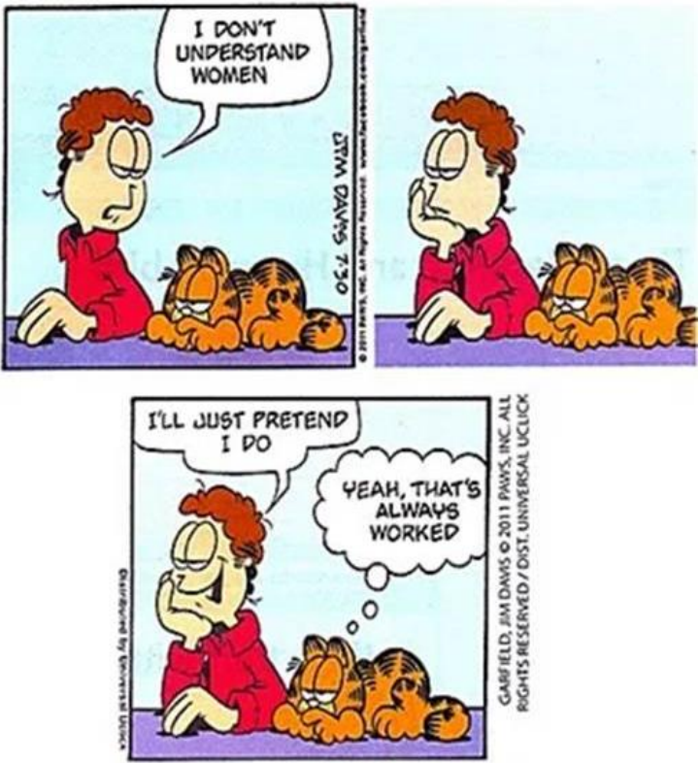
TUDO SALA DE AULA. Portal educacional com recursos didáticos para professores da Educação Básica. Available at: https://www.tudosaladeaula.com. Accessed on: Mar. 21, 2025.
In relation to the elements from the comic strip, Text VI, consider the following statements.
I. In the utterance “I don’t understand women”, the word “women” is the plural form of woman, and is classified as an irregular noun whose plural is formed by mutation, in other words, a change in the vowel of the singular form. Other examples of plural nouns formed by mutation include “man/men”, “tooth/teeth”, and “mouse/mice”.
II. In the clause “that’s always worked”, replacing the verb “worked” with the phrasal verb “given up” would preserve the original meaning of the sentence, as both expressions convey the idea of successful effort or effectiveness over time.
III. The term "yeah" is a conjunction that expresses surprise or disbelief, commonly used in formal written English to indicate hesitation or irony.
IV. In “I’ll pretend I do”, the term “do” refers to “understand women” and is used to avoid unnecessary repetition.
V. In the clause “Yeah, that’s always worked”, the apostrophe+s (´s) is a contraction of the verb “to be” in the present tense (that is), forming a structure that indicates an action that began in the past and continues into the present.
Mark the alternative in which the statements are correct.
Provas
Caderno Container