Foram encontradas 46.760 questões.
Disciplina: Inglês (Língua Inglesa)
Banca: AMEOSC
Orgão: Pref. Guarujá Sul-SC
O texto seguinte servirá de base para responder à questão.
Vianden Castle History
(1º§) The rocky outcrop above the modern town of Vianden was first fortified in late antiquity. Excavations at the foot of the castle chapel in 1994 led to the discovery that parts of the crumbling masonry of the Late Antique tower must have existed in Merovingian times and that this square building, the only surviving structure from the period known as Late Antiquity, was incorporated into the first medieval castle.
(2º§) The first fortification was built at the beginning of Late Antiquity on the castle hill at an ancient crossroads, where a branch of the great Roman road Reims-Cologne through the Ardennes and the valley of Our led to the valley of the Sauer and through Echternach to Bitburg and Trier, at that time a thriving metropolis.
(3º§) After the Vianden fort was abandoned around 430/440 AD, the Roman Tower seems to have been sufficiently usable to remain a decisive element in the subsequent periods of castle building up to the High Middle Ages.
(4º§) The first medieval fortification was erected on the rocky spur overlooking Vianden around the year 1000. The main part of this fortification consisted of an oval ring wall. This defensive wall, meticulously reinforced with small slabs of slate, was exactly one meter wide. As with the ancient wall, this special construction technique allowed archaeologists to retrace it virtually its entire length. The old late antique moat also remained in use during this period. The entire inner surface of the fortification was leveled by filling the lower defensive wall with stones and earth. This complex also included a hall, used for administrative purposes, and a chapel, which was installed in the remains of the late antique tower.
(5º§) Vianden Castle was extensively rebuilt around 1170. The remains of the wooden scaffolding found in the new residential tower made it possible to determine the date of construction using the three-ring dating technique.
(6º§) Important architectural contributions were made, in Gothic style, between the 13th and 14th centuries by the Counts of Vianden. In 1417 the castle became a possession of the Orange-Nassau family who made changes in the Renaissance style. The castle was long in the possession of the grand-ducal family until it became state property in 1977. After this date, it was restored and shines in its former glory. Today, Vianden Castle is one of the most important architectural monuments in Europe being one of the largest and most beautiful feudal residences of the Romanesque and Gothic periods. In the entrance area there is a modern interactive visitor center.
https://www.histouring.com/en/historical-places/vianden-castle/
Provas

Disciplina: Inglês (Língua Inglesa)
Banca: AMEOSC
Orgão: Pref. Guarujá Sul-SC
O texto seguinte servirá de base para responder à questão.
Vianden Castle History
(1º§) The rocky outcrop above the modern town of Vianden was first fortified in late antiquity. Excavations at the foot of the castle chapel in 1994 led to the discovery that parts of the crumbling masonry of the Late Antique tower must have existed in Merovingian times and that this square building, the only surviving structure from the period known as Late Antiquity, was incorporated into the first medieval castle.
(2º§) The first fortification was built at the beginning of Late Antiquity on the castle hill at an ancient crossroads, where a branch of the great Roman road Reims-Cologne through the Ardennes and the valley of Our led to the valley of the Sauer and through Echternach to Bitburg and Trier, at that time a thriving metropolis.
(3º§) After the Vianden fort was abandoned around 430/440 AD, the Roman Tower seems to have been sufficiently usable to remain a decisive element in the subsequent periods of castle building up to the High Middle Ages.
(4º§) The first medieval fortification was erected on the rocky spur overlooking Vianden around the year 1000. The main part of this fortification consisted of an oval ring wall. This defensive wall, meticulously reinforced with small slabs of slate, was exactly one meter wide. As with the ancient wall, this special construction technique allowed archaeologists to retrace it virtually its entire length. The old late antique moat also remained in use during this period. The entire inner surface of the fortification was leveled by filling the lower defensive wall with stones and earth. This complex also included a hall, used for administrative purposes, and a chapel, which was installed in the remains of the late antique tower.
(5º§) Vianden Castle was extensively rebuilt around 1170. The remains of the wooden scaffolding found in the new residential tower made it possible to determine the date of construction using the three-ring dating technique.
(6º§) Important architectural contributions were made, in Gothic style, between the 13th and 14th centuries by the Counts of Vianden. In 1417 the castle became a possession of the Orange-Nassau family who made changes in the Renaissance style. The castle was long in the possession of the grand-ducal family until it became state property in 1977. After this date, it was restored and shines in its former glory. Today, Vianden Castle is one of the most important architectural monuments in Europe being one of the largest and most beautiful feudal residences of the Romanesque and Gothic periods. In the entrance area there is a modern interactive visitor center.
https://www.histouring.com/en/historical-places/vianden-castle/
Provas
Disciplina: Inglês (Língua Inglesa)
Banca: AMEOSC
Orgão: Pref. Guarujá Sul-SC
O texto seguinte servirá de base para responder à questão.
Vianden Castle History
(1º§) The rocky outcrop above the modern town of Vianden was first fortified in late antiquity. Excavations at the foot of the castle chapel in 1994 led to the discovery that parts of the crumbling masonry of the Late Antique tower must have existed in Merovingian times and that this square building, the only surviving structure from the period known as Late Antiquity, was incorporated into the first medieval castle.
(2º§) The first fortification was built at the beginning of Late Antiquity on the castle hill at an ancient crossroads, where a branch of the great Roman road Reims-Cologne through the Ardennes and the valley of Our led to the valley of the Sauer and through Echternach to Bitburg and Trier, at that time a thriving metropolis.
(3º§) After the Vianden fort was abandoned around 430/440 AD, the Roman Tower seems to have been sufficiently usable to remain a decisive element in the subsequent periods of castle building up to the High Middle Ages.
(4º§) The first medieval fortification was erected on the rocky spur overlooking Vianden around the year 1000. The main part of this fortification consisted of an oval ring wall. This defensive wall, meticulously reinforced with small slabs of slate, was exactly one meter wide. As with the ancient wall, this special construction technique allowed archaeologists to retrace it virtually its entire length. The old late antique moat also remained in use during this period. The entire inner surface of the fortification was leveled by filling the lower defensive wall with stones and earth. This complex also included a hall, used for administrative purposes, and a chapel, which was installed in the remains of the late antique tower.
(5º§) Vianden Castle was extensively rebuilt around 1170. The remains of the wooden scaffolding found in the new residential tower made it possible to determine the date of construction using the three-ring dating technique.
(6º§) Important architectural contributions were made, in Gothic style, between the 13th and 14th centuries by the Counts of Vianden. In 1417 the castle became a possession of the Orange-Nassau family who made changes in the Renaissance style. The castle was long in the possession of the grand-ducal family until it became state property in 1977. After this date, it was restored and shines in its former glory. Today, Vianden Castle is one of the most important architectural monuments in Europe being one of the largest and most beautiful feudal residences of the Romanesque and Gothic periods. In the entrance area there is a modern interactive visitor center.
https://www.histouring.com/en/historical-places/vianden-castle/
Provas
Disciplina: Inglês (Língua Inglesa)
Banca: AMEOSC
Orgão: Pref. Guarujá Sul-SC
O texto seguinte servirá de base para responder à questão.
Vianden Castle History
(1º§) The rocky outcrop above the modern town of Vianden was first fortified in late antiquity. Excavations at the foot of the castle chapel in 1994 led to the discovery that parts of the crumbling masonry of the Late Antique tower must have existed in Merovingian times and that this square building, the only surviving structure from the period known as Late Antiquity, was incorporated into the first medieval castle.
(2º§) The first fortification was built at the beginning of Late Antiquity on the castle hill at an ancient crossroads, where a branch of the great Roman road Reims-Cologne through the Ardennes and the valley of Our led to the valley of the Sauer and through Echternach to Bitburg and Trier, at that time a thriving metropolis.
(3º§) After the Vianden fort was abandoned around 430/440 AD, the Roman Tower seems to have been sufficiently usable to remain a decisive element in the subsequent periods of castle building up to the High Middle Ages.
(4º§) The first medieval fortification was erected on the rocky spur overlooking Vianden around the year 1000. The main part of this fortification consisted of an oval ring wall. This defensive wall, meticulously reinforced with small slabs of slate, was exactly one meter wide. As with the ancient wall, this special construction technique allowed archaeologists to retrace it virtually its entire length. The old late antique moat also remained in use during this period. The entire inner surface of the fortification was leveled by filling the lower defensive wall with stones and earth. This complex also included a hall, used for administrative purposes, and a chapel, which was installed in the remains of the late antique tower.
(5º§) Vianden Castle was extensively rebuilt around 1170. The remains of the wooden scaffolding found in the new residential tower made it possible to determine the date of construction using the three-ring dating technique.
(6º§) Important architectural contributions were made, in Gothic style, between the 13th and 14th centuries by the Counts of Vianden. In 1417 the castle became a possession of the Orange-Nassau family who made changes in the Renaissance style. The castle was long in the possession of the grand-ducal family until it became state property in 1977. After this date, it was restored and shines in its former glory. Today, Vianden Castle is one of the most important architectural monuments in Europe being one of the largest and most beautiful feudal residences of the Romanesque and Gothic periods. In the entrance area there is a modern interactive visitor center.
https://www.histouring.com/en/historical-places/vianden-castle/
Provas
Disciplina: Inglês (Língua Inglesa)
Banca: AMEOSC
Orgão: Pref. Guarujá Sul-SC
O texto seguinte servirá de base para responder à questão.
Vianden Castle History
(1º§) The rocky outcrop above the modern town of Vianden was first fortified in late antiquity. Excavations at the foot of the castle chapel in 1994 led to the discovery that parts of the crumbling masonry of the Late Antique tower must have existed in Merovingian times and that this square building, the only surviving structure from the period known as Late Antiquity, was incorporated into the first medieval castle.
(2º§) The first fortification was built at the beginning of Late Antiquity on the castle hill at an ancient crossroads, where a branch of the great Roman road Reims-Cologne through the Ardennes and the valley of Our led to the valley of the Sauer and through Echternach to Bitburg and Trier, at that time a thriving metropolis.
(3º§) After the Vianden fort was abandoned around 430/440 AD, the Roman Tower seems to have been sufficiently usable to remain a decisive element in the subsequent periods of castle building up to the High Middle Ages.
(4º§) The first medieval fortification was erected on the rocky spur overlooking Vianden around the year 1000. The main part of this fortification consisted of an oval ring wall. This defensive wall, meticulously reinforced with small slabs of slate, was exactly one meter wide. As with the ancient wall, this special construction technique allowed archaeologists to retrace it virtually its entire length. The old late antique moat also remained in use during this period. The entire inner surface of the fortification was leveled by filling the lower defensive wall with stones and earth. This complex also included a hall, used for administrative purposes, and a chapel, which was installed in the remains of the late antique tower.
(5º§) Vianden Castle was extensively rebuilt around 1170. The remains of the wooden scaffolding found in the new residential tower made it possible to determine the date of construction using the three-ring dating technique.
(6º§) Important architectural contributions were made, in Gothic style, between the 13th and 14th centuries by the Counts of Vianden. In 1417 the castle became a possession of the Orange-Nassau family who made changes in the Renaissance style. The castle was long in the possession of the grand-ducal family until it became state property in 1977. After this date, it was restored and shines in its former glory. Today, Vianden Castle is one of the most important architectural monuments in Europe being one of the largest and most beautiful feudal residences of the Romanesque and Gothic periods. In the entrance area there is a modern interactive visitor center.
https://www.histouring.com/en/historical-places/vianden-castle/
Provas
Text 7
From EFL to ELF in Brazil: what the Brazilian education guidelines suggest.
At the beginning of the text devoted to English language teaching in the BNCC, it is made clear that the notion of an increasingly globalized, plural social world is fundamental to shed light on the relevance of learning the English language. According to the document,
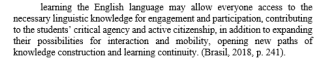
Based on this formative assessment, the BNCC lists three important functions of English language teaching (henceforward ELT): (1) to review the relations between language, territory and culture; (2) to broaden the understanding of literacy; and (3) to situate the English language in its lingua franca status.
Before delving into the first function of ELT, a brief, clear definition of English as a lingua franca (henceforward ELF) is necessary. Jenkins (2012, p. 486) states that ‘it is a means of communication between people who come from different first language backgrounds.’ In this sense, any English speaker can be an ELF speaker, be they native users of English or not. She also adds that ‘ELF is not a language variety in the traditional sense of the term.’
The first ELT function described in the BNCC is in line with Jenkins’s view of ELF.
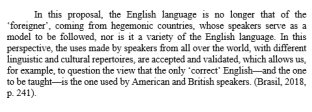
This quote argues that treating English as a lingua franca validates the uses of the language by speakers from places where English is neither the first language (L1) nor an official language, which is the case of Brazilian users of English. The BNCC also contributes to the ownership debate concerning the English language, which has been brought to the fore by Widdowson (1994), who points out that native speakers of English who live in the US or the UK no longer ‘own’ the language. Given the fact that English has become an international language, he argues that ‘no nation can have custody over it’ (Widdowson, 1994, p. 385).
FRANCO, C. P. Teaching English as a Lingua Franca in Brazil: insights into materials writing. In: International Journal of English Linguistics; Vol. 11, No. 3; 2021. P. 62-63
Provas
Text 7
From EFL to ELF in Brazil: what the Brazilian education guidelines suggest.
At the beginning of the text devoted to English language teaching in the BNCC, it is made clear that the notion of an increasingly globalized, plural social world is fundamental to shed light on the relevance of learning the English language. According to the document,
Based on this formative assessment, the BNCC lists three important functions of English language teaching (henceforward ELT): (1) to review the relations between language, territory and culture; (2) to broaden the understanding of literacy; and (3) to situate the English language in its lingua franca status.
Before delving into the first function of ELT, a brief, clear definition of English as a lingua franca (henceforward ELF) is necessary. Jenkins (2012, p. 486) states that ‘it is a means of communication between people who come from different first language backgrounds.’ In this sense, any English speaker can be an ELF speaker, be they native users of English or not. She also adds that ‘ELF is not a language variety in the traditional sense of the term.’
The first ELT function described in the BNCC is in line with Jenkins’s view of ELF.
This quote argues that treating English as a lingua franca validates the uses of the language by speakers from places where English is neither the first language (L1) nor an official language, which is the case of Brazilian users of English. The BNCC also contributes to the ownership debate concerning the English language, which has been brought to the fore by Widdowson (1994), who points out that native speakers of English who live in the US or the UK no longer ‘own’ the language. Given the fact that English has become an international language, he argues that ‘no nation can have custody over it’ (Widdowson, 1994, p. 385).
FRANCO, C. P. Teaching English as a Lingua Franca in Brazil: insights into materials writing. In: International Journal of English Linguistics; Vol. 11, No. 3; 2021. P. 62-63
Provas
Text 6
The sociolinguistics of English as Lingua Franca (EFL) pronunciation.
As far as sociolinguistics is concerned, the first task is to problematise the notion of standard accent. Essentially there is no such thing as a ‘standard’ accent, merely prestige accents, primarily RP and General American English (GA), stigmatised accents both native and (more often) non-native (see Lippi-Green, 1997; Bonfiglio, 2002), and a range of variously tolerated regional and social accents between the two extremes. The so-called BritishEnglish standard accent (RP) is claimed nowadays to be used by a mere fraction of British Native Speakers (NSs), possibly only three per cent in its unmodified form (see Trudgill, 2002: 171). The vast majority of NSs of English speak with regionallyand/or socially-modified accents, whether tolerated or stigmatised. Clearly, then, the RP accent cannot be ‘standard’ in the sense of being a widely-used norm. Instead, ‘standard’ refers accent-wise to a level of pronunciation assumed by many to be better in some way than the others, and is thus standard only in the sense of a level of excellence to be aspired to. Excellence, however, is not something that can be measured linguistically: it is not intrinsic to an accent, but merely reflects the value judgements of the elitist group who habitually use it or would if they could.
It should be a matter for teachers and their learners to decide whether they wish to subscribe to the (linguistically-unsound) belief in the superiority of RP. In some communication contexts an RP accent will undoubtedly provide them with a social advantage. This is more likely to be the case if learners intend to use their English to communicate and blend in largely with NSs, especially if the communication will take place in NS countries. Even here, though, their awareness should be raised to the fact that the majority of NSs with whom they communicate will not have an RP accent. At the most, it will probably be regionallymodified RP. On the other hand, having been apprised of the facts of sociolinguistic variation, learners may prefer to project their own (L2) regional and social identity through their accent. In this case their goal is more likely to be an accent that retains a clear trace of their L1, provided that it does not threaten the intelligibility of their pronunciation in their target (probably ELF) communication contexts.
JENKINS, J. Teaching Pronunciation for English as a Lingua Franca: A Sociopolitical Perspective. In GNUTZMANN, C.; INTEMANN, F. (Org.) The Globalization of English and the English Language Classroom. Oxford: OUP, 2005. p. 145-158.
Provas
Text 6
The sociolinguistics of English as Lingua Franca (EFL) pronunciation.
As far as sociolinguistics is concerned, the first task is to problematise the notion of standard accent. Essentially there is no such thing as a ‘standard’ accent, merely prestige accents, primarily RP and General American English (GA), stigmatised accents both native and (more often) non-native (see Lippi-Green, 1997; Bonfiglio, 2002), and a range of variously tolerated regional and social accents between the two extremes. The so-called BritishEnglish standard accent (RP) is claimed nowadays to be used by a mere fraction of British Native Speakers (NSs), possibly only three per cent in its unmodified form (see Trudgill, 2002: 171). The vast majority of NSs of English speak with regionallyand/or socially-modified accents, whether tolerated or stigmatised. Clearly, then, the RP accent cannot be ‘standard’ in the sense of being a widely-used norm. Instead, ‘standard’ refers accent-wise to a level of pronunciation assumed by many to be better in some way than the others, and is thus standard only in the sense of a level of excellence to be aspired to. Excellence, however, is not something that can be measured linguistically: it is not intrinsic to an accent, but merely reflects the value judgements of the elitist group who habitually use it or would if they could.
It should be a matter for teachers and their learners to decide whether they wish to subscribe to the (linguistically-unsound) belief in the superiority of RP. In some communication contexts an RP accent will undoubtedly provide them with a social advantage. This is more likely to be the case if learners intend to use their English to communicate and blend in largely with NSs, especially if the communication will take place in NS countries. Even here, though, their awareness should be raised to the fact that the majority of NSs with whom they communicate will not have an RP accent. At the most, it will probably be regionallymodified RP. On the other hand, having been apprised of the facts of sociolinguistic variation, learners may prefer to project their own (L2) regional and social identity through their accent. In this case their goal is more likely to be an accent that retains a clear trace of their L1, provided that it does not threaten the intelligibility of their pronunciation in their target (probably ELF) communication contexts.
JENKINS, J. Teaching Pronunciation for English as a Lingua Franca: A Sociopolitical Perspective. In GNUTZMANN, C.; INTEMANN, F. (Org.) The Globalization of English and the English Language Classroom. Oxford: OUP, 2005. p. 145-158.
Provas
Text 6
The sociolinguistics of English as Lingua Franca (EFL) pronunciation.
As far as sociolinguistics is concerned, the first task is to problematise the notion of standard accent. Essentially there is no such thing as a ‘standard’ accent, merely prestige accents, primarily RP and General American English (GA), stigmatised accents both native and (more often) non-native (see Lippi-Green, 1997; Bonfiglio, 2002), and a range of variously tolerated regional and social accents between the two extremes. The so-called BritishEnglish standard accent (RP) is claimed nowadays to be used by a mere fraction of British Native Speakers (NSs), possibly only three per cent in its unmodified form (see Trudgill, 2002: 171). The vast majority of NSs of English speak with regionallyand/or socially-modified accents, whether tolerated or stigmatised. Clearly, then, the RP accent cannot be ‘standard’ in the sense of being a widely-used norm. Instead, ‘standard’ refers accent-wise to a level of pronunciation assumed by many to be better in some way than the others, and is thus standard only in the sense of a level of excellence to be aspired to. Excellence, however, is not something that can be measured linguistically: it is not intrinsic to an accent, but merely reflects the value judgements of the elitist group who habitually use it or would if they could.
It should be a matter for teachers and their learners to decide whether they wish to subscribe to the (linguistically-unsound) belief in the superiority of RP. In some communication contexts an RP accent will undoubtedly provide them with a social advantage. This is more likely to be the case if learners intend to use their English to communicate and blend in largely with NSs, especially if the communication will take place in NS countries. Even here, though, their awareness should be raised to the fact that the majority of NSs with whom they communicate will not have an RP accent. At the most, it will probably be regionallymodified RP. On the other hand, having been apprised of the facts of sociolinguistic variation, learners may prefer to project their own (L2) regional and social identity through their accent. In this case their goal is more likely to be an accent that retains a clear trace of their L1, provided that it does not threaten the intelligibility of their pronunciation in their target (probably ELF) communication contexts.
JENKINS, J. Teaching Pronunciation for English as a Lingua Franca: A Sociopolitical Perspective. In GNUTZMANN, C.; INTEMANN, F. (Org.) The Globalization of English and the English Language Classroom. Oxford: OUP, 2005. p. 145-158.
Provas
Caderno Container