Foram encontradas 46.760 questões.
Answer question according to
TEXT 4 below.
TEXT 4
The Future of Education: How Artificial
Intelligence is Transforming Learning
Education is a fundamental pillar in society.
Throughout history, education has been the
means through which future generations
acquire knowledge and skills to thrive in an
ever-evolving world. However, the world is
changing at a dizzying pace, and education
must also adapt. Artificial intelligence (AI) has
become one of the most powerful tools in
shaping the future of education. In the
educational context, this means that machines
can assist students in learning in a way more
efficiently and personally. Let's explore how AI
is transforming education and what role it plays
in shaping the classroom of the future.
1 – Adapting Education to Individual Needs:
Every student is unique, with different learning
paces and comprehension styles. One of the
main advantages of AI in education is its ability
to offer personalized learning.
2 – Personalized Educational Content: AI
does not only personalize the way content is
presented, but also the content itself. It can
generate learning materials based on each
student's specific needs and interests.
3 – Prognostics: AI can analyze vast amounts
of educational data to identify trends and
patterns. This is especially useful for school
administrators and teachers to make decisions
and plan future action.
4 – Access to Education: AI-based education
is not limited by geographical or temporal
constraints. This is particularly important for
those who have difficulty attending in-person
classes due to geographical barriers or work
commitments.
5 – Development of 21st Century Skills:
Education is not only about acquiring
knowledge but also about developing skills. AI
helps students develop 21st-century skills such
as critical thinking, problem-solving, and
effective communication.
6 – Identification and Support for Diverse
Learning: Every student is different, and some
may have special needs. AI can identify students who need additional support and
provide specific resources for their needs.
Conclusion
Taking all the above into account, the
advantages that AI offers are irrefutable, and, in
the area of education, it is no exception.
However, despite all the potential benefits, the
implementation of AI in education also raises
challenges and ethical issues. US Government
entities have proposed the parameters that
educational entities must comply with, if they
want to make use of AI. These regulations focus
on privacy, equity and transparency, in order to
protect the rights of students and also
guarantee access to these innovations.
Avaliable at LINKEDIN, published at Oct 27, 2023, in
https://www.linkedin.com/pulse/future-education-how-artificialintelligence-transforming-alyre. Access on: Mar. 21st, 2024.
Adapted.
Provas
Questão presente nas seguintes provas

Answer question according to
TEXT 4 below.
TEXT 4
The Future of Education: How Artificial
Intelligence is Transforming Learning
Education is a fundamental pillar in society.
Throughout history, education has been the
means through which future generations
acquire knowledge and skills to thrive in an
ever-evolving world. However, the world is
changing at a dizzying pace, and education
must also adapt. Artificial intelligence (AI) has
become one of the most powerful tools in
shaping the future of education. In the
educational context, this means that machines
can assist students in learning in a way more
efficiently and personally. Let's explore how AI
is transforming education and what role it plays
in shaping the classroom of the future.
1 – Adapting Education to Individual Needs:
Every student is unique, with different learning
paces and comprehension styles. One of the
main advantages of AI in education is its ability
to offer personalized learning.
2 – Personalized Educational Content: AI
does not only personalize the way content is
presented, but also the content itself. It can
generate learning materials based on each
student's specific needs and interests.
3 – Prognostics: AI can analyze vast amounts
of educational data to identify trends and
patterns. This is especially useful for school
administrators and teachers to make decisions
and plan future action.
4 – Access to Education: AI-based education
is not limited by geographical or temporal
constraints. This is particularly important for
those who have difficulty attending in-person
classes due to geographical barriers or work
commitments.
5 – Development of 21st Century Skills:
Education is not only about acquiring
knowledge but also about developing skills. AI
helps students develop 21st-century skills such
as critical thinking, problem-solving, and
effective communication.
6 – Identification and Support for Diverse
Learning: Every student is different, and some
may have special needs. AI can identify students who need additional support and
provide specific resources for their needs.
Conclusion
Taking all the above into account, the
advantages that AI offers are irrefutable, and, in
the area of education, it is no exception.
However, despite all the potential benefits, the
implementation of AI in education also raises
challenges and ethical issues. US Government
entities have proposed the parameters that
educational entities must comply with, if they
want to make use of AI. These regulations focus
on privacy, equity and transparency, in order to
protect the rights of students and also
guarantee access to these innovations.
Avaliable at LINKEDIN, published at Oct 27, 2023, in
https://www.linkedin.com/pulse/future-education-how-artificialintelligence-transforming-alyre. Access on: Mar. 21st, 2024.
Adapted.
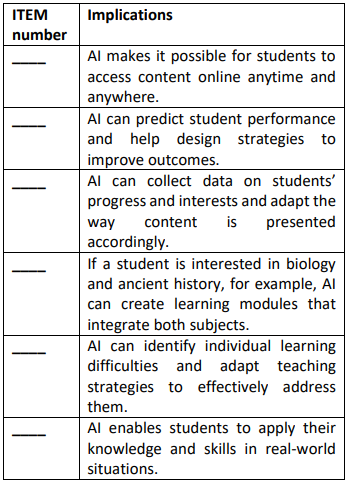
Indique o número do item (de 1 a 6) a que cada implicação se refere e, abaixo, marque a alternativa que contém os itens que você indicou, na ordem em que aparecem na tabela.
Provas
Questão presente nas seguintes provas
Answer question according to
TEXT 4 below.
TEXT 4
The Future of Education: How Artificial
Intelligence is Transforming Learning
Education is a fundamental pillar in society.
Throughout history, education has been the
means through which future generations
acquire knowledge and skills to thrive in an
ever-evolving world. However, the world is
changing at a dizzying pace, and education
must also adapt. Artificial intelligence (AI) has
become one of the most powerful tools in
shaping the future of education. In the
educational context, this means that machines
can assist students in learning in a way more
efficiently and personally. Let's explore how AI
is transforming education and what role it plays
in shaping the classroom of the future.
1 – Adapting Education to Individual Needs:
Every student is unique, with different learning
paces and comprehension styles. One of the
main advantages of AI in education is its ability
to offer personalized learning.
2 – Personalized Educational Content: AI
does not only personalize the way content is
presented, but also the content itself. It can
generate learning materials based on each
student's specific needs and interests.
3 – Prognostics: AI can analyze vast amounts
of educational data to identify trends and
patterns. This is especially useful for school
administrators and teachers to make decisions
and plan future action.
4 – Access to Education: AI-based education
is not limited by geographical or temporal
constraints. This is particularly important for
those who have difficulty attending in-person
classes due to geographical barriers or work
commitments.
5 – Development of 21st Century Skills:
Education is not only about acquiring
knowledge but also about developing skills. AI
helps students develop 21st-century skills such
as critical thinking, problem-solving, and
effective communication.
6 – Identification and Support for Diverse
Learning: Every student is different, and some
may have special needs. AI can identify students who need additional support and
provide specific resources for their needs.
Conclusion
Taking all the above into account, the
advantages that AI offers are irrefutable, and, in
the area of education, it is no exception.
However, despite all the potential benefits, the
implementation of AI in education also raises
challenges and ethical issues. US Government
entities have proposed the parameters that
educational entities must comply with, if they
want to make use of AI. These regulations focus
on privacy, equity and transparency, in order to
protect the rights of students and also
guarantee access to these innovations.
Avaliable at LINKEDIN, published at Oct 27, 2023, in
https://www.linkedin.com/pulse/future-education-how-artificialintelligence-transforming-alyre. Access on: Mar. 21st, 2024.
Adapted.
Provas
Questão presente nas seguintes provas
Answer question according to
TEXT 4 below.
TEXT 4
The Future of Education: How Artificial
Intelligence is Transforming Learning
Education is a fundamental pillar in society.
Throughout history, education has been the
means through which future generations
acquire knowledge and skills to thrive in an
ever-evolving world. However, the world is
changing at a dizzying pace, and education
must also adapt. Artificial intelligence (AI) has
become one of the most powerful tools in
shaping the future of education. In the
educational context, this means that machines
can assist students in learning in a way more
efficiently and personally. Let's explore how AI
is transforming education and what role it plays
in shaping the classroom of the future.
1 – Adapting Education to Individual Needs:
Every student is unique, with different learning
paces and comprehension styles. One of the
main advantages of AI in education is its ability
to offer personalized learning.
2 – Personalized Educational Content: AI
does not only personalize the way content is
presented, but also the content itself. It can
generate learning materials based on each
student's specific needs and interests.
3 – Prognostics: AI can analyze vast amounts
of educational data to identify trends and
patterns. This is especially useful for school
administrators and teachers to make decisions
and plan future action.
4 – Access to Education: AI-based education
is not limited by geographical or temporal
constraints. This is particularly important for
those who have difficulty attending in-person
classes due to geographical barriers or work
commitments.
5 – Development of 21st Century Skills:
Education is not only about acquiring
knowledge but also about developing skills. AI
helps students develop 21st-century skills such
as critical thinking, problem-solving, and
effective communication.
6 – Identification and Support for Diverse
Learning: Every student is different, and some
may have special needs. AI can identify students who need additional support and
provide specific resources for their needs.
Conclusion
Taking all the above into account, the
advantages that AI offers are irrefutable, and, in
the area of education, it is no exception.
However, despite all the potential benefits, the
implementation of AI in education also raises
challenges and ethical issues. US Government
entities have proposed the parameters that
educational entities must comply with, if they
want to make use of AI. These regulations focus
on privacy, equity and transparency, in order to
protect the rights of students and also
guarantee access to these innovations.
Avaliable at LINKEDIN, published at Oct 27, 2023, in
https://www.linkedin.com/pulse/future-education-how-artificialintelligence-transforming-alyre. Access on: Mar. 21st, 2024.
Adapted.
Provas
Questão presente nas seguintes provas
Answer question according to TEXT 3 below.
TEXT 3
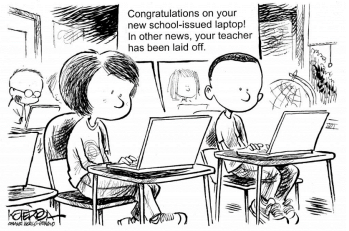
Available at: https://larrycuban.wordpress.com/2019/11/25/evenmore-cartoons-on-technology/. Access on: Apr. 9th, 2024.
Provas
Questão presente nas seguintes provas
Answer question according to TEXT 3 below.
TEXT 3
Available at: https://larrycuban.wordpress.com/2019/11/25/evenmore-cartoons-on-technology/. Access on: Apr. 9th, 2024.
Provas
Questão presente nas seguintes provas
Answer question according to TEXT 3 below.
TEXT 3
Available at: https://larrycuban.wordpress.com/2019/11/25/evenmore-cartoons-on-technology/. Access on: Apr. 9th, 2024.
Provas
Questão presente nas seguintes provas
Answer question according to
TEXT 2 below.
TEXT 2
Expand your horizons at the Social Sciences
Conference of the year!
Welcome to the 6th International Conference on
Modern Approach in Humanities and Social
Sciences (ICMHS), taking place on 10-12
March 2023 in Prague, Czech Republic.
We invite you to join us for three days of
learning and networking. You are guaranteed to
leave the event with a suitcase full of knowledge
and inspiration. With 30+ countries present at
the event; this is a unique opportunity to
understand the challenges your peers are
facing and come up with creative solutions.
See you in Prague!
Conference Themes and Topics
The humanities and social sciences
conferences are seeking submissions related to
the following conference topics: Social
Sciences, Humanities, and Language and
Literature. Other related tracks and topics will
also be considered.
Submitted abstracts will be evaluated by the
Scientific Committee. If the abstract is
accepted, the author agrees to send full-text
paper, including results, tables, figures, and
references. All submissions should report
original and previously unpublished research
results no matter the type of research paper you
are presenting. Full-text papers (.docx and .doc)
will be accepted by Electronic Submission
Form. Manuscripts should meet the format set
by the Conference committee and are subject
to review.
Avaliable at: https://www.icmhs.org/online-submission/.
Access on: Jan. 10th, 2023.
Provas
Questão presente nas seguintes provas
Answer question according to
TEXT 2 below.
TEXT 2
Expand your horizons at the Social Sciences
Conference of the year!
Welcome to the 6th International Conference on
Modern Approach in Humanities and Social
Sciences (ICMHS), taking place on 10-12
March 2023 in Prague, Czech Republic.
We invite you to join us for three days of
learning and networking. You are guaranteed to
leave the event with a suitcase full of knowledge
and inspiration. With 30+ countries present at
the event; this is a unique opportunity to
understand the challenges your peers are
facing and come up with creative solutions.
See you in Prague!
Conference Themes and Topics
The humanities and social sciences
conferences are seeking submissions related to
the following conference topics: Social
Sciences, Humanities, and Language and
Literature. Other related tracks and topics will
also be considered.
Submitted abstracts will be evaluated by the
Scientific Committee. If the abstract is
accepted, the author agrees to send full-text
paper, including results, tables, figures, and
references. All submissions should report
original and previously unpublished research
results no matter the type of research paper you
are presenting. Full-text papers (.docx and .doc)
will be accepted by Electronic Submission
Form. Manuscripts should meet the format set
by the Conference committee and are subject
to review.
Avaliable at: https://www.icmhs.org/online-submission/.
Access on: Jan. 10th, 2023.
Provas
Questão presente nas seguintes provas
Answer question according to
TEXT 1 below.
TEXT 1
TRUE STORIES – The School teacher
1 IT'S HAPPENED TO me half a dozen
times, lately. I'm walking home through the
Edinburgh Gardens and I see them heading
towards me. Heavy kids, eight of them, maybe
ten. I keep walking, but I keep my eyes on them,
and my feet wait for the sign to take off.
2 They are Greeks and Italians, all
adolescents, all wearing green or maroon
cardigans with a double black stripe round the
chest, Levis or Wranglers that fit just right,
showing a bit of sock and reddish shoes with big
heels. I move across to the outside of the
footpath to let them pass. They spread out a
little. They're close enough now in the almost-dark for me to see their faces.
3 And it's all right, because the front one is
Chris, from Fitzroy High, and he says, 'Hello,
miss!' and the others are kids who have grinned
and nodded at me a hundred times in the yard
at school.
4 I had taught migrants before, but Fitzroy
High is one of those legendary inner-suburban
schools which can no longer be properly
described as Australian. In none of the classes
I took were there more than four kids with
Australian names. A blond head was a surprise.
The administration battled to assimilate these
kids into recognizable moulds. In a hundred
subtle ways they were defeated.
5 Most of the girls had pierced ears and had
worn gold earrings since they were babies. The
line was that plain gold sleepers were the only
ear decorations allowed. At the time when it was
fashionable, in Australia, to wear a zillion
colored plastic bangles up your arm, teachers
strove hopelessly to prevent this display of
gaiety at school. The girls went on wearing them
and pulled their sleeves down when they saw a
senior mistress coming.
6 There were weekly segregated
assemblies. I don't know what they told the
boys, but at one girls' assembly I actually heard
the senior mistress say, 'As girls we must be
modest, quiet, hardworking and well-groomed
at all times'.
7 What astonished me was the stubbornness
of the kids' resistance to the rules. They didn't
organize or protest. They defied. If the pressure
got too much for them, they stayed away. And
yet they hated to be suspended. One boy was
suspended for a week, and every day I'd see
him leaning against my front fence, staring
wistfully at the school where his mates were
tight-roping their way dangerously through the
day.
8 In the three other schools I'd taught at, I'd
been an authoritarian, a good disciplinarian. It
wasn't only political or educational thinking that
changed my attitude at Fitzroy High. It was the
kids themselves. I suppose I fell in love with the
whole nine hundred of them. In other schools,
I'd known kids who were 'trouble-makers' or
'over-achievers', or ‘irresponsible' or 'antisocial. But somehow the kids at Fitzroy cut right
through those categories.
9 To begin with, they made me laugh. I can't
remember ever knowing such exuberant, merry
kids. Every class had more than its share of
natural clowns. The plays they invented were
full of hilarious delight. In a second-form class I
had for a year, two Italian boys called Claudio
and Joseph used to present weekly plays so
excruciatingly funny that we lay across the
desks aching and wiping our eyes.
10 A kid called Ilya wrote wonderful, magical
stories; he could write fairy tales his
grandparents had told him in Yugoslavia.
Lemonia could break your heart with a story
about a lost fountain pen, and Dora with an
account of her dreams. Their English may have
been rocky, but there was a pure, delicate
humour lying bone-deep in them that nothing
could corrupt.
GARNER, Helen. True Stories. Melbourne, Australia: The
Publishing Company, 2013, pp. 26-28. Adapted.
Provas
Questão presente nas seguintes provas
Cadernos
Caderno Container