Foram encontradas 47.349 questões.
California woman arrested in theft of 65 Stanley cups - valued at nearly $2,500
By C Mandler
January 22, 2024 / 3:05 PM EST / CBS News
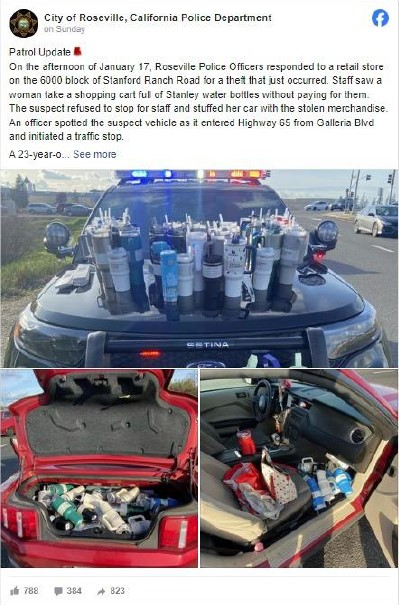
On Jan. 17, police in Roseville, California, discovered a 23-year-old woman had allegedly absconded with 65 Stanley cups from a nearby store — worth nearly $2,500.
"Staff saw a woman take a shopping cart full of Stanley water bottles without paying for them," said the Roseville Police Department in a statement on Facebook.
After being confronted by retail staff, the woman refused to stop, stuffing the cups into her car. She was subsequently arrested on a charge of grand theft and has yet to be identified by officers.
"While Stanley Quenchers are all the rage, we strongly advise against turning to crime to fulfill your hydration habits," said the Roseville police.
One commenter on the post pointed out that in addition to the trove of cups in the trunk and front seat, there was also a bright red Stanley cup in the cup holder, which they hoped police also confiscated. Colorful Stanley cups caused consumer mayhem earlier this month when the brand dropped a limited-edition batch of Valentine's Day colors of the popular tumbler at in-Target Starbucks locations.
Viral video showed shoppers running toward displays of the cups, as well as long lines of consumers waiting to get their hands on one of the coveted Quenchers.
https://www.cbsnews.com/news/stanley-cups-theft-california-target-2500-65/ (First published on January 22, 2024 /3:05PM EST)
C Mandler is a social media producer and trending topics writer for CBS News, focusing on American politics and LGBTQ+ issues.
FIGURA 1
Fonte: CBS NEWS, 2024.
Given the context provided in the article, select the potential motives behind the woman's decision to steal the cups.
Provas

California woman arrested in theft of 65 Stanley cups - valued at nearly $2,500
By C Mandler
January 22, 2024 / 3:05 PM EST / CBS News
On Jan. 17, police in Roseville, California, discovered a 23-year-old woman had allegedly absconded with 65 Stanley cups from a nearby store — worth nearly $2,500.
"Staff saw a woman take a shopping cart full of Stanley water bottles without paying for them," said the Roseville Police Department in a statement on Facebook.
After being confronted by retail staff, the woman refused to stop, stuffing the cups into her car. She was subsequently arrested on a charge of grand theft and has yet to be identified by officers.
"While Stanley Quenchers are all the rage, we strongly advise against turning to crime to fulfill your hydration habits," said the Roseville police.
One commenter on the post pointed out that in addition to the trove of cups in the trunk and front seat, there was also a bright red Stanley cup in the cup holder, which they hoped police also confiscated. Colorful Stanley cups caused consumer mayhem earlier this month when the brand dropped a limited-edition batch of Valentine's Day colors of the popular tumbler at in-Target Starbucks locations.
Viral video showed shoppers running toward displays of the cups, as well as long lines of consumers waiting to get their hands on one of the coveted Quenchers.
https://www.cbsnews.com/news/stanley-cups-theft-california-target-2500-65/ (First published on January 22, 2024 /3:05PM EST)
C Mandler is a social media producer and trending topics writer for CBS News, focusing on American politics and LGBTQ+ issues.
FIGURA 1
Fonte: CBS NEWS, 2024.
Considering the events detailed in the article, choose the statement that outlines the events leading to the arrest of the author.
Provas
Text V
Urbanization is one of the defining trends of this century and a key driver of development. By 2050, around 70% of the world’s population will be living in cities and towns. Asia and Africa will collectively account for a significant majority of the urban growth rate, a development that reflects the growth of both ‘megacities’ and smaller urban settlements in both regions over the past three decades. Today, cities produce around 80% of the global GDP and this importance is likely to continue. Cities also use 75% of global energy and are responsible for 70% of global carbon emissions. Accompanying the pace and extent of urbanization are a number of positive and negative trends — from increased economic opportunities and improvements in lives and livelihoods, through to the potential for greater urban-rural disparity, lower quality of life, and conflict. One thing is clear, cities across the world play a critical role in driving sustainable development.
However, cities today face numerous vulnerabilities and threats. Without proper planning, policies, and support, urbanization often leads to unnecessary risks and costs, preventing cities from reaching their full potential. Cases such as urban sprawls and the proliferation of informal settlements are increasing, and the communities who reside in such areas often suffer from the poor provision of public services (or lack of) such as healthcare or waste management systems. As their population grows, cities also become more complex, making long-term planning and city management a challenge. Amongst the numerous challenges that policymakers must tackle include those that are environmental, those pertaining to resource allocation, and even social challenges such as reducing intra-city inequalities.
Cities are providing a wide range of opportunities and possibilities for its citizens and, in order for them to be fully harnessed, cities should be built for and together with its citizens to fully unlock their potential. This includes taking into account the various needs and aspirations of people, making sure that everyone can have equal and inclusive access to services and create urban spaces and environments to enhance livability.
Internet: <www.undp.org> (adapted).
Based on text V, judge whether the following statement are right (C) or wrong (E).
Despite the many vulnerabilities and threats cities encounter, it is reasonable to conclude that with effective planning, policies, and adequate support, urbanization can avoid unnecessary risks and costs, enabling cities to achieve their full potential.
Provas
Text V
Urbanization is one of the defining trends of this century and a key driver of development. By 2050, around 70% of the world’s population will be living in cities and towns. Asia and Africa will collectively account for a significant majority of the urban growth rate, a development that reflects the growth of both ‘megacities’ and smaller urban settlements in both regions over the past three decades. Today, cities produce around 80% of the global GDP and this importance is likely to continue. Cities also use 75% of global energy and are responsible for 70% of global carbon emissions. Accompanying the pace and extent of urbanization are a number of positive and negative trends — from increased economic opportunities and improvements in lives and livelihoods, through to the potential for greater urban-rural disparity, lower quality of life, and conflict. One thing is clear, cities across the world play a critical role in driving sustainable development.
However, cities today face numerous vulnerabilities and threats. Without proper planning, policies, and support, urbanization often leads to unnecessary risks and costs, preventing cities from reaching their full potential. Cases such as urban sprawls and the proliferation of informal settlements are increasing, and the communities who reside in such areas often suffer from the poor provision of public services (or lack of) such as healthcare or waste management systems. As their population grows, cities also become more complex, making long-term planning and city management a challenge. Amongst the numerous challenges that policymakers must tackle include those that are environmental, those pertaining to resource allocation, and even social challenges such as reducing intra-city inequalities.
Cities are providing a wide range of opportunities and possibilities for its citizens and, in order for them to be fully harnessed, cities should be built for and together with its citizens to fully unlock their potential. This includes taking into account the various needs and aspirations of people, making sure that everyone can have equal and inclusive access to services and create urban spaces and environments to enhance livability.
Internet: <www.undp.org> (adapted).
Based on text V, judge whether the following statement are right (C) or wrong (E).
Due to the amount of global GDP produced by cities, the article shows how important it is for cities to continue growing to help the urbanization process.
Provas
Text V
Urbanization is one of the defining trends of this century and a key driver of development. By 2050, around 70% of the world’s population will be living in cities and towns. Asia and Africa will collectively account for a significant majority of the urban growth rate, a development that reflects the growth of both ‘megacities’ and smaller urban settlements in both regions over the past three decades. Today, cities produce around 80% of the global GDP and this importance is likely to continue. Cities also use 75% of global energy and are responsible for 70% of global carbon emissions. Accompanying the pace and extent of urbanization are a number of positive and negative trends — from increased economic opportunities and improvements in lives and livelihoods, through to the potential for greater urban-rural disparity, lower quality of life, and conflict. One thing is clear, cities across the world play a critical role in driving sustainable development.
However, cities today face numerous vulnerabilities and threats. Without proper planning, policies, and support, urbanization often leads to unnecessary risks and costs, preventing cities from reaching their full potential. Cases such as urban sprawls and the proliferation of informal settlements are increasing, and the communities who reside in such areas often suffer from the poor provision of public services (or lack of) such as healthcare or waste management systems. As their population grows, cities also become more complex, making long-term planning and city management a challenge. Amongst the numerous challenges that policymakers must tackle include those that are environmental, those pertaining to resource allocation, and even social challenges such as reducing intra-city inequalities.
Cities are providing a wide range of opportunities and possibilities for its citizens and, in order for them to be fully harnessed, cities should be built for and together with its citizens to fully unlock their potential. This includes taking into account the various needs and aspirations of people, making sure that everyone can have equal and inclusive access to services and create urban spaces and environments to enhance livability.
Internet: <www.undp.org> (adapted).
Based on text V, judge whether the following statement are right (C) or wrong (E).
To ensure equal and inclusive access to services and create urban spaces that improve livability, cities should be developed by citizens aiming to fully realize their potential.
Provas
Text V
Urbanization is one of the defining trends of this century and a key driver of development. By 2050, around 70% of the world’s population will be living in cities and towns. Asia and Africa will collectively account for a significant majority of the urban growth rate, a development that reflects the growth of both ‘megacities’ and smaller urban settlements in both regions over the past three decades. Today, cities produce around 80% of the global GDP and this importance is likely to continue. Cities also use 75% of global energy and are responsible for 70% of global carbon emissions. Accompanying the pace and extent of urbanization are a number of positive and negative trends — from increased economic opportunities and improvements in lives and livelihoods, through to the potential for greater urban-rural disparity, lower quality of life, and conflict. One thing is clear, cities across the world play a critical role in driving sustainable development.
However, cities today face numerous vulnerabilities and threats. Without proper planning, policies, and support, urbanization often leads to unnecessary risks and costs, preventing cities from reaching their full potential. Cases such as urban sprawls and the proliferation of informal settlements are increasing, and the communities who reside in such areas often suffer from the poor provision of public services (or lack of) such as healthcare or waste management systems. As their population grows, cities also become more complex, making long-term planning and city management a challenge. Amongst the numerous challenges that policymakers must tackle include those that are environmental, those pertaining to resource allocation, and even social challenges such as reducing intra-city inequalities.
Cities are providing a wide range of opportunities and possibilities for its citizens and, in order for them to be fully harnessed, cities should be built for and together with its citizens to fully unlock their potential. This includes taking into account the various needs and aspirations of people, making sure that everyone can have equal and inclusive access to services and create urban spaces and environments to enhance livability.
Internet: <www.undp.org> (adapted).
Based on text V, judge whether the following statement are right (C) or wrong (E).
It can be inferred that the more urban expansions and proliferation of informal settlements are created, the more problems the communities nearby will face in terms of provision of public services.
Provas
Text IV
In the middle of July, Roger was making his first ministerial speech. I did not need reminding, having drafted enough of them, how much speeches mattered — to parliamentary bosses, to any kind of tycoon. Draft after draft: the search for the supreme, the impossible, the more than Flaubertian perfection; the scrutiny for any phrase that said more than it ought to say, so that each speech at the end was bound, by the law of official inexplicitness, to be more porridge-like than when it started out in its first draft. I had always hated writing drafts for other people, and nowadays got out of it. To Hector, to Douglas, it was part of the job, which they took with their usual patience, their usual lack of egotism: when a minister crossed out their sharp, clear English and went in for a literary composition of his own, they gave a wintry smile and let it stand.
C. P. Snow. Corridors of Power. London: Penguin Books, 1972, p. 31.
Considering the grammatical and semantic aspects of text IV, judge whether the following statement are right (C) or wrong (E).
The narrator of the text considers that the process of rewriting the speech multiple times contributes to its becoming more focused and direct.
Provas
Text IV
In the middle of July, Roger was making his first ministerial speech. I did not need reminding, having drafted enough of them, how much speeches mattered — to parliamentary bosses, to any kind of tycoon. Draft after draft: the search for the supreme, the impossible, the more than Flaubertian perfection; the scrutiny for any phrase that said more than it ought to say, so that each speech at the end was bound, by the law of official inexplicitness, to be more porridge-like than when it started out in its first draft. I had always hated writing drafts for other people, and nowadays got out of it. To Hector, to Douglas, it was part of the job, which they took with their usual patience, their usual lack of egotism: when a minister crossed out their sharp, clear English and went in for a literary composition of his own, they gave a wintry smile and let it stand.
C. P. Snow. Corridors of Power. London: Penguin Books, 1972, p. 31.
Considering the grammatical and semantic aspects of text IV, judge whether the following statement are right (C) or wrong (E).
In the first sentence of the text, the verb “making” is being used with the sense of writing.
Provas
Text IV
In the middle of July, Roger was making his first ministerial speech. I did not need reminding, having drafted enough of them, how much speeches mattered — to parliamentary bosses, to any kind of tycoon. Draft after draft: the search for the supreme, the impossible, the more than Flaubertian perfection; the scrutiny for any phrase that said more than it ought to say, so that each speech at the end was bound, by the law of official inexplicitness, to be more porridge-like than when it started out in its first draft. I had always hated writing drafts for other people, and nowadays got out of it. To Hector, to Douglas, it was part of the job, which they took with their usual patience, their usual lack of egotism: when a minister crossed out their sharp, clear English and went in for a literary composition of his own, they gave a wintry smile and let it stand.
C. P. Snow. Corridors of Power. London: Penguin Books, 1972, p. 31.
Considering the grammatical and semantic aspects of text IV, judge whether the following statement are right (C) or wrong (E).
The text suggests that, when their original drafts were modified by a minister, Hector and Douglas would stand up to him and insist on retaining the sharp, clear English of the original.
Provas
Text III
Aside from the difficulties of operating a decidedly multinational staff organization, once it is formed, the problem of reconciling the principle of equitable geographical distribution of recruits with that of “securing the highest standards of efficiency, competence, and integrity” is a formidable one. This delicate task was politically imposed upon the League of Nations secretary-general, and is constitutionally required of his counterpart in the United Nations.
For better or for worse, recruitment policy cannot be based exclusively upon the criterion of the individual’s personal qualifications; in the field of international employment, the relevant irrelevancy is not “whom do you know” but “where are you from?” From a strictly administrative point of view, there is some positive value in securing broad nationality distribution, even at the expense of sheer quality; for some purposes, a slightly incompetent man’s nationality may make him more useful than a more expert civil servant of inappropriate nationality.
For the most part, however, the Charter principle of geographical distribution is a concession to political necessity. It licenses a kind of international spoils system in which states seek to nourish their national self-esteem by securing an adequate quota of international jobs for their citizens. Ironically, perhaps, because it is politically necessary it is also politically and administratively desirable; what shall it profit an international organization to maintain its administrative purity and lose its own members or their political support?
Inis L. and Claude Jr. Swords into Plowshares: The Problems and Progress
of International Organization. 4th ed. New York: McGraw-Hill, 1984, pp. 196-197 (adapted).
Regarding text III, judge whether the following statement are right (C) or wrong (E).
The excerpt “It licenses a kind of international spoils system” could be, without altering the meaning of the sentence, replaced with It spoils the international system.
Provas
Caderno Container