Magna Concursos

Foram encontradas 46.262 questões.

3359834 Ano: 2024
Disciplina: Inglês (Língua Inglesa)
Banca: UFT
Orgão: Pref. Palmas-TO
Provas:
Segundo Fábregas (2015), morfologia é a área da linguística que estuda as informações gramaticais contidas nas palavras e explora como as palavras se relacionam entre si de acordo com seu significado e forma.
FÁBREGAS, A. Morphology in Linguistics. In International Encyclopedia of the Social & Behavioral Sciences, 2015.
Com base na informação fornecida, assinale a alternativa que apresenta um morfema derivacional.
Questão Anulada

Provas

Questão presente nas seguintes provas

3351991 Ano: 2024
Disciplina: Inglês (Língua Inglesa)
Banca: CESPE / CEBRASPE
Orgão: IRB
Provas:

Text IV

In the middle of July, Roger was making his first ministerial speech. I did not need reminding, having drafted enough of them, how much speeches mattered — to parliamentary bosses, to any kind of tycoon. Draft after draft: the search for the supreme, the impossible, the more than Flaubertian perfection; the scrutiny for any phrase that said more than it ought to say, so that each speech at the end was bound, by the law of official inexplicitness, to be more porridge-like than when it started out in its first draft. I had always hated writing drafts for other people, and nowadays got out of it. To Hector, to Douglas, it was part of the job, which they took with their usual patience, their usual lack of egotism: when a minister crossed out their sharp, clear English and went in for a literary composition of his own, they gave a wintry smile and let it stand.

C. P. Snow. Corridors of Power. London: Penguin Books, 1972, p. 31.

Considering the grammatical and semantic aspects of text IV, judge whether the following statement are right (C) or wrong (E).

In the third sentence of the text, “supreme” is an adjective modifying the noun “perfection”.

Questão Anulada

Provas

Questão presente nas seguintes provas
3349218 Ano: 2024
Disciplina: Inglês (Língua Inglesa)
Banca: FACET Concursos
Orgão: Pref. Caraúbas-RN
Provas:
Choose the correct answer:

"Where are you going to have lunch?"
"We are going to have lunch__________ at school."
Questão Anulada

Provas

Questão presente nas seguintes provas
3322408 Ano: 2024
Disciplina: Inglês (Língua Inglesa)
Banca: Verbena
Orgão: IFS
Leia o texto a seguir.

Avram Noam Chomsky é um linguista, filósofo, ativista, autor e analista político estadunidense que nasceu na Filadélfia (Estados Unidos), no dia sete de dezembro de 1928. Foi introduzido na linguística por seu pai, especializado em linguística histórica hebraica. Estudou na universidade da Pensilvânia, onde se tornou doutor (1955) com uma tese sobre a análise transformacional, elaborada a partir das teorias de Z. Harris, de quem foi discípulo. Assim, tornou-se professor do renomado MIT (Massachussetts Institute of Technology), a partir de 1961.

Thais Pacievitch. InfoEscola. Noam Chomsky. Disponível em: <https://www.infoescola.com/biografias/noam-chomsky/. Acesso em: 31 mai. 2024.


Partindo da perspectiva gerativista de Noam Chomski, é válido dizer que
Questão Anulada

Provas

Questão presente nas seguintes provas
3322368 Ano: 2024
Disciplina: Inglês (Língua Inglesa)
Banca: Verbena
Orgão: IFS

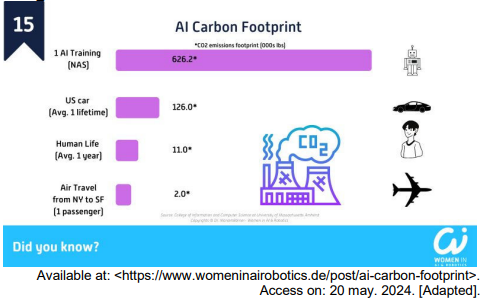
Image 1


Enunciado 3715218-1

According to the image verbal and non-verbal elements, the training of an AI model produces
Questão Anulada

Provas

Questão presente nas seguintes provas
3314966 Ano: 2024
Disciplina: Inglês (Língua Inglesa)
Banca: EDUCA
Orgão: Pref. Juripiranga-PB
Morphology either refers to the mental system involved in the word formation process or to the branch of Linguistics that deals with words, their internal structure, and how they are formed. When it comes to the process of word formation, there are two possibilities to study such complex process, which are: Inflection and Derivation. It being understood that, match the second column based on the information provided in the first one, then check the correct answer.
( A ) INFLECTION ( B ) DERIVATION
( ) refers to the formation of new lexemes – words. ( ) refers to the grammatical contrasts and distinctions. ( ) a stem is considered to be a semantic core of a word. ( ) a root is considered to be a semantic core of a word.
Questão Anulada

Provas

Questão presente nas seguintes provas
3304794 Ano: 2024
Disciplina: Inglês (Língua Inglesa)
Banca: IVIN
Orgão: Pref. Conceição Canindé-PI
Provas:
Women's History Month: How It Started
By Andrea Wurzburger - Updated on March 1, 2024 05:35AM EST
Enunciado 3630371-1
PHOTO: GETTY IMAGES


1. Women's History Month was initially just International Women's Day, a day that commemorated the Feb. 28 meeting of socialists and suffragists in Manhattan in 1909. One year later, on March 8, 1910, according to the BBC, a German activist named Clara Zetkin suggested they recognize International Women’s Day at na International Conference of Working Women in Copenhagen. With 17 countries in attendance at the conference, they all agreed.

2. On March 8, 1911, the first International Women’s Day was celebrated in Austria, Switzerland, Germany and Denmark, though the holiday wasn’t widely celebrated in the United States until the United Nations began sponsoring it in 1975.

3. In 1977, in order to persuade school principals to comply with the recently passed Title IX, a task force in California created Women’s History Week. In March 1980, after celebrations had spread across the country, President Jimmy Carter declared that March 8 was officially the start of National Women’s History Week. That same year, Utah Senator Orrin Hatch and Maryland Representative Barbara Mikulski co-sponsored the first Joint Congressional Resolution declaring the week of March 8, 1981, National Women’s History Week.
4. By 1987, Congress declared the entire month of March Women's History Month. Since then, every president has proclaimed the month of March Women's History Month. We celebrate Women's History Month to remind everyone of the achievements of women throughout the years in our culture and society, and why it's important to study them and their important moments in history. From science to politics to entertainment, it is a chance to reflect on the trailblazing women who lead the way for change. People Staff. (2023, march). Women's History Month: Facts Explainer.
People Staff. (2023, march). Women's History Month: Facts Explainer. People. Disponível em: https://people.com/human-interest/womens-history-month-facts-explainer/.
In the term “throughout” (4th paragraph) can be replaced by
Questão Anulada

Provas

Questão presente nas seguintes provas
3298949 Ano: 2024
Disciplina: Inglês (Língua Inglesa)
Banca: Instituto JK
Orgão: Pref. Icatu-MA
Provas:
Select the sentence with the appropriate use of a reflexive pronoun.
Questão Anulada

Provas

Questão presente nas seguintes provas
3145664 Ano: 2024
Disciplina: Inglês (Língua Inglesa)
Banca: EDUCA
Orgão: Pref. Juru-PB
Provas:

Comparative Adjectives compare one person or thing with another and enable us to say whether a person or thing has more or less of a particular quality. On the other hand, Superlative Adjectives describe one person or thing as having more of a quality than all other people or things in a group. Both Comparatives and Superlatives Adjectives can be used to highlight SUPERIORITY, as their principles and rules of formation may differ typically based on the type of adjectives, may it be short or long. That being said, check (T) for TRUE and (F) for FALSE, considering the information provided on Comparatives and Superlatives Adjectives formation to highlight SUPERIORITY, then check the correct answer.

( ) The comparative of short adjectives such as “pretty, happy and heavy” are “prettyer than, happyer than and heavyer than”, for the vowel “y” is preceded by another consonant.

( ) The comparative of long adjectives such as “beautiful, interesting and expensive” are “beautifuler than, interestinger than and expensiver than”, as the suffix “ER” is considered to be the general rule for those type of adjectives.

( ) The comparative of short adjectives such as “grey, fey and stray” are “greier than, feier than and straier than”, for the vowel “y” is preceded by another vowel. ( ) The comparative of Latin origin adjectives such as “basic, famous and competent” are “more basic than, more famous than and more competent than”, for using “more” before adjectives like those is considered to be the most adequate rule to use.

( ) The comparative of short adjectives such as “nice, wise and late” are “nicer than, wiser than and later than”, for they are all ending in “E”, and adding only the suffix “R” at the end of those type of adjectives is the correct rule to use.

( ) The superlative of short adjectives such as “fat, thin and big” are “the fatter, the thinner and the bigger”, for they all are ending in “C-V-C” (consonant-vowel-consonant).

( ) The superlative of irregular adjectives such as “good, bad and far” are “the goodest, the baddest and the farrest”, for adding the suffix “EST” at the end of those type of adjectives is considered to be the most appropriate rule to use.

( ) The superlative of long adjectives such as “pleasant, intelligent and successful” are “the most pleasant, the most intelligent and the most successful”, for adding “most” before those types of adjectives, instead of suffixes such as “ST, EST or IEST”, is the correct rule to use.

( ) The superlative of short adjectives such as “much, some and many” is “the most”, not because those adjectives are necessarily short, but because they are all irregular and share at certain point and extent the same semantics – meaning.

( ) If it is correct to say adjectives such as “bad, good and far” are irregular, it is also correct to say that the comparative of these adjectives are “worse than, better than and farther than” in this respective order.

Questão Anulada

Provas

Questão presente nas seguintes provas
3138522 Ano: 2024
Disciplina: Inglês (Língua Inglesa)
Banca: FUNDATEC
Orgão: Pref. Criciúma-SC
Provas:

Poor Things – Emma Stone transfixes in Lanthimos’s thrilling carnival of oddness

  1. It may only be the beginning of the year, but it’s hard to imagine that there will be a funnier,
  2. filthier, or more extravagantly peculiar film this year than Yorgos Lanthimos’s latest picture. To
  3. describe Poor Things, which is adapted by Tony McNamara from the 1992 novel by Alasdair Gray,
  4. as creatively uninhibited hardly does justice to the wild, wild ride that this explosively inventive
  5. picture takes us on. Driven by a courageous and physically committed performance from Emma
  6. Stone, the film follows her journey as Bella Baxter, at the start of the picture a barely verbal blank
  7. slate, who embarks on an autodidact voyage of discovery to become the ultimate self-made
  8. woman.
  9. Like in the book, the period is impossible to pin down exactly. The story unfolds in a parallel
  10. past, a gothic, steampunk-infused Victoriana, a world that is distorted by the patriarchal power
  11. disparities in society. Without giving away the specifics, the picture is a subversive spin on Mary
  12. Shelley’s Frankenstein, with the role of Bella’s creator and guardian taken by unorthodox genius
  13. Dr Godwin Baxter (Willem Dafoe). Called “God” by Bella, Godwin bears grotesque scars on his face
  14. and body resulting from his childhood experience as the subject of his father’s deranged scientific
  15. curiosity – an experience that failed to stymie his own rather baroque quest for empirical facts.
  16. When Godwin recruits eager student Max McCandles (Ramy Youssef) to keep a record of Bella’s
  17. accelerated progress, her grasp of language expands exponentially.
  18. But Bella’s hunger knowledge and experience is too voracious to be contained the
  19. walls Godwin’s mansion. She grasps the opportunity offered by caddish lawyer and man
  20. about-town Duncan Wedderburn (a marvelously hammy Mark Ruffalo) and ventures forth
  21. London, first to Lisbon, then by steamship to Alexandria, and finally to a Parisian brothel. As Bella’s
  22. horizons broaden, so the look of the film alters to encompass her experiences. The chapter set
  23. predominantly in Godwin’s home is black and white, but once Bella ventures forth, the film shifts
  24. into color. But not just any color – there’s an uncanny, hyperreal quality to the palette that makes
  25. each frame look like a hand-tinted piece of Victorian postcard erotica.
  26. It’s an alchemic combination, this continuing collaboration between Lanthimos and Stone, a
  27. working relationship that started with The Favourite and will continue with another feature film
  28. project, titled Kinds of Kindness. They unleash in each other an extra level of uninhibited artistic
  29. daring that must be rooted in an uncommon degree of mutual trust. Nowhere is this more evident
  30. than in the physicality of Stone’s remarkable performance. Stone’s virtuoso use of her body – the
  31. way it inhabits space, the way she gradually masters her gangling, string-like limbs, the guilelessly
  32. open play of emotions in her face – is one of the most crucial elements in our experience of Bella’s
  33. journey.
  34. That journey is supported by a deliciously eccentric score by Jerskin Fendrix. An uneasy,
  35. detuned four-note motif played on flayed violin strings opens the film and returns in various
  36. incarnations throughout, sounding at one point like a hippo mating with a harmonium. The gradual
  37. build of intricacy and sophistication in the music brilliantly mirrors Bella’s intellectual growth.
  38. Bella’s appetite for novelty is reflected in film-making that evokes a similar sense of wonder and
  39. discovery in the audience. From the quirky flamboyance of Holly Waddington’s costumes to the
  40. off-kilter production design by Shona Heath and James Price, Poor Things is an endlessly
  41. fascinating carnival of oddness.

(Available at: www.theguardian.com/film/2024/jan/14/poor-things-review-yorgos-lanthimos-emma-stone-frankenstein – text specially adapted for this test).

Analyze the following sentences below about the excerpt “it’s hard to imagine that there will be a funnier, filthier, or more extravagantly peculiar film this year than Yorgos Lanthimos’s latest picture” (l. 01-02):

I. “Funnier” and “filthier” are both comparative forms of short adjectives.

II. “Extravagantly” is an adverb and should not be used in a comparative structure.

III. “Lastest” is a superlative form.

Which statements are correct?

Questão Anulada

Provas

Questão presente nas seguintes provas