Foram encontradas 50 questões.
Durante a utilização do Método de Análise do Modo e Efeito de Falha (FMEA) em um determinado equipamento, foram detectados 6 (seis) tipos diferentes de eventos de falhas e a frequência na qual eles ocorrem, conforme mostrado abaixo:
| FALHA | FREQUÊNCIA DE OCORRÊNCIA | ÍNDICE DE RISCO |
| A | 2% | Baixo |
| B | 10% | Baixo |
| C | 17% | Médio |
| D | 9% | Alto |
| E | 56% | Alto |
| F | 6% | Muito Alto |
Utilizando-se a análise de Pareto, é correto fazer a seguinte afirmação:
Provas
Questão presente nas seguintes provas

Assinale a afirmativa incorreta feita com base no seguinte texto: “Diante de mim, se estende, em face do mar azul, o Brasil imenso, esse grande todo, esse continente unido. Na contemplação dele, vieram-me muitas reflexões.” (Gilberto Amado)
Provas
Questão presente nas seguintes provas
Analise as afirmativas abaixo:
I – A disponibilidade é a probabilidade de um item desempenhar uma função requerida sob condições definidas de uso durante um intervalo de tempo estabelecido.
II – Uma das causas das falhas prematuras de equipamentos é o erro humano.
III – Um dos benefícios da aplicação do conceito de confiabilidade é a eliminação de causas básicas de paradas não programas de equipamentos.
Em relação aos itens acima pode-se dizer que:
Provas
Questão presente nas seguintes provas
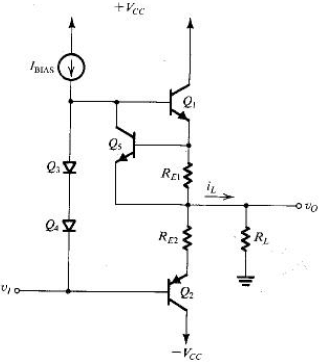
O transistor Q5 foi conectado ao circuito abaixo para fornecer proteção contra curto-circuito na saída. Com relação ao circuito, suponha que a corrente de polarização, IBIAS , seja igual a 0,28 mA e que, para Q5, a corrente de saturação seja IS = 10-14 A e a sua área de junção seja igual à área de junção dos diodos. Quando a corrente de saída fornecida pelo circuito for de 2 A, o valor que RE1 assume para que Q5 entre em condução e desvie uma corrente de 0,28 mA será o seguinte: (considere a corrente quiescente desprezível em relação à corrente fornecida pelo circuito à carga e utilize ln 2,8 = 1 e ln 10 = 2,3)
Provas
Questão presente nas seguintes provas
Um dos grandes avanços no campo da manutenção foi a implementação do conceito de Gestão Estratégica da Manutenção. Dentro desse conceito, existe o procedimento pelo qual são criados os indicadores de desempenho da atividade de manutenção. Esses indicadores também são conhecidos como:
Provas
Questão presente nas seguintes provas
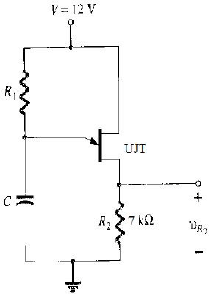
Dado o oscilador de relaxação abaixo, cujo componente ativo é um UJT (unijunction transistor - transistor de unijunção), a tensão mínima que permite o acionamento do UJT é igual a: (Considere a resistência entre os terminais do UJT aberto RBB = 5 kΩ e a relação de equilíbrio intrínseca do UJT η = 0,6)
Provas
Questão presente nas seguintes provas
TEXT
Spain's property crash casts a long shadow over a place in the sun
Graham Norwood, The Guardian, Saturday 2 April 2011
Graham Norwood, The Guardian, Saturday 2 April 2011
Spanish homeowners used to have little in common with the wealthy north Europeans snapping up holiday villas and apartments on the Costas. Now both are united in adversity. Both are suffering in a market preoccupied with falling values, negative equity, a glut of unsold new property and, in some cases, doubts about the legality of new estates. An estimated 600,000 new homes, and 200,000 part-completed ones remain unsold, a sizeable proportion of which are in holiday areas. The Bank of Spain says official house prices have fallen 17% since 2007, but many observers believe that the market is much worse than that, as the bank's index is based on valuations, not achieved sale prices. Estate agents say prices of homes have typically fallen 20% to 50% in different parts of the country, with no sector unaffected.
"There is an entire generation of young Spaniards with a millstone round their necks," says Enrique Quemada of One to One Capital Partners, a business consultancy. "They will have to work their whole lives to pay for houses now worth half what they bought them for." Meanwhile, the holiday home market also remains in the doldrums. A three-bedroom bungalow in Castellon, north of Valencia, has been slashed by its British owner from £109,000 to £79,000, and then to £66,000, but still has no takers. Taylor Wimpey, a British developer which has been building homes in Spain for more than 50 years, has new villas on the Costa Blanca for sale at £140,000, down from £235,000. On the Balearic Islands, until recently thought of as immune from the crash, prices are down as much as 40%.
"There are some real bargains, especially at the top of the market," says a spokeswoman for Savills estate agency, which has one new luxury villa on Mallorca slashed from £15.4m to a mere £9.5m. Desperate developers are also faced with a slump in British demand because of the poor euro-sterling exchange rate. As a result, a golfing resort in Catalunya is selling its homes with a guaranteed rate of €1.25 to the pound on all purchases over the summer; the market rate is €1.14. Most commentators believe that more price falls are inevitable, but even if Britons choose to buy now, the prospect of getting a Spanish mortgage is "pretty bleak," according to Melanie Bien of broker Private Finance.
"Spain stands out with a housing market and a lending record that's far worse than France, Portugal or Italy. If you must buy, somehow try to remortgage money from your own home back in Britain," she advises. The latest figures to emerge from Spain show little respite from a downturn that is now in its fourth year. Although there was a small rise in the number of homes sold early in 2010, this was driven by the desire to beat deadlines for the scrapping of mortgage tax relief and a rise on VAT on new homes. By the end of last year, sales volumes were again on the slide. Despite the glut of unsold new homes, another 257,443 were completed in 2010. Even so, there has been a 43% collapse in the value of the Spanish construction industry, according to EU figures, and a collapse in land prices of about 50%.
Spanish banks – many of which hold thousands of repossessed homes as assets – are legally obliged to start selling these homes after holding them for two years. As a result, more properties are expected to flood the market for sale this year. Meanwhile, as if that's not enough, the scandal of Spain's "illegal homes" continues. For more than a decade there have been disputes over some new developments retrospectively declared illegal by councils, controversial compulsory purchase powers given to developers by some local authorities, and politicians who have been jailed for accepting bungs.
The most recent controversy blew up last month when 12,697 new homes were declared illegal in the Almanzora Valley in south-east Spain, an area popular with holiday-home buyers. Some 920 have been earmarked for demolition, while the remainder may be rezoned, thus allowing them to be declared legal and have utilities connected. "How many will be made homeless, or lose their life savings, if 920 houses are demolished? Who's going to compensate those who bought in good faith?" asks Maura Hillen, president of Abusos Urbanisticos Almanzora No, a local pressure group composed mainly of British residents. Similar groups of disgruntled UK buyers exist across many of Spain's tourist areas.
Now the housing crash has become so much a part of the modern Spanish psyche it has been accorded the ultimate tribute – its own television soap opera. Crematorio has a storyline that includes unhappy foreign buyers, corrupt councilors, lurid affairs, drugs and violence against a backdrop of the Spanish Costas.
Far-fetched? Not this time. Many believe the fiction is some way behind the fact. Britain and Spain aren't a million miles apart when it comes to home ownership aspirations. Both are big on owner-occupation. Spain has one of the highest rates in the whole EU – a whopping 82% – with the rental market concentrated in a few major cities such as Madrid and Barcelona, says the Rics European Housing Review 2011, a major annual study of Europe's property markets. Tax breaks have encouraged people to invest in housing, though many of these have now been scrapped as part of the recent austerity measures.
And it's not just Brits and other northern Europeans who have responded to the siren call of Spain's sun-kissed beaches. The Rics study points out that, among Spaniards, "there is also a high propensity to aspire to own a second home in the countryside or on the coast: over a fifth of households own one. This helps to make crowded urban conditions more tolerable for those that can afford it".
The latter point is a reference to the fact that Spain's houses are typically pretty busy, bustling places. Says the report: "This cramped lifestyle reflects cultural factors, as well as housing shortages, as several generations of families may live together in dense urban accommodation. The number of rooms per dwelling is quite high by average EU standards, yet they tend to be small, with the usable floor area towards the bottom of the rankings."
Property prices may have fallen, but last month Spain was named one of the world's most overvalued housing markets. A report in The Economist claimed Spanish homes are overvalued by more than 43%, and said this compared with just under 30% for Britain, 20% for Ireland and -12% for Germany (ie, the market in Germany is "undervalued"). It reckons home prices should reflect the rents that tenants pay, so its index calculates the ratio of prices to rents in 20 economies. Spain was the fourth most overvalued after Australia, Hong Kong and France.
But, writing on his Spanish Property Insight website, Mark Stucklin says: "You have to take these figures with a pinch of salt as far as Spain is concerned." The problem, he says, is they are based on official figures which "significantly understate the true extent to which prices have fallen. Spanish prices have fallen much further than this index suggests ... If you want to know what's going on in the residential property market, a much more revealing figure is the collapse in planning approvals, down by 90% since 2006".
(source: http://www.guardian.co.uk/money/2011/apr/02/spain-property-prices-collapse)
The connective meanwhile in the sentence “Meanwhile, the holiday home market also remains in the doldrums.” could be replaced, without changing meaning, by:
Provas
Questão presente nas seguintes provas
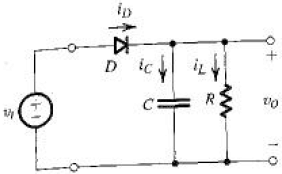
Considere um retificador de pico alimentado por uma senoide de 60 Hz tendo um valor de pico Vp = 300 V. Suponha uma resistência de carga R = 200 kΩ. O valor da capacitância C que resultará em uma ondulação de pico a pico de 1 V é o seguinte: (utilize a aproximação: e-1/α ~ 1 – 1/α, onde α é um coeficiente qualquer, e !$ \mathrm{\,\underline\,{"e"}\,} !$ é a base dos logaritmos neperianos)
Provas
Questão presente nas seguintes provas
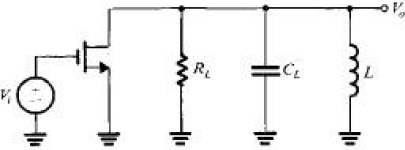
Deseja-se projetar um amplificador sintonizado conforme o circuito abaixo, tendo f0 = 1/!$ \pi !$ MHz, faixa de passagem de 3 dB igual a 10/!$ \pi !$ kHz e ganho de frequência central de -25. O FET (Field Effect Transistor – Transistor de Efeito de Campo) disponível no ponto de polarização tem transcondutância, gm, igual a 5 mA/V e resistência de saída, ro, igual a 10 kΩ. A capacitância da saída é desprezível. Os valores de RL, CL e L são, respectivamente:
Provas
Questão presente nas seguintes provas
Segundo a gramática normativa, o substantivo sempre há de pertencer a um gênero, o que não ocorre com o adjetivo que assumirá o gênero em que o substantivo está empregado. Assim sendo, assinale a alternativa em que ambos os adjetivos não se flexionam em gênero:
Provas
Questão presente nas seguintes provas
Cadernos
Caderno Container