Foram encontradas 100 questões.
Lei de iniciativa parlamentar do Município Beta criou conselho
popular com atribuição de participar do planejamento municipal,
fiscalizar a respectiva execução e opinar sobre questões
consideradas relevantes.
Diante do exposto, é correto afirmar que a Lei é:
Diante do exposto, é correto afirmar que a Lei é:
Provas
Questão presente nas seguintes provas

- Direitos e Garantias FundamentaisDireitos e Deveres Individuais e ColetivosRemédios ConstitucionaisMandado de Segurança
- Organização dos PoderesFunções Essenciais à JustiçaMinistério Público
O Ministério Público de Contas do Estado Gama impetrou
mandado de segurança contra acórdão do Tribunal de Contas
daquele Estado que determinou a extinção e o arquivamento de
representação promovida pelo Parquet de Contas para se apurar
supostas irregularidades em procedimento licitatório relativo a
contrato de edificação da nova sede administrativa do
mencionado Tribunal.
Diante do exposto, é correto afirmar que o Ministério Público de Contas:
Diante do exposto, é correto afirmar que o Ministério Público de Contas:
Provas
Questão presente nas seguintes provas
O Tribunal de Contas do Estado Gama apurou irregularidades em
contrato administrativo realizado entre o Município Alfa,
localizado no Estado Gama, e determinada empresa prestadora
de serviços de engenharia. A Assembleia Legislativa do referido
Estado Gama instaurou Comissão Parlamentar de Inquérito (CPI),
mediante requerimento de dois terços de seus membros, para
apurar as irregularidades encontradas.
Diante do exposto, é correto afirmar que:
Diante do exposto, é correto afirmar que:
Provas
Questão presente nas seguintes provas
O Sindicato da Indústria e de Material Plástico do Estado Beta
manejou ação direta de inconstitucionalidade, perante o Tribunal
de Justiça do Estado Beta, em face de Lei do Município Alfa
(localizado no Estado Beta), que dispõe sobre a obrigação de
substituição do uso de sacos e sacolas plásticas de lixos por sacos
e sacolas ecológicas.
Diante do exposto, é correto afirmar que é:
Diante do exposto, é correto afirmar que é:
Provas
Questão presente nas seguintes provas
“A intervenção do Poder Judiciário em políticas públicas voltadas
à realização de direitos fundamentais, em caso de ausência ou
deficiência grave do serviço, não viola o princípio da separação
dos poderes. A decisão judicial, como regra, em lugar de
determinar medidas pontuais, deve apontar as finalidades a
serem alcançadas e determinar à Administração Pública que
apresente um plano e/ou os meios adequados para alcançar o
resultado; No caso de serviços de saúde, o déficit de profissionais
pode ser suprido por concurso público ou, por exemplo, pelo
remanejamento de recursos humanos e pela contratação de
organizações sociais (OS) e organizações da sociedade civil de
interesse público (OSCIP).”
Diante do exposto, é correto afirmar que tal assertiva está:
Diante do exposto, é correto afirmar que tal assertiva está:
Provas
Questão presente nas seguintes provas
Em um determinado contexto no Brasil, a Controladoria Geral do
Município (CGM) apresenta-se como central em seu
planejamento a ideia de
“Ser referência na atuação preventiva, na promoção de ambiente ético e na responsabilização de atos ímprobos junto à Prefeitura, na aplicação de práticas modernas e inovadoras de Controle Interno e na participação social nas atividades de controle interno para a efetividade na Gestão Pública Municipal”.
Considerando-se as noções de planejamento nas organizações públicas, a declaração refere-se ao conceito de:
“Ser referência na atuação preventiva, na promoção de ambiente ético e na responsabilização de atos ímprobos junto à Prefeitura, na aplicação de práticas modernas e inovadoras de Controle Interno e na participação social nas atividades de controle interno para a efetividade na Gestão Pública Municipal”.
Considerando-se as noções de planejamento nas organizações públicas, a declaração refere-se ao conceito de:
Provas
Questão presente nas seguintes provas
Contemporaneamente, é reconhecido que o exercício do
controle sobre os serviços públicos tem potencial para incorporar
mais ativamente a população, os usuários e os gestores das
políticas nos processos de controle. A esse respeito, há o
potencial de serem desenvolvidas ações como:
• presença mais direta da população/segmentos sociais diversos na discussão sobre leis e sua aplicação;
• controle social sobre as decisões no Parlamento e no Judiciário, facilitado, por exemplo, pelas TVs;
• utilização de plataformas virtuais para operacionalização da participação cidadã;
• monitoramento de informações, de processos administrativos e de execução de serviços por observatórios sociais;
• participação dos usuários e representantes da sociedade na avaliação da qualidade da gestão e dos serviços.
Nesse contexto, entende-se que a função controle se expandiria por ações sustentadas no conceito de:
• presença mais direta da população/segmentos sociais diversos na discussão sobre leis e sua aplicação;
• controle social sobre as decisões no Parlamento e no Judiciário, facilitado, por exemplo, pelas TVs;
• utilização de plataformas virtuais para operacionalização da participação cidadã;
• monitoramento de informações, de processos administrativos e de execução de serviços por observatórios sociais;
• participação dos usuários e representantes da sociedade na avaliação da qualidade da gestão e dos serviços.
Nesse contexto, entende-se que a função controle se expandiria por ações sustentadas no conceito de:
Provas
Questão presente nas seguintes provas
- ProlegômenosPrincípios da Administração PúblicaPrincípios Expressos
- ProlegômenosRegime Jurídico Administrativo
Uma determinada entidade da administração pública, ao emitir
uma ordem de serviço, indevidamente, não promoveu a inclusão
no Diário Oficial, prejudicando a transparência sobre o processo.
Nessa situação, a organização feriu o princípio básico da
administração pública de:
Provas
Questão presente nas seguintes provas
Figura 1
Uma determinada organização social atuando na área de saúde
pública iniciou a elaboração do seu balanced score card (BSC),
adaptando a metodologia para a realidade de sua atuação. No
BSC elaborado, é possível perceber a adaptação das quatro
perspectivas, bem como dos objetivos estratégicos e,
posteriormente, seus indicadores.
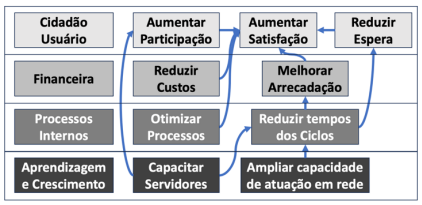
É compatível com a perspectiva de aprendizagem e crescimento:
Provas
Questão presente nas seguintes provas
Figura 1
Uma determinada organização social atuando na área de saúde
pública iniciou a elaboração do seu balanced score card (BSC),
adaptando a metodologia para a realidade de sua atuação. No
BSC elaborado, é possível perceber a adaptação das quatro
perspectivas, bem como dos objetivos estratégicos e,
posteriormente, seus indicadores.
Provas
Questão presente nas seguintes provas
Cadernos
Caderno Container