Foram encontradas 100 questões.
Considerando o disposto no Código de Conduta, Ética e Integridade da Embrapa e na Lei n.º 13.303/2016, julgue os itens a seguir.
A Lei n.º 13.303/2016 assegura a participação de representantes dos empregados no conselho de administração da empresa pública.
Provas

Julgue os itens a seguir, referentes à lógica proposicional, considerando os símbolos lógicos comuns e as letras maiúsculas como representativas de proposições simples.
Se as primeiras três colunas da tabela-verdade da proposição lógica (P ∨ Q) → R forem iguais às apresentadas a seguir, então, nesse caso, a última coluna dessa tabela-verdade apresentará valores V ou F, tomados de cima para baixo, na seguinte sequência: V F V F V F V V.
| P | Q | R |
|---|---|---|
| V | V | V |
| V | V | F |
| V | F | V |
| V | F | F |
| F | V | V |
| F | V | F |
| F | F | V |
| F | F | F |
Provas
Julgue os itens a seguir, referentes à lógica proposicional, considerando os símbolos lógicos comuns e as letras maiúsculas como representativas de proposições simples.
A proposição lógica (Q → R) ∧ P é equivalente à proposição lógica (~Q ∧ P) ∨ (R ∧ P).
Provas
Julgue os itens a seguir, referentes à lógica proposicional, considerando os símbolos lógicos comuns e as letras maiúsculas como representativas de proposições simples.
A proposição lógica P → (R ∧ Q) representa corretamente a seguinte sentença: “A elevada produtividade de uma empresa agropecuária é consequência direta de uma gestão que prioriza a valorização dos recursos naturais e a otimização dos processos de produção.”.
Provas
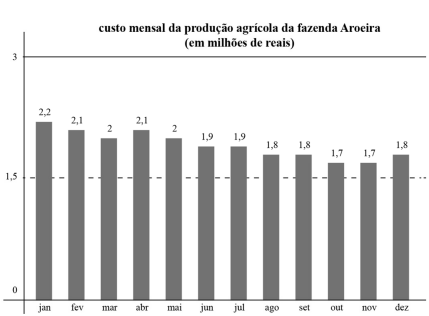
Com base no gráfico precedente, julgue os itens seguintes, considerando que, para essa sequência de dados, a média é 1,92 e a variância é 0,025.
Para a sequência de dados apresentada, a média é superior à mediana.
Provas
Com base no gráfico precedente, julgue os itens seguintes, considerando que, para essa sequência de dados, a média é 1,92 e a variância é 0,025.
Para a sequência de dados apresentada, a média é superior a 110% do valor da moda.
Provas
Com base no gráfico precedente, julgue os itens seguintes, considerando que, para essa sequência de dados, a média é 1,92 e a variância é 0,025.
O desvio padrão dos dados do gráfico é inferior a 0,13.
Provas
Grain poisoning of cattle and sheep
Grain poisoning, also known as grain overload or lactic acidosis, is usually the result of stock consuming large quantities of grain or pellets to which they are unaccustomed. Pasture-fed cows or feedlot cattle not yet adapted to grain may become acutely ill or die after eating only moderate amounts of grain, whereas stock accustomed to diets high in grain content may consume large amounts of grain with little or no effect. Some circumstances under which grain poisoning can occur include: accidental access to grain stores; stock access to stubble paddocks containing excess grain after harvest; stock access to standing crops; cattle and sheep on feedlot rations without proper introduction; and grain feeding during drought without proper introduction.
How is it caused? Grain and finely ground carbohydrate (such as found in pellets) is rapidly fermented by bacteria in the rumen, producing large quantities of lactic acid, which lowers the pH in the rumen. The build-up of acid has effects on the animal such as: there is a decrease in the numbers of useful bacteria in the rumen and an increase in the amount of acid-producing bacteria (causing further build-up of acid in the rumen), rumen contractions cease, lactic acid draws fluid into the rumen from the tissues and blood, resulting in dehydration, and, in severe cases, the blood may become more acid, resulting in heart failure, kidney failure and or even death.
Grains with a higher fibre content, such as oats and sorghum, are safer to feed than, for example, wheat and barley, since the fibre slows the rate of digestion. Cracking grain increases the rate of digestion of the starch and consequently may increase the risk of grain poisoning. Any factor that causes variation in the intake of grain, or variation in the availability of carbohydrate, may lead to grain poisoning problems. For example, an unpalatable additive or inclement weather may put cattle off their feed on one day, but then they gorge the next day. The effects of grain poisoning may be worsened if the animal is also suffering from cold stress. It is a wise precaution to increase the proportion of roughage fed during particularly cold weather. Other sources of carbohydrates, such as apples, grapes, bread, baker’s dough and incompletely fermented brewer’s grain, can also cause poisoning if eaten in excess.
Internet:<dpi.nsw.gov.au> (adapted).
Judge the following items based on the text above.
An unpleasant additive or harsh weather might cause cattle to skip their feed one day, leading them to overeat the following day.
Provas
Grain poisoning of cattle and sheep
Grain poisoning, also known as grain overload or lactic acidosis, is usually the result of stock consuming large quantities of grain or pellets to which they are unaccustomed. Pasture-fed cows or feedlot cattle not yet adapted to grain may become acutely ill or die after eating only moderate amounts of grain, whereas stock accustomed to diets high in grain content may consume large amounts of grain with little or no effect. Some circumstances under which grain poisoning can occur include: accidental access to grain stores; stock access to stubble paddocks containing excess grain after harvest; stock access to standing crops; cattle and sheep on feedlot rations without proper introduction; and grain feeding during drought without proper introduction.
How is it caused? Grain and finely ground carbohydrate (such as found in pellets) is rapidly fermented by bacteria in the rumen, producing large quantities of lactic acid, which lowers the pH in the rumen. The build-up of acid has effects on the animal such as: there is a decrease in the numbers of useful bacteria in the rumen and an increase in the amount of acid-producing bacteria (causing further build-up of acid in the rumen), rumen contractions cease, lactic acid draws fluid into the rumen from the tissues and blood, resulting in dehydration, and, in severe cases, the blood may become more acid, resulting in heart failure, kidney failure and or even death.
Grains with a higher fibre content, such as oats and sorghum, are safer to feed than, for example, wheat and barley, since the fibre slows the rate of digestion. Cracking grain increases the rate of digestion of the starch and consequently may increase the risk of grain poisoning. Any factor that causes variation in the intake of grain, or variation in the availability of carbohydrate, may lead to grain poisoning problems. For example, an unpalatable additive or inclement weather may put cattle off their feed on one day, but then they gorge the next day. The effects of grain poisoning may be worsened if the animal is also suffering from cold stress. It is a wise precaution to increase the proportion of roughage fed during particularly cold weather. Other sources of carbohydrates, such as apples, grapes, bread, baker’s dough and incompletely fermented brewer’s grain, can also cause poisoning if eaten in excess.
Internet:<dpi.nsw.gov.au> (adapted).
Judge the following items based on the text above.
The excerpt: “It is a wise precaution to increase the proportion of roughage fed during particularly cold weather.” (in the third paragraph) can be correctly translated as: É uma precaução sensata aumentar a proporção de forragem fornecida durante climas particularmente frios.
Provas
Grain poisoning of cattle and sheep
Grain poisoning, also known as grain overload or lactic acidosis, is usually the result of stock consuming large quantities of grain or pellets to which they are unaccustomed. Pasture-fed cows or feedlot cattle not yet adapted to grain may become acutely ill or die after eating only moderate amounts of grain, whereas stock accustomed to diets high in grain content may consume large amounts of grain with little or no effect. Some circumstances under which grain poisoning can occur include: accidental access to grain stores; stock access to stubble paddocks containing excess grain after harvest; stock access to standing crops; cattle and sheep on feedlot rations without proper introduction; and grain feeding during drought without proper introduction.
How is it caused? Grain and finely ground carbohydrate (such as found in pellets) is rapidly fermented by bacteria in the rumen, producing large quantities of lactic acid, which lowers the pH in the rumen. The build-up of acid has effects on the animal such as: there is a decrease in the numbers of useful bacteria in the rumen and an increase in the amount of acid-producing bacteria (causing further build-up of acid in the rumen), rumen contractions cease, lactic acid draws fluid into the rumen from the tissues and blood, resulting in dehydration, and, in severe cases, the blood may become more acid, resulting in heart failure, kidney failure and or even death.
Grains with a higher fibre content, such as oats and sorghum, are safer to feed than, for example, wheat and barley, since the fibre slows the rate of digestion. Cracking grain increases the rate of digestion of the starch and consequently may increase the risk of grain poisoning. Any factor that causes variation in the intake of grain, or variation in the availability of carbohydrate, may lead to grain poisoning problems. For example, an unpalatable additive or inclement weather may put cattle off their feed on one day, but then they gorge the next day. The effects of grain poisoning may be worsened if the animal is also suffering from cold stress. It is a wise precaution to increase the proportion of roughage fed during particularly cold weather. Other sources of carbohydrates, such as apples, grapes, bread, baker’s dough and incompletely fermented brewer’s grain, can also cause poisoning if eaten in excess.
Internet:<dpi.nsw.gov.au> (adapted).
Judge the following items based on the text above.
Sudden changes in grain intake or carbohydrate availability will increase the risk of grain poisoning.
Provas
Caderno Container