Foram encontradas 950 questões.
Silva (2015), em seu trabalho intitulado O Guerreiro Alagoano: Corpo e Pedagogia Multirreferencial, apresenta o seguinte trecho:
Na dança do Guerreiro Alagoano, assim como na maioria das nossas danças populares é o Mestre quem possui o conhecimento para reger e direcionar as partes da brincadeira. Ele utiliza de seu apito para direcionar as cenas, a orquestra e o coro. [...] personagens sendo os principais: Mestre, Contra- Mestre, Rei, Rainha (duas), Lira, Índio Peri e seus Vassalos, Mateus (dois), o Boi, Embaixadores (dois), General, Palhaços (dois), uma Catirina (às vezes), Sereia, Estrela de Ouro, Estrela Brilhante, Estrela Republicana, a Banda da lua e as Figuras ou os Entremeios (Silva, 2015, p. 49).
SILVA, Cláudio Antônio Santos da. O guerreiro alagoano: corpo e pedagogia multirreferencial. 2015. 132 f. Dissertação (Mestrado em Artes Cênicas) – Escola de Teatro e de Dança, Universidade Federal da Bahia, Salvador, 2015.
Caso um/a professor/a de Educação Física do Instituto Federal de Alagoas tenha intenção de trabalhar com o Guerreiro Alagoano em suas aulas, de acordo com os princípios norteadores da Base Nacional Comum Curricular (BNCC) (Brasil, 2018), esse docente
Provas

A fisiologia do exercício é considerada uma das disciplinas básicas na formação em Educação Física e deve fundamentar também a prática pedagógica do professor de Educação Física na escola, pois permitirá que os alunos entendam o funcionamento do corpo em movimento.
Sobre os aspectos fisiológicos do exercício no corpo humano, assinale a alternativa correta.
Provas
Language Pedagogy and Teacher Identity:
A Decolonial Lens to English Language Teaching from a Teacher Educator’s Experience
[...] Identity is a central category in ELT (English Language Teaching). For instance, several studies have been conducted to document English language teachers’ identities (ELTIs) and how they are constructed [...]. However, identity continues to be seen and researched within what Mignolo (2009) labels as the colonial difference. The colonial difference operates by converting differences into values and establishing a hierarchy of human beings ontologically and epistemically. Ontologically, it is assumed that there are inferior human beings. Epistemically, it is assumed that inferior human beings are rationally and aesthetically deficient.
In this respect, the ELT field has witnessed how colonial constructions of ELTIs have been combined with factors such as race, gender, ethnicity, class, language, and others [...].
Therefore, ELP (English Language Pedagogy) is a remnant of coloniality. In particular, ELP in ELT has separated the subjects from their bodies/identitary features and their geographical location regarding the teaching practice [...]. This attempt is evident in the insertion of the notion of competence as the only discourse mostly reproduced in teaching and teacher education. This unidirectional/dimensional discourse is what has caused that “English language teaching and learning identities are more oriented towards that goal of identifying decontextualized forms of being in the field of teaching” (Castañeda-Peña, 2018, p. 18). For instance, Grosfoguel (2010), when discussing coloniality, claims that: “By breaking the link between the subject of enunciation and the ethnic/racial/sexual/gender/epistemic place, Western philosophy and science manage to create a myth about a real universal knowledge that masks, that is, conceals not only the speaker but also the epistemic, geo and body-political place of the structures of colonial power/knowledge from which the subject speaks [...].
In line with decoloniality by Mignolo and Walsh (2018), we think of ELP otherwise – as “the ongoing serpentine movement toward possibilities of other modes of being, thinking, knowing, sensing, and living”; a movement only possible if those who enact ELP name it, reclaim it, and commit to “changing, disrupting, and dismantling the hegemonic relations” [...].
Therefore, I would like to resort to intersectionality – the intersection of different identitary features – to allow the recognition of whom we are based on what we do, as “who we are and from where we speak is highly relevant for the intellectual projects we are likely to pursue” (Moya, 2011, p. 79). Intersectionality can assist in claiming agency (Stone-Mediatore, 2003) in spaces and territories where colonial histories have been present [...].
Intersectional narratives are then discursive representations of experience in which there is conceptual integration among those conversing. In fact, intersectional narratives serve this study to ground concepts and interpretations for “knowledge co-creation, in which researchers and participants develop shared understandings and develop new ideas” (Galafassi et al., 2018, p. 9). This is why intersectional narratives in this study comprise a relevant theoretical construct indispensable to investigating epistemological ruptures [...].
Available in: https://revistas.unal.edu.co/index.php/profile/article/view/90754. Acess on: Feb. 10, 2026. (Adapted).
The article states that
Provas
Communication Strategies in English as a Second Language (ESL) Context
[...] Foreign language learners may encounter various communication problems when their interlanguage is limited. In order to convey their messages and remain in a conversation until their communication goal is achieved, [...] learners need to employ communication strategies, which have been defined generally as device used by second language learners to overcome perceived barriers to achieving specific communication goals [...]. Language learning cannot be separated from its culture. Language is a clear manifestation of culture. A word can have both cognitive meaning and cultural meaning. Cultural meaning refers to words and expressions which represent cultural perception, values and behavior. At discourse level, the link between language, communication and culture is virtually inseparable.
Miscommunication occurs when one interprets communicative rules of one culture in terms of the rules of another culture. In the process of learning a second language, learners make some errors due to first language interference. By knowing strategies to avoid misinterpretation between different backgrounds of speakers, the problems mentioned before shall be avoided easily. Language teaching at school has traditionally been aimed at developing linguistic competence. Teachers tend to teach grammar and linguistic features without letting their learners practice and improve their communication in English. Probably this is one reason that cause some learners are good in English but they cannot use English orally. This problem may be solved by introducing communication strategies to learners in order to avoid communication problems and equip them with strategies to overcome the problems of speaking that they are dealing with [...].
Communication strategies are usually associated with spoken language and research has shown that students tend to use various communication strategies when they are unable to express what they want to say because of their lack of resources in their second language (L2) [...]. When learners experience that fluency in their first language (hereafter L1) does not follow the same pattern as their L2, a gap is created in the knowledge of their L2. These gaps can take many forms: a word, a phrase, a structure, a tense marker or an idiom [...]. In order to overcome that gap, learners have two options: they can either leave the original communicative goal or they can try to reach alternative plans and use other linguistic means that they have at their disposal [...]. It is also important to know that culture and language cannot be separated. Therefore, in the context of language teaching, the knowledge of language and its culture need to be taught as well. The role of teachers in introducing communication strategies to students could determine learners’ successfulness in facing problems of communication [...].
Despite the fact that many [...] researchers lend support to communication strategies training, some opposition to it has been expressed. Bialystok (1990) and Kellerman (1991) argue that one should teach the language itself rather than the strategies. Schmidt (1983) believes that L2 learners develop their strategic competence at the expense of their linguistic competence. According to Skehan (1998), using communication strategies by skilled learners may hinder the development of their interlanguage knowledge resources [...].
Available in: https://files.eric.ed.gov/fulltext/EJ1129727.pdf. Acess on: Jan. 30, 2026.
According to the text,
Provas
Multiliteracies and multimodal literacies are a comprehensive response to the mobile semiotics of contemporary society. Flows of people, images and ideas, have meant the impact is experienced globally as well as locally and contextually. Along with New Literacy Studies, multiliteracies framework has as its central focus a socially just and culturally inclusive curriculum. Further, informed by critical pedagogy and critical literacy, multiliteracies has, at its conceptual centre, a transformative pedagogy aimed at effective learning across social and cultural differences, and across different learning styles. To attend to the change in social futures, multiliteracies has, at its nexus, student knowledges, lived experiences and student centred resources.
Central to multiliteracies is the concept of Design. The New London Group indicates the numerous ways by which signification occurs. More recently, as Kalantzis and Cope (2005) describe it, “there is a nice ambiguity in the word ‘design’. Design can denote morphology or the sense of invisible inner structures or inherent relationships of cause and effect” (p. 41). Kalantzis and Cope (2005) use Design in a comprehensive manner to denote “agency” as the “stuff of the characteristically self-conscious pedagogical moves, teaching frameworks and organisational forms of education as we currently understand it” (p. 41). In brief, as Falk (2001) observes, for the New London Group, Design expresses “the active role of the literacy learner in constructing new meaning from existing resources” (p. 314). Because Design rejects isolated, abstract and decentralised learning, it demands “production of the new rather than replication of the old” (Kress, 2000, p. 141). In Design, the learner is actively creating and re-creating while having choices in learning that did not exist in traditional print-based models of literacy.
The modes or Design concepts are: linguistic, visual, audio, spatial and gestural; however, the New London Group do not perceive each of these literacies as singular and isolated from other literacies. For students who engage with the four knowledge processes there is deep understanding and proactive learning:
• Experiencing: through the known and the new, where the evidence data from the prior knowledge and life experience of the learner is combined with immersion in new knowledge and new experience in meaningful settings.
• Conceptualising: abstract concepts and theoretical synthesis by the process of naming and theorising. This enables the learner to define, apply concepts and comprehend the abstract generalised meanings in concepts and visual representations.
• Analysing: analysing, interpreting functions capably, through the comprehension of the role of knowledge and critically by analysing purpose and intentions.
• Applying: knowledge appropriately and creatively by understanding suitable situations to apply knowledge and extending it to create new knowledges.
IYER, Radha; LUKE, Carmen. Multimodal, Multiliteracies: Texts and Literacies for the 21st century. In: PULLEN, Darren L.; COLE, David R. Multiliteracies and Technology Enhanced Education. Social Practice and the Global Classroom. Hershey and New York: ICI Global, 2010, p. 22. (Adapted).
After reading this passage on multiliteracies and design, choose the alternative that best conceptualizes those two words.
Provas
Read the abstract from na article titled “Social media pedagogy: Applying an interdisciplinary approach to teach multimodal critical digital literacy”.
Abstract
Social media permeates the daily lives of millennials, as they use it constantly for a variety of reasons. A significant contributing factor is the availability of social media through smartphones and mobile apps. This kind of immersive and complex media environment calls for a literacy pedagogy that prepares students to understand, engage with, and adapt to social media that are inevitably going to remain a part of their lives. Research into digital literacy/literacies has sought to address the development of tools and methods to aid college students in becoming more situated and adept digital citizens. This article extends the conceptualization and application of digital media literacy through the inclusion of a critical, multimodal, and interdisciplinary pedagogical approach. The paper illustrates that critical digital literacy drawing upon multimodal and interdisciplinary analysis is imperative in preparing students to manage the predominance of social media in their lives.
TALIB, Saman. Social media pedagogy: Applying an interdisciplinary approach to teach multimodal critical digital literacy. In E-Learning and Digital Media. Sage, 2018. Available at: journals.sagepub.com/home/ldm. Access on: Feb 12, 2026. DOI: 10.1177/2042753018756904.
This objective of the article as stated in the abstract is to
Provas
The EFL Students’ Critical Reading Skills across Cognitive Styles
[...] Considering the importance of having critical reading skills for English as a Foreign Language (EFL) students, the topic of developing of the students’ critical reading always has a prominent place among the researchers and educators. Numerous studies have been conducted to investigate the students’ critical reading ability in English language teaching (ELT) [...].
All of the studies reveal significant roles of critical reading ability on students’ success in academic study and its powerful effect on students’ critical thinking. More specifically, a study by Sultan et al. (2017) reveals that critical literacy approach had a significant effect on the pre-service language teachers’ critical reading skills, which include interpretation, analysis, making an inference, evaluation, explanation, and self-regulation [...].
Moreover, a study conducted by Karabay (2015) finds that, when reading texts, critical readers are always analytical; especially when they take critical notes and underline important information in the texts. Similarly, Kobayashi (2007), far before the study conducted by Karabay (2015), also indicate that critical readers substantially produce critical notes while reading expository texts, comparing to the less-critical readers who relied much on making a summary of the texts.
Critical reading is a skeptical, careful, active, reflective, and analytical activity to judge the value of the text [...]. It is true that when reading texts, critical readers do not only grasp what is explicitly stated in the text but also go far beyond it using their high order thinking skills (HOTs) to tackle and evaluate the content of reading texts.
These skeptical and analytical skills are required because of the emergence of the internet and other media [...]. This suggests that critical reading should become a part of foreign language teaching and learning. The English teachers or instructors should design appropriate teaching activities which encourage the students to develop their critical skills in reading [...]. The critical reading skills are important for the students because it affects their critical thinking abilities which are required nowadays, and in turn, helping them to be critical citizens and critical readers.
A study by Zin & Eng (2014) indicates that critical reading ability can foster the students’ critical thinking habits. This is because reading is thinking and one cannot read without thinking [...]. Nevertheless, it is still difficult for the students to acquire the critical reading ability and big efforts and time are necessary to train the students to be critical. It is because the freshmen are sometimes not ready for the college academic tasks which require their critical thinking. Research carried out by Lisa (2008) confirms that many of the freshmen at the university level are not prepared for the demands of college reading, however, their critical reading skills are developed throughout the semester [...].
Available in: https://jurnalfaktarbiyah.iainkediri.ac.id/index.php/jeels/article/view/72. Acess on: Jan. 30, 2026.
According to the article,
Provas
Certain people from certain places (the Global North) in certain languages (overwhelmingly English) produce the vast amount of knowledge about language, second language learning, education, language policy, and so on, and make universal claims to the applicability of that knowledge to the rest of the world. This is not just vaguely inappropriate knowledge, but rather knowledge that seeks to colonize. To oppose this requires several kinds of action that can bring a strong element of renewal to a discipline that all too often speaks only to itself, and largely in English. A central part of this is a process of decolonization of knowledge and practices, of language and theories of second language acquisition, of language policies, and language in education. We need to systematically and thoroughly deconstruct cultural hegemony in our own discipline and beyond and enlist more and more scholars from especially developing Third World societies to participate in the construction or re-invention of various cultural frameworks of research including both aboriginal, native cultural and intellectual resource and local specific conditions, needs and aspirations.
Decolonizing applied linguistics suggests first of all the need to decolonize ‘language’– or the way that language is framed in linguistics and applied linguistics – aspart of any reclamation project. We can identify several key northern ideas about language that are at best inappropriate when applied to southern contexts and at worst are downright harmful. These include a legacy of considering languages in terms of cognitive, literate systems rather than embodied and embedded cultural processes; a tendency to reify languages as if they exist outside of human relations; and a set of assumptions about languages as repositories of knowledge that once lost, lead simultaneously to the loss of shared forms of culture and knowledge. Language reclamation itself can be understood as a process of decolonization both in terms of giving new life to a language that has been cast aside by processes of coloniality and modernity, and in terms of changing the ways in which language is understood (resisting the colonial archives of linguistic modernity). Decolonization from this point of view involves community needs and goals rather than top-down assumptions about grammatical fluency, and above all, community ontologies of language.
PENNYCOOK, Alastair; MACONI, Sinfree. Innovations and Challenges in Applied Linguistics from the Global South. London and New York: Routledge, 2019, pp. 126-7.
After reading the excerpt, think about the possible relation between applied linguistics and language reclamation and choose the alternative that best associates them.
Provas
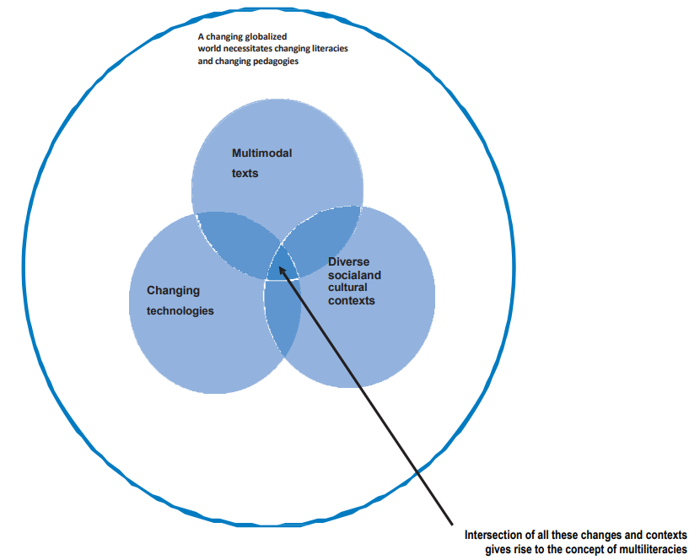
The chart taken from the chapter “The rise of multiliteracies” from a book titled Foundations of Multiliteracies visually conceptualizes multiliteracies. Observe the chart and them choose the definition that best completes the sentence: Multiliteracies is
Provas
Exploring digital multimodal text in EFL classroom: Transformed Practice in Multiliteracies Pedagogy
[...] In the twenty-first century, education is faced with the sophisticated technology and advance communication because people are now living in a global society with increasingly different local contexts. Students have discovered various ways of using media to communicate, collaborate, and create in the digital space. Much research has been done on multiliteracies pedagogy and a substantial number of studies have investigated multimodal texts [...].
This new environment changes the concept of text from reading and writing to be multimodal. Consequently, education needs to improve the quality of leaners that have high level of creativity to understand multimodal text. Multimodalities are always integrated with the advanced technology where information comes from many sources in different forms [...]. Not only do English teachers need to include the students with all their diversities in situated contexts, but they also need to engage them in multiliteracies.
Multiliteracies pedagogy concerned with the use of multimodal layers of learners’ world in the classroom to engage students with the tools and technology that they are already familiar with. It has been considered that multiliteracies pedagogy is a meaningful way that can effectively engage students in teaching and learning practice by offering four benefits. First, it strengthens the relationship between teacher and students. Second, it increases the inclusivity for multiplicity. Third, it develops performances of literacy practices. Last, it creates positive classroom community. The concept of multiliteracies pedagogy is has four major components which can be implemented in teaching practices. Those components are situated practice, overt instruction, critical framing, and transformed practice. Every component has its important role in teaching and learning practice. They do not stand in linear hierarchy, but each of them can happen repeatedly, randomly, or simultaneously in complex ways [...].
Situated practice means the involvement of meaningful practices that able to relate to students’ experience and background. Through situated practice, teacher needs to construct the students’ life world experience and putting the meaning-making process in the real-world context. Overt instruction is defined as an active interaction between teacher and students that helps students to understand what they learn. Critical framing is similar with analyzing the social and cultural meaning of texts by assessing particular designs of meaning. Transformed practice is transferring the previous design to create a new design of text in a different context and cultural site. With transformed practice, students are expected to apply the knowledge they gained (from situated practice, overt instruction, and critical framing) appropriately and creatively. This involves activities such as writing, drawing, problem-solving [...].
Available in: https://journal.ipm2kpe.or.id/index.php/LEEA/article/view/1416. Acess on: Feb. 10, 2026. (Adapted).
The article affirms that
Provas
Caderno Container