Foram encontradas 40 questões.
Leia a história em quadrinhos.

(Disponível em http://doodletimeinportuguese.tumblr.com/page/5. Acesso em 18/07/2015.)
Em relação às estratégias de produção textual nas modalidades escrita e oral, a história em quadrinhos apresentada
Provas
Questão presente nas seguintes provas

Another Defeat for Brazil’s Kids
SÃO PAULO, Brazil — This month, public school teachers from the state of São Paulo announced the end of their three-month-long strike — without any of their demands having been met. For the first time since it began, the strike reached the front page of a major newspaper(d); it had been mostly neglected until then. The headline declared: “Defeated, São Paulo’s Teachers Put an End to Their Strike.”
It was the longest teachers’ strike in the state. They maintained to the end their demand of pay parity with other college-educated professionals — which would ultimately have meant a 75 percent salary increase. This is a steep rise(a) in public salaries, but the parity principle is part of the National Educational Plan, a law adopted last year with support from President Dilma Rousseff. According to that plan, parity is to be achieved by 2020.
The teachers also demanded smaller classes, with at most 25 students. The secretary of education stipulates a maximum of 40 students in high school classes, but last February, at the beginning of the school year, there were accounts of classes with 85 or 95 enrolled students. As if that weren’t bad enough(b), the state government shut down(c) more than 3,000 classes this year, according to the teachers’ union for São Paulo State.
For a 40-hour workweek, professionals with a graduate degree who teach fifth to 12th graders earn a base salary of $770 a month, or $9,240 a year. And this is the best scenario; those who teach for elementary school (first through fourth grades) earn $8,100 a year. The extra hourly wage for teachers in the upper grades is $3.80, less than half what a fast-food worker earns in the United States. Let me stress the point: They are paid around $4 for teaching a whole class of 40 students for an hour.
The protesters also complain that the government does not follow a law that mandates one-third of the working hours to be spent in activities outside the class, such as marking exams and preparing for class.
(Available at http://www.nytimes.com/2015/06/26/opinion/vanessa-barbara-another-defeat-for-brazils-kids. Access 2015/07/07.)
Considering the meaning of the words in the text, mark the correct statement.
Provas
Questão presente nas seguintes provas
Transbording
Triste o país que tem vergonha da própria língua.
Fico pensando num corretor de imóveis tendo que mostrar, para compradores em potencial, um apartamento no edifício Golden Tower, ou similar, em algum lugar do Brasil.
– Isto é o que nós chamamos de “entrance”(c).
– “Entrance”?
– Ou “front door”. Porta da frente.
– Ah.
– Aqui temos o “living room” e o “dining room” conjugados. Ou “conjugated”. Por aqui, a “gourmet kitchen”.
– “Kitchen” é...?
– Cozinha, mas nós não gostamos do termo. Isto aqui é interessante: é o que chamamos de “coffee corner”, onde a família pode tomar seu “breakfast” de manhã. A “gourmet kitchen” vem com todos os “appliances”, e o prédio tem uma “smart laundry” comunitária.
– O que é “smart laundry”?(d)
– Não tenho a menor ideia, mas é o que está escrito no “flyer”(a). E passamos para o “corridor”, que leva ao “master bedroom”, ou “suíte”, em português. As camas podem ser “king size” ou “queen size”. Aqui temos o “closet”, que em português também é “closet”. E aqui temos esta “giant window”, que dá para o “garden” do prédio, e o “playground”. Você tem “kids”?
– O quê?
– “Kids”. Crianças.
– Ah. Não.
– O “garden” também tem uma “green walk”, que é uma trilha para passear entre as “trees and tropical plants”, e uma “infinity pool”, que é uma piscina que parece que está sempre transbordando, ou “transbording”. Além disto, claro, existe um “indoor pool”, que faz parte do “fitness center”. Ah, e se comprarem o apartamento, vocês automaticamente passam a fazer parte do “party club”, onde tem um “barbecue pit”.
– “Barbecue pit”?
– Churrasqueira. E podem usar o “working hub”, que eu também não sei o que é, mas com esse nome só pode ser coisa fina.
– E a segurança...?
– Garantida dia e noite, ou “twenty-four/seven”.
– Porteiro?
– Sim, mas não chamamos de porteiro. Ele é um “hall concierge”(b).
– Tudo ótimo, mas não sei se vamos comprar o apartamento.
– Por que não?
– Ter que mostrar o passaporte, sempre, para entrar em casa... Sei não.
(VERÍSSIMO, L. F. O Estado de S. Paulo, 21 de maio de 2015.)
A respeito do uso das aspas na crônica de L. F. Veríssimo, é correto afirmar que foram utilizadas
Provas
Questão presente nas seguintes provas
Exam focus damaging pupils' mental health, says NUT
Too much focus on exams is damaging pupils' mental health and self-esteem in England's schools, a report says.
The National Union of Teachers' report says pupils are developing stress-related conditions linked to testing.
Based on a survey of 8,000 teachers and a review of research, the report says drilling for tests has narrowed what children are learning.
The government said it is determined to ensure every child is able to realise their potential.
The report “Exam Factories? The Impact of Accountability Measures on Children and Young People”, by Prof Merryn Hutchings of London Metropolitan University, says pupils' emotional health and wellbeing is suffering because of "high-stakes testing".
'Complete meltdown'
These are the national tests, exams and progress measures which the government uses to hold schools to account.
Most teachers surveyed for the report agreed pupils became "very stressed/anxious in the time leading up to Sats/public examinations".
One teacher said: "You just see them sat there, a 10- or 11-year-old kid in complete meltdown."
Another said: "I have just had a child off school for three days because he was so worried about his recent test result and didn't want to take any more tests."
Lucie Russell, director of campaigns at mental health charity Young Minds, which backed the report, said: "Both pupils and teachers are under a lot of pressure to achieve results in a pressure cooker, exam factory environment.
"Many of the young people Young Minds works with say that they feel completely defined by their grades and that this is very detrimental to their wellbeing and self-esteem."
According to the report, the tests affect both able and less able pupils similarly.
'High expectations'
One secondary school special-needs co-ordinator said: "The higher ability [pupils], and the ones with the very supportive or pushy parents, are receiving higher levels of stress because of how much is being expected of them.
"I think the lower end or those with maybe less supportive parents as well are suffering from the fact that they are not being given a curriculum that suits them."
The report also argued the focus on testing was harming pupil-teacher relationships, with teachers less able to view pupils in the round.
One junior school teacher said: "I am in danger of seeing them more in terms of what colour they are in my pupils' list, eg: are they red (below expectation), green (above expectation) or purples (Pupil Premium) - rather than as individuals."
'New curriculum'
Kevin Courtney, deputy general-secretary of the NUT, said: "Teachers at the sharp end are saying this loud and clear, 'If it isn't relevant to a test then it is not seen as a priority.'
"The whole culture of a school has become geared towards meeting government targets and Ofsted expectations. As this report shows, schools are on the verge of becoming 'exam factories'."
He argued the accountability agenda was "damaging children's experience of education", which should be joyful and leave them with "a thirst for knowledge for the rest of their lives".
A Department for Education spokesperson said: "Part of our commitment to social justice is the determination to ensure every child is given an education that allows them realise their potential.
"That's why we are raising standards with a rigorous new curriculum, world class exams and new accountability system that rewards those schools which help every child to achieve their best."
(Available at http://www.bbc.com/news/education-33380155. Access 2015/07/07.)
In this article, one can see different points of view regarding a single issue. As to this polyphonic constitution, cross the right option.
Provas
Questão presente nas seguintes provas
A unidade básica da linguagem verbal é o texto, compreendido como a fala e o discurso que se produz, e a função comunicativa, o principal eixo de sua atualização e a razão do ato linguístico.
(Linguagens, códigos e suas tecnologias. Brasília: Ministério da Educação, 2006.)
À luz dos conceitos defendidos pelos Parâmetros Curriculares Nacionais e das mais recentes pesquisas linguísticas, é consenso que a concepção de linguagem subjaz à metodologia adotada nas aulas de Língua Portuguesa. De acordo com esse enfoque, assinale a alternativa que apresenta o viés adotado pelos Parâmetros Curriculares Nacionais para o trabalho com o texto nas aulas de Língua Portuguesa.
Provas
Questão presente nas seguintes provas
Transbording
Triste o país que tem vergonha da própria língua.
Fico pensando num corretor de imóveis tendo que mostrar, para compradores em potencial, um apartamento no edifício Golden Tower, ou similar, em algum lugar do Brasil.
– Isto é o que nós chamamos de “entrance”.
– “Entrance”?
– Ou “front door”. Porta da frente.
– Ah.
– Aqui temos o “living room” e o “dining room” conjugados. Ou “conjugated”. Por aqui, a “gourmet kitchen”.
– “Kitchen” é...?
– Cozinha, mas nós não gostamos do termo. Isto aqui é interessante: é o que chamamos de “coffee corner”, onde a família pode tomar seu “breakfast” de manhã. A “gourmet kitchen” vem com todos os “appliances”, e o prédio tem uma “smart laundry” comunitária.
– O que é “smart laundry”?
– Não tenho a menor ideia, mas é o que está escrito no “flyer”. E passamos para o “corridor”, que leva ao “master bedroom”, ou “suíte”, em português. As camas podem ser “king size” ou “queen size”. Aqui temos o “closet”, que em português também é “closet”. E aqui temos esta “giant window”, que dá para o “garden” do prédio, e o “playground”. Você tem “kids”?
– O quê?
– “Kids”. Crianças.
– Ah. Não.
– O “garden” também tem uma “green walk”, que é uma trilha para passear entre as “trees and tropical plants”, e uma “infinity pool”, que é uma piscina que parece que está sempre transbordando, ou “transbording”. Além disto, claro, existe um “indoor pool”, que faz parte do “fitness center”. Ah, e se comprarem o apartamento, vocês automaticamente passam a fazer parte do “party club”, onde tem um “barbecue pit”.
– “Barbecue pit”?
– Churrasqueira. E podem usar o “working hub”, que eu também não sei o que é, mas com esse nome só pode ser coisa fina.
– E a segurança...?
– Garantida dia e noite, ou “twenty-four/seven”.
– Porteiro?
– Sim, mas não chamamos de porteiro. Ele é um “hall concierge”.
– Tudo ótimo, mas não sei se vamos comprar o apartamento.
– Por que não?
– Ter que mostrar o passaporte, sempre, para entrar em casa... Sei não.
(VERÍSSIMO, L. F. O Estado de S. Paulo, 21 de maio de 2015.)
– O “garden” também tem uma “green walk”, que é uma trilha para passear entre as “trees and tropical plants”, e uma “infinity pool”, que é uma piscina que parece que está sempre transbordando, ou “transbording”. Além disto, claro, existe um “indoor pool”, que faz parte do “fitness center”. Ah, e se comprarem o apartamento, vocês automaticamente passam a fazer parte do “party club”, onde tem um “barbecue pit”.
Esse parágrafo utiliza a palavra que cinco vezes. Sua função morfossintática nessas ocorrências é, respectivamente:
Provas
Questão presente nas seguintes provas
Exam focus damaging pupils' mental health, says NUT
Too much focus on exams is damaging pupils' mental health and self-esteem in England's schools, a report says.
The National Union of Teachers' report says pupils are developing stress-related conditions linked to testing.
Based on a survey of 8,000 teachers and a review of research, the report says drilling for tests has narrowed what children are learning.
The government said it is determined to ensure every child is able to realise their potential.
The report “Exam Factories? The Impact of Accountability Measures on Children and Young People”, by Prof Merryn Hutchings of London Metropolitan University, says pupils' emotional health and wellbeing is suffering because of "high-stakes testing".
'Complete meltdown'
These are the national tests, exams and progress measures which the government uses to hold schools to account.
Most teachers surveyed for the report agreed pupils became "very stressed/anxious in the time leading up to Sats/public examinations".
One teacher said: "You just see them sat there, a 10- or 11-year-old kid in complete meltdown."
Another said: "I have just had a child off school for three days because he was so worried about his recent test result and didn't want to take any more tests."
Lucie Russell, director of campaigns at mental health charity Young Minds, which backed the report, said: "Both pupils and teachers are under a lot of pressure to achieve results in a pressure cooker, exam factory environment.
"Many of the young people Young Minds works with say that they feel completely defined by their grades and that this is very detrimental to their wellbeing and self-esteem."
According to the report, the tests affect both able and less able pupils similarly.
'High expectations'
One secondary school special-needs co-ordinator said: "The higher ability [pupils], and the ones with the very supportive or pushy parents, are receiving higher levels of stress because of how much is being expected of them.
"I think the lower end or those with maybe less supportive parents as well are suffering from the fact that they are not being given a curriculum that suits them."
The report also argued the focus on testing was harming pupil-teacher relationships, with teachers less able to view pupils in the round.
One junior school teacher said: "I am in danger of seeing them more in terms of what colour they are in my pupils' list, eg: are they red (below expectation), green (above expectation) or purples (Pupil Premium) - rather than as individuals."
'New curriculum'
Kevin Courtney, deputy general-secretary of the NUT, said: "Teachers at the sharp end are saying this loud and clear, 'If it isn't relevant to a test then it is not seen as a priority.'
"The whole culture of a school has become geared towards meeting government targets and Ofsted expectations. As this report shows, schools are on the verge of becoming 'exam factories'."
He argued the accountability agenda was "damaging children's experience of education", which should be joyful and leave them with "a thirst for knowledge for the rest of their lives".
A Department for Education spokesperson said: "Part of our commitment to social justice is the determination to ensure every child is given an education that allows them realise their potential.
"That's why we are raising standards with a rigorous new curriculum, world class exams and new accountability system that rewards those schools which help every child to achieve their best."
(Available at http://www.bbc.com/news/education-33380155. Access 2015/07/07.)
An educational environment such as the one described in the text might cause the following result in students of English as a foreign language:
Provas
Questão presente nas seguintes provas
A respeito dos encontros vocálicos em Língua Portuguesa, assinale a classificação correta das palavras dadas.
Provas
Questão presente nas seguintes provas
THE IMPLEMENTATION OF PROJECT WORK DIFFERS GREATLY FROM ONE INSTRUCTIONAL setting to another. In some settings, fairly(b) non-elaborated(c) tasks, confined to a single class session, are labeled as projects. In other settings, elaborate sets of tasks establish the process for completing the project and span(a) an entire instructional(c) unit; in settings like these, the benefits of project work are maximized because students are actively(b) engaged in information gathering, processing, and reporting over a period of time, and the outcome is increased content knowledge and language mastery. In addition, students experience increased motivation, autonomy, engagement, and a more positive attitude toward(d) English. Although(d) project-based learning presents challenges for teachers and students (Beckett 2002; Eyring 1997), most project-work proponents assert that the advantages outweigh(a) the disadvantages.
(BÜLENT, A. and TOLLER, F. L. S. Maximizing theBenefits of Project Work in Foreign Language Classrooms. Vol. 43 number 4 2005.)
Considering the linguistic aspects of the text, mark the correct statement.
Provas
Questão presente nas seguintes provas
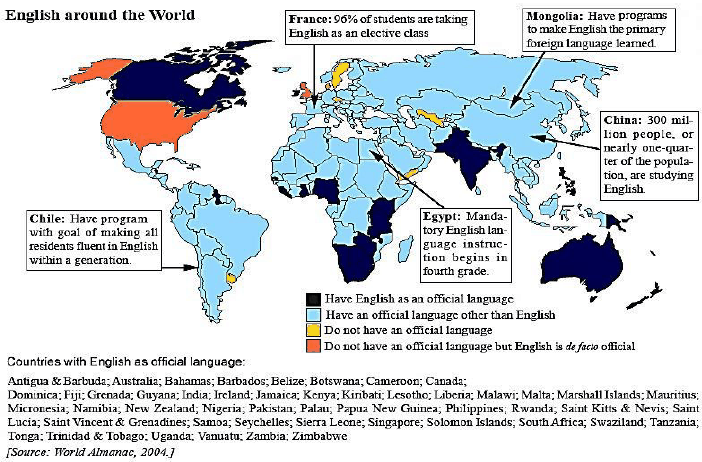
(Available at http://www.infobarrel.com/The_10_Most_Common_Languages_in_the_World. Access 2015/07/02.)
Considering what the text says about the learning of English around the world, mark T for the true statements and F for the false ones.
( ) In France, most students are taking English as an optional class.
( ) English learning is compulsory in Egypt during high school.
( ) In China, learning English is a priority for most of its population.
( ) English is the only foreign language taught in Mongolese schools.
Mark the correct sequence.
Provas
Questão presente nas seguintes provas
Cadernos
Caderno Container