Foram encontradas 40 questões.
Segundo Alfredo Bosi (1989), “Visto à luz da cultura europeia, o reage às correntes analíticas dos meados do século, assim como o reagira à Ilustração triunfante em [17] 89. Ambos os movimentos exprimem o desgosto das soluções racionalistas e mecânicas e nestas reconhecem o correlato da burguesia industrial em ascensão; ambos recusam-se a limitar a arte ao objeto, à técnica de produzi-lo, a seu aspecto palpável; ambos, enfim, esperam ir além do empírico e tocar, com a sonda da poesia, um fundo comum que susteria os fenômenos, chame-se Natureza, Absoluto, Deus ou Nada.”
A alternativa que completa, de forma correta, as lacunas do texto acima é, respectivamente
Provas
Questão presente nas seguintes provas

FIORIN e SAVIOLI (2004) afirmam que “coerência deve ser entendida como unidade do texto. Um texto coerente é um conjunto harmônico, em que todas as partes se encaixam de maneira complementar de modo que não haja nada destoante, nada ilógico, nada contraditório, nada desconexo. No texto coerente, não há nenhuma parte que não se solidarize com as demais.” (p. 261). Dentre os níveis de coerência abaixo, qual deles NÃO é apontado pelos autores?
Provas
Questão presente nas seguintes provas
Read the text below:

Available at: <http://rrenatto.files.wordpress.com/2012/03/up-to.png.>
Consulted on Mar.28th, 2014.
Considering the context of production of the dialogue above, as well as the phrasal verb presented in it, it is correct to imagine that Garfield is about to
Provas
Questão presente nas seguintes provas

Disponível em: <http://deposito-de-tirinhas.tumblr.com/>
Acesso em: abril de 2014.
Considerando a variante linguística utilizada na tira nas falas do personagem Chico Bento, o uso do vocábulo “mais”, no segundo quadrinho tem valor semântico de
Provas
Questão presente nas seguintes provas
Disponível em: <http://deposito-de-tirinhas.tumblr.com/>
Acesso em: abril de 2014.
Considerando as inferências textuais, podemos perceber que a figura de linguagem presente no primeiro quadrinho da tira é uma:
Provas
Questão presente nas seguintes provas
Online students can't help being sociable
By Sean CoughlanBBC News education correspondent
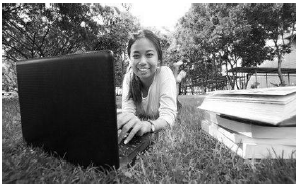
Online university students want to talk outside the computer screen
It was a revolution moving higher education from bricks to clicks… and now it's started to go back to bricks again.
Online university providers, which offered people the chance to study from home, are turning full circle by creating a network of learning centres where students can meet and study together.
Instead of demolishing the dusty old classrooms, the online university revolution is responsible for opening some new ones.
Coursera, a major California-based provider of online courses, is creating an international network of "learning hubs", where students can follow these virtual courses in real-life, bricks and mortar settings.
And there are thousands of meet-ups in cafes and libraries where students get together to talk about their online courses.
This is the latest stage in the rapid evolution of so-called Moocs - massive open online courses - where some of the world's leading universities have created digital versions of courses which are offered free over the internet.
Learning together
Coursera now has seven million registered users. That's bigger than the entire university populations of the UK and France combined. But it seems there is an irresistible social side to learning. Finding stuff out together seems to be more appealing than following a course alone.
The Coursera learning hubs are running in more than 30 cities, from Baghdad to Buenos Aires, Moscow to Mumbai and Shanghai to Santiago. The learning hubs are run by partner organisations, providing a place where students following Coursera online courses can come to study together and get help from mentors.
In Moscow, the learning hub is hosted by Digital October, a centre for technology and entrepreneurship. Yulia Lesnikova, director of educational programs, says it provides a more sociable way of following online courses.
'Like a village'
There have been four online courses so far followed in the Moscow learning hub. This includes a course about genetics created by the University of British Columbia, with students in Moscow being supported by an expert from one of Russia's oldest genetics institutes.
There is a course on gamification from the University of Pennsylvania's Wharton School of Business, with sub-titles in Russian.
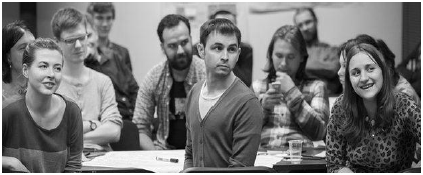
Students following an online course at the Digital October learning hub in Moscow
When students are gathered for their Mooc classes it becomes a focus for other spin-offs, such as firms wanting to recruit staff or to get students involved in developing commercial projects.
In Beijing, the learning hub has been set up with Guokr, a Chinese science-based social networking website.
Yang Liu, Guokr's education director, says studying as a group provides a way of keeping students connected. It's also introduced the word "Moocer" into China, she says.
"Learning can be very lonely, they can drop out."
It can be a more effective way of studying, she says. In a group of people there's likely to be a spread of knowledge, with students able to help one another.
"It's like a village, they form a small society."
It also allows for different types of learner to be supported. About half of the people following Coursera courses in Beijing are university students, she says.
Cutting drop-out rates
But there are also isolated individuals who like the social setting, such as older people living alone or mothers looking after children at home.
Yin Lu, responsible for Coursera's international development, says learning hubs have a wide range of local approaches. They can be based around tutors or around organised projects or else emphasise the social aspect of learning.
In India, the focus is on teacher training and professional development. It means that courses designed for students in the US or Europe are being played out in classrooms in New Delhi and Mumbai.
What has become apparent, she says, is that there is a much lower drop-out rate for students who attend a learning hub.
Moocs allow anyone to enter, with no barriers from cost or qualifications, but that also means relatively few ever finish a course. Ms Lu says that the typical completion rate for a Mooc is about 5% to 10%.
Practical projects are run alongside the online courses
For Mooc students attending learning hubs, the completion rates are between 30% and 100%, she says.
Ms Lu says it's likely that more hubs will open where there are concentrations of Coursera students.
But she says there are no plans for these learning hubs to become fully-fledged colleges, where students might take exams as well as follow courses.
"We exist to complement what universities can provide," she says. But it wouldn't be difficult to imagine the commercial possibilities if they changed their mind.
'Meet-ups'
There is something almost organic about how these digital projects have taken root in the physical world.
Moocs were meant to be the university courses of the laptop era, self-sustaining and free-standing, with students able to stop and start materials on the internet and get online support from social networking.
But you can't stop people from wanting to talk to each other, outside the computer screen.
As well as the more formal learning hubs, self-organised "meet-ups" for Coursera students have sprung up in more than 3,700 cities around the world, based around specific Coursera online courses.
For example, in London there are groups meeting in cafes at the British Library and the South Bank Centre. In Paris, there are meetings in the Pompidou Centre and in university buildings.
Meet-ups are held in a whole range of public places, where students want to discuss and debate these digital courses.
They're scheduled and arranged online, with the only vital ingredients being a laptop, wi-fi and somewhere to talk.
Even virtual students want to have a cup of coffee and a conversation after a lecture.
Available at: <http://www.bbc.com/news/business-26925463>
consulted on Apr. 12th. 2014.
Which of the following is NOT CORRECT, according to the text?
Provas
Questão presente nas seguintes provas
Technology in education: if students aren't worried, why are teachers?
As a new episode of My Teacher is an App airs on BBC Radio 4, Edward Lawless urges teachers to embrace digital technology in the classroom – however frightening it seems
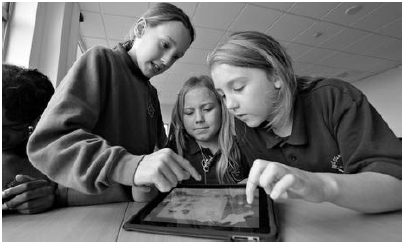
"As teachers, our role must change to one that embraces digital technology as a fundamental part of student learning," says Edward Lawless. Photograph: Athena
The third episode of the BBC Radio 4 series, My Teacher is an App, offered a provocative glimpse into the ways that technology is now being used to meet current educational needs. I attended the debate at The Great Hall of King's College London, where a respected panel and an energetic audience discussed the future of online technology and education.
While students in the audience didn't think it was a big deal, not all of the educators saw technology and education flowing together so smoothly. There was some anxiety in the room about what would happen to "authentic teaching", whether online learning could really offer "meaningful activity" and "true engagement", and if social media could provide "real interaction". Then, of course, there was concern about what would become of "the human element" in a virtual classroom.
These are all valid concerns, but they represent the dangerous assumption that a "different" learning environment can't preserve cherished educational priorities. I have seen online courses that are committed to promoting authentic teaching and learning, and worked with "virtual" teachers who regularly offer meaningful engagement, bringing the "human element" to their students around the world.
On the other hand, I have also seen traditional secondary and university classrooms that disregard these same priorities, with "live" teachers and lecturers capable of automating instruction, objectifying and isolating students, and reducing education to the mere transfer of content.
No matter what the conditions may be – online or face-to-face – the quality of the educational experience depends on the integrity of the curriculum, the teacher and the learning community.
That said, it's normal that teachers and leaders find the integration of online technology in education frightening. First of all, our generation of "digital immigrant" teachers must shift out of our comfort zone and into the world of our "digital-native" students. Second, it requires bricks-and-mortar schools to take a leap of faith into a medium that's essentially an unknown world. They have to let go of the familiar model that we hold dear – not necessarily because it works so well, but because it's what we know so well – to embrace an educational medium that many of us don't use, don't understand and don't trust. Third, and most importantly, it requires us to shift the power of learning from the teacher to the student; to become the facilitator for learning rather than the deliverer of knowledge and in so doing, to let students lead their own learning. That is a very disturbing prospect for many educators – and parents – because it's all about relinquishing control and taking risks.
But the internet is a natural part of students' lives and for many of them it has been that way since before they could walk. It's their natural environment for watching movies and TV programmes, accessing music, communicating with friends and organising their daily lives. It's not surprising that these digital natives don't consider online learning as such a risky venture. The internet already empowers our students with unprecedented educational access in ways that we could never have foreseen as teachers in training. The question is – how are we teaching them to use that power?
At the close of the Radio 4 debate evening, one audience member remarked to the panel that we need to proceed with caution – our students could suffer if we are too bold in adopting online learning technologies. One panellist quietly responded that our students and our future will more likely suffer because we are too timid rather than too bold.
I couldn't agree more. As teachers, our role must change to one that enables, guides, personalises and embraces digital technology as a fundamental part of student learning. The most dangerous thing we can do to our students is to keep doing what our teachers and professors did to us:
!$ \bullet !$ Remain centre stage in a face-to-face classroom.
!$ \bullet !$ Ensure that every lesson goes according to our educational script.
!$ \bullet !$ Focus upon what we want all students to cover during a scheduled lesson rather than what each student needs to learn, when they need to learn it.
!$ \bullet !$ Keep overestimating our own importance in the teaching-learning dynamic and underestimating the potential of students to learn independently and collaboratively.
!$ \bullet !$ Maintain our roles as mediators of content rather than developing our students' capacities as discriminating, self-regulated learners in an open-source world.
It was good enough for us. Right?
Edward Lawless is the principal of Pamoja Education, an online provider of the International Baccalaureate Diploma Programme
Available at: <http://www.theguardian.com/teacher-network/teacher-blog/2014/mar/10/
technology-education-students-teachers-worried> Consulted on Mar. 26th, 2014.
From the title and the information in the text it is correct to infer that
Provas
Questão presente nas seguintes provas
Read the text below:

Available at: <http://rrenatto.files.wordpress.com/2012/04/fill-out21.png.>
Consulted on Mar. 28th, 2014.
After talking on the phone to the operator, the man, surprised, calls his wife to tell her about the weird conversation. The alternative in which he reports the facts accordingly, considering verb tenses used in reported speech, is
Provas
Questão presente nas seguintes provas
Entre as competências a serem desenvolvidas nas aulas de Língua Portuguesa do Ensino
Médio, os PCN’s apontam: “Respeitar e preservar as diferentes manifestações de linguagem utilizadas por diferentes grupos sociais, em suas esferas de socialização [...]”; “Compreender e usar a língua portuguesa como língua materna, geradora de significação e integradora da organização de mundo e da própria identidade”
(BRASIL. Parâmetros Curriculares Nacionais: Ensino Médio: Linguagens, Códigos e suas
tecnologias. Brasília: MEC/SEMTEC, 2006.)
A língua é um enorme iceberg flutuando no mar do tempo, e a gramática normativa é a tentativa de descrever apenas uma parcela mais visível dele, a chamada norma culta.
Essa descrição, é claro, tem seu valor e seus méritos, mas é parcial (no sentido literal e figurado do termo) e não pode ser autoritariamente aplicada a todo o resto da língua — afinal, a ponta do iceberg que emerge representa apenas um quinto do seu volume total. Mas é essa aplicação autoritária, intolerante e repressiva que impera na ideologia geradora do preconceito linguístico. (BAGNO, Marcos. Preconceito Linguístico, 2001. p.9)
Considerando os conceitos acerca do uso da língua portuguesa presentes nos PCNs e na obra do linguista Marcos Bagno, apenas é INCORRETO afirmar que:
Provas
Questão presente nas seguintes provas
According to research results presented in ELLIS (1994), all the assertions below about formal instruction and language learning are correct, EXCEPT the one in alternative
Provas
Questão presente nas seguintes provas
Cadernos
Caderno Container