Foram encontradas 40 questões.
Disciplina: Inglês (Língua Inglesa)
Banca: UEPB
Orgão: Pref. Cacimba Dentro-PB
TEXT I –
Limited learning and impaired oral skills are some of the impacts of the pandemic on English teaching
(Newsroom - 29/Nov/2020)
Lack of internet connection and devices have prevented many students from attending online classes. Public schools have adopted
different strategies to reach these students, such as the distribution of printed material and broadcasts via open TV.

As in other sectors, the pandemic has had profound impacts on education. With the suspension of face-to-face classes, schools were forced to adopt the remote format, which required re-adapting pedagogical practices and methods. But for this type of education to become viable, it is necessary that teachers and students have access to the internet, good quality connection and adequate equipment and devices. In this context, differences emerged, especially between the public and private networks, highlighting the inequalities in the country's educational system.
In the case of language teaching, which essentially depends on communication and interactivity between teacher and student, one of the difficulties was maintaining contact with students, since many, especially those who study in public schools, do not have these resources. And even among those who managed to follow live classes, for example, there was a loss in relation to oral practice. This orality, which in a way already happens with some difficulty in face-to-face classes, has become even more challenging in the digital environment.
Lucilelia Lemes de Castro Silva Nascimento, English teacher and pedagogical advisor to the Goiás Tec Technological Mediation Project, of the Goiás State Department of Education, says that the digital tools adopted during the pandemic compromised the teacher communication in a certain way with the student.
'From the curriculum matrix, we use music, movies and email messages to stimulate interest in the language, and we work on that. But there was a gap in the communication part. Even in the moments of interaction, using tools like Teams and Zoom, we were unable to maintain this interactivity in English '.
According to her, the conversations during the online activities happened in Portuguese. 'We stopped communicating in English because they were not very comfortable to talk and to carry on a conversation. In person, there is already shyness, but the inhibition was even greater in the remote mode '. (…)
The negative impact of the pandemic on the development of students' oral competence was also identified by Marilda Macedo Souto Franco, pedagogical supervisor and English teacher at the Inter-School of Languages (CIL) of Ceilândia, in the Federal District (DF). The CILs, linked to the State Secretariat of Education, primarily serve students from the DF public school system. (…)
She also considers that remote education is not an adequate form of teaching for children and adolescents who still need to learn to organize themselves to participate even in face-to-face classes. Another difficulty that she points out is that many students do not even have an appropriate place to study at home. (…)
For her, the biggest challenge has been keeping students motivated considering so many particular issues they are facing during the pandemic. 'The amount of work by teachers has doubled because they always need to be in contact with the student via WhatsApp and the platform so they don't give up'.
Amid so many challenges, the pedagogical supervisor also sees lessons to be learned and positive aspects of the experience. One is for the student to take responsibility for his learning. 'We realized that they are still unable to do this because the skills to develop autonomy and discipline in contact with the language have not been properly worked out. To be a good language learner it is necessary
to put yourself in that position. We have reflected on this issue, which opens the door to a change in our approach to teaching '.
Another positive point, according to her, was the improvement of school materials and activities that can help students learn, even when they are away from the teacher. 'The statements and proposals for activities have been improved. For students accessing the platform, activities require audio recording. Thus, they can practice orality '.
(Adapted from: https://www.inglesnasescolas.org/en/headline/limited-learning-and-impaired-oral-skills-are-some-of-the-impacts-of-the-pandemic-on-englishteaching/. Accessed on June 14th, 2021)
In line with the article, we may infer that
Provas

Disciplina: Inglês (Língua Inglesa)
Banca: UEPB
Orgão: Pref. Cacimba Dentro-PB
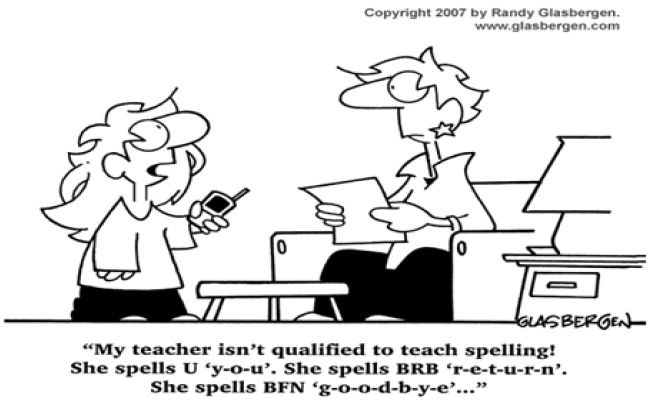
(Available from: https://www.glasbergen.com/education-cartoons/education-technology/cartoons/education-technology/page/2 . Accessed on June 10th, 2021)
In terms of word formation, in the words teacher, qualified and spelling there are examples of:
Provas
Disciplina: Inglês (Língua Inglesa)
Banca: UEPB
Orgão: Pref. Cacimba Dentro-PB
Integrating digital technologies in Brazilian English language teacher education through blended learning
Abstract: This paper aims at reflecting upon the integration of digital technologies in the form of blended learning (BL) approaches in
pre-service English Language Teaching (ELT) Education. With that aim, a BL approach was designed and implemented in a pedagogical intervention carried out in the form of an action research in a pre-service ELT practicum course in a federal university in Brazil. Data includes questionnaires and interviews administered to the pre-service English teachers and observations carried out in the practicum course. The analysis of data suggests that despite little involvement in the online environment, the BL approach was able to promote critical reflection on the integration of digital technologies in ELT. Moreover, it showed that pre-service teachers' views of the educational value attributed to the online environment and professors' readiness to offer varied and innovating learning options may determine the success of the integration of digital technologies in BL outcomes. The study concludes that the implementation of BL approaches in pre-service ELT education provides a space for reflection on action fostering informed pedagogical decisions regarding the integration of digital technologies in ELT.
Keywords: Blended learning; Pre-service English language teacher education; Digital technologies.
Source: MENDES, Ana Rachel Macedo; FINARDI, Kyria Rebeca. Integrating Digital Technologies in Brazilian English Language Teacher Education Through Blended Learning.
Educação em Revista [online]. 2020, v. 36. Epub 30 Nov 2020. Available from: https://doi.or /10.1590/0102-4698233799 . Accessed on June 17th, 2021.
In the sentence “…innovating learning options may determine the success of the integration of digital technologies in BL outcomes”,
the modal verb expresses
Provas
Disciplina: Inglês (Língua Inglesa)
Banca: UEPB
Orgão: Pref. Cacimba Dentro-PB
Integrating digital technologies in Brazilian English language teacher education through blended learning
Abstract: This paper aims at reflecting upon the integration of digital technologies in the form of blended learning (BL) approaches in
pre-service English Language Teaching (ELT) Education. With that aim, a BL approach was designed and implemented in a pedagogical intervention carried out in the form of an action research in a pre-service ELT practicum course in a federal university in Brazil. Data includes questionnaires and interviews administered to the pre-service English teachers and observations carried out in the practicum course. The analysis of data suggests that despite little involvement in the online environment, the BL approach was able to promote critical reflection on the integration of digital technologies in ELT. Moreover, it showed that pre-service teachers' views of the educational value attributed to the online environment and professors' readiness to offer varied and innovating learning options may determine the success of the integration of digital technologies in BL outcomes. The study concludes that the implementation of BL approaches in pre-service ELT education provides a space for reflection on action fostering informed pedagogical decisions regarding the integration of digital technologies in ELT.
Keywords: Blended learning; Pre-service English language teacher education; Digital technologies.
Source: MENDES, Ana Rachel Macedo; FINARDI, Kyria Rebeca. Integrating Digital Technologies in Brazilian English Language Teacher Education Through Blended Learning.
Educação em Revista [online]. 2020, v. 36. Epub 30 Nov 2020. Available from: https://doi.or /10.1590/0102-4698233799 . Accessed on June 17th, 2021.
The words moreover, readiness and regarding belong, respectively, to the following word classes
Provas
Disciplina: Inglês (Língua Inglesa)
Banca: UEPB
Orgão: Pref. Cacimba Dentro-PB
Integrating digital technologies in Brazilian English language teacher education through blended learning
Abstract: This paper aims at reflecting upon the integration of digital technologies in the form of blended learning (BL) approaches in
pre-service English Language Teaching (ELT) Education. With that aim, a BL approach was designed and implemented in a pedagogical intervention carried out in the form of an action research in a pre-service ELT practicum course in a federal university in Brazil. Data includes questionnaires and interviews administered to the pre-service English teachers and observations carried out in the practicum course. The analysis of data suggests that despite little involvement in the online environment, the BL approach was able to promote critical reflection on the integration of digital technologies in ELT. Moreover, it showed that pre-service teachers' views of the educational value attributed to the online environment and professors' readiness to offer varied and innovating learning options may determine the success of the integration of digital technologies in BL outcomes. The study concludes that the implementation of BL approaches in pre-service ELT education provides a space for reflection on action fostering informed pedagogical decisions regarding the integration of digital technologies in ELT.
Keywords: Blended learning; Pre-service English language teacher education; Digital technologies.
Source: MENDES, Ana Rachel Macedo; FINARDI, Kyria Rebeca. Integrating Digital Technologies in Brazilian English Language Teacher Education Through Blended Learning.
Educação em Revista [online]. 2020, v. 36. Epub 30 Nov 2020. Available from: https://doi.or /10.1590/0102-4698233799 . Accessed on June 17th, 2021.
Based on Text III, analyze the following sentences and check True (T) or False (F).
( ) The integration of digital technologies in pre-service ELT education fosters the implementation of BL approaches.
( ) Reflection regarding the integration of digital technologies in ELT is favored by the implementation of BL approaches in preservice
ELT education.
( ) Although pre-service teachers consider the importance of the online environment, they have shown little involvement in it.
Choose the alternative with the CORRECT sequence:
Provas
Disciplina: Inglês (Língua Inglesa)
Banca: UEPB
Orgão: Pref. Cacimba Dentro-PB
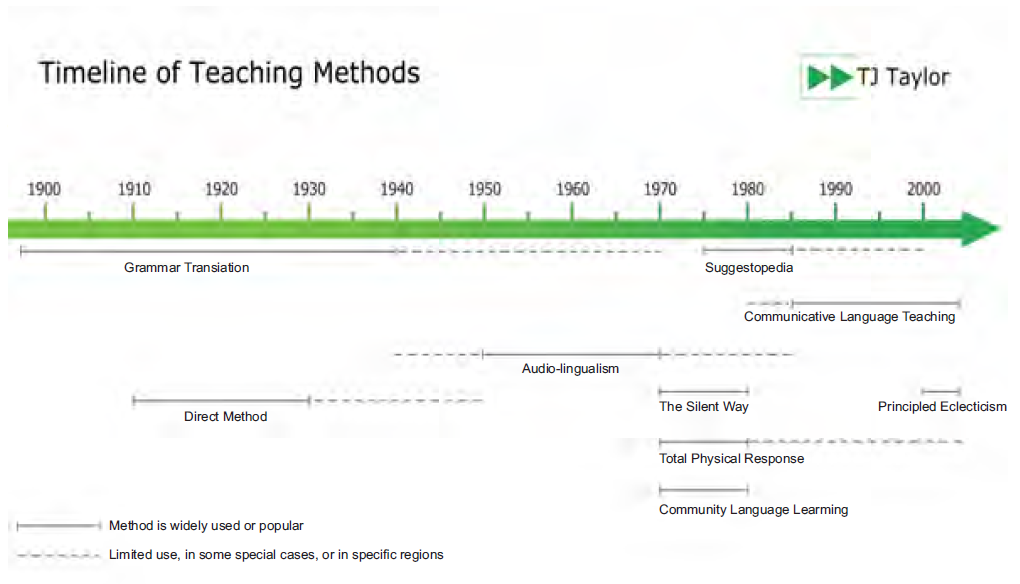
(Available from: https://blog.tjtaylor.net/teaching-inethods/. Accessed on June 10th, 2021)
In agreement with Text II, we may state that
Provas
Disciplina: Inglês (Língua Inglesa)
Banca: UEPB
Orgão: Pref. Cacimba Dentro-PB
(Available from: https://blog.tjtaylor.net/teaching-inethods/. Accessed on June 10th, 2021)
According to the Timeline, it is possible to say that
Provas
Disciplina: Inglês (Língua Inglesa)
Banca: UEPB
Orgão: Pref. Cacimba Dentro-PB
TEXT I –
Limited learning and impaired oral skills are some of the impacts of the pandemic on English teaching
(Newsroom - 29/Nov/2020)
Lack of internet connection and devices have prevented many students from attending online classes. Public schools have adopted
different strategies to reach these students, such as the distribution of printed material and broadcasts via open TV.
As in other sectors, the pandemic has had profound impacts on education. With the suspension of face-to-face classes, schools were forced to adopt the remote format, which required re-adapting pedagogical practices and methods. But for this type of education to become viable, it is necessary that teachers and students have access to the internet, good quality connection and adequate equipment and devices. In this context, differences emerged, especially between the public and private networks, highlighting the inequalities in the country's educational system.
In the case of language teaching, which essentially depends on communication and interactivity between teacher and student, one of the difficulties was maintaining contact with students, since many, especially those who study in public schools, do not have these resources. And even among those who managed to follow live classes, for example, there was a loss in relation to oral practice. This orality, which in a way already happens with some difficulty in face-to-face classes, has become even more challenging in the digital environment.
Lucilelia Lemes de Castro Silva Nascimento, English teacher and pedagogical advisor to the Goiás Tec Technological Mediation Project, of the Goiás State Department of Education, says that the digital tools adopted during the pandemic compromised the teacher communication in a certain way with the student.
'From the curriculum matrix, we use music, movies and email messages to stimulate interest in the language, and we work on that. But there was a gap in the communication part. Even in the moments of interaction, using tools like Teams and Zoom, we were unable to maintain this interactivity in English '.
According to her, the conversations during the online activities happened in Portuguese. 'We stopped communicating in English because they were not very comfortable to talk and to carry on a conversation. In person, there is already shyness, but the inhibition was even greater in the remote mode '. (…)
The negative impact of the pandemic on the development of students' oral competence was also identified by Marilda Macedo Souto Franco, pedagogical supervisor and English teacher at the Inter-School of Languages (CIL) of Ceilândia, in the Federal District (DF). The CILs, linked to the State Secretariat of Education, primarily serve students from the DF public school system. (…)
She also considers that remote education is not an adequate form of teaching for children and adolescents who still need to learn to organize themselves to participate even in face-to-face classes. Another difficulty that she points out is that many students do not even have an appropriate place to study at home. (…)
For her, the biggest challenge has been keeping students motivated considering so many particular issues they are facing during the pandemic. 'The amount of work by teachers has doubled because they always need to be in contact with the student via WhatsApp and the platform so they don't give up'.
Amid so many challenges, the pedagogical supervisor also sees lessons to be learned and positive aspects of the experience. One is for the student to take responsibility for his learning. 'We realized that they are still unable to do this because the skills to develop autonomy and discipline in contact with the language have not been properly worked out. To be a good language learner it is necessary
to put yourself in that position. We have reflected on this issue, which opens the door to a change in our approach to teaching '.
Another positive point, according to her, was the improvement of school materials and activities that can help students learn, even when they are away from the teacher. 'The statements and proposals for activities have been improved. For students accessing the platform, activities require audio recording. Thus, they can practice orality '.
(Adapted from: https://www.inglesnasescolas.org/en/headline/limited-learning-and-impaired-oral-skills-are-some-of-the-impacts-of-the-pandemic-on-englishteaching/. Accessed on June 14th, 2021)
“In person, there is already shyness, but the inhibition was even greater in the remote mode.” Choose the option that defines the
phenomenon that occurred in this sentence.
Provas
Disciplina: Inglês (Língua Inglesa)
Banca: UEPB
Orgão: Pref. Cacimba Dentro-PB
TEXT I –
Limited learning and impaired oral skills are some of the impacts of the pandemic on English teaching
(Newsroom - 29/Nov/2020)
Lack of internet connection and devices have prevented many students from attending online classes. Public schools have adopted
different strategies to reach these students, such as the distribution of printed material and broadcasts via open TV.
As in other sectors, the pandemic has had profound impacts on education. With the suspension of face-to-face classes, schools were forced to adopt the remote format, which required re-adapting pedagogical practices and methods. But for this type of education to become viable, it is necessary that teachers and students have access to the internet, good quality connection and adequate equipment and devices. In this context, differences emerged, especially between the public and private networks, highlighting the inequalities in the country's educational system.
In the case of language teaching, which essentially depends on communication and interactivity between teacher and student, one of the difficulties was maintaining contact with students, since many, especially those who study in public schools, do not have these resources. And even among those who managed to follow live classes, for example, there was a loss in relation to oral practice. This orality, which in a way already happens with some difficulty in face-to-face classes, has become even more challenging in the digital environment.
Lucilelia Lemes de Castro Silva Nascimento, English teacher and pedagogical advisor to the Goiás Tec Technological Mediation Project, of the Goiás State Department of Education, says that the digital tools adopted during the pandemic compromised the teacher communication in a certain way with the student.
'From the curriculum matrix, we use music, movies and email messages to stimulate interest in the language, and we work on that. But there was a gap in the communication part. Even in the moments of interaction, using tools like Teams and Zoom, we were unable to maintain this interactivity in English '.
According to her, the conversations during the online activities happened in Portuguese. 'We stopped communicating in English because they were not very comfortable to talk and to carry on a conversation. In person, there is already shyness, but the inhibition was even greater in the remote mode '. (…)
The negative impact of the pandemic on the development of students' oral competence was also identified by Marilda Macedo Souto Franco, pedagogical supervisor and English teacher at the Inter-School of Languages (CIL) of Ceilândia, in the Federal District (DF). The CILs, linked to the State Secretariat of Education, primarily serve students from the DF public school system. (…)
She also considers that remote education is not an adequate form of teaching for children and adolescents who still need to learn to organize themselves to participate even in face-to-face classes. Another difficulty that she points out is that many students do not even have an appropriate place to study at home. (…)
For her, the biggest challenge has been keeping students motivated considering so many particular issues they are facing during the pandemic. 'The amount of work by teachers has doubled because they always need to be in contact with the student via WhatsApp and the platform so they don't give up'.
Amid so many challenges, the pedagogical supervisor also sees lessons to be learned and positive aspects of the experience. One is for the student to take responsibility for his learning. 'We realized that they are still unable to do this because the skills to develop autonomy and discipline in contact with the language have not been properly worked out. To be a good language learner it is necessary
to put yourself in that position. We have reflected on this issue, which opens the door to a change in our approach to teaching '.
Another positive point, according to her, was the improvement of school materials and activities that can help students learn, even when they are away from the teacher. 'The statements and proposals for activities have been improved. For students accessing the platform, activities require audio recording. Thus, they can practice orality '.
(Adapted from: https://www.inglesnasescolas.org/en/headline/limited-learning-and-impaired-oral-skills-are-some-of-the-impacts-of-the-pandemic-on-englishteaching/. Accessed on June 14th, 2021)
“Amid so many challenges, the pedagogical supervisor also sees lessons to be learned and positive aspects of the experience.” The
word amid is a/an
Provas
Disciplina: Inglês (Língua Inglesa)
Banca: UEPB
Orgão: Pref. Cacimba Dentro-PB
TEXT I –
Limited learning and impaired oral skills are some of the impacts of the pandemic on English teaching
(Newsroom - 29/Nov/2020)
Lack of internet connection and devices have prevented many students from attending online classes. Public schools have adopted
different strategies to reach these students, such as the distribution of printed material and broadcasts via open TV.
As in other sectors, the pandemic has had profound impacts on education. With the suspension of face-to-face classes, schools were forced to adopt the remote format, which required re-adapting pedagogical practices and methods. But for this type of education to become viable, it is necessary that teachers and students have access to the internet, good quality connection and adequate equipment and devices. In this context, differences emerged, especially between the public and private networks, highlighting the inequalities in the country's educational system.
In the case of language teaching, which essentially depends on communication and interactivity between teacher and student, one of the difficulties was maintaining contact with students, since many, especially those who study in public schools, do not have these resources. And even among those who managed to follow live classes, for example, there was a loss in relation to oral practice. This orality, which in a way already happens with some difficulty in face-to-face classes, has become even more challenging in the digital environment.
Lucilelia Lemes de Castro Silva Nascimento, English teacher and pedagogical advisor to the Goiás Tec Technological Mediation Project, of the Goiás State Department of Education, says that the digital tools adopted during the pandemic compromised the teacher communication in a certain way with the student.
'From the curriculum matrix, we use music, movies and email messages to stimulate interest in the language, and we work on that. But there was a gap in the communication part. Even in the moments of interaction, using tools like Teams and Zoom, we were unable to maintain this interactivity in English '.
According to her, the conversations during the online activities happened in Portuguese. 'We stopped communicating in English because they were not very comfortable to talk and to carry on a conversation. In person, there is already shyness, but the inhibition was even greater in the remote mode '. (…)
The negative impact of the pandemic on the development of students' oral competence was also identified by Marilda Macedo Souto Franco, pedagogical supervisor and English teacher at the Inter-School of Languages (CIL) of Ceilândia, in the Federal District (DF). The CILs, linked to the State Secretariat of Education, primarily serve students from the DF public school system. (…)
She also considers that remote education is not an adequate form of teaching for children and adolescents who still need to learn to organize themselves to participate even in face-to-face classes. Another difficulty that she points out is that many students do not even have an appropriate place to study at home. (…)
For her, the biggest challenge has been keeping students motivated considering so many particular issues they are facing during the pandemic. 'The amount of work by teachers has doubled because they always need to be in contact with the student via WhatsApp and the platform so they don't give up'.
Amid so many challenges, the pedagogical supervisor also sees lessons to be learned and positive aspects of the experience. One is for the student to take responsibility for his learning. 'We realized that they are still unable to do this because the skills to develop autonomy and discipline in contact with the language have not been properly worked out. To be a good language learner it is necessary
to put yourself in that position. We have reflected on this issue, which opens the door to a change in our approach to teaching '.
Another positive point, according to her, was the improvement of school materials and activities that can help students learn, even when they are away from the teacher. 'The statements and proposals for activities have been improved. For students accessing the platform, activities require audio recording. Thus, they can practice orality '.
(Adapted from: https://www.inglesnasescolas.org/en/headline/limited-learning-and-impaired-oral-skills-are-some-of-the-impacts-of-the-pandemic-on-englishteaching/. Accessed on June 14th, 2021)
Based on Text I, analyze the following sentences and check True (T) or False (F).
( ) English teachers haven't learned yet how to develop appropriate statements and activities for online classes.
( ) Many teachers and students could barely get in touch during remote classes.
( ) Digital environment seems to be even tougher for the development of students' oral competence.
Choose the alternative with the CORRECT sequence:
Provas
Caderno Container