Foram encontradas 845 questões.
Analyze the following sentences and mark the one that presents the correct and most appropriate use of comparative
adjectives in context.
Provas
Questão presente nas seguintes provas

Read the following comic strip to answer question:

(Available at: 7 tech comics that will put a big smile on your face - Pingdom)
Provas
Questão presente nas seguintes provas
Read the following comic strip to answer question:
(Available at: 7 tech comics that will put a big smile on your face - Pingdom)
Provas
Questão presente nas seguintes provas
The integration of digital technologies into language teaching has transformed traditional classrooms, offering new ways to
promote interaction, autonomy, and authentic communication. When used critically and purposefully, technological tools
can enhance language learning by connecting students to global contexts and fostering multimodal literacy. Choose the
alternative that best represents an effective use of new technologies in language teaching.
Provas
Questão presente nas seguintes provas
Although there are several criticals to the Base Nacional Comum Curricular (BNCC), it is correct to say that the primary
objective of teaching English within Brazilian basic education is to:
Provas
Questão presente nas seguintes provas
Read the excert to answer the question.
In the Common Core National Curriculum (Base Nacional Comum Curricular, or BNCC) for basic education which came into
effect in 2018, the declared ideological basis was a preoccupation with citizenship seen as a concern with the quality of
education in Brazil with its extreme regional differences. It is intended to overcome the perceived shortcomings of previous
national curricula, such as the […] National Curriculum Document (Parâmetros Curriculares Nacionais, or PCN`s), which were
based on the homogeneous educational needs, demands and characterisitcs of the largely urban, industrial and prosperous
Southeast of the country. With a lack of adequate funding for materials and teacher education in the rest of the country, it
is claimed that the previous curricula ended up privileging learners in the Southeast who received an adequate education,
and created a divide with the rest of the country whose needs, demands, and largely rural characteristics were not attended
to, thus prejudicing equality of opportunities and citizenship. The BNCC then proceeds to offer the possibility of a “commom
core” model of which at least 60% of its content needs to be covered nationally, while 40% can be “complemented” regionally by schools systems. What concern us here is how the teaching of languages is portrayed In the BNCC, and the political
implications of this.
(Available at: Menezes de Souza, L. M. T. Coloniality, epistemicide, and language learning in Brazil. In: Multilingual Nations, Monolingual Schools: Confronting colonial language policies across the Americas. New York: Teachers College Press, p. 64, 2024 )
Provas
Questão presente nas seguintes provas
Read the excert to answer the question.
In the Common Core National Curriculum (Base Nacional Comum Curricular, or BNCC) for basic education which came into
effect in 2018, the declared ideological basis was a preoccupation with citizenship seen as a concern with the quality of
education in Brazil with its extreme regional differences. It is intended to overcome the perceived shortcomings of previous
national curricula, such as the […] National Curriculum Document (Parâmetros Curriculares Nacionais, or PCN`s), which were
based on the homogeneous educational needs, demands and characterisitcs of the largely urban, industrial and prosperous
Southeast of the country. With a lack of adequate funding for materials and teacher education in the rest of the country, it
is claimed that the previous curricula ended up privileging learners in the Southeast who received an adequate education,
and created a divide with the rest of the country whose needs, demands, and largely rural characteristics were not attended
to, thus prejudicing equality of opportunities and citizenship. The BNCC then proceeds to offer the possibility of a “commom
core” model of which at least 60% of its content needs to be covered nationally, while 40% can be “complemented” regionally by schools systems. What concern us here is how the teaching of languages is portrayed In the BNCC, and the political
implications of this.
(Available at: Menezes de Souza, L. M. T. Coloniality, epistemicide, and language learning in Brazil. In: Multilingual Nations, Monolingual Schools: Confronting colonial language policies across the Americas. New York: Teachers College Press, p. 64, 2024 )
Provas
Questão presente nas seguintes provas
Read the excert to answer the question.
In the Common Core National Curriculum (Base Nacional Comum Curricular, or BNCC) for basic education which came into
effect in 2018, the declared ideological basis was a preoccupation with citizenship seen as a concern with the quality of
education in Brazil with its extreme regional differences. It is intended to overcome the perceived shortcomings of previous
national curricula, such as the […] National Curriculum Document (Parâmetros Curriculares Nacionais, or PCN`s), which were
based on the homogeneous educational needs, demands and characterisitcs of the largely urban, industrial and prosperous
Southeast of the country. With a lack of adequate funding for materials and teacher education in the rest of the country, it
is claimed that the previous curricula ended up privileging learners in the Southeast who received an adequate education,
and created a divide with the rest of the country whose needs, demands, and largely rural characteristics were not attended
to, thus prejudicing equality of opportunities and citizenship. The BNCC then proceeds to offer the possibility of a “commom
core” model of which at least 60% of its content needs to be covered nationally, while 40% can be “complemented” regionally by schools systems. What concern us here is how the teaching of languages is portrayed In the BNCC, and the political
implications of this.
(Available at: Menezes de Souza, L. M. T. Coloniality, epistemicide, and language learning in Brazil. In: Multilingual Nations, Monolingual Schools: Confronting colonial language policies across the Americas. New York: Teachers College Press, p. 64, 2024 )
Provas
Questão presente nas seguintes provas
O Romantismo transformará Satã no símbolo do espírito livre, da vida alegre, não contra uma lei moral, mas segundo uma lei
natural, contrária à aversão por este mundo pregada pela Igreja. Satanás significa liberdade, progresso, ciência, vida. Tornarse-á moda a identificação com o Demônio, assim como procurar refletir no semblante o olhar, o riso, a zombaria im pressos
nas feições tradicionais do Diabo. (...) O Diabo passa a representar a rebelião contra a fé e a moral tradicional, representando
a revolta do homem, mas com a aceitação do sofrimento porque este é uma fonte purificadora do espírito, uma nobreza
moral, da qual só pode surgir o bem da humanidade. E o demoníaco torna-se o símbolo do Renascimento: demoníaco como
paixão, como terror do desconhecido, como descoberta do lado irracional existente no homem: a explosão da imaginação
contra obstáculos excessivos da consciência e das leis.
NOGUEIRA, Carlos Roberto Figueiredo. O diabo no imaginário cristão. Bauru: Edusc, 2000.
No excerto, Nogueira analisa a transformação simbólica de Satã no imaginário romântico, momento em que o “demônio” deixa de representar o mal absoluto e passa a encarnar a rebeldia e a liberdade criadora.
Do ponto de vista da análise historiográfica das representações culturais, esse deslocamento de sentido revela
NOGUEIRA, Carlos Roberto Figueiredo. O diabo no imaginário cristão. Bauru: Edusc, 2000.
No excerto, Nogueira analisa a transformação simbólica de Satã no imaginário romântico, momento em que o “demônio” deixa de representar o mal absoluto e passa a encarnar a rebeldia e a liberdade criadora.
Do ponto de vista da análise historiográfica das representações culturais, esse deslocamento de sentido revela
Provas
Questão presente nas seguintes provas
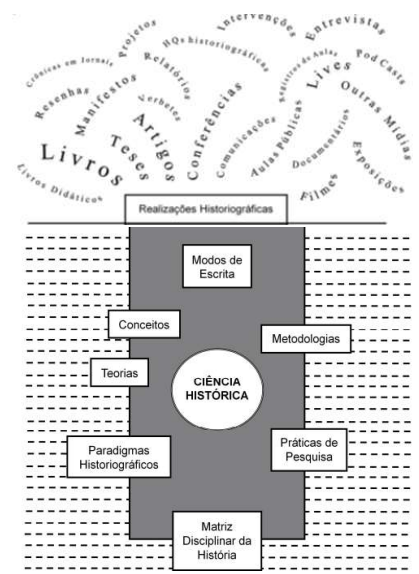
O “Iceberg” da Historiografia. BARROS, José D'Assunção. História e historiografia: todas as interações possíveis. In: BARROS, José D'Assunção (org.). À historiografia como fonte histórica. Petrópolis, RJ: Editora Vozes, 2022.
A imagem apresenta uma representação esquemática da Ciência Histórica, evidenciando seus diferentes componentes — como teorias, conceitos, metodologias e modos de escrita — que articulam a produção do conhecimento histórico. Com base nessa representação, qual das alternativas expressa com maior precisão o modo como se organiza o procedimento da pesquisa em História?
Provas
Questão presente nas seguintes provas
Cadernos
Caderno Container