Foram encontradas 248 questões.

(Source: http://www.information-age.com/approach-cloud-computingcyber-security-2017-123466624/ Retrieved on January 26th, 2018)
How to approach cloud computing and cyber security in 2017
The adoption of cloud computing has been on the up since as far back as 2008, when a survey conducted by the Pew Research Institute found that cloud services were used by nearly 69% of Americans. Since then, the industry has experienced hypergrowth and exceeded the already vast predictions of how big it would become.
IDC predicts that the cloud computing market in 2017 will be worth $107 billion and, according to Gartner, by 2020 a corporate ‘no-cloud’ policy will be as unusual as a ‘no-internet’ policy would be today. Indeed, it would be difficult to imagine an organisation in 2017 that did not use webmail, file sharing and storage, and data backup.
As the use of cloud computing spreads so does awareness of the associated risks. At the time of writing, there have been 456 data breaches worldwide this year according to the Identity Theft Resource Center (ITRC). The ITRC also noted a 40% increase in data breaches in 2016 compared to the previous year. Yet, despite the well-documented cases of data breaches, organisations continue to invest in and adopt cloud computing services because the benefits usually outweigh the risks.
To understand why the growth of cloud computing has continued in the face of high-profile data breaches, look first to what it can offer an organisation.
Cheaper, bigger, better
Cloud computing is a virtual environment that can adapt to meet user needs. It is not constrained by physical limits, and is easily scalable – making it an obvious choice for start-ups. Cloud computing makes state-of-the-art capability available to anyone with an internet connection and a browser, reducing hardware and IT personnel costs.
Cloud services and software applications are managed and upgraded off-site by the provider, meaning organisations can access technology they would not have been able to afford to install and manage on their own. The popularity of the cloud essentially comes down to its provision of advanced, nextgeneration IT resources in an environment that is cheaper and more scalable than local networks.
The risks involved with cloud computing are mostly securitybased. Clouds are often made up of multiple entities, which means that no configuration can be more secure than its weakest link. The link between separate entities means that attacks to multiple sites can occur simultaneously. When cloud providers do not employ adequate cyber security measures, those clouds become a target for cybercriminals.
Yet, it’s not all bad news. A user survey conducted by one cloud service provider found that concerns about security fell to 25% compared to 29% last year. And as more becomes known about security risks so too does our knowledge around what organisations can do to protect themselves.
(Source: http://www.information-age.com/approach-cloud-computingcyber-security-2017-123466624/. Retrieved on January 25th, 2018)
Provas

(Source: http://www.information-age.com/approach-cloud-computingcyber-security-2017-123466624/ Retrieved on January 26th, 2018)
How to approach cloud computing and cyber security in 2017
The adoption of cloud computing has been on the up since as far back as 2008, when a survey conducted by the Pew Research Institute found that cloud services were used by nearly 69% of Americans. Since then, the industry has experienced hypergrowth and exceeded the already vast predictions of how big it would become.
IDC predicts that the cloud computing market in 2017 will be worth $107 billion and, according to Gartner, by 2020 a corporate ‘no-cloud’ policy will be as unusual as a ‘no-internet’ policy would be today. Indeed, it would be difficult to imagine an organisation in 2017 that did not use webmail, file sharing and storage, and data backup.
As the use of cloud computing spreads so does awareness of the associated risks. At the time of writing, there have been 456 data breaches worldwide this year according to the Identity Theft Resource Center (ITRC). The ITRC also noted a 40% increase in data breaches in 2016 compared to the previous year. Yet, despite the well-documented cases of data breaches, organisations continue to invest in and adopt cloud computing services because the benefits usually outweigh the risks.
To understand why the growth of cloud computing has continued in the face of high-profile data breaches, look first to what it can offer an organisation.
Cheaper, bigger, better
Cloud computing is a virtual environment that can adapt to meet user needs. It is not constrained by physical limits, and is easily scalable – making it an obvious choice for start-ups. Cloud computing makes state-of-the-art capability available to anyone with an internet connection and a browser, reducing hardware and IT personnel costs.
Cloud services and software applications are managed and upgraded off-site by the provider, meaning organisations can access technology they would not have been able to afford to install and manage on their own. The popularity of the cloud essentially comes down to its provision of advanced, nextgeneration IT resources in an environment that is cheaper and more scalable than local networks.
The risks involved with cloud computing are mostly securitybased. Clouds are often made up of multiple entities, which means that no configuration can be more secure than its weakest link. The link between separate entities means that attacks to multiple sites can occur simultaneously. When cloud providers do not employ adequate cyber security measures, those clouds become a target for cybercriminals.
Yet, it’s not all bad news. A user survey conducted by one cloud service provider found that concerns about security fell to 25% compared to 29% last year. And as more becomes known about security risks so too does our knowledge around what organisations can do to protect themselves.
(Source: http://www.information-age.com/approach-cloud-computingcyber-security-2017-123466624/. Retrieved on January 25th, 2018)
Provas
(Source:http://www.revasolutions.com/internet-of-things-newchallenges-and-practices-for-information-governance/. Retrieved on January 26th, 2018)
Governance Challenges for the Internet of Things
Virgilio A.F. Almeida -Federal University of Minas Gerais, Brazil
Danilo Doneda - Rio de Janeiro State University
Marília Monteiro - Public Law Institute of Brasília
Published by the IEEE Computer Society
© 2015
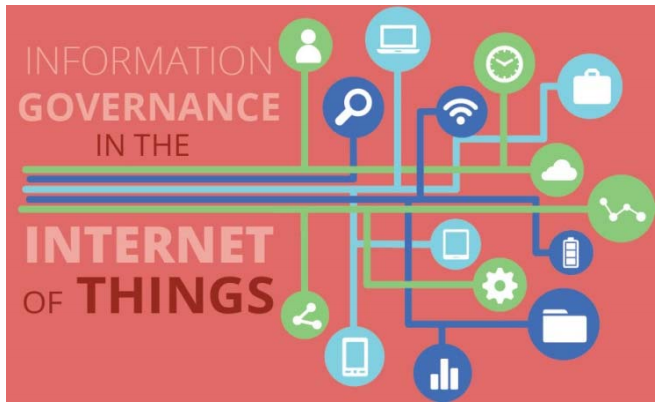
The future will be rich with sensors capable of collecting vast amounts of information. The Internet will be almost fused with the physical world as the Internet of Things (IoT) becomes a reality. Although it’s just beginning, experts estimate that by the end of 2015 there will be around 25 billion “things” connected to the global Internet. By 2025, the estimated number of connected devices should reach 100 billion. These estimates include smartphones, vehicles, appliances, and industrial equipment. Privacy, security, and safety fears grow as the IoT creates conditions for increasing surveillance by governments and corporations. So the question is: Will the IoT be good for the many, or the mighty few?
While technological aspects of the IoT have been extensively published in the technical literature, few studies have addressed the IoT’s social and political impacts. Two studies have shed light on challenges for the future with the IoT. In 2013, the European Commission (EC) published a study focusing on relevant aspects for possible IoT governance regimes. The EC report identified many challenges for IoT governance — namely privacy, security, ethics, and competition. In 2015, the US Federal Trade Commission (FTC) published the FTC Staff Report The Internet of Things: Privacy and Security in a Connected World. Although the report emphasizes the various benefits that the IoT will bring to consumers and citizens, it acknowledges that there are many risks associated with deploying IoT-based applications, especially in the realm of privacy and security.
[…]
The nature of privacy and security problems frequently associated with the IoT indicates that further research, analysis, and discussion are needed to identify possible solutions. First, the introduction of security and privacy elements in the very design of sensors, implementing Privacy by Design, must be taken into account for outcomes such as the homologation process of sensors by competent authorities. Even if the privacy governance of IoT can oversee the control centers for collected data, we must develop concrete means to set limits on the amount or nature of the personal data collected.
Other critical issues regard notification and consent. If, from one side, it’s true that several sensors are already collecting as much personal data as possible, something must be done to increase citizens’ awareness of these data collection processes. Citizens must have means to take measures to protect their rights whenever necessary. If future scenarios indicate the inadequacy of a mere notice-and-consent approach, alternatives must be presented so that the individual’s autonomy isn’t eroded.
As with other technologies that aim to change human life, the IoT must be in all respects designed with people as its central focus. Privacy and ethics aren’t natural aspects to be considered in technology’s agenda. However, these features are essential to build the necessary trust in an IoT ecosystem, making it compatible with human rights and ensuring that it’s drafted at the measure, and not at the expense, of people.
(Source: https://cyber.harvard.edu/~valmeida/pdf/IoT-governance.pdf Retrieved on January 23rd, 2018)
Mark the statements below as true (T) or false (F) according to Text II:
( ) There are already many studies on the social and political effects of the IoT.
( ) Research studies on security and privacy still need to be carried out.
( ) The report from the US Federal Trade Commission supported the unrestricted use of the IoT.
Provas
(Source:http://www.revasolutions.com/internet-of-things-newchallenges-and-practices-for-information-governance/. Retrieved on January 26th, 2018)
Governance Challenges for the Internet of Things
Virgilio A.F. Almeida -Federal University of Minas Gerais, Brazil
Danilo Doneda - Rio de Janeiro State University
Marília Monteiro - Public Law Institute of Brasília
Published by the IEEE Computer Society
© 2015
The future will be rich with sensors capable of collecting vast amounts of information. The Internet will be almost fused with the physical world as the Internet of Things (IoT) becomes a reality. Although it’s just beginning, experts estimate that by the end of 2015 there will be around 25 billion “things” connected to the global Internet. By 2025, the estimated number of connected devices should reach 100 billion. These estimates include smartphones, vehicles, appliances, and industrial equipment. Privacy, security, and safety fears grow as the IoT creates conditions for increasing surveillance by governments and corporations. So the question is: Will the IoT be good for the many, or the mighty few?
While technological aspects of the IoT have been extensively published in the technical literature, few studies have addressed the IoT’s social and political impacts. Two studies have shed light on challenges for the future with the IoT. In 2013, the European Commission (EC) published a study focusing on relevant aspects for possible IoT governance regimes. The EC report identified many challenges for IoT governance — namely privacy, security, ethics, and competition. In 2015, the US Federal Trade Commission (FTC) published the FTC Staff Report The Internet of Things: Privacy and Security in a Connected World. Although the report emphasizes the various benefits that the IoT will bring to consumers and citizens, it acknowledges that there are many risks associated with deploying IoT-based applications, especially in the realm of privacy and security.
[…]
The nature of privacy and security problems frequently associated with the IoT indicates that further research, analysis, and discussion are needed to identify possible solutions. First, the introduction of security and privacy elements in the very design of sensors, implementing Privacy by Design, must be taken into account for outcomes such as the homologation process of sensors by competent authorities. Even if the privacy governance of IoT can oversee the control centers for collected data, we must develop concrete means to set limits on the amount or nature of the personal data collected.
Other critical issues regard notification and consent. If, from one side, it’s true that several sensors are already collecting as much personal data as possible, something must be done to increase citizens’ awareness of these data collection processes. Citizens must have means to take measures to protect their rights whenever necessary. If future scenarios indicate the inadequacy of a mere notice-and-consent approach, alternatives must be presented so that the individual’s autonomy isn’t eroded.
As with other technologies that aim to change human life, the IoT must be in all respects designed with people as its central focus. Privacy and ethics aren’t natural aspects to be considered in technology’s agenda. However, these features are essential to build the necessary trust in an IoT ecosystem, making it compatible with human rights and ensuring that it’s drafted at the measure, and not at the expense, of people.
(Source: https://cyber.harvard.edu/~valmeida/pdf/IoT-governance.pdf Retrieved on January 23rd, 2018)
Provas
(Source:http://www.revasolutions.com/internet-of-things-newchallenges-and-practices-for-information-governance/. Retrieved on January 26th, 2018)
Governance Challenges for the Internet of Things
Virgilio A.F. Almeida -Federal University of Minas Gerais, Brazil
Danilo Doneda - Rio de Janeiro State University
Marília Monteiro - Public Law Institute of Brasília
Published by the IEEE Computer Society
© 2015
The future will be rich with sensors capable of collecting vast amounts of information. The Internet will be almost fused with the physical world as the Internet of Things (IoT) becomes a reality. Although it’s just beginning, experts estimate that by the end of 2015 there will be around 25 billion “things” connected to the global Internet. By 2025, the estimated number of connected devices should reach 100 billion. These estimates include smartphones, vehicles, appliances, and industrial equipment. Privacy, security, and safety fears grow as the IoT creates conditions for increasing surveillance by governments and corporations. So the question is: Will the IoT be good for the many, or the mighty few?
While technological aspects of the IoT have been extensively published in the technical literature, few studies have addressed the IoT’s social and political impacts. Two studies have shed light on challenges for the future with the IoT. In 2013, the European Commission (EC) published a study focusing on relevant aspects for possible IoT governance regimes. The EC report identified many challenges for IoT governance — namely privacy, security, ethics, and competition. In 2015, the US Federal Trade Commission (FTC) published the FTC Staff Report The Internet of Things: Privacy and Security in a Connected World. Although the report emphasizes the various benefits that the IoT will bring to consumers and citizens, it acknowledges that there are many risks associated with deploying IoT-based applications, especially in the realm of privacy and security.
[…]
The nature of privacy and security problems frequently associated with the IoT indicates that further research, analysis, and discussion are needed to identify possible solutions. First, the introduction of security and privacy elements in the very design of sensors, implementing Privacy by Design, must be taken into account for outcomes such as the homologation process of sensors by competent authorities. Even if the privacy governance of IoT can oversee the control centers for collected data, we must develop concrete means to set limits on the amount or nature of the personal data collected.
Other critical issues regard notification and consent. If, from one side, it’s true that several sensors are already collecting as much personal data as possible, something must be done to increase citizens’ awareness of these data collection processes. Citizens must have means to take measures to protect their rights whenever necessary. If future scenarios indicate the inadequacy of a mere notice-and-consent approach, alternatives must be presented so that the individual’s autonomy isn’t eroded.
As with other technologies that aim to change human life, the IoT must be in all respects designed with people as its central focus. Privacy and ethics aren’t natural aspects to be considered in technology’s agenda. However, these features are essential to build the necessary trust in an IoT ecosystem, making it compatible with human rights and ensuring that it’s drafted at the measure, and not at the expense, of people.
(Source: https://cyber.harvard.edu/~valmeida/pdf/IoT-governance.pdf Retrieved on January 23rd, 2018)
Provas
(Source:http://www.revasolutions.com/internet-of-things-newchallenges-and-practices-for-information-governance/. Retrieved on January 26th, 2018)
Governance Challenges for the Internet of Things
Virgilio A.F. Almeida -Federal University of Minas Gerais, Brazil
Danilo Doneda - Rio de Janeiro State University
Marília Monteiro - Public Law Institute of Brasília
Published by the IEEE Computer Society
© 2015
The future will be rich with sensors capable of collecting vast amounts of information. The Internet will be almost fused with the physical world as the Internet of Things (IoT) becomes a reality. Although it’s just beginning, experts estimate that by the end of 2015 there will be around 25 billion “things” connected to the global Internet. By 2025, the estimated number of connected devices should reach 100 billion. These estimates include smartphones, vehicles, appliances, and industrial equipment. Privacy, security, and safety fears grow as the IoT creates conditions for increasing surveillance by governments and corporations. So the question is: Will the IoT be good for the many, or the mighty few?
While technological aspects of the IoT have been extensively published in the technical literature, few studies have addressed the IoT’s social and political impacts. Two studies have shed light on challenges for the future with the IoT. In 2013, the European Commission (EC) published a study focusing on relevant aspects for possible IoT governance regimes. The EC report identified many challenges for IoT governance — namely privacy, security, ethics, and competition. In 2015, the US Federal Trade Commission (FTC) published the FTC Staff Report The Internet of Things: Privacy and Security in a Connected World. Although the report emphasizes the various benefits that the IoT will bring to consumers and citizens, it acknowledges that there are many risks associated with deploying IoT-based applications, especially in the realm of privacy and security.
[…]
The nature of privacy and security problems frequently associated with the IoT indicates that further research, analysis, and discussion are needed to identify possible solutions. First, the introduction of security and privacy elements in the very design of sensors, implementing Privacy by Design, must be taken into account for outcomes such as the homologation process of sensors by competent authorities. Even if the privacy governance of IoT can oversee the control centers for collected data, we must develop concrete means to set limits on the amount or nature of the personal data collected.
Other critical issues regard notification and consent. If, from one side, it’s true that several sensors are already collecting as much personal data as possible, something must be done to increase citizens’ awareness of these data collection processes. Citizens must have means to take measures to protect their rights whenever necessary. If future scenarios indicate the inadequacy of a mere notice-and-consent approach, alternatives must be presented so that the individual’s autonomy isn’t eroded.
As with other technologies that aim to change human life, the IoT must be in all respects designed with people as its central focus. Privacy and ethics aren’t natural aspects to be considered in technology’s agenda. However, these features are essential to build the necessary trust in an IoT ecosystem, making it compatible with human rights and ensuring that it’s drafted at the measure, and not at the expense, of people.
(Source: https://cyber.harvard.edu/~valmeida/pdf/IoT-governance.pdf Retrieved on January 23rd, 2018)
Provas
(Source: http://www.information-age.com/approach-cloud-computingcyber-security-2017-123466624/ Retrieved on January 26th, 2018)
How to approach cloud computing and cyber security in 2017
The adoption of cloud computing has been on the up since as far back as 2008, when a survey conducted by the Pew Research Institute found that cloud services were used by nearly 69% of Americans. Since then, the industry has experienced hypergrowth and exceeded the already vast predictions of how big it would become.
IDC predicts that the cloud computing market in 2017 will be worth $107 billion and, according to Gartner, by 2020 a corporate ‘no-cloud’ policy will be as unusual as a ‘no-internet’ policy would be today. Indeed, it would be difficult to imagine an organisation in 2017 that did not use webmail, file sharing and storage, and data backup.
As the use of cloud computing spreads so does awareness of the associated risks. At the time of writing, there have been 456 data breaches worldwide this year according to the Identity Theft Resource Center (ITRC). The ITRC also noted a 40% increase in data breaches in 2016 compared to the previous year. Yet, despite the well-documented cases of data breaches, organisations continue to invest in and adopt cloud computing services because the benefits usually outweigh the risks.
To understand why the growth of cloud computing has continued in the face of high-profile data breaches, look first to what it can offer an organisation.
Cheaper, bigger, better
Cloud computing is a virtual environment that can adapt to meet user needs. It is not constrained by physical limits, and is easily scalable – making it an obvious choice for start-ups. Cloud computing makes state-of-the-art capability available to anyone with an internet connection and a browser, reducing hardware and IT personnel costs.
Cloud services and software applications are managed and upgraded off-site by the provider, meaning organisations can access technology they would not have been able to afford to install and manage on their own. The popularity of the cloud essentially comes down to its provision of advanced, nextgeneration IT resources in an environment that is cheaper and more scalable than local networks.
The risks involved with cloud computing are mostly securitybased. Clouds are often made up of multiple entities, which means that no configuration can be more secure than its weakest link. The link between separate entities means that attacks to multiple sites can occur simultaneously. When cloud providers do not employ adequate cyber security measures, those clouds become a target for cybercriminals.
Yet, it’s not all bad news. A user survey conducted by one cloud service provider found that concerns about security fell to 25% compared to 29% last year. And as more becomes known about security risks so too does our knowledge around what organisations can do to protect themselves.
(Source: http://www.information-age.com/approach-cloud-computingcyber-security-2017-123466624/. Retrieved on January 25th, 2018)
Provas
TEXT II
Brazil's mega hydro plan foreshadows China's growing impact on the Amazon
by Jonathan Watts
Thu 5 Oct ‘17 06.45 BST
Last modified on Mon 27 Nov ‘17 15.56 GMT
The government wants to open up the Tapajós basin – an area the size of France – for trade with China. But the indigenous Munduruku won’t let it happen without a fight
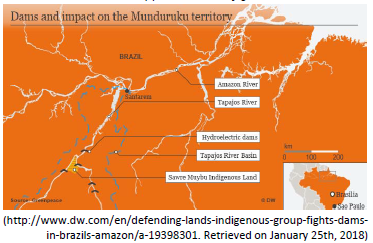
This is the gateway to a land that indigenous inhabitants call Mundurukania, after their tribe, the Munduruku, which has settled the middle and upper reaches of the Rio Tapajós since ancient times. The thickly vegetated shores, misty hills and untamed waters – breached at one point by a dolphin – mark it out as one of the few regions of the planet still to be explored and exploited by industrial commerce.
The tranquillity is breathtaking, but misleading. These rapids are now on the frontline of one of the world’s most important struggles for indigenous rights and environmental protection. Long ignored, they are suddenly seen as a strategically crucial step between the nations with the world’s biggest farms – Brazil – and the world’s most numerous dining tables – China. Longer term, the changes now being planned could bring this waterway closer to the industrialised, traffic-filled Yangtze in more ways than one.
Over the coming years, the Brazilian government – backed by Chinese and European finance and engineering – wants to turn this river into the world’s biggest grain canal by building 49 major dams on the Tapajós and its tributaries.
This would make the rapids navigable by barges carrying produce from the deforested cerrado savanna of Mato Grosso – which produces a third of the world’s soya – up to the giant container port being planned in the closest city of Santarém and then out to global markets, particularly in Asia.
The network of dams would also produce 29gW of electricity, increasing Brazil’s current supply by 25%. A consortium headed by Furnas – a subsidiary of the state-run energy utility Electrobras – plans to sell the power to distant cities and to local mining companies that want to unearth the mineral riches under the forest.
For the Brazilian government, this mega-scheme to open up the Tapajós basin – which is roughly the area of France – is a linchpin of national economic development and trade with China. For local politicians, it is an opportunity to industrialise, expand and enrich the business of nearby cities, which expect their populations to double in size over the next 10 years.
For opponents, however, the “hydrovia” – as the river transport scheme is known – and related projects are the biggest threat ever posed to the native inhabitants, traditional riverine communities, waters and wildlife. By one estimate, 950,000 hectares of forest would be cleared, releasing significant amounts of carbon dioxide.
Provas
TEXT II
Brazil's mega hydro plan foreshadows China's growing impact on the Amazon
by Jonathan Watts
Thu 5 Oct ‘17 06.45 BST
Last modified on Mon 27 Nov ‘17 15.56 GMT
The government wants to open up the Tapajós basin – an area the size of France – for trade with China. But the indigenous Munduruku won’t let it happen without a fight
This is the gateway to a land that indigenous inhabitants call Mundurukania, after their tribe, the Munduruku, which has settled the middle and upper reaches of the Rio Tapajós since ancient times. The thickly vegetated shores, misty hills and untamed waters – breached at one point by a dolphin – mark it out as one of the few regions of the planet still to be explored and exploited by industrial commerce.
The tranquillity is breathtaking, but misleading. These rapids are now on the frontline of one of the world’s most important struggles for indigenous rights and environmental protection. Long ignored, they are suddenly seen as a strategically crucial step between the nations with the world’s biggest farms – Brazil – and the world’s most numerous dining tables – China. Longer term, the changes now being planned could bring this waterway closer to the industrialised, traffic-filled Yangtze in more ways than one.
Over the coming years, the Brazilian government – backed by Chinese and European finance and engineering – wants to turn this river into the world’s biggest grain canal by building 49 major dams on the Tapajós and its tributaries.
This would make the rapids navigable by barges carrying produce from the deforested cerrado savanna of Mato Grosso – which produces a third of the world’s soya – up to the giant container port being planned in the closest city of Santarém and then out to global markets, particularly in Asia.
The network of dams would also produce 29gW of electricity, increasing Brazil’s current supply by 25%. A consortium headed by Furnas – a subsidiary of the state-run energy utility Electrobras – plans to sell the power to distant cities and to local mining companies that want to unearth the mineral riches under the forest.
For the Brazilian government, this mega-scheme to open up the Tapajós basin – which is roughly the area of France – is a linchpin of national economic development and trade with China. For local politicians, it is an opportunity to industrialise, expand and enrich the business of nearby cities, which expect their populations to double in size over the next 10 years.
For opponents, however, the “hydrovia” – as the river transport scheme is known – and related projects are the biggest threat ever posed to the native inhabitants, traditional riverine communities, waters and wildlife. By one estimate, 950,000 hectares of forest would be cleared, releasing significant amounts of carbon dioxide.
Provas
TEXT II
Brazil's mega hydro plan foreshadows China's growing impact on the Amazon
by Jonathan Watts
Thu 5 Oct ‘17 06.45 BST
Last modified on Mon 27 Nov ‘17 15.56 GMT
The government wants to open up the Tapajós basin – an area the size of France – for trade with China. But the indigenous Munduruku won’t let it happen without a fight
This is the gateway to a land that indigenous inhabitants call Mundurukania, after their tribe, the Munduruku, which has settled the middle and upper reaches of the Rio Tapajós since ancient times. The thickly vegetated shores, misty hills and untamed waters – breached at one point by a dolphin – mark it out as one of the few regions of the planet still to be explored and exploited by industrial commerce.
The tranquillity is breathtaking, but misleading. These rapids are now on the frontline of one of the world’s most important struggles for indigenous rights and environmental protection. Long ignored, they are suddenly seen as a strategically crucial step between the nations with the world’s biggest farms – Brazil – and the world’s most numerous dining tables – China. Longer term, the changes now being planned could bring this waterway closer to the industrialised, traffic-filled Yangtze in more ways than one.
Over the coming years, the Brazilian government – backed by Chinese and European finance and engineering – wants to turn this river into the world’s biggest grain canal by building 49 major dams on the Tapajós and its tributaries.
This would make the rapids navigable by barges carrying produce from the deforested cerrado savanna of Mato Grosso – which produces a third of the world’s soya – up to the giant container port being planned in the closest city of Santarém and then out to global markets, particularly in Asia.
The network of dams would also produce 29gW of electricity, increasing Brazil’s current supply by 25%. A consortium headed by Furnas – a subsidiary of the state-run energy utility Electrobras – plans to sell the power to distant cities and to local mining companies that want to unearth the mineral riches under the forest.
For the Brazilian government, this mega-scheme to open up the Tapajós basin – which is roughly the area of France – is a linchpin of national economic development and trade with China. For local politicians, it is an opportunity to industrialise, expand and enrich the business of nearby cities, which expect their populations to double in size over the next 10 years.
For opponents, however, the “hydrovia” – as the river transport scheme is known – and related projects are the biggest threat ever posed to the native inhabitants, traditional riverine communities, waters and wildlife. By one estimate, 950,000 hectares of forest would be cleared, releasing significant amounts of carbon dioxide.
Provas
Caderno Container