Foram encontradas 255 questões.
Disciplina: Inglês (Língua Inglesa)
Banca: VUNESP
Orgão: Pref. São José Campos-SP
Leia o texto e responda à questão.
Culture is really an integral part of the interaction between language and thought. Cultural patterns, customs, and ways of life are expressed in language; culture-specific world views are reflected in language. Each culture has at its disposal a particular range of colours, illustrating its particular world view on what color is and how to identify color. The African Shona and Bassa peoples, for example, have fewer color categories than speakers of European languages and they break up the spectrum at different points, as shown below:
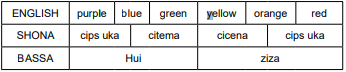
Of course, the Shona or Bassa are able to perceive and describe other colors, in the same way that an English speaker might describe a “dark bluish green”, but the labels which the language provides tend to shape the person’s overall cognitive organization of color and to cause varying degrees of color discrimination. Eskimo tribes commonly have as many as seven different words for snow to distinguish among different types of snow (falling snow, snow on the ground, fluffy snow, wet snow, etc.), whereas certain African cultures in the equatorial forests of Zaire have no word at all for snow.
(Douglas Brown. Principles of language learning and teaching. 5th ed. Longman, 2000. Adaptado)
Provas

Disciplina: Inglês (Língua Inglesa)
Banca: VUNESP
Orgão: Pref. São José Campos-SP
Leia o texto e responda à questão.
Culture is really an integral part of the interaction between language and thought. Cultural patterns, customs, and ways of life are expressed in language; culture-specific world views are reflected in language. Each culture has at its disposal a particular range of colours, illustrating its particular world view on what color is and how to identify color. The African Shona and Bassa peoples, for example, have fewer color categories than speakers of European languages and they break up the spectrum at different points, as shown below:
Of course, the Shona or Bassa are able to perceive and describe other colors, in the same way that an English speaker might describe a “dark bluish green”, but the labels which the language provides tend to shape the person’s overall cognitive organization of color and to cause varying degrees of color discrimination. Eskimo tribes commonly have as many as seven different words for snow to distinguish among different types of snow (falling snow, snow on the ground, fluffy snow, wet snow, etc.), whereas certain African cultures in the equatorial forests of Zaire have no word at all for snow.
(Douglas Brown. Principles of language learning and teaching. 5th ed. Longman, 2000. Adaptado)
A alternativa em que se encontram palavras seguindo os mesmos processos de formação, respectivamente, é:
Provas
Disciplina: Inglês (Língua Inglesa)
Banca: VUNESP
Orgão: Pref. São José Campos-SP
Leia o texto e responda à questão.
Culture is really an integral part of the interaction between language and thought. Cultural patterns, customs, and ways of life are expressed in language; culture-specific world views are reflected in language. Each culture has at its disposal a particular range of colours, illustrating its particular world view on what color is and how to identify color. The African Shona and Bassa peoples, for example, have fewer color categories than speakers of European languages and they break up the spectrum at different points, as shown below:
Of course, the Shona or Bassa are able to perceive and describe other colors, in the same way that an English speaker might describe a “dark bluish green”, but the labels which the language provides tend to shape the person’s overall cognitive organization of color and to cause varying degrees of color discrimination. Eskimo tribes commonly have as many as seven different words for snow to distinguish among different types of snow (falling snow, snow on the ground, fluffy snow, wet snow, etc.), whereas certain African cultures in the equatorial forests of Zaire have no word at all for snow.
(Douglas Brown. Principles of language learning and teaching. 5th ed. Longman, 2000. Adaptado)
Provas
Disciplina: Inglês (Língua Inglesa)
Banca: VUNESP
Orgão: Pref. São José Campos-SP
Leia o texto e responda à questão.
Culture is really an integral part of the interaction between language and thought. Cultural patterns, customs, and ways of life are expressed in language; culture-specific world views are reflected in language. Each culture has at its disposal a particular range of colours, illustrating its particular world view on what color is and how to identify color. The African Shona and Bassa peoples, for example, have fewer color categories than speakers of European languages and they break up the spectrum at different points, as shown below:
Of course, the Shona or Bassa are able to perceive and describe other colors, in the same way that an English speaker might describe a “dark bluish green”, but the labels which the language provides tend to shape the person’s overall cognitive organization of color and to cause varying degrees of color discrimination. Eskimo tribes commonly have as many as seven different words for snow to distinguish among different types of snow (falling snow, snow on the ground, fluffy snow, wet snow, etc.), whereas certain African cultures in the equatorial forests of Zaire have no word at all for snow.
(Douglas Brown. Principles of language learning and teaching. 5th ed. Longman, 2000. Adaptado)
Provas
Disciplina: Inglês (Língua Inglesa)
Banca: VUNESP
Orgão: Pref. São José Campos-SP
Leia o texto e responda à questão.
Culture is really an integral part of the interaction between language and thought. Cultural patterns, customs, and ways of life are expressed in language; culture-specific world views are reflected in language. Each culture has at its disposal a particular range of colours, illustrating its particular world view on what color is and how to identify color. The African Shona and Bassa peoples, for example, have fewer color categories than speakers of European languages and they break up the spectrum at different points, as shown below:
Of course, the Shona or Bassa are able to perceive and describe other colors, in the same way that an English speaker might describe a “dark bluish green”, but the labels which the language provides tend to shape the person’s overall cognitive organization of color and to cause varying degrees of color discrimination. Eskimo tribes commonly have as many as seven different words for snow to distinguish among different types of snow (falling snow, snow on the ground, fluffy snow, wet snow, etc.), whereas certain African cultures in the equatorial forests of Zaire have no word at all for snow.
(Douglas Brown. Principles of language learning and teaching. 5th ed. Longman, 2000. Adaptado)
Provas
Disciplina: Inglês (Língua Inglesa)
Banca: VUNESP
Orgão: Pref. São José Campos-SP
Leia o texto e responda à questão.
Culture is really an integral part of the interaction between language and thought. Cultural patterns, customs, and ways of life are expressed in language; culture-specific world views are reflected in language. Each culture has at its disposal a particular range of colours, illustrating its particular world view on what color is and how to identify color. The African Shona and Bassa peoples, for example, have fewer color categories than speakers of European languages and they break up the spectrum at different points, as shown below:
Of course, the Shona or Bassa are able to perceive and describe other colors, in the same way that an English speaker might describe a “dark bluish green”, but the labels which the language provides tend to shape the person’s overall cognitive organization of color and to cause varying degrees of color discrimination. Eskimo tribes commonly have as many as seven different words for snow to distinguish among different types of snow (falling snow, snow on the ground, fluffy snow, wet snow, etc.), whereas certain African cultures in the equatorial forests of Zaire have no word at all for snow.
(Douglas Brown. Principles of language learning and teaching. 5th ed. Longman, 2000. Adaptado)
Provas
Disciplina: Inglês (Língua Inglesa)
Banca: VUNESP
Orgão: Pref. São José Campos-SP
Leia a charge e responda à questão.
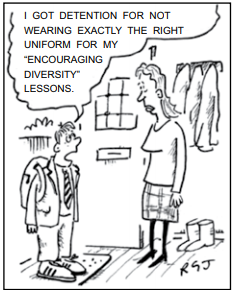
(www.cartoonstock.com)
Humor in the charge derives from
Provas
Dois em cada três hotéis vazam dados pessoais de hospedes.
Considerando-se verdadeira essa informação, é correto afirmar que
Provas
Dia da semana Valor total das vendas Segunda-feira R$ 2.900,00 Terça-feira R$ 2.800,00 Quarta-feira R$ 2.500,00 Quinta-feira R$ 3.000,00 Sexta-feira R$ 3.500,00
A diferença entre os valores médio e mediano das vendas, nesse período, é igual a
Provas
Provas
Caderno Container