Foram encontradas 50 questões.
TEXT 3
REFERS TO QUESTION FROM
The Literary Influences of Superstar Musician David Bowie
BY JOHN O'CONNELL ON 10/31/19 AT 5:00 AM EDT
David Bowie was a pop star for most of his career from the 1960s until his death in 2016. He was known for his flamboyant style, songwriting and the ability to artistically turn on a dime. But Bowie, who died of cancer at 69, was more than a multi-platinum rock and roller. He was also one of the more literate composers in the business.
So much so, in fact, that in conjunction with a career retrospective in 2013 at the Victoria & Albert Museum in London, Bowie issued a list of the one hundred books he considered the most important and influential. British music columnist John O'Connell linked this list to Bowie's prolific music. The result? A book called Bowie's Bookshelf out this month from Gallery Books.
William S. Burroughs first made the link between Bowie's lyrics and T. S. Eliot's poetry. In a Rolling Stone interview, Burroughs asked if Hunky Dory's "Eight Line Poem" had been influenced by Eliot's "The Hollow Men." Bowie's reply: "Never read him." But Bowie was definitely exposed to Eliot's influence. "Goodnight Ladies" on Transformer, the album Bowie produced for Lou Reed in 1972, is a riff on the end of the second section, "A Game of Chess," from Eliot's poem "The Waste Land." Eliot, for his part, is deliberately quoting Ophelia's "Good night, sweet ladies" speech from Hamlet. Eliot's method established a new protocol for artistic theft—the modern poet in dialogue with his or her predecessors. Bowie, too, was candid about how much he took from other artists. "You can't steal from a thief," he said when LCD Soundsystem's James Murphy admitted to stealing from Bowie's songs.
Avaiable in : https://www.newsweek.com/2019/11/15, accessed on February 20th, 2020. Adapted.
The word closest in meaning to ABILITY as in “the ability to artistically turn on a dime”
Provas

TEXT 3
REFERS TO QUESTION FROM
The Literary Influences of Superstar Musician David Bowie
BY JOHN O'CONNELL ON 10/31/19 AT 5:00 AM EDT
David Bowie was a pop star for most of his career from the 1960s until his death in 2016. He was known for his flamboyant style, songwriting and the ability to artistically turn on a dime. But Bowie, who died of cancer at 69, was more than a multi-platinum rock and roller. He was also one of the more literate composers in the business.
So much so, in fact, that in conjunction with a career retrospective in 2013 at the Victoria & Albert Museum in London, Bowie issued a list of the one hundred books he considered the most important and influential. British music columnist John O'Connell linked this list to Bowie's prolific music. The result? A book called Bowie's Bookshelf out this month from Gallery Books.
William S. Burroughs first made the link between Bowie's lyrics and T. S. Eliot's poetry. In a Rolling Stone interview, Burroughs asked if Hunky Dory's "Eight Line Poem" had been influenced by Eliot's "The Hollow Men." Bowie's reply: "Never read him." But Bowie was definitely exposed to Eliot's influence. "Goodnight Ladies" on Transformer, the album Bowie produced for Lou Reed in 1972, is a riff on the end of the second section, "A Game of Chess," from Eliot's poem "The Waste Land." Eliot, for his part, is deliberately quoting Ophelia's "Good night, sweet ladies" speech from Hamlet. Eliot's method established a new protocol for artistic theft—the modern poet in dialogue with his or her predecessors. Bowie, too, was candid about how much he took from other artists. "You can't steal from a thief," he said when LCD Soundsystem's James Murphy admitted to stealing from Bowie's songs.
Avaiable in : https://www.newsweek.com/2019/11/15, accessed on February 20th, 2020. Adapted.
According to text 3, it is accurate to state that:
Provas
TEXT 1
REFERS TO QUESTION FROM
Lessons for Americans, From a Chines Classroom
Observing how Chinese 2- and 3-year-olds navigated a second language, I wondered whether I could have done this for my children.
SHANGHAI — We sat in toddler-size wooden chairs around an orderly circle of Chinese 2-year-olds, busy with circle time. As a parent of three children who collectively spent 15 years in American day care, I am very familiar with circle time.
But I was in this Shanghai classroom as a professor, with college students from many different countries in a class I’m teaching here on children and childhood.
We were observing in a private kindergarten, designed to provide young children — starting at age 2 — with a carefully structured, fully bilingual curriculum, especially important because English language skills are vital for educational success in China.
Visits to Chinese educational institutions allow the college students in my course to get a look at real children and the ways that they learn, while also thinking about Chinese society today. They get windows onto certain slices of this complex country: a high-end private bilingual program that starts with toddlers; a city high school for academically gifted students; a middle school created for the children of the rural migrants who have come by the millions from China’s poorer provinces to work in Shanghai, but whose rights to social benefits are severely limited in the city.
These visits offer the college students insights into many of the social issues facing China, and we spend time in class discussing questions like the huge role that the annual gaokao college entrance exam plays in determining a child’s educational destiny (English is one of the required subjects), the pressures on families that create a culture of cram schools, and the controversies over reserving spots in colleges for kids from rural areas.
But all of those questions have powerful resonances when you think about the issues of childhood education and child development, which have to be addressed in every country. As my college students discuss the different facets of childhood around the world, visiting the Chinese schools also helps them in remembering and thinking about what children look like at different ages, and how they play and interact and learn.
Available in : https://www.nytimes.com/2020/01/20/, accessed on February 26th, 2020. Adapted
The word WHO is:
Provas
Choose the correct answer for the following question: “So what did you get the missus this year?”
Provas
REFERS TO QUESTION FROM
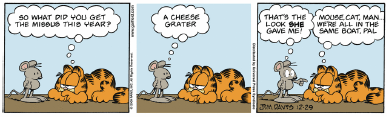
Available in: https://www.gocomics.com, accessed on February 18th, 2020. Garfield by Jim Davis
Choose correct meaning for MISSUS as in: “So what did you get the missus this year?”
Provas
REFERS TO QUESTION FROM
Available in: https://www.gocomics.com, accessed on February 18th, 2020. Garfield by Jim Davis
Read the sentences below and choose the one that has a verb which could replace ALLOW and keep the same meaning as in “Visits to Chinese educational institutions allow the college students in my course to get a look at real children”.
Provas
É aquele que compreende todo o processo ensino aprendizagem durante o ano letivo, explicitando todas as disciplinas ou módulos do curso. É o documento que o aluno recebe no primeiro dia de aula descrevendo: identificação da disciplina, carga horária, objetivos, cronograma de atividades (conteúdos), instrumentos de avaliativos, bibliografia recomendada. Eventualmente o educador não tem oportunidade de elaborar o plano de ensino, pois, conforme a instituição é previamente elaborado e apresentado, sem espaço para ser revisitado.
https://edisciplinas.usp.br/pluginfile.php/4505701/mod_resource/content/2/TEXTO%20PLANO%20DE%20AULA.pdf) - Acessado em fevereiro 2020.
Estamos falando de qual documento pedagógico?
Provas
Segundo Libâneo, “é uma tarefa docente que inclui tanto a previsão das atividades didáticas em termos de organização e coordenação em face dos objetivos propostos, quanto a sua revisão e adequação no decorrer do processo de ensino”. As características elencadas pelo autor são de:
Provas
As Correrias eram expedições armadas. Eram formadas com intuito de “limpar” as matas, assim atacavam aldeias indígenas do território acreano, visando amansar índios brabos, também assassinavam os líderes, expulsando-os ou escravizando-os. Quem eram esses homens brancos, colonizadores, que combatiam os diferentes grupos indígenas?
Provas
O Rendimento nominal mensal domiciliar per capita, no estado do Acre, de acordo com o IBGE é de?
Provas
Caderno Container