Foram encontradas 70 questões.
Em um sistema supervisório, é possível monitorar e controlar uma planta industrial, permitindo ações proativas a
fim de melhorar a produtividade da planta.
A seguinte caracterização NÃO descreve adequadamente um sistema supervisório:
A seguinte caracterização NÃO descreve adequadamente um sistema supervisório:
Provas
Questão presente nas seguintes provas

A International Organization for Standardization (ISO), na
norma técnica ISO 8373, define robô como:
um manipulador multifuncional, controlado automaticamente, reprogramável, com três ou mais eixos, que pode estar fixo em determinado local ou ser móvel, utilizado em aplicações industriais.
Dentre os robôs industriais, os robôs articulados têm destaque. Eles podem ter vários eixos, todos rotativos. Para que o controlador do robô possa determinar as necessidades de posicionamento de cada braço ou elo, cada eixo possui um sensor que fornece informações para o controlador.
Dos sensores abaixo, qual é o utilizado nos robôs articulados?
um manipulador multifuncional, controlado automaticamente, reprogramável, com três ou mais eixos, que pode estar fixo em determinado local ou ser móvel, utilizado em aplicações industriais.
Dentre os robôs industriais, os robôs articulados têm destaque. Eles podem ter vários eixos, todos rotativos. Para que o controlador do robô possa determinar as necessidades de posicionamento de cada braço ou elo, cada eixo possui um sensor que fornece informações para o controlador.
Dos sensores abaixo, qual é o utilizado nos robôs articulados?
Provas
Questão presente nas seguintes provas
As válvulas pneumáticas proporcionais são utilizadas no
comando de precisão e reguladas por sinais analógicos
proporcionais. Esse tipo de válvula é utilizado para controle de pressão e vazão.
Das situações abaixo, qual NÃO é adequada à utilização de válvula proporcional em operações de controle?
Das situações abaixo, qual NÃO é adequada à utilização de válvula proporcional em operações de controle?
Provas
Questão presente nas seguintes provas
Um sistema automatizado é composto por três elementos: 1 - Sistema de Energia; 2 - Programa de Instruções;
e 3 - Sistema de Controle.
Considerando-se uma operação automatizada de torneamento, o programa de instruções
Considerando-se uma operação automatizada de torneamento, o programa de instruções
Provas
Questão presente nas seguintes provas
Pode-se definir Sistema de Manufatura como uma coleção de equipamentos e recursos humanos integrados,
com a função de realizar tarefas e operações de processamentos de fabricação e montagem.
Alguns exemplos de Sistema de Manufatura são: células individuais, agrupamento de máquinas, linha de montagem manual, linha de transferência automatizada, sistema de montagem automatizado, células de máquinas, sistema de manufatura flexível, e outros.
A seguinte descrição representa um Sistema de Manufatura Flexível:
Alguns exemplos de Sistema de Manufatura são: células individuais, agrupamento de máquinas, linha de montagem manual, linha de transferência automatizada, sistema de montagem automatizado, células de máquinas, sistema de manufatura flexível, e outros.
A seguinte descrição representa um Sistema de Manufatura Flexível:
Provas
Questão presente nas seguintes provas
O dispositivo que recebe na entrada uma grandeza física
e emite uma saída, que pode ser a mesma grandeza física ou não, é o
Provas
Questão presente nas seguintes provas
Nas entradas e na saída de um Controlador Lógico Programável (CLP) estão conectados os seguintes componentes:
Entradas:
X0 = Botão retentivo de 2 posições, sendo, na posição 1, automático; na posição 2, manual.
X1 = Sensor S1
X2 = Sensor S2
X3 = Botão liga pulsante
X4 = Botão desliga pulsante
Nota: O botão retentivo na entrada X0 , na posição 1 (automático) emite um sinal na entrada. Se na posição 2 (manual) não emite sinal na entrada.
Saída: Y0 = Bomba d’água
O programa em Ladder instalado no CLP é o seguinte:

Analisando-se o programa, constata-se que o sistema em
Entradas:
X0 = Botão retentivo de 2 posições, sendo, na posição 1, automático; na posição 2, manual.
X1 = Sensor S1
X2 = Sensor S2
X3 = Botão liga pulsante
X4 = Botão desliga pulsante
Nota: O botão retentivo na entrada X0 , na posição 1 (automático) emite um sinal na entrada. Se na posição 2 (manual) não emite sinal na entrada.
Saída: Y0 = Bomba d’água
O programa em Ladder instalado no CLP é o seguinte:
Analisando-se o programa, constata-se que o sistema em
Provas
Questão presente nas seguintes provas
Os esquemas pneumático e elétrico de controle de um determinado dispositivo eletropneumático são mostrados abaixo.
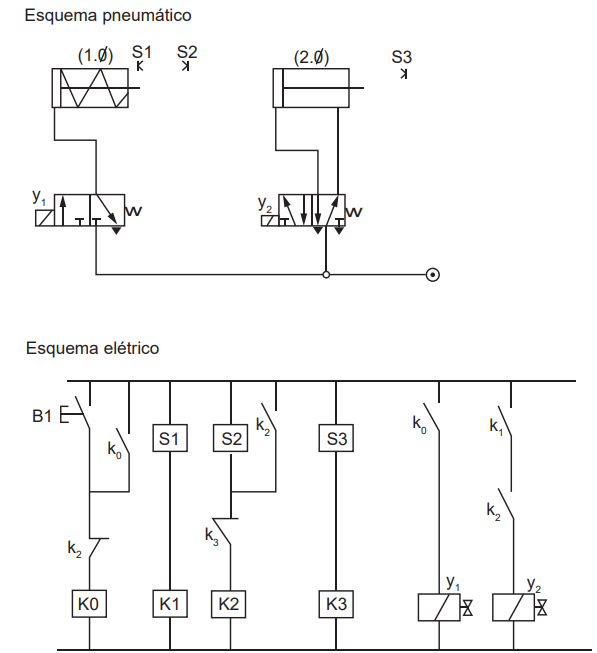
Pode-se apresentar o trajeto-passo de um circuito pneumático, escrevendo em sequência o número do atuador e o sinal + ou -, indicando avanço ou recuo respectivamente. Por exemplo: 1+ 2+ 1- 2- significa que o atuador 1 avança, em seguida o atuador 2 avança, em seguida o atuador 1 recua, e, finalmente, o atuador 2 recua.
Considerando-se os esquemas pneumático e elétrico acima, qual sequência de atuação é a correta, após acionamento do botão B1?
Pode-se apresentar o trajeto-passo de um circuito pneumático, escrevendo em sequência o número do atuador e o sinal + ou -, indicando avanço ou recuo respectivamente. Por exemplo: 1+ 2+ 1- 2- significa que o atuador 1 avança, em seguida o atuador 2 avança, em seguida o atuador 1 recua, e, finalmente, o atuador 2 recua.
Considerando-se os esquemas pneumático e elétrico acima, qual sequência de atuação é a correta, após acionamento do botão B1?
Provas
Questão presente nas seguintes provas
How space technology is bringing
green wins for transport
1 Space technology is developing fast, and, with
every advance, it is becoming more accessible to
industry. Today, satellite communications (satcoms)
and space-based data are underpinning new ways
of operating that boost both sustainability and
profitability. Some projects are still in the planning
stages, offering great promise for the future. However,
others are already delivering practical results.
2 The benefits of space technology broadly fall
into two categories: connectivity that can reach into
situations where terrestrial technologies struggle to
deliver and the deep, unique insights delivered by
Earth Observation (EO) data. Both depend on access
to satellite networks, particularly medium earth orbit
(MEO) and low earth orbit (LEO) satellites that offer
low-latency connectivity and frequently updated data.
Right now, the satellite supplier market is booming,
driving down the cost of access to satellites. Suppliers
are increasingly tailoring their services to emerging
customer needs and the potential applications are
incredible – as a look at the transportation sector
shows.
3 Satellite technology is a critical part of
revolutionizing connectivity on trains. The Satellites
for Digitalization of Railways (SODOR) project will
provide low latency, highly reliable connectivity that,
combined with monitoring sensors, will mean near realtime data guides operational decisions. This insight
will help trains run more efficiently with fewer delays
for passengers. Launching this year, SODOR will help
operators reduce emissions by using the network
more efficiently, allowing preventative maintenance
and extending the lifetime of some existing trains. It
will also make rail travel more attractive and help shift
more passengers from road to rail (that typically emits
even less CO2
per passenger than electric cars do).
4 Satellite data and communications will also play
a fundamental role in shaping a sustainable future
for road vehicles. Right now, the transport sector
contributes around 14% of the UK’s greenhouse gas
emissions, of which 91% is from road vehicles – and
this needs to change.
5 A future where Electric Vehicles (EV) dominate
will need a smart infrastructure to monitor and control
the electricity network, managing highly variable
supply and demand, as well as a large network of
EV charging points. EO data will be critical in future
forecasting models for wind and solar production, to
help manage a consistent flow of green energy.
6 Satellite communications will also be pivotal. As
more wind and solar installations join the electricity
network – often in remote locations – satcoms will step in to deliver highly reliable connectivity where 4G
struggles to reach. It will underpin a growing network
of EV charging points, connecting each point to the
internet for operational management purposes, for
billing and access app functionality and for the users’
comfort, they may access the system wherever they
are.
7 Satellite technology will increasingly be a part of
the vehicles themselves, particularly when automated
driving becomes more mainstream. It will be essential
for every vehicle to have continuous connectivity to
support real-time software patches, map updates
and inter-vehicle communications. Already, satellites
provide regular software updates to vehicles and
enhanced safety through an in-car emergency call
service.
8 At our company, we have been deeply embedded
in the space engineering for more than 40 years – and
we continue to be involved with the state-of-the-art
technologies and use cases. We have a strong track
record of translating these advances into practical
benefits for our customers that make sense on both a
business and a sustainability level.
Available at: https://www.cgi.com/uk/en-gb/blog/space/how-space-technology-is-bringing-green-wins-to-transport. Retrieved on
April 25, 2023. Adapted.
Provas
Questão presente nas seguintes provas
How space technology is bringing
green wins for transport
1 Space technology is developing fast, and, with
every advance, it is becoming more accessible to
industry. Today, satellite communications (satcoms)
and space-based data are underpinning new ways
of operating that boost both sustainability and
profitability. Some projects are still in the planning
stages, offering great promise for the future. However,
others are already delivering practical results.
2 The benefits of space technology broadly fall
into two categories: connectivity that can reach into
situations where terrestrial technologies struggle to
deliver and the deep, unique insights delivered by
Earth Observation (EO) data. Both depend on access
to satellite networks, particularly medium earth orbit
(MEO) and low earth orbit (LEO) satellites that offer
low-latency connectivity and frequently updated data.
Right now, the satellite supplier market is booming,
driving down the cost of access to satellites. Suppliers
are increasingly tailoring their services to emerging
customer needs and the potential applications are
incredible – as a look at the transportation sector
shows.
3 Satellite technology is a critical part of
revolutionizing connectivity on trains. The Satellites
for Digitalization of Railways (SODOR) project will
provide low latency, highly reliable connectivity that,
combined with monitoring sensors, will mean near realtime data guides operational decisions. This insight
will help trains run more efficiently with fewer delays
for passengers. Launching this year, SODOR will help
operators reduce emissions by using the network
more efficiently, allowing preventative maintenance
and extending the lifetime of some existing trains. It
will also make rail travel more attractive and help shift
more passengers from road to rail (that typically emits
even less CO2
per passenger than electric cars do).
4 Satellite data and communications will also play
a fundamental role in shaping a sustainable future
for road vehicles. Right now, the transport sector
contributes around 14% of the UK’s greenhouse gas
emissions, of which 91% is from road vehicles – and
this needs to change.
5 A future where Electric Vehicles (EV) dominate
will need a smart infrastructure to monitor and control
the electricity network, managing highly variable
supply and demand, as well as a large network of
EV charging points. EO data will be critical in future
forecasting models for wind and solar production, to
help manage a consistent flow of green energy.
6 Satellite communications will also be pivotal. As
more wind and solar installations join the electricity
network – often in remote locations – satcoms will step in to deliver highly reliable connectivity where 4G
struggles to reach. It will underpin a growing network
of EV charging points, connecting each point to the
internet for operational management purposes, for
billing and access app functionality and for the users’
comfort, they may access the system wherever they
are.
7 Satellite technology will increasingly be a part of
the vehicles themselves, particularly when automated
driving becomes more mainstream. It will be essential
for every vehicle to have continuous connectivity to
support real-time software patches, map updates
and inter-vehicle communications. Already, satellites
provide regular software updates to vehicles and
enhanced safety through an in-car emergency call
service.
8 At our company, we have been deeply embedded
in the space engineering for more than 40 years – and
we continue to be involved with the state-of-the-art
technologies and use cases. We have a strong track
record of translating these advances into practical
benefits for our customers that make sense on both a
business and a sustainability level.
Available at: https://www.cgi.com/uk/en-gb/blog/space/how-space-technology-is-bringing-green-wins-to-transport. Retrieved on
April 25, 2023. Adapted.
Provas
Questão presente nas seguintes provas
Cadernos
Caderno Container