Foram encontradas 64 questões.
A luz é uma forma de energia eletromagnética que se comporta como onda e como partícula. As ondas são caracterizadas por comprimentos de onda, enquanto a partícula de luz, o fóton, possui uma determinada quantidade de energia, que é inversamente proporcional ao comprimento de onda da luz. Entretanto, o olho humano é sensível a apenas uma faixa do comprimento de onda e, dentro desse espectro de luz visível, está a radiação que promove a fotossíntese.
A imagem abaixo ilustra o espectro eletromagnético, com destaque para o espectro de luz visível ao olho humano.
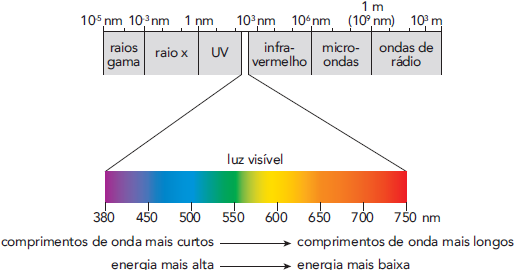
Sabe-se que, durante a fotossíntese, a absorção de um fóton de luz pela clorofila provoca a transição dessa molécula de um estado base para um estado excitado.
Dessa forma, pode-se afirmar que a clorofila alcançará seu estado energético mais elevado ao absorver fótons na faixa da luz:
Provas

Os esteroides são lipídios que se caracterizam por apresentar uma estrutura química composta de quatro anéis de átomos de carbono interligados. O colesterol é o principal esteroide presente nos tecidos animais, frequentemente associado ao desenvolvimento de doenças cardiovasculares. Entretanto, o organismo humano utiliza o colesterol como precursor de moléculas que desempenham uma série de funções metabólicas, incluindo os hormônios esteroides.
O colesterol é a molécula precursora para a síntese do seguinte hormônio:
Provas
18,9É sabido que o consumo de frutas reduz o risco de doenças e contribui para a manutenção da homeostase do corpo e da qualidade de vida. Observe a tabela abaixo, que apresenta informações nutricionais de quatro frutas.
QUANTIDADE DE NUTRIENTES POR 100 GRAMAS DE POLPA DE FRUTA
|
Fruta |
Cálcio | Fósforo | Potássio |
Vitamina C |
|
Abacaxi |
3,70 |
17,2 | 0,45 |
10,4 |
|
Banana |
4,86 |
31,1 |
0,41 |
3,90 |
|
Laranja |
7,69 | 18,9 |
0,21 |
29,8 |
|
Limão |
5,70 | 12,5 | 0,17 |
32,6 |
A fruta cujo consumo é o mais indicado para indivíduos com alteração da musculatura esquelética, caracterizada pela redução da força e da massa muscular, é:
Provas
A síndrome de Down é uma condição genética na qual uma pessoa nasce com uma cópia extra do cromossomo 21. Pessoas com essa síndrome geralmente apresentam traços faciais característicos, deficiência intelectual leve a moderada e retardo do crescimento.
O número de cromossomos do tipo autossomo presentes nas células epiteliais de uma pessoa com síndrome de Down, é:
Provas
When we think of AI, we think of robots that act like humans or computer programs that have a “conscience”. This concept is largely associated with science fiction, but it’s fast becoming a reality all around us.
These days, AI is a hot topic in multiple industries – even in clinical research. Essentially, AI, or Artificial Intelligence, is a field combining computer science with expansive datasets, which allows for machine-enabled problem solving. AI writing and art generators are the better-known examples for the general public, but it is also used in other industries, such as clinical research, which is shifting to more decentralized models, as the use of wearable medical technology has risen.
Actually, AI can support and improve the use of wearables in many ways. Besides automatically collecting and processing data inputs, it can also automate decision-making regarding device notifications. An AI program could also generate recommended patient actions based on patterns in their health data. There are several obstacles when it comes to decentralized clinical trials, one of which is data collection and processing. Since patients are off-site, they have to regularly and consciously submit their own participation data. This can bring up issues with patient compliance and data errors. CROs and medical research institutions can leverage AI to solve these issues in several ways. They can create algorithms to analyze patient data and create decisions that will achieve a desired outcome. Lastly, AI can optimize and generate notifications that prompt patients to complete electronic clinical outcome assessments (eCOA) for a more reliable data pool.
Moreover, AI programs can assist patients in submitting their data by analyzing the quality of the data prior to acceptance. For example, an AI program can evaluate an image to see whether it fits the requirements of the clinical trial. It can then prompt the patient to retake the image with recommendations regarding image quality, such as lighting or angle. This limits the amount of insufficient or substandard submissions, thereby leading to fewer data processing errors.
Of course, implementing new technologies comes with challenges and difficulties. This is especially true when it comes to a complex technology such as AI, which is still being developed and optimized. But, what is important is that existing applications of artificial intelligence in clinical practices and trials have begun changing the way research is conducted and executed. AI has been supporting, enhancing, and transforming clinical research – all to the benefit of patients all over the world.
Adapted from: vial.com/blog. Accessed June 7 2023.
The statement which best summarizes the message in the last paragraph is:
Provas
When we think of AI, we think of robots that act like humans or computer programs that have a “conscience”. This concept is largely associated with science fiction, but it’s fast becoming a reality all around us.
These days, AI is a hot topic in multiple industries – even in clinical research. Essentially, AI, or Artificial Intelligence, is a field combining computer science with expansive datasets A) , which allows for machine-enabled problem solving. AI writing and art generators are the better-known examples for the general public, but it is also used in other industries, such as clinical research, which is shifting to more decentralized models, as the use of wearable medical technology has risen.
Actually, AI can support and improve the use of wearables in many ways B). Besides automatically collecting and processing data inputs, it can also automate decision-making regarding device notifications. An AI program could also generate recommended patient actions based on patterns in their health data. There are several obstacles when it comes to decentralized clinical trials, one of which is data collection and processing. Since patients are off-site, they have to regularly and consciously submit their own participation data. This can bring up issues with patient compliance and data errors. CROs and medical research institutions can leverage AI to solve these issues in several ways. They can create algorithms to analyze patient data and create decisions that will achieve a desired outcome. Lastly, AI can optimize and generate notifications that prompt patients to complete electronic clinical outcome assessments (eCOA) for a more reliable data pool C).
Moreover, AI programs can assist patients in submitting their data by analyzing the quality of the data prior to acceptance D). For example, an AI program can evaluate an image to see whether it fits the requirements of the clinical trial. It can then prompt the patient to retake the image with recommendations regarding image quality, such as lighting or angle. This limits the amount of insufficient or substandard submissions, thereby leading to fewer data processing errors.
Of course, implementing new technologies comes with challenges and difficulties. This is especially true when it comes to a complex technology such as AI, which is still being developed and optimized. But, what is important is that existing applications of artificial intelligence in clinical practices and trials have begun changing the way research is conducted and executed. AI has been supporting, enhancing, and transforming clinical research – all to the benefit of patients all over the world.
Adapted from: vial.com/blog. Accessed June 7 2023.
“Besides automatically collecting and processing data inputs, it can also automate decision-making regarding device notifications.”
A word with the same semantic value as “besides” is present in:
Provas
When we think of AI, we think of robots that act like humans or computer programs that have a “conscience”. This concept is largely associated with science fiction, but it’s fast becoming a reality all around us.
These days, AI is a hot topic in multiple industries – even in clinical research. Essentially, AI, or Artificial Intelligence, is a field combining computer science with expansive datasets, which allows for machine-enabled problem solving. AI writing and art generators are the better-known examples for the general public, but it is also used in other industries, such as clinical research, which is shifting to more decentralized models, as the use of wearable medical technology has risen.
Actually, AI can support and improve the use of wearables in many ways. Besides automatically collecting and processing data inputs, it can also automate decision-making regarding device notifications. An AI program could also generate recommended patient actions based on patterns in their health data. There are several obstacles when it comes to decentralized clinical trials, one of which is data collection and processing. Since patients are off-site, they have to regularly and consciously submit their own participation data. This can bring up issues with patient compliance and data errors. CROs and medical research institutions can leverage AI to solve these issues in several ways. They can create algorithms to analyze patient data and create decisions that will achieve a desired outcome. Lastly, AI can optimize and generate notifications that prompt patients to complete electronic clinical outcome assessments (eCOA) for a more reliable data pool.
Moreover, AI programs can assist patients in submitting their data by analyzing the quality of the data prior to acceptance. For example, an AI program can evaluate an image to see whether it fits the requirements of the clinical trial. It can then prompt the patient to retake the image with recommendations regarding image quality, such as lighting or angle. This limits the amount of insufficient or substandard submissions, thereby leading to fewer data processing errors.
Of course, implementing new technologies comes with challenges and difficulties. This is especially true when it comes to a complex technology such as AI, which is still being developed and optimized. But, what is important is that existing applications of artificial intelligence in clinical practices and trials have begun changing the way research is conducted and executed. AI has been supporting, enhancing, and transforming clinical research – all to the benefit of patients all over the world.
Adapted from: vial.com/blog. Accessed June 7 2023.
“There are several obstacles when it comes to decentralized clinical trials, one of which is data collection and processing.” The underlined word refers to:
Provas
When we think of AI, we think of robots that act like humans or computer programs that have a “conscience”. This concept is largely associated with science fiction, but it’s fast becoming a reality all around us.
These days, AI is a hot topic in multiple industries – even in clinical research. Essentially, AI, or Artificial Intelligence, is a field combining computer science with expansive datasets, which allows for machine-enabled problem solving. AI writing and art generators are the better-known examples for the general public, but it is also used in other industries, such as clinical research, which is shifting to more decentralized models, as the use of wearable medical technology has risen.
Actually, AI can support and improve the use of wearables in many ways. Besides automatically collecting and processing data inputs, it can also automate decision-making regarding device notifications. An AI program could also generate recommended patient actions based on patterns in their health data. There are several obstacles when it comes to decentralized clinical trials, one of which is data collection and processing. Since patients are off-site, they have to regularly and consciously submit their own participation data. This can bring up issues with patient compliance and data errors. CROs and medical research institutions can leverage AI to solve these issues in several ways. They can create algorithms to analyze patient data and create decisions that will achieve a desired outcome. Lastly, AI can optimize and generate notifications that prompt patients to complete electronic clinical outcome assessments (eCOA) for a more reliable data pool.
Moreover, AI programs can assist patients in submitting their data by analyzing the quality of the data prior to acceptance. For example, an AI program can evaluate an image to see whether it fits the requirements of the clinical trial. It can then prompt the patient to retake the image with recommendations regarding image quality, such as lighting or angle. This limits the amount of insufficient or substandard submissions, thereby leading to fewer data processing errors.
Of course, implementing new technologies comes with challenges and difficulties. This is especially true when it comes to a complex technology such as AI, which is still being developed and optimized. But, what is important is that existing applications of artificial intelligence in clinical practices and trials have begun changing the way research is conducted and executed. AI has been supporting, enhancing, and transforming clinical research – all to the benefit of patients all over the world.
Adapted from: vial.com/blog. Accessed June 7 2023.
Considering “clinical research”, the main focus of the article is to:
Provas
Considere um quadrado ABCD cujo lado mede 2 \( \sqrt{2} \) metros. Dois pontos P e Q partem simultaneamente do vértice B, deslocando-se, no sentido horário, sobre os lados desse quadrado com velocidades escalares constantes. A figura a seguir indica o momento em que o ponto P percorreu \( \sqrt{2} \) metros.

Admita que o deslocamento, em metros, feito pelo ponto P seja sempre o dobro do feito por Q. Se o ponto P percorrer 10 \( \sqrt{2} \) m, o comprimento do segmento de reta PQ, em metros, será igual a:
Provas
Uma pesquisa foi realizada em um grupo de 240 pessoas que receberam pelo menos uma das vacinas A e B. A probabilidade de escolher ao acaso uma dessas pessoas e ela ter recebido:
• as duas vacinas é igual a \( \dfrac{1}{5} \) ; e
• apenas a vacina A é o triplo de ter recebido apenas a B.
O número de pessoas que receberam a vacina B foi igual a:
Provas
Caderno Container