Foram encontradas 80 questões.
Based on the comic strip, answer question.
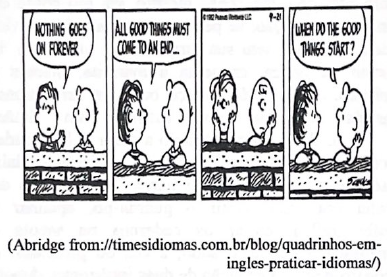
According to the comic strip above, choose the correct alternative.
Provas

Based on the comic strip, answer question.
According to the sentence "Nothing goes on forever" from the comic strip, read the sentences below and choose the correct sentence, as far as the use of the indefinite pronoum is grammatically correct.
Provas
Which sentences are grammatically correct?
I - They are an European couple.
II - I'm studying at a university close to home.
III - Diego lives in 234 Chicago Avenue.
IV - I was born on August 1.
V - Smiths are coming for lunch today.
Provas
Choose the option that correctly completes the text below, respectively.
Thanks to team of sniffers, led by George Aldrich, astronauts can breathe a little bit easier. Aldrich is the "chief sniffer" at the White Sands Test Facility in New Mexico. job is to smell items before they can be flown in the space shuttle.
Aldrich explained that smells change in space and that once astronauts are up there, stuck with whatever smells are onboard with them. In space, astronauts aren't able to open the window for extra ventilation. He also said that important not to introduce substances that will change the delicate balance of the climate of the Internatonal Space Station and the space shuttle. This is even more important to the ISS astronauts than it was to the Apollo astronauts in .
Provas
Complete the sentence using the appropriate conjunction.
You should tell him the true story about yesterday's discussion. he'll get upset with you.
Provas
Text IV
Based on the text below, answer question.
Europe's bottest winter
This January, temperatures across Europe reached an all-time-high. Many nations are suffering from a warmer winter. For example, in Bosnia, the exceptionally warm weather prompted tourism authorities to consider a declaration of a natural emergency. ln Switzerland, Alpine slopes lack the blanket of snow needed to ski. ln Macedonia, low snow has kept away thousands of tourists from ski resorts. ln Bilbao, Spain, the temperature reached 25.1 degrees Celsius, which was 10 degrees more than average for this time of year. According to scientists, extreme weather events are more frequent, more intense, and last longer because of human-induced climate change. Experts forecast the above-normal temperatures to last until mid-January.
https://lwww.newsinlevels.com/products/europes-hottest-
winter-level-3/)
Consider the title of the text: "Europe's hottest winter", which sentences are grammatically correct?
I - The best place to find cold weather in Germany is in the state of Bavaria.
II - The Strait of Dover is the narrowest part of the English Channel.
III - Italy is the eldest country in Europe.
IV - Austria is voted the worse country for skiing in Europe.
V - By surface area, France is the most large country and Malta the smallest.
Provas
Text IV
Based on the text below, answer question.
Europe's bottest winter
This January, temperatures across Europe reached an all-time-high. Many nations are suffering from a warmer winter. For example, in Bosnia, the exceptionally warm weather prompted tourism authorities to consider a declaration of a natural emergency. ln Switzerland, Alpine slopes lack the blanket of snow needed to ski. ln Macedonia, low snow has kept away thousands of tourists from ski resorts. ln Bilbao, Spain, the temperature reached 25.1 degrees Celsius, which was 10 degrees more than average for this time of year. According to scientists, extreme weather events are more frequent, more intense, and last longer because of human-induced climate change. Experts forecast the above-normal temperatures to last until mid-January.
https://lwww.newsinlevels.com/products/europes-hottest-
winter-level-3/)
In the fragment of the text: "In Macedonia, low snow has kept away thousands of tourists from ski resort", the phrasal verb in bold has the same meaning, EXCEPT in
Provas
Text III
Read the text below and answer question.
Building the impossible: Golden Gate Bridge
In the mid-1930s, two familiar spires towered above the morning fog. Stretching 227 meters into the sky, these 22,000-ton towers would help support California's Golden Gate Bridge.
But since they were currently in Pennsylvania, they first had to be dismantled, packaged, and shipped piece by piece over 4,500 kilometers away. Moving the bridge's towers across a continent was just one of the challengers facing Charles Ellis and Joseph Strauss, the project's lead engineers. Even before construction began, the pair faced all kinds of opposition.
The military feared the bridge would make the important harbor an even more vulnerable target. Ferry companies claimed the bridge would steal their business, and residents wanted to preserve the area's natural scenery.
Worse still, many engineers thought the project was impossible. The Golden Gate Strait was home to 96-kilometer-per-hour winds, swirling tides, an endless blanket of fog, and the earthquake-prone San Andreas fault.
But Strauss was convinced the bridge could be built; and that it would provide San Francisco's commuters more reliable passage to the city. He was, however, a bit out of his depth. Strauss's initial plans to span the strait used a cantilever bridge. This kind of bridge consists of a single beam anchored at one end and extended horizontally like a diving board.
Since these bridges can only extend so far before collapsing under their own weight, Strauss's design used two cantilevers, linked by a structure in the middle. But Ellis and his colleague Leon Moisseif convinced Strauss to pursue a different approach: the suspension bridge.
Where a cantilever bridge is supported from one end a suspension bridge suspends its deck from cables strung across the gap. The result is a more flexible structure that's resilient to winds and shifting loads.This kind of design had long been used for small rope bridges. And in the 1930s, advanced steel manufacturing could create cables of bundled wire to act as strong steel rope for large-scale construction.
At the time, the Golden Gate Bridge was the longest and tallest suspension bridge ever attempted, and its design was only possible due to these innovations.
But cables and towers of this size could only be built at large steelworks on the country's east coast.
What were the challenges faced by Charles Ellis and Joseph Strauss in building the Golden Gate Bridge? Choose the correct option.
I - Opposition from the military.
II - Opposition from ferry companies.
III - Opposition from residents.
IV - Opposition from his colleague Leon Moisseif.
V - Opposition from the engineers.
Provas
Text III
Read the text below and answer question.
Building the impossible: Golden Gate Bridge
In the mid-1930s, two familiar spires towered above the morning fog. Stretching 227 meters into the sky, these 22,000-ton towers would help support California's Golden Gate Bridge.
But since they were currently in Pennsylvania, they first had to be dismantled, packaged, and shipped piece by piece over 4,500 kilometers away. Moving the bridge's towers across a continent was just one of the challengers facing Charles Ellis and Joseph Strauss, the project's lead engineers. Even before construction began, the pair faced all kinds of opposition.
The military feared the bridge would make the important harbor an even more vulnerable target. Ferry companies claimed the bridge would steal their business, and residents wanted to preserve the area's natural scenery.
Worse still, many engineers thought the project was impossible. The Golden Gate Strait was home to 96-kilometer-per-hour winds, swirling tides, an endless blanket of fog, and the earthquake-prone San Andreas fault.
But Strauss was convinced the bridge could be built; and that it would provide San Francisco's commuters more reliable passage to the city. He was, however, a bit out of his depth. Strauss's initial plans to span the strait used a cantilever bridge. This kind of bridge consists of a single beam anchored at one end and extended horizontally like a diving board.
Since these bridges can only extend so far before collapsing under their own weight, Strauss's design used two cantilevers, linked by a structure in the middle. But Ellis and his colleague Leon Moisseif convinced Strauss to pursue a different approach: the suspension bridge.
Where a cantilever bridge is supported from one end a suspension bridge suspends its deck from cables strung across the gap. The result is a more flexible structure that's resilient to winds and shifting loads.This kind of design had long been used for small rope bridges. And in the 1930s, advanced steel manufacturing could create cables of bundled wire to act as strong steel rope for large-scale construction.
At the time, the Golden Gate Bridge was the longest and tallest suspension bridge ever attempted, and its design was only possible due to these innovations.
But cables and towers of this size could only be built at large steelworks on the country's east coast.
What is the main difference between a cantilever bridge and a suspension bridge?
Provas
Text III
Read the text below and answer question.
Building the impossible: Golden Gate Bridge
In the mid-1930s, two familiar spires towered above the morning fog. Stretching 227 meters into the sky, these 22,000-ton towers would help support California's Golden Gate Bridge.
But since they were currently in Pennsylvania, they first had to be dismantled, packaged, and shipped piece by piece over 4,500 kilometers away. Moving the bridge's towers across a continent was just one of the challengers facing Charles Ellis and Joseph Strauss, the project's lead engineers. Even before construction began, the pair faced all kinds of opposition.
The military feared the bridge would make the important harbor an even more vulnerable target. Ferry companies claimed the bridge would steal their business, and residents wanted to preserve the area's natural scenery.
Worse still, many engineers thought the project was impossible. The Golden Gate Strait was home to 96-kilometer-per-hour winds, swirling tides, an endless blanket of fog, and the earthquake-prone San Andreas fault.
But Strauss the bridge be built; and that it provide San Francisco's commuters more reliable passage to the city. He was, however, a bit out of his depth. Strauss's initial plans to span the strait used a cantilever bridge. This kind of bridge consists of a single beam anchored at one end and extended horizontally like a diving board.
Since these bridges can only extend so far before collapsing under their own weight, Strauss's design used two cantilevers, linked by a structure in the middle. But Ellis and his colleague Leon Moisseif convinced Strauss to pursue a different approach: the suspension bridge.
Where a cantilever bridge is supported from one end a suspension bridge suspends its deck from cables strung across the gap. The result is a more flexible structure that's resilient to winds and shifting loads.This kind of design had long been used for small rope bridges. And in the 1930s, advanced steel manufacturing could create cables of bundled wire to act as strong steel rope for large-scale construction.
At the time, the Golden Gate Bridge was the longest and tallest suspension bridge ever attempted, and its design was only possible due to these innovations.
But cables and towers of this size could only be built at large steelworks on the country's east coast.
Mark the option that completes the blank space, in the fifth paragraph, in the text above.
"But Strauss the bridge be built; and that it provide San Francisco's commuters more reliable passage to the city."
Provas
Caderno Container