Foram encontradas 80 questões.
As lhe Olympics Approaches, a Lesson in Overcoming Adversity
8ert R. Mandelbaum, MD
Ju[y 20, 2016
Ju[y 20, 2016
I've known a lot 01 athletes who qualilied lor the Olympic Games injuries. But I know 01 only one who qualified beca use of an injury.
Cliff Meidl's story captures the spirit 01 the Olympics.
In November 1986, Cliff, a 20-year-old plumber's apprentice, hit three buried high-voltage electrical cables with a jackhammer. An estimated 30,000 volts surged through his body, exploding bone and cartilage lrom the inside ali the way up to his head. To put that into perspective, electric chairs use only 1500-2000 volts for executions. So it's sale to say that Cliff should have died.
And he nearly did. His heart stopped. Paramedics were able to get it going again, but they had to resuscitate him on the way to the hospital.
As part of a team with renowned plastic surgeon Malcolm Lesavoy, MD, and others, I got to work reconstructing Cliffs legs. Our best hope was to avoid amputation.
But very quickly, we noticed something else going on - something that had nothing to do with our expertise. Through every step of his painlul rehabilitation, Cliff grew more and more determined. He never complained. He just asked, 'What's next?"
Belore he had even linished the rehabilitation, Cliff started paddling various watercralts. The days spent on crutches had already strengthened his upper body, and he took naturally to the sport. The same year in which he was injured, he began competing in canoe and kayak events, and in 1996 he qualilied lor the Olympics - not the Paralympic Games, the Olympic Games.
Four years later, in Sydney, Australia, I was overseeing the sports medicine team at the Olympic soccer tournament. I was sitting in the stands during the opening ceremonies when Cliff walked into the Olympic Stadium carrying the Stars and Stripes.
It's a long-standing tradition lor delegations of athletes to select one among their number to bear the Ilag, and the choice olten symbolizes some extraordinary accomplishment. I had no idea that Cliff would be selected. So when he strode into the stadium with a normal gait, I nearly broke down.
Moments like that reinlorce what I have always believed: that sport can bring out the best in us alI.
The Olympic Games (...) are devoted to celebrating the human capacity to improve body, mind, and sou I.
They are about taking part - not necessarily about winning. Cliffs peers in the US delegation of 2000 recognized that when they elected him to bear the nation's colors. He never won a medal at the games, but the spirit with which he overcame adversity inspired ali of them.
The Olympic moUo - laster, higher, stronger - can help our patients realize that the real victory is the "win within." The Win Within: Capturing Your Victorious Spirit is the name of the book I wrote to show people that coming back Irom adversity is part of our heritage - that we as human beings are more adapted to adversity than we are to success.
Adversity is the engine of unimagined opportunity. It can unleash our energy and stimulate our will. It moves us to succeed. If I don't have lood, I have to go get some. If I'm cold, I have to build a shelter.
I remind patients who don't participate in sports that they have the heritage of athletes. We ali have the genes of pursuit-hunters who survived by running down their prey and running away Irom their predators. That's why even now, in 2016, when we go out and take a run, we leel good. We get an endorphin surge and our lipids go down. Our hearts and brains become clear.
The life of sport and sport of life are interlinked. Exercise is our birthright; it's our legacy; it's why we are here.
We no longer have to lear saber-toothed tigers or cave bears. But when you look today at how people can be successful in 2016, it's by avoiding the predators in our urban life: overeating, inactivity, and smoking. And it's by rising to meet adversity.
(Adapted trom http://WNIN.medscape.comlviewarticle/866279)
According to the text, which statement is correct?
Provas
Questão presente nas seguintes provas

O dono do livro
Li outro dia um fato real narrado pelo escritor moçambicano Mia Couto. Ele disse que certa vez chegou em casa no fim do dia, já havia anoitecido, quando um garoto humilde de 16 anos o esperava sentado no muro. O garoto estava com um dos braços para trás, o que perturbou o escritor, que imaginou que pudesse ser assaltado.
Mas logo o menino mostrou o que tinha em mãos: um livro do próprio Mia Couto. Esse livro é seu? perguntou o menino. Sim, respondeu o escritor. Vim devolver. O garoto explicou que horas antes estava na rua quando viu uma moça com aquele livro nas mãos, cuja capa trazia a foto do autor.
O garoto reconheceu Mia Couto pelas fotos que já havia visto em jornais. Então perguntou para a moça: Esse livro é do Mia Couto? Ela respondeu: É. E o garoto mais que ligeiro tirou o livro das mãos dela e correu para a casa do escritor para fazer a boa ação de devolver a obra ao verdadeiro dono.
Uma história assim pode acontecer em qualquer país habitado por pessoas que ainda não estejam familiarizadas com os livros - aqui no Brasil, inclusive. De quem é o livro? A resposta não é a mesma de quando se pergunta: "Quem escreveu o livro?".
O autor é quem escreve, mas o livro é de quem lê, e isso de uma forma muito mais abrangente do que o conceito de propriedade privada - comprei, é meu. O livro é de quem lê mesmo quando foi retirado de uma biblioteca, mesmo que seja emprestado, mesmo que tenha sido encontrado num banco de praça.
O livro é de quem tem acesso às suas páginas e através delas consegue imaginar os personagens, os cenários, a voz e o jeito com que se movimentam. São do leitor as sensações provocadas, a tristeza, a euforia, o medo, o espanto, tudo o que é transmitido pelo autor, mas que reflete em quem lê de uma forma muito pessoal. E do leitor o prazer. E do leitor a identificação. E do leitor o aprendizado. É do leitor o livro.
Dias atrás gravei um comercial de rádio em prol do Instituto Estadual do Livro em que falo aos leitores exatamente isso: os meus livros são os seus livros. E são, de fato. Não existe livro sem leitor. Não existe. É um objeto fantasma que não serve pra nada.
Aquele garoto de Moçambique não vê assim. Para ele, o livro é de quem traz o nome estampado na capa, como se isso sinalizasse o direito de posse. Não tem ideia de como se dá o processo todo, possivelmente nunca entrou numa livraria, nem sabe o que é tiragem.
Mas, em seu desengano, teve a gentileza de tentar colocar as coisas em seu devido lugar, mesmo que para isso tenha roubado o livro de uma garota sem perceber.
Ela era a dona do livro. E deve ter ficado estupefata. Um fã do Mia Couto afanou seu exemplar. Não levou o celular, a carteira, só quis o livro. Um danado de um amante da literatura, deve ter pensado ela. Assim são as histórias escritas também pela vida, interpretadas a seu modo por cada dono.
(Martha Medeiros. JORNAL ZERO HORA - 06/11/11.1 Revista O Globo, 25 de novembro de 2012.)
Assinale a opção em que a troca da palavra sublinhada pela que está entre parênteses mantém corretas as relações de sentido e a regência nominal ou verbal.
Provas
Questão presente nas seguintes provas
Chama-se conjunto-verdade de uma sentença aberta p(x) em um conjunto A o conjunto de todos os elementos a !$ ∈ !$ A, tais que p(a) é uma proposição verdadeira (V). Sejam p(x), q(x) e r(x) sentenças abertas em um mesmo conjunto A. Encontre o conjunto-verdade da sentença aberta composta !$ (P(x) → q(x)) v ~ r(x) !$, em função de !$ V_p !$, !$ V_q !$. e !$ V_r !$, e assinale a opção correta.
Provas
Questão presente nas seguintes provas
Which is the correct option to complete the paragraph below?
How to use the camera at the beach or near water
the camera dry naturally in case it gets wet. After that, please the door/cover to be sure no sand is present. as required. the camera
anywhere the temperature may exeeed 35ºC as this may damage the unit.
Provas
Questão presente nas seguintes provas
Uma pirâmide triangular tem como base um triângulo de lados !$ 13cm !$, !$ 14 cm !$ e !$ 15 cm !$; as outras arestas medem l. Sabendo que o volume da pirâmide é de !$ 105 \sqrt{22} cm^3 !$, o valor de I, em em, é igual a:
Provas
Questão presente nas seguintes provas
Choose the correct option to complete this paragraph.
Pamela is absolutely dedicated to work. She is a doctor and director of a university department where she has a lot of research on anesthesiology. She has also grants from federal and private organizations and has her projects all over the world to be presented at professional meetings.
Provas
Questão presente nas seguintes provas
Analise as figuras a seguir.
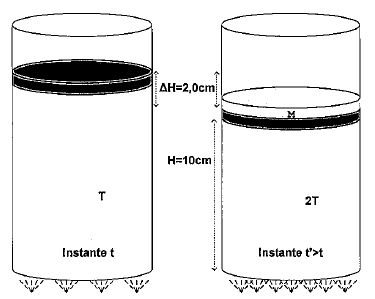
As figuras acima mostram dois instantes diferentes, !$ t !$ e !$ t^1 !$, de um mesmo sistema, imerso no ar ao nivel do mar. O sistema é constituído por um cilindro, cuja área da base é de 3,0 cm², contendo um gás ideal comprimido por um pistão móvel de massa desprezível. No instante t, a base do cilindro está em contato com uma chama que mantém o gás a uma temperatura T. No instante t', a base do cilindro está em contato com uma chama mais intensa que mantém o gás a uma temperatura 2T, e sobre o pistão encontra-se uma massa M que promove um deslocamento do pistão de 2,0 cm para baixo. Qual o valor da massa M, em kg?
Dados: !$ g = 10 m/s^2 !$
!$ p_o = 10^5Pa !$
!$ p_o = 10^5Pa !$
Provas
Questão presente nas seguintes provas
Um chuveiro elétrico opera em uma rede elétrica de 220 volts dissipando 7600 J/s de calor em sua resistência. Se esse mesmo chuveiro for conectado a uma rede de 110 volts, a potência dissipada, em J/s, passará a ser de
Provas
Questão presente nas seguintes provas
As lhe Olympics Approaches, a Lesson in Overcoming Adversity
8ert R. Mandelbaum, MD
Ju[y 20, 2016
Ju[y 20, 2016
I've known a lot 01 athletes who qualilied lor the Olympic Games injuries. But I know 01 only one who qualified beca use of an injury.
Cliff Meidl's story captures the spirit 01 the Olympics.
In November 1986, Cliff, a 20-year-old plumber's apprentice, hit three buried high-voltage electrical cables with a jackhammer. An estimated 30,000 volts surged through his body, exploding bone and cartilage lrom the inside ali the way up to his head. To put that into perspective, electric chairs use only 1500-2000 volts for executions. So it's sale to say that Cliff should have died.
And he nearly did. His heart stopped. Paramedics were able to get it going again, but they had to resuscitate him on the way to the hospital.
As part of a team with renowned plastic surgeon Malcolm Lesavoy, MD, and others, I got to work reconstructing Cliffs legs. Our best hope was to avoid amputation.
But very quickly, we noticed something else going on - something that had nothing to do with our expertise. Through every step of his painlul rehabilitation, Cliff grew more and more determined. He never complained. He just asked, 'What's next?"
Belore he had even linished the rehabilitation, Cliff started paddling various watercralts. The days spent on crutches had already strengthened his upper body, and he took naturally to the sport. The same year in which he was injured, he began competing in canoe and kayak events, and in 1996 he qualilied lor the Olympics - not the Paralympic Games, the Olympic Games.
Four years later, in Sydney, Australia, I was overseeing the sports medicine team at the Olympic soccer tournament. I was sitting in the stands during the opening ceremonies when Cliff walked into the Olympic Stadium carrying the Stars and Stripes.
It's a long-standing tradition lor delegations of athletes to select one among their number to bear the Ilag, and the choice olten symbolizes some extraordinary accomplishment. I had no idea that Cliff would be selected. So when he strode into the stadium with a normal gait, I nearly broke down.
Moments like that reinlorce what I have always believed: that sport can bring out the best in us alI.
The Olympic Games (...) are devoted to celebrating the human capacity to improve body, mind, and sou I.
They are about taking part - not necessarily about winning. Cliffs peers in the US delegation of 2000 recognized that when they elected him to bear the nation's colors. He never won a medal at the games, but the spirit with which he overcame adversity inspired ali of them.
The Olympic moUo - laster, higher, stronger - can help our patients realize that the real victory is the "win within." The Win Within: Capturing Your Victorious Spirit is the name of the book I wrote to show people that coming back Irom adversity is part of our heritage - that we as human beings are more adapted to adversity than we are to success.
Adversity is the engine of unimagined opportunity. It can unleash our energy and stimulate our will. It moves us to succeed. If I don't have lood, I have to go get some. If I'm cold, I have to build a shelter.
I remind patients who don't participate in sports that they have the heritage of athletes. We ali have the genes of pursuit-hunters who survived by running down their prey and running away Irom their predators. That's why even now, in 2016, when we go out and take a run, we leel good. We get an endorphin surge and our lipids go down. Our hearts and brains become clear.
The life of sport and sport of life are interlinked. Exercise is our birthright; it's our legacy; it's why we are here.
We no longer have to lear saber-toothed tigers or cave bears. But when you look today at how people can be successful in 2016, it's by avoiding the predators in our urban life: overeating, inactivity, and smoking. And it's by rising to meet adversity.
(Adapted trom http://WNIN.medscape.comlviewarticle/866279)
Which option completes the first paragraph of the tex! correctly?
"I've known a lot of athletes who qualified for the Olympic Games injuries. But I know of only one who qualified because of an injury."
Provas
Questão presente nas seguintes provas
Which of lhe senlences below is correct?
Provas
Questão presente nas seguintes provas
Cadernos
Caderno Container