Foram encontradas 750 questões.
1. A República, para mim, exige atenção!
2. Cada macaco no seu galho, mas meu galho é melhor do que o seu!
3. A voz do povo é a voz de Deus, mas Deus anda meio calado ultimamente.
4. Água mole em cabeça dura tanto bate até que, finalmente, esclarece.
Há intertextualidade em qual(ais) sentença(s):
Provas

Examine a tirinha Os Bichos, de Fred Wagner, abaixo:
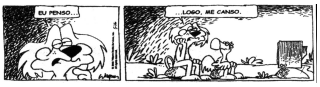
Sobre a intertextualidade, assinale qual a classificação correta.
Provas
Leia os trechos abaixo:
Via-Láctea – Olavo Bilac
“Ora (direis) ouvir estrelas! Certo
Perdeste o senso!” E eu vos direi, no entanto,
Que, para ouvi-las, muita vez desperto
E abro as janelas, pálido de espanto…

A intertextualidade assinala a conversa, o diálogo entre textos, no qual haverá um texto-fonte, que servirá como referência. A relação de intertextualidade ocorre de forma explícita ou implícita e não se restringe apenas a textos verbais, uma vez que pode acontecer em outras linguagens, como filmes, músicas, pinturas.
Assinale a alternativa correta sobre os trechos acima.
Provas
1. Após o acidente, ele tornou-se órfão de pai e mãe aos sete anos.
2. Desde que o professor se aposentou, a turma ficou órfã de bons debates.
3. O código estava cheio de tags órfãs que não se conectavam a nenhum estilo.
4. Evite deixar linhas órfãs no final da página para manter a estética do texto.
Assinale a alternativa que indica todas as afirmativas corretas.
Provas
Provas
“Para a escritora, o autor que a fez se apaixonar pelo texto curto das crônicas (…)”
Este pronome exerce função sintática na oração na qual está inserido.
Assinale a alternativa onde a expressão destacada exerce a mesma função sintática do pronome a destacada na construção acima.
Provas
Provas
Provas
1. A crônica é gênero efêmero que emprega situações do cotidiano.
2. A crônica tem total compromisso com a realidade, com o factual, e busca a análise profunda do comportamento humano.
3. A crônica emprega linguagem simples, coloquial, a fim de aproximar o leitor.
Assinale a alternativa que indica todas as afirmativas corretas.
Provas
Text 3
If you visit Japan, you might choose to travel around the country by shinkansen train. These high-speed trains connect the major cities of Japan. They are nicknamed “bullet trains” because they go very fast and have pointy noses like a bullet.
Bullet trains are a good way to travel for several reasons other than their speed. They are very punctual, often leaving on time to the second. They are also comfortable. All the seats face forward, and there is plenty of leg room. Most importantly, bullet trains are very safe. In their 35-year history, there have been only a few accidents and no deaths.
The only downside to bullet trains is that they are expensive. A ticket to travel to another city can cost almost as much as an airline ticket would. However, if you fly, you will land at an airport at the edge of a city. Train stations are usually right in the middle of a city. This means that it is often more convenient to take a bullet train instead of flying, because you will arrive exactly where you want to be.
( ) These trains are nicknamed “bullet trains” because of their speed and shape.
( ) The train that the author of the passage talks about is the shinkansen.
( ) The author says that one reason to take a bullet train instead of flying is because the bullet train is often much cheaper.
( ) To help travelers decide between a bullet train and an airplane, it would be most helpful for the author to add information about how many seats each one has.
Choose the alternative which presents the correct sequence, from top to bottom.
Provas
Caderno Container