Foram encontradas 40 questões.
Disciplina: Inglês (Língua Inglesa)
Banca: FUNDATEC
Orgão: Pref. Nova Santa Rita-RS
Instruction: Answer questions 29 to 36 based on the following text. The highlights throughout the text are cited in the questions.
Watch your back! Idioms with the word ‘back’
01 There are __ extraordinary number of phrases containing the word ‘back’, and some use
02 ‘back’ in the sense of __ part of __ body. Several phrases make use of the idea that if someone
03 is behind you, you can’t see them so you don’t know what they are doing. For example, if you do
04 something behind someone’s back, you do it without them knowing about it. Similarly, if you do
05 something while someone’s back is turned, you do it when they are not able to see or notice you:
06 His staff started whispering about him behind his back. / As soon as her back was turned, we
07 crept out of the room.
08 The idea of not being able to see what is behind you also features in some phrases to do
09 with possible danger or harm. For instance, if someone tells you to watch your back, they mean
10 that you should be careful because people around you may harm you, either physically or in
11 other ways. If you cover your back, you make sure you can’t be blamed or criticized for something
12 at a later time and if someone you trusted stabs you in the back, they harm you when you do not
13 deserve it: You need to watch your back because you’ve upset lots of people around here. / I sent
14 the documents to my boss, just to cover my back. / When my friend told my parents my secret,
15 I felt she’d stabbed me in the back.
16 Informally, if someone is on your back, they are constantly criticizing you or forcing you to
17 do things, but if you get someone off your back, you manage to stop them from behaving this
18 way. If you have your back to the wall, you have some very serious problems and you don’t have
19 many options about what you can do: My parents are always on my back about getting a job. / I
20 gave him the money just to get him off my back. / She didn’t want to fire her employees but she
21 had her back to the wall.
22 To finish this list, here are two nice phrases. First, if you say that you could do something
23 with one arm/hand tied behind your back, you mean that it is very easy. And second, you scratch
24 my back and I’ll scratch yours means that you will help someone if they help you: My mum could
25 make a cake like that with one arm tied behind her back. / There are plenty of ways we can help
26 each other. You scratch my back and I’ll scratch yours.
(Available at: https://dictionaryblog.cambridge.org/2023/03/01/watch-your-back-idioms-with-the-word-back/ – text especially adapted for this test).
The idiom “you scratch my back and I’ll scratch yours” (lines 23 and 24) suggests an action that is reciprocal. The sentence could be rewritten using reciprocal pronouns with no significative changes in meaning, as in:
Provas

Disciplina: Inglês (Língua Inglesa)
Banca: FUNDATEC
Orgão: Pref. Nova Santa Rita-RS
Instruction: Answer questions 29 to 36 based on the following text. The highlights throughout the text are cited in the questions.
Watch your back! Idioms with the word ‘back’
01 There are __ extraordinary number of phrases containing the word ‘back’, and some use
02 ‘back’ in the sense of __ part of __ body. Several phrases make use of the idea that if someone
03 is behind you, you can’t see them so you don’t know what they are doing. For example, if you do
04 something behind someone’s back, you do it without them knowing about it. Similarly, if you do
05 something while someone’s back is turned, you do it when they are not able to see or notice you:
06 His staff started whispering about him behind his back. / As soon as her back was turned, we
07 crept out of the room.
08 The idea of not being able to see what is behind you also features in some phrases to do
09 with possible danger or harm. For instance, if someone tells you to watch your back, they mean
10 that you should be careful because people around you may harm you, either physically or in
11 other ways. If you cover your back, you make sure you can’t be blamed or criticized for something
12 at a later time and if someone you trusted stabs you in the back, they harm you when you do not
13 deserve it: You need to watch your back because you’ve upset lots of people around here. / I sent
14 the documents to my boss, just to cover my back. / When my friend told my parents my secret,
15 I felt she’d stabbed me in the back.
16 Informally, if someone is on your back, they are constantly criticizing you or forcing you to
17 do things, but if you get someone off your back, you manage to stop them from behaving this
18 way. If you have your back to the wall, you have some very serious problems and you don’t have
19 many options about what you can do: My parents are always on my back about getting a job. / I
20 gave him the money just to get him off my back. / She didn’t want to fire her employees but she
21 had her back to the wall.
22 To finish this list, here are two nice phrases. First, if you say that you could do something
23 with one arm/hand tied behind your back, you mean that it is very easy. And second, you scratch
24 my back and I’ll scratch yours means that you will help someone if they help you: My mum could
25 make a cake like that with one arm tied behind her back. / There are plenty of ways we can help
26 each other. You scratch my back and I’ll scratch yours.
(Available at: https://dictionaryblog.cambridge.org/2023/03/01/watch-your-back-idioms-with-the-word-back/ – text especially adapted for this test).
Analyze the following statements about the article:
I. Some idioms may use the word “back” meaning the part of the body, but the idioms explained in the article use it as references to either direction or time.
II. The examples used in the first paragraph (lines 05 to 07) do not show those two idioms used in a positive situation.
III. In line 15, the action of “being stabbed in the back” has a literal meaning.
Which ones are correct?
Provas
Disciplina: Inglês (Língua Inglesa)
Banca: FUNDATEC
Orgão: Pref. Nova Santa Rita-RS
Instruction: Answer questions 29 to 36 based on the following text. The highlights throughout the text are cited in the questions.
Watch your back! Idioms with the word ‘back’
01 There are __ extraordinary number of phrases containing the word ‘back’, and some use
02 ‘back’ in the sense of __ part of __ body. Several phrases make use of the idea that if someone
03 is behind you, you can’t see them so you don’t know what they are doing. For example, if you do
04 something behind someone’s back, you do it without them knowing about it. Similarly, if you do
05 something while someone’s back is turned, you do it when they are not able to see or notice you:
06 His staff started whispering about him behind his back. / As soon as her back was turned, we
07 crept out of the room.
08 The idea of not being able to see what is behind you also features in some phrases to do
09 with possible danger or harm. For instance, if someone tells you to watch your back, they mean
10 that you should be careful because people around you may harm you, either physically or in
11 other ways. If you cover your back, you make sure you can’t be blamed or criticized for something
12 at a later time and if someone you trusted stabs you in the back, they harm you when you do not
13 deserve it: You need to watch your back because you’ve upset lots of people around here. / I sent
14 the documents to my boss, just to cover my back. / When my friend told my parents my secret,
15 I felt she’d stabbed me in the back.
16 Informally, if someone is on your back, they are constantly criticizing you or forcing you to
17 do things, but if you get someone off your back, you manage to stop them from behaving this
18 way. If you have your back to the wall, you have some very serious problems and you don’t have
19 many options about what you can do: My parents are always on my back about getting a job. / I
20 gave him the money just to get him off my back. / She didn’t want to fire her employees but she
21 had her back to the wall.
22 To finish this list, here are two nice phrases. First, if you say that you could do something
23 with one arm/hand tied behind your back, you mean that it is very easy. And second, you scratch
24 my back and I’ll scratch yours means that you will help someone if they help you: My mum could
25 make a cake like that with one arm tied behind her back. / There are plenty of ways we can help
26 each other. You scratch my back and I’ll scratch yours.
(Available at: https://dictionaryblog.cambridge.org/2023/03/01/watch-your-back-idioms-with-the-word-back/ – text especially adapted for this test).
Which of the following sentences uses a correctly formed idiom with the word “back”, according to the definitions in the article?
Provas
Seja x = !$ \dfrac{0,8\ x\ 3^0}{0,1} !$ e y = !$ \dfrac{\sqrt{144}-2^3}{\dfrac{2}{10}} !$ o valor de x/y é igual a:
Provas
Determine o valor de x , sabendo que as retas r, s e t são paralelas entre si, ou seja, r//s//t
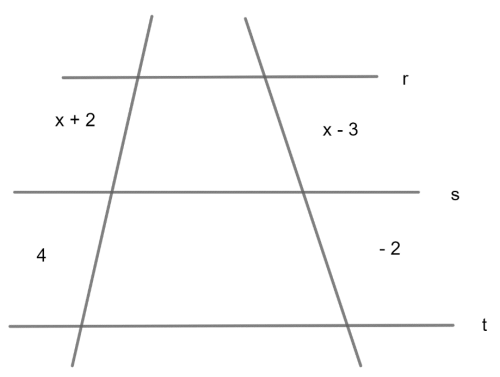
Provas
Disciplina: Matemática Financeira
Banca: FUNDATEC
Orgão: Pref. Nova Santa Rita-RS
Pablo aplicou um capital de R$ 25.000,00 a juros simples durante 1 ano (12 meses) a juros de 2,3% ao mês. Após esse período, Pablo destinou 45% dos juros obtidos para doar a uma instituição de caridade. Qual o valor doado por Pablo?
Provas
Analise as assertivas a seguir a respeito dos conjuntos numéricos:
I. Os números √2, √9 e !$ \pi !$ são exemplos de números irracionais.
II. Pertencem ao conjunto dos números reais apenas os conjuntos dos números naturais, inteiros e irracionais.
III. Todo número natural é também um número inteiro.
IV. São exemplos de números racionais os números 0,5 e - 1,3.
Quais estão corretas?
Provas
- Estatística DescritivaMedidas de Tendência CentralMédiasMédia AritméticaMédia Simples (Não Agrupados)
A média de idade de um time deve ser igual a 17 anos. O time será composto por 8 jogadoras, sendo que nele já há 2 jogadoras com 16 anos, 2 jogadoras com 17 anos e 2 jogadoras com 18 anos e uma jogadora com 15 anos. Qual deve ser a idade da última integrante do time para que a média de idade seja exatamente 17 anos?
Provas
Determine o polinômio que representa o quociente (resultado) da divisão entre os polinômios P(x) = 5x3 + 2x2 – 10x + 87 e Q(x) = x + 3. Sabendo que o polinômio P(x) é divisível pelo polinômio Q(x), ou seja não há resto nesta divisão.
Provas
- SintaxeConcordânciaConcordância VerbalRegras gerais
- Interpretação de TextosSubstituição/Reescritura de TextoReorganização e Reescrita de Orações e Períodos
Instrução: As questões de números 01 a 10 referem-se ao texto abaixo. Os destaques ao longo do texto estão citados nas questões.
Espiritualidade no dia a dia: até lavar louça ajuda na evolução interior
Por Eduarda Araia
01 --------As tarefas físicas mais simples, como lavar louça, nos ensinam a ficar neste mundo de
02 --maneira sagrada, ensina um lama. No Ocidente do tempo escasso e do materialismo opressivo,
03 --vida espiritual parece ... primeira vista um assunto que só diz respeito ... religiosos. Dedicar
04 --tempo ... espiritualidade, pensam os leigos, é missão para algum momento no fim de semana,
05 --e com sacrifício – a final há prioridades como contas a pagar, obstáculos profissionais a vencer,
06 --cuidados com o lar, problemas com cônjuge e filhos…
07 --------Nada mais falso. A espiritualidade está presente em todos os momentos da vida. Basta abrir
08 --os olhos para descobri-la em nosso cotidiano, com todo o extraordinário potencial de
09 --desenvolvimento interior que ela nos traz.
10 --------Um exemplo poderoso disso é a narrativa da readaptação de um lama ocidental à sua terra,
11 --após três anos de retiro no Tibete. Segundo seu relato – mencionado no livro “Depois do Êxtase,
12 --Lave a Roupa Suja”, de Kornfield –, nos cinco primeiros anos após o retorno ele penou para
13 --ligar-se ... vida espiritual, pois em nosso dia a dia as pessoas “só têm sensibilidade para correr
14 --atrás das coisas”. Para manter o que aprendera e equilibrar sua mente, o lama usava um recurso
15 --surpreendente em sua simplicidade: a limpeza.
16 --------“Em silêncio, eu cantava um mantra de compaixão a cada prato que lavava, a cada chão
17 --que esfregava”, conta. “Fazia também uma prece para que todos os pisos e o coração de todos
18 --os seres à minha volta ficassem limpos, purificados e inocentes. O tempo parava como se eu
19 --fosse parte da terra que se purifica na primavera.”
20 --------Em um primeiro momento, a ideia de lavar pratos para progredir espiritualmente parece
21 --uma grande tolice. Mas todas as tradições espirituais ressaltam a importância de sermos seres
22 --integrais – e como conseguiríamos isso ignorando o que pensamos e fazemos no cotidiano?
23 --------Conciliar espiritualidade e dia a dia não é tarefa simples em nenhum lugar do planeta. No
24 --Ocidente, o principal obstáculo é nossa cultura consumista, que impele as pessoas ... buscar
25 --gratificação imediata e externa – a roupa da moda, o celular de última geração, o carro
26 --importado. Com isso, a espiritualidade fica em plano secundário, e a maior parte do tempo é
27 --vivida como se as crenças religiosas, morais ou éticas nem existissem.
28 --------Mas é impossível fugir do cotidiano. Atos como pagar contas, ir ao trabalho ou levar os
29 --filhos à escola também são espiritualmente importantes, e sem ter consciência disso não
30 --podemos evoluir. “Não dá para acertar num departamento da vida e continuar errando em
31 --outro”, afirmou Gandhi. “A vida é um todo indivisível.”
32 --------Para iniciar essa revisão do dia a dia, nada melhor do que a família. Existe lugar mais
33 --adequado do que o próprio lar para refinar a tolerância, o respeito e o despir-se de preconceitos
34 --e expectativas para ver a vida como ela é?
35 --------Outro item crucial é o dinheiro, energia de troca que funciona como um excelente professor
36 --– para o e para o – no caminho espiritual. A supervalorização que o Ocidente lhe atribui
37 --conduz à ganância, à avareza, ao medo da escassez.
38 --------Entrar em contato com a espiritualidade no cotidiano exige desenvolver o que o budismo
39 --chama de atenção plena. De acordo com o escritor David Spangler, essa observação atenta e
40 --sem julgamento do que ocorre a cada instante nos leva a uma profunda consciência, que nos
41 --dá insights sobre o mundo e nós mesmos. A atenção plena nos permite reagir ao presente de
42 --modo mais espontâneo e livre.
43 --------Descobrir a espiritualidade no dia a dia significa ter muito mais recursos para equilibrar-se
44 --e mudar o futuro pessoal. A vida seguirá com êxitos e fracassos, mas a mente aprende, sem
45 --entrar em desequilíbrio, a extrair lições de todas as situações.
46 --------“Em tudo que uma pessoa faz é possível criar e manter um estado de ser que reflete nosso
47 --verdadeiro destino”, observa Karlfried Graf von Dürckheim no livro Daily Life as Spiritual
48 --Exercise. “Quando essa possibilidade é posta em prática, o dia comum não é mais comum. Ele
49 --se torna uma aventura do espírito.”
(Disponível em: https://www.revistaplaneta.com.br/ 31/01/2023 – texto adaptado especialmente para esta prova).
Avalie as propostas de alteração no texto, assinalando V, se verdadeiras, ou F, se falsas.
( ) Caso na linha 05 o verbo ‘existir’ fosse usado em lugar do ‘haver’ no mesmo tempo e modo, continuaríamos a flexioná-lo na terceira pessoa do singular.
( ) A troca de ‘lavar’ (l. 20) por ‘fazer a limpeza’ implicaria a inserção de uma preposição imediatamente após a colocação do termo proposto a fim de manter a correção gramatical do período.
( ) Se em lugar da forma verbal ‘conduz’ (l. 37) fosse utilizada ‘leva’ nenhuma alteração seria necessária no período visando a correção gramatical.
A ordem correta de preenchimento dos parênteses, de cima para baixo, é:
Provas
Caderno Container