Foram encontradas 150 questões.
Examine o gráfico e o mapa e leia o texto para responder a questão.
In March 2022, parts of Antarctica have been 40 ºC warmer than their March average
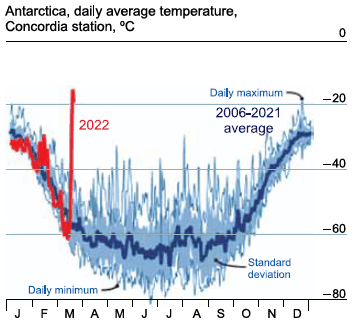
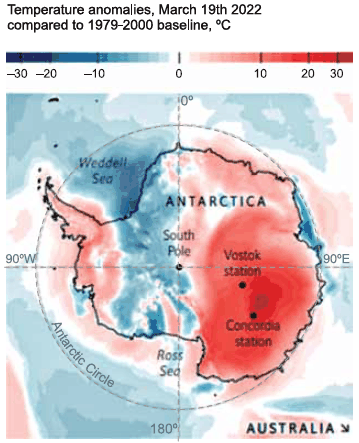
The Concordia research station is one of the most inhospitable places on Earth. At 3,000 m above sea level on the Antarctic Plateau, the temperature rarely rises above -25 ºC even in the summer. In midwinter it can fall to around -80 ºC. The air is painfully dry, and fingers, toes and noses can freeze in minutes. The dozen or so crew, mainly French and Italian, who live and work in the station would normally venture out only for essential work. But Concordia has recently experienced a heatwave. On March 18th the temperature reached a high of -11.8 ºC — more than 40 ºC warmer than the average for this time of year.
Similarly freakish weather was recorded across eastern Antarctica. Temperatures at the Russian-run Vostok research station rose to -17.7 ºC, more than 15 ºC above the previous record for March, set in 1967. Across the continent temperatures were 4.5 ºC higher than usual (though in recent days they have returned to a normal range).
Meteorologists have attributed the latest heatwave to an atmospheric “river” of warm, damp air blowing towards Antarctica from the Southern Ocean near Australia. It is difficult to know whether climate change is to blame for one-off weather events. But over the past 65 years or so there has been an increase in the number of “high temperature” days at Antarctic stations.
Most regions of Antarctica have been spared global warming. In the late 20th century, a large hole opened up in the ozone layer above the South Pole. This has a regional cooling effect, which has offset much of the heating caused by rising concentrations of greenhouse gases in the atmosphere. Temperatures on the continent rarely climb above freezing, which preserves its vast ice sheets (although rising sea temperatures do threaten some areas). Even in the recent surge, temperatures stayed well below zero.
(www.economist.com, 24.03.2022. Adaptado.)
Based on your knowledge of geography, as well as on the information provided by the text, map and graph, Antarctica
Provas

Examine o gráfico e o mapa e leia o texto para responder a questão.
In March 2022, parts of Antarctica have been 40 ºC warmer than their March average
The Concordia research station is one of the most inhospitable places on Earth. At 3,000 m above sea level on the Antarctic Plateau, the temperature rarely rises above -25 ºC even in the summer. In midwinter it can fall to around -80 ºC. The air is painfully dry, and fingers, toes and noses can freeze in minutes. The dozen or so crew, mainly French and Italian, who live and work in the station would normally venture out only for essential work. But Concordia has recently experienced a heatwave. On March 18th the temperature reached a high of -11.8 ºC — more than 40 ºC warmer than the average for this time of year.
Similarly freakish weather was recorded across eastern Antarctica. Temperatures at the Russian-run Vostok research station rose to -17.7 ºC, more than 15 ºC above the previous record for March, set in 1967. Across the continent temperatures were 4.5 ºC higher than usual (though in recent days they have returned to a normal range).
Meteorologists have attributed the latest heatwave to an atmospheric “river” of warm, damp air blowing towards Antarctica from the Southern Ocean near Australia. It is difficult to know whether climate change is to blame for one-off weather events. But over the past 65 years or so there has been an increase in the number of “high temperature” days at Antarctic stations.
Most regions of Antarctica have been spared global warming. In the late 20th century, a large hole opened up in the ozone layer above the South Pole. This has a regional cooling effect, which has offset much of the heating caused by rising concentrations of greenhouse gases in the atmosphere. Temperatures on the continent rarely climb above freezing, which preserves its vast ice sheets (although rising sea temperatures do threaten some areas). Even in the recent surge, temperatures stayed well below zero.
(www.economist.com, 24.03.2022. Adaptado.)
As informações apresentadas pelo gráfico também podem ser encontradas
Provas
Examine o gráfico e o mapa e leia o texto para responder a questão.
In March 2022, parts of Antarctica have been 40 ºC warmer than their March average
The Concordia research station is one of the most inhospitable places on Earth. At 3,000 m above sea level on the Antarctic Plateau, the temperature rarely rises above -25 ºC even in the summer. In midwinter it can fall to around -80 ºC. The air is painfully dry, and fingers, toes and noses can freeze in minutes. The dozen or so crew, mainly French and Italian, who live and work in the station would normally venture out only for essential work. But Concordia has recently experienced a heatwave. On March 18th the temperature reached a high of -11.8 ºC — more than 40 ºC warmer than the average for this time of year.
Similarly freakish weather was recorded across eastern Antarctica. Temperatures at the Russian-run Vostok research station rose to -17.7 ºC, more than 15 ºC above the previous record for March, set in 1967. Across the continent temperatures were 4.5 ºC higher than usual (though in recent days they have returned to a normal range).
Meteorologists have attributed the latest heatwave to an atmospheric “river” of warm, damp air blowing towards Antarctica from the Southern Ocean near Australia. It is difficult to know whether climate change is to blame for one-off weather events. But over the past 65 years or so there has been an increase in the number of “high temperature” days at Antarctic stations.
Most regions of Antarctica have been spared global warming. In the late 20th century, a large hole opened up in the ozone layer above the South Pole. This has a regional cooling effect, which has offset much of the heating caused by rising concentrations of greenhouse gases in the atmosphere. Temperatures on the continent rarely climb above freezing, which preserves its vast ice sheets (although rising sea temperatures do threaten some areas). Even in the recent surge, temperatures stayed well below zero.
(www.economist.com, 24.03.2022. Adaptado.)
The information presented by the graph, the map and the text show that in March 2022
Provas
The literary principle according to which the writing and criticism of poetry and drama were to be guided by rules and precedents derived from the best ancient Greek and Roman authors; a codified form of classicism that dominated French literature in the 17th and 18th centuries, with a significant influence on English writing, especially from c.1660 to c.1780. In a more general sense, often employed in contrast with romanticism, the term has also been used to describe the characteristic world-view or value-system of this “Age of Reason”, denoting a preference for rationality, clarity, restraint, order, and decorum, and for general truths rather than particular insights.
(Chris Baldick. The Concise Oxford Dictionary of Literary Terms, 2001.)
O termo literário a que o texto se refere é o
Provas
Um prisma triangular reto, com 12 cm de altura, foi seccionado de modo a resultar no sólido VUNESP, com arestas laterais perpendiculares ao plano que contém sua base triangular UNE, como ilustrado a seguir.
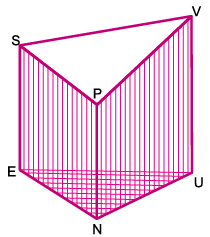
Nesse sólido, NE = 3 cm, NU = 4 cm, UE = 5 cm, e suas arestas laterais medem SE = 10 cm, PN = 8 cm e VU = 12 cm.
O volume desse sólido, em cm3, é igual a
Provas
A figura indica o projeto de um braço mecânico em que !$ \overline{AB} !$ assume função próxima de um bíceps humano, !$ \overline{BC} !$ de um antebraço e !$ \overline{CD} !$ de um punho. Sabe-se que a medida de !$ \overline{AB} !$ supera a de !$ \overline{CD} !$ em 11 cm e que a medida de !$ \overline{BC} !$ é 8 cm.
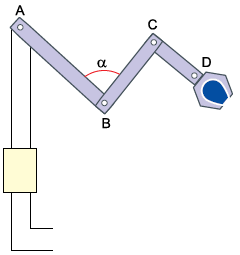
Se, para !$ \alpha !$ = 60º, a distância entre os pontos A e C do mecanismo é igual a !$ 8\sqrt3 !$ cm, a extensão máxima horizontal do braço mecânico, em cm, é igual a
Provas
Analise duas sequências de teclas digitadas por Tales em uma calculadora científica e os respectivos resultados apresentados em seu visor.
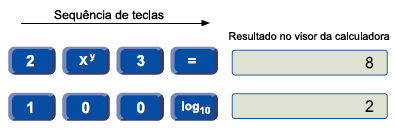
Tales digitou nessa mesma calculadora, que também possui teclas de parênteses para a separação das operações, a seguinte sequência de teclas:

O resultado obtido por Tales no visor da calculadora foi
Provas
De um paralelepípedo reto-retângulo de dimensões 20 cm por !$ 6 \sqrt2 !$ cm por !$ 6 \sqrt2 !$ cm serão retirados dois cubos, cujos lados medem x cm. Esses cubos têm três arestas contidas em três arestas do paralelepípedo e uma das faces contida em uma mesma face quadrada do paralelepípedo.
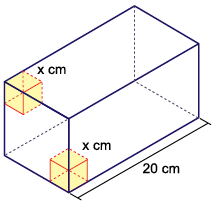
Ao adotar o valor máximo para x, o volume do prisma remanescente, após a retirada dos cubos, será igual a:
Provas
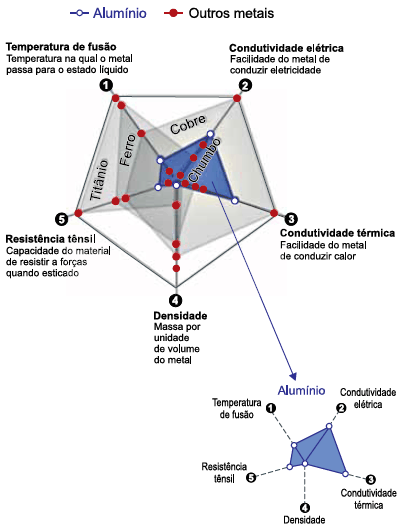
O alumínio é um metal valorizado por ter baixa densidade e baixa temperatura de fusão, o que o torna ideal para a fabricação de embalagens baratas, resistentes e de fácil reciclagem, além de amplo uso na fabricação de veículos.
O gráfico mostra um comparativo de cinco metais, incluindo o alumínio, para cinco propriedades.
(www.nexojornal.com.br, 27.02.2022. Adaptado.)
Considerando-se que em determinado projeto industrial são desejáveis os menores valores possíveis das propriedades 1 e 4 e os maiores valores possíveis das propriedades 2, 3 e 5, dos cinco metais comparados, o alumínio é o mais vantajoso
Provas
Observe a figura, formada por um triângulo PQR inscrito em uma circunferência de diâmetro PR = 10 m, em que PQ = 6 m. Uma partícula se move sobre a linha contínua, iniciando seu movimento em P, passando por Q, depois por R e, finalmente, voltando a P, como mostram as setas sobre a trajetória.
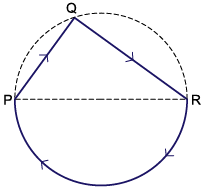
A partícula parte de P com velocidade inicial de 8 m/s, e o módulo de sua velocidade aumenta uniformemente ao longo da trajetória, até chegar novamente em P, com velocidade de 10 m/s. Adotando !$ \pi !$ = 3, o módulo da aceleração escalar dessa partícula ao longo de todo seu percurso é de:
Provas
Caderno Container