Foram encontradas 40 questões.
Read the text below to answer question from.
The Secret Life of Passwords
By IAN URBINA
Howard Lutnick, the chief executive of Cantor Fitzgerald, one of the world’s largest financial-services firms, still cries when he talks about it. Not long after the planes struck the twin towers, killing 658 of his co-workers and friends, including his brother, one of the first things on Lutnick’s mind was passwords. This may seem callous, but it was not.
Like virtually everyone else caught up in the events that day, Lutnick, who had taken the morning off to escort his son, Kyle, to his first day of kindergarten, was in shock. But he was also the one person most responsible for ensuring the viability of his company. The biggest threat to that survival became apparent almost immediately: No one knew the passwords for hundreds of accounts and files that were needed to get back online in time for the reopening of the bond markets. Cantor Fitzgerald did have extensive contingency plans in place, including a requirement that all employees tell their work passwords to four nearby colleagues. But now a large majority of the firm’s 960 New York employees were dead. “We were thinking of a major fire,” Lutnick said. “No one in those days had ever thought of an entire four-to-six-block radius being destroyed.” The attacks also knocked out one of the company’s main backup servers, which were housed, at what until that day seemed like a safe distance away, under 2 World Trade Center.
Hours after the attacks, Microsoft dispatched more than security expert to an improvised Cantor Fitzgerald command center in Rochelle Park, N.J., roughly 20 miles from the rubble. Many of the missing passwords would prove to be relatively secure — the “JHx6fT!9” type that the company’s I.T. department implored everyone to choose. To crack those, the Microsoft technicians performed “brute force” attacks, using fast computers to begin with “a” then work through every possible letter and number combination before ending at “ZZZZZZZ.” But even with the fastest computers, brute-force attacks, working through trillions of 26 combinations, could take days. Wall Street was not going to wait.
Microsoft’s technicians, Lutnick recalled, knew that they needed to take advantage of two facts: Many people use the same password for multiple accounts, and these passwords are typically personalized. The technicians explained that for their algorithms to work best, they needed large amounts of trivia about the owner of each missing password, the kinds of things that were too specific, too personal and too idiosyncratic for companies to keep on file. “It’s the details that make people distinct, that make them individuals,” Lutnick said. He soon found himself on the phone, desperately trying to compartmentalize his own agony while calling the spouses, parents and siblings of his former colleagues to console them — and to ask them, ever so gently, whether they knew their loved ones’ passwords. Most often they did not, which meant that Lutnick had to begin working his way through a checklist that had been provided to him by the Microsoft technicians. “What is your wedding anniversary? Tell me again where he went for undergrad? You guys 40 have a dog, don’t you? What’s her name? You have two children. Can you give me their birth dates?"
“Remember, this was less than 24 hours after the towers had fallen,” he said. “The fire department was still referring to it as a search-and-rescue mission.” Families had not accepted their losses. Lutnick said he never referred to anyone as being dead, just “not available right now.” He framed his questions to be an affirmation of that person’s importance to the company, he said. Conversations oscillated between sudden bawling and agonizing silences. “Awful,” he said. Sometimes it took more than an hour to work through the checklist, but Lutnick said he made sure he was never the one to hang up first.
In the end, Microsoft’s technicians got what they needed. The firm was back in operation within two days. The same human sentimentality that made Cantor Fitzgerald’s passwords “weak,” ultimately proved to be its saving grace.
From:< http://www.nytimes.com/2014/11/19/magazine/the-secret-life-of-passwords.html?hpw&rref=technology&action=click&pgtype=Homepage&module=well-region®ion=bottom-well&WT.nav=bottom-well&_r=0> Accessed on December 11, 2014.
According to the text, it is correct to say:
Provas
Questão presente nas seguintes provas

Leia o texto, a seguir, atentamente para responder à questão.
Um estranho poder de cura
Meu filho, deficiente mental, Hikari, foi despertado pela voz dos pássaros para a música de Bach e Mozart e acabou produzindo suas próprias obras. As pequenas peças que ele inicialmente compôs eram cheias de frescor e prazer. Pareciam gotas de orvalho brilhando sobre a relva. A palavra inocência é composta do prefixo “in”, que significa “não”, e de “nocere”, “ferir”. Ou seja, ela quer dizer “aquele que não fere”. A música de Hikari era uma manifestação natural de sua própria inocência. Conforme ele passou a criar mais obras, no entanto, não pude deixar de ouvir nelas também a voz de uma alma escura e atormentada. Apesar de deficiente, seus esforços extenuantes permitiram que ele descobrisse do fundo de seu coração uma massa de tristeza que até então ele fora incapaz de expressar com palavras. O fato de expressá-la em música cura Hikari de sua tristeza, é um ato de recuperação. Mais ainda, seus ouvintes aceitaram essa música como algo que também os fortalece e restaura. Nesses fenômenos, eu encontro as razões para acreditar no estranho poder curativo da arte.
Trecho do discurso de aceitação do Prêmio Nobel de
Kenzaburo Oe. Disponível em: <http://veja.abril.com.br/050303/p_100.html>. Acesso em: 02 dez. 2014.
No texto, o autor explica o sentido de inocência a partir da relação entre “in” e “nocere”. Considerando os pressupostos saussurianos, e refletindo sobre o signo incapaz empregado no texto, afirma-se:
I. O agrupamento entre “in” e “capaz”, que resulta no signo incapaz (linha 10), ocorre somente no eixo das associações.
II. No eixo sintagmático, incapaz (linha 10) se encontra em relação com infeliz, invisível, inacabado, etc.
III. Na linha 10, a relação entre ele, fora, incapaz, de, expressar, com, palavras é uma relação in praesentia.
II. No eixo sintagmático, incapaz (linha 10) se encontra em relação com infeliz, invisível, inacabado, etc.
III. Na linha 10, a relação entre ele, fora, incapaz, de, expressar, com, palavras é uma relação in praesentia.
Está (ão) correta(s) a(s) afirmativa(s)
Provas
Questão presente nas seguintes provas
O Curso de Linguística Geral (2006) marca uma etapa importante na história dos estudos linguísticos. A partir do conteúdo nele apresentado, analise as afirmações indicando verdadeiro (V) ou falso (F).
( ) O signo linguístico tem duas faces: o significante (conceito) e o significado (imagem acústica).
( ) A linguagem possui um lado individual (fala) e um lado social (língua), sendo impossível conceber um sem o outro.
( ) O signo, combinação de significante e significado, tem por finalidade unir uma coisa a uma palavra. Assim, mesa une o signo ao objeto no mundo.
( ) A noção de valor é essencial no desenvolvimento do pensamento saussuriano. Para Saussure, o valor de um termo é determinado pela sua relação com aquilo que o rodeia.
A sequência correta, de cima para baixo, é
Provas
Questão presente nas seguintes provas
Considere o texto abaixo para a resolução da questão.
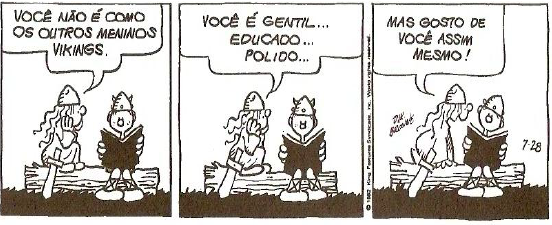
Disponível em: <https://cursocontextual.wordpress.com/2011/02/15/compreender-e-interpretar-textos/charge-filho-do-hagar/>. Acesso em: 28 nov. 2014.
Na tirinha, especificamente no terceiro quadrinho, a personagem inicia seu enunciado com mas.
Com base em Koch, é correto afirmar que mas
Provas
Questão presente nas seguintes provas
The ONLY sentence which the underlined part is correct is:
Provas
Questão presente nas seguintes provas
Com base nos conceitos da Fonética e da Fonologia, importantes áreas da linguística, está INCORRETA a alternativa:
Provas
Questão presente nas seguintes provas
Read the text below to answer question from.
The Secret Life of Passwords
By IAN URBINA
Howard Lutnick, the chief executive of Cantor Fitzgerald, one of the world’s largest financial-services firms, still cries when he talks about it. Not long after the planes struck the twin towers, killing 658 of his co-workers and friends, including his brother, one of the first things on Lutnick’s mind was passwords. This may seem callous, but it was not.
Like virtually everyone else caught up in the events that day, Lutnick, who had taken the morning off to escort his son, Kyle, to his first day of kindergarten, was in shock. But he was also the one person most responsible for ensuring the viability of his company. The biggest threat to that survival became apparent almost immediately: No one knew the passwords for hundreds of accounts and files that were needed to get back online in time for the reopening of the bond markets. Cantor Fitzgerald did have extensive contingency plans in place, including a requirement that all employees tell their work passwords to four nearby colleagues. But now a large majority of the firm’s 960 New York employees were dead. “We were thinking of a major fire,” Lutnick said. “No one in those days had ever thought of an entire four-to-six-block radius being destroyed.” The attacks also knocked out one of the company’s main backup servers, which were housed, at what until that day seemed like a safe distance away, under 2 World Trade Center.
Hours after the attacks, Microsoft dispatched more than security expert to an improvised Cantor Fitzgerald command center in Rochelle Park, N.J., roughly 20 miles from the rubble. Many of the missing passwords would prove to be relatively secure — the “JHx6fT!9” type that the company’s I.T. department implored everyone to choose. To crack those, the Microsoft technicians performed “brute force” attacks, using fast computers to begin with “a” then work through every possible letter and number combination before ending at “ZZZZZZZ.” But even with the fastest computers, brute-force attacks, working through trillions of 26 combinations, could take days. Wall Street was not going to wait.
Microsoft’s technicians, Lutnick recalled, knew that they needed to take advantage of two facts: Many people use the same password for multiple accounts, and these passwords are typically personalized. The technicians explained that for their algorithms to work best, they needed large amounts of trivia about the owner of each missing password, the kinds of things that were too specific, too personal and too idiosyncratic for companies to keep on file. “It’s the details that make people distinct, that make them individuals,” Lutnick said. He soon found himself on the phone, desperately trying to compartmentalize his own agony while calling the spouses, parents and siblings of his former colleagues to console them — and to ask them, ever so gently, whether they knew their loved ones’ passwords. Most often they did not, which meant that Lutnick had to begin working his way through a checklist that had been provided to him by the Microsoft technicians. “What is your wedding anniversary? Tell me again where he went for undergrad? You guys 40 have a dog, don’t you? What’s her name? You have two children. Can you give me their birth dates?"
“Remember, this was less than 24 hours after the towers had fallen,” he said. “The fire department was still referring to it as a search-and-rescue mission.” Families had not accepted their losses. Lutnick said he never referred to anyone as being dead, just “not available right now.” He framed his questions to be an affirmation of that person’s importance to the company, he said. Conversations oscillated between sudden bawling and agonizing silences. “Awful,” he said. Sometimes it took more than an hour to work through the checklist, but Lutnick said he made sure he was never the one to hang up first.
In the end, Microsoft’s technicians got what they needed. The firm was back in operation within two days. The same human sentimentality that made Cantor Fitzgerald’s passwords “weak,” ultimately proved to be its saving grace.
From:< http://www.nytimes.com/2014/11/19/magazine/the-secret-life-of-passwords.html?hpw&rref=technology&action=click&pgtype=Homepage&module=well-region®ion=bottom-well&WT.nav=bottom-well&_r=0> Accessed on December 11, 2014.
The words callous, escort, dispatched, rubble and idiosyncratic can be substituted without interference on their meanings on the context of the text by:
Provas
Questão presente nas seguintes provas
Em sala de aula, o professor pode desenvolver diferentes assuntos a partir da utilização de gêneros discursivos. Considerando a importância deste conceito para o ensino, e com base na teoria elaborada por Bakhtin (2003), é INCORRETO afirmar que
Provas
Questão presente nas seguintes provas
Em relação ao Barroco, é correto afirmar que
Provas
Questão presente nas seguintes provas
Which option best explains the meaning of the sentence: “And you mustn’t say anything about the surprise.”
Provas
Questão presente nas seguintes provas
Cadernos
Caderno Container