Foram encontradas 440 questões.
2336831
Ano: 2022
Disciplina: Inglês (Língua Inglesa)
Banca: UPENET/IAUPE
Orgão: Pref. Bom Conselho - PE
Disciplina: Inglês (Língua Inglesa)
Banca: UPENET/IAUPE
Orgão: Pref. Bom Conselho - PE
Provas:
Read and answer.
Text 01 (For question)
Films are a great medium to use not only to practice English, but also to facilitate intercultural learning. Today
English is a global language spoken by people from many countries and cultural backgrounds. Since culture greatly
impacts communication, it is helpful for teachers to introduce lessons and activities that reveal how different dialects,
forms of address, customs, taboos, and other cultural elements influence interaction among different groups. (...)
Culture, according to one definition, is the values, traditions, customs, art, and institutions shared by a group of
people who are unified by nationality, ethnicity, religion, or language. The language teaching profession"s interest in
cross-cultural communication has increased during the past few decades. According to Kramsch (1995), the
development is due to political, educational, and ideological factors; even though politicians might feel that learning a
foreign language will solve socioeconomic problems, educators think that for that to happen a language course must
contain legitimate cultural content. (...)
Intercultural topics that show how people from different backgrounds communicate and interact are becoming
more prominent in language teaching. Teachers can benefit from the treasure trove of films that deal with subjects like
immigration, xenophobia, adjusting to a new culture, or dilemmas faced when one belongs to two cultures. Although
films cannot substitute for actual interaction with numbers of other cultures, they can provide useful preparation for
those encounters by fostering understanding and developing sensitivity. “Learning about stereotypes, ethnocentrism,
discrimination, and acculturation in the abstract can be flat and uninspiring. But if we experience intercultural contact
with our eyes and years, we begin to understand it” (Summerfield 1993, 1). Intercultural contact through films enables
students to understand other people"s actions and to have empathy with members of minority groups. Films also vividly
represent intercultural misunderstandings and the roots of racism.
There is a wide variety of films with intercultural themes, and the teacher must consult reviews or see the movie
firsthand to determine if it is appropriate for the desired lesson.
(Source: ROEL, Christine. Intellectual Training with Films. Forum English Teaching, vol. 48, number 2, Washington DC,
2010.)
“Although films cannot substitute for actual interaction with numbers of other cultures, they can provide useful preparation for those encounters by fostering understanding and developing sensitivity. ”
In the excerpt above, the words actual and sensitivity can be respectively translated into Portuguese as:
Provas
Questão presente nas seguintes provas

2336830
Ano: 2022
Disciplina: Inglês (Língua Inglesa)
Banca: UPENET/IAUPE
Orgão: Pref. Bom Conselho - PE
Disciplina: Inglês (Língua Inglesa)
Banca: UPENET/IAUPE
Orgão: Pref. Bom Conselho - PE
Provas:
Read and answer.
Text 01 (For question)
Films are a great medium to use not only to practice English, but also to facilitate intercultural learning. Today
English is a global language spoken by people from many countries and cultural backgrounds. Since culture greatly
impacts communication, it is helpful for teachers to introduce lessons and activities that reveal how different dialects,
forms of address, customs, taboos, and other cultural elements influence interaction among different groups. (...)
Culture, according to one definition, is the values, traditions, customs, art, and institutions shared by a group of
people who are unified by nationality, ethnicity, religion, or language. The language teaching profession"s interest in
cross-cultural communication has increased during the past few decades. According to Kramsch (1995), the
development is due to political, educational, and ideological factors; even though politicians might feel that learning a
foreign language will solve socioeconomic problems, educators think that for that to happen a language course must
contain legitimate cultural content. (...)
Intercultural topics that show how people from different backgrounds communicate and interact are becoming
more prominent in language teaching. Teachers can benefit from the treasure trove of films that deal with subjects like
immigration, xenophobia, adjusting to a new culture, or dilemmas faced when one belongs to two cultures. Although
films cannot substitute for actual interaction with numbers of other cultures, they can provide useful preparation for
those encounters by fostering understanding and developing sensitivity. “Learning about stereotypes, ethnocentrism,
discrimination, and acculturation in the abstract can be flat and uninspiring. But if we experience intercultural contact
with our eyes and years, we begin to understand it” (Summerfield 1993, 1). Intercultural contact through films enables
students to understand other people"s actions and to have empathy with members of minority groups. Films also vividly
represent intercultural misunderstandings and the roots of racism.
There is a wide variety of films with intercultural themes, and the teacher must consult reviews or see the movie
firsthand to determine if it is appropriate for the desired lesson.
(Source: ROEL, Christine. Intellectual Training with Films. Forum English Teaching, vol. 48, number 2, Washington DC,
2010.)
The word Although highlighted in the excerpt could be best replaced by
Provas
Questão presente nas seguintes provas
2336829
Ano: 2022
Disciplina: Inglês (Língua Inglesa)
Banca: UPENET/IAUPE
Orgão: Pref. Bom Conselho - PE
Disciplina: Inglês (Língua Inglesa)
Banca: UPENET/IAUPE
Orgão: Pref. Bom Conselho - PE
Provas:
Read and answer.
Text 01 (For question)
Films are a great medium to use not only to practice English, but also to facilitate intercultural learning. Today
English is a global language spoken by people from many countries and cultural backgrounds. Since culture greatly
impacts communication, it is helpful for teachers to introduce lessons and activities that reveal how different dialects,
forms of address, customs, taboos, and other cultural elements influence interaction among different groups. (...)
Culture, according to one definition, is the values, traditions, customs, art, and institutions shared by a group of
people who are unified by nationality, ethnicity, religion, or language. The language teaching profession"s interest in
cross-cultural communication has increased during the past few decades. According to Kramsch (1995), the
development is due to political, educational, and ideological factors; even though politicians might feel that learning a
foreign language will solve socioeconomic problems, educators think that for that to happen a language course must
contain legitimate cultural content. (...)
Intercultural topics that show how people from different backgrounds communicate and interact are becoming
more prominent in language teaching. Teachers can benefit from the treasure trove of films that deal with subjects like
immigration, xenophobia, adjusting to a new culture, or dilemmas faced when one belongs to two cultures. Although
films cannot substitute for actual interaction with numbers of other cultures, they can provide useful preparation for
those encounters by fostering understanding and developing sensitivity. “Learning about stereotypes, ethnocentrism,
discrimination, and acculturation in the abstract can be flat and uninspiring. But if we experience intercultural contact
with our eyes and years, we begin to understand it” (Summerfield 1993, 1). Intercultural contact through films enables
students to understand other people"s actions and to have empathy with members of minority groups. Films also vividly
represent intercultural misunderstandings and the roots of racism.
There is a wide variety of films with intercultural themes, and the teacher must consult reviews or see the movie
firsthand to determine if it is appropriate for the desired lesson.
(Source: ROEL, Christine. Intellectual Training with Films. Forum English Teaching, vol. 48, number 2, Washington DC,
2010.)
Provas
Questão presente nas seguintes provas
2336828
Ano: 2022
Disciplina: Inglês (Língua Inglesa)
Banca: UPENET/IAUPE
Orgão: Pref. Bom Conselho - PE
Disciplina: Inglês (Língua Inglesa)
Banca: UPENET/IAUPE
Orgão: Pref. Bom Conselho - PE
Provas:
Read and answer.
Text 01 (For question)
Films are a great medium to use not only to practice English, but also to facilitate intercultural learning. Today
English is a global language spoken by people from many countries and cultural backgrounds. Since culture greatly
impacts communication, it is helpful for teachers to introduce lessons and activities that reveal how different dialects,
forms of address, customs, taboos, and other cultural elements influence interaction among different groups. (...)
Culture, according to one definition, is the values, traditions, customs, art, and institutions shared by a group of
people who are unified by nationality, ethnicity, religion, or language. The language teaching profession"s interest in
cross-cultural communication has increased during the past few decades. According to Kramsch (1995), the
development is due to political, educational, and ideological factors; even though politicians might feel that learning a
foreign language will solve socioeconomic problems, educators think that for that to happen a language course must
contain legitimate cultural content. (...)
Intercultural topics that show how people from different backgrounds communicate and interact are becoming
more prominent in language teaching. Teachers can benefit from the treasure trove of films that deal with subjects like
immigration, xenophobia, adjusting to a new culture, or dilemmas faced when one belongs to two cultures. Although
films cannot substitute for actual interaction with numbers of other cultures, they can provide useful preparation for
those encounters by fostering understanding and developing sensitivity. “Learning about stereotypes, ethnocentrism,
discrimination, and acculturation in the abstract can be flat and uninspiring. But if we experience intercultural contact
with our eyes and years, we begin to understand it” (Summerfield 1993, 1). Intercultural contact through films enables
students to understand other people"s actions and to have empathy with members of minority groups. Films also vividly
represent intercultural misunderstandings and the roots of racism.
There is a wide variety of films with intercultural themes, and the teacher must consult reviews or see the movie
firsthand to determine if it is appropriate for the desired lesson.
(Source: ROEL, Christine. Intellectual Training with Films. Forum English Teaching, vol. 48, number 2, Washington DC,
2010.)
Provas
Questão presente nas seguintes provas
“A República Velha, período da história brasileira mais conhecido pelos historiadores como Primeira República,
estendeu-se de 1889 a 1930. Foi a primeira fase da República no Brasil e, como tal, foi um período cheio de tensões, seja
na economia, seja na política e também na sociedade como um todo. A desigualdade social, os aumentos nos impostos, as
necessidades não atendidas, o racismo, o medo, a insatisfação política etc., tudo isso foi raiz para revoltas na Primeira
República.”
(https://brasilescola.uol.com.br/historiab/rebelioes-na-republica-velha.htm)
Em relação às revoltas que eclodiram nas primeiras décadas do Brasil Republicano, assinale alternativa CORRETA.
(https://brasilescola.uol.com.br/historiab/rebelioes-na-republica-velha.htm)
Em relação às revoltas que eclodiram nas primeiras décadas do Brasil Republicano, assinale alternativa CORRETA.
Provas
Questão presente nas seguintes provas
Analise a charge abaixo:
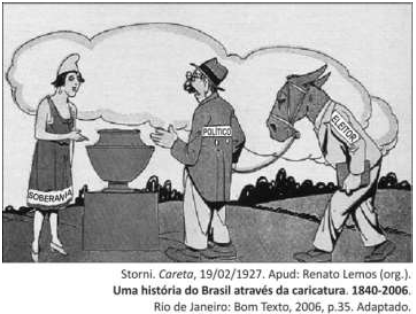
Sobre a charge, assinale a alternativa CORRETA.
Provas
Questão presente nas seguintes provas
Analise o trecho que se segue de uma palestra proferida por Edson Carneiro, em 1971.
“Além de libertar os ingênuos, a lei (a) criava um Fundo de Emancipação, que administraria verbas destinadas a
manumissões pelo Estado, (b) reconhecia ao escravo o direito de constituir pecúlio, (c) proibia a separação dos cônjuges e
dos seus filhos menores de 12 anos, (d) revogava as Ordena*ões, na parte que permitia a ailulação das alforrias por
ingratidão, (e) libertal~a os escravos da nação (i. e., do Estado), os dados em usufruto à Coroa, os das heranças vagas e os
abandonados pelos senhores, (f) tornava sumário o processo de liberdade, com apelação ex-officio quando as decisões lhe
fossem contrárias e (g) mandava fazer a matrícula especial dos beneficiados por ela, considerando livres os não
matriculados após um ano.”
(Conferência pronunciada por Adison Carneiro no CEAO, em 1971)
Assinale a alternativa que indica a Lei Emancipacionista à qual o trecho se refere.
(Conferência pronunciada por Adison Carneiro no CEAO, em 1971)
Assinale a alternativa que indica a Lei Emancipacionista à qual o trecho se refere.
Provas
Questão presente nas seguintes provas
“A fim de elaborar o projeto de Constituição que seria apresentado à nova Assembleia, conforme a promessa feita por
ocasião da dissolução, ainda em novembro de 1823, por sugestão que atribuímos a Vilela Barbosa, criou o Imperador um
Conselho de Estado, composto dos seis Ministros recentemente nomeados e mais quatro personalidades políticas, todos
brasileiros natos... Imediatamente instalado o Conselho de Estado, com tanto afinco, trabalhou o novo órgão, sob a
presidência e com ativa participação direta do Imperador, que já no dia 11 do mês seguinte, dezembro de 1823, completou a
sua tarefa primordial, a elaboração do projeto constitucional.”
(https://bdor.sibi.ufrj.br/bitstream/doc/386/1/339%20PDF%20-%20OCR%20-%20RED.pdf)
Assinale a alternativa CORRETA no que diz respeito à Constituição de 1824.
(https://bdor.sibi.ufrj.br/bitstream/doc/386/1/339%20PDF%20-%20OCR%20-%20RED.pdf)
Assinale a alternativa CORRETA no que diz respeito à Constituição de 1824.
Provas
Questão presente nas seguintes provas
“Os estudos que apresentamos se propõem a abordar a aula de História através de instrumentos de análise de pensadores
que tem revolucionado a leitura que tradicionalmente temos feito das relações entre o capitalismo e os processos de
produção das subjetividades. A ideia da colonialidade do poder, do saber e do ser constituem-se em uma compreensão de
que os povos latinoamericanos vivem e constroem suas relações com os outros desde o “espelho da colonialidade”. Uma
maneira de ver, experienciar e ser no mundo, tributária de uma cosmologia europeia, que encerra um conjunto particular de
representações sociais, mas se apresentam como universais.”
(PEREIRA, Nilton. PAIM, Elison. Revista do Programa de Pós-graduação em Educação da Unochapecó).
O fragmento acima se refere a uma abordagem teórica do ensino da história. Assinale a alternativa que a representa.
(PEREIRA, Nilton. PAIM, Elison. Revista do Programa de Pós-graduação em Educação da Unochapecó).
O fragmento acima se refere a uma abordagem teórica do ensino da história. Assinale a alternativa que a representa.
Provas
Questão presente nas seguintes provas
A Primeira Grande Guerra foi considerada o acontecimento que marcou o início do século XX (HOBSBAWN,
1995). Foi peça-chave para a compreensão deste momento histórico. Com o início da Guerra, chega ao fim o período
conhecido como Belle Époque, compreendido entre os anos 1871 e 1914. A Primeira Guerra Mundial envolveu todas
as seis grandes potências europeias da época: Grã-Bretanha, França, Rússia, Áustria-Hungria, Prússia (após 1871
ampliada para Alemanha), Itália, após a unificação, além de Estados Unidos e Japão.
(https://www.cedem.unesp.br/#!/primeira-grande-guerra/primeira-grande-guerra182/)
Assinale a alternativa que indica as causas desse conflito.
(https://www.cedem.unesp.br/#!/primeira-grande-guerra/primeira-grande-guerra182/)
Assinale a alternativa que indica as causas desse conflito.
Provas
Questão presente nas seguintes provas
Cadernos
Caderno Container