Foram encontradas 40 questões.
4246336
Ano: 2026
Disciplina: Inglês (Língua Inglesa)
Banca: UniFil
Orgão: Pref. Congonhinhas-PR
Disciplina: Inglês (Língua Inglesa)
Banca: UniFil
Orgão: Pref. Congonhinhas-PR
Provas:
AI teachers and cybernetics - what could the world look like
in 2050?
Laura Cress - Technology reporter
The last 25 years has seen some mind-bending
technological changes. At the start of the century, most
computers connected to the internet with noisy dial-up
connections, Netflix was an online DVD rental company, and
the vast majority of people hadn't even heard of a smartphone.
Fast forward two and a half decades, and innovations in AI,
robotics and much else besides are emerging at an incredible
rate. So we decided to ask experts what the next 25 years could
bring. Here are their predictions for the technology we'll be
using by 2050 - and how it could reshape our lives.
Merging humans and machines
Science fiction set in the 2050s is full of examples of
humans using technological enhancements to feel fitter, happier
and more productive. In the 2000 hit game Deus Ex - set in 2052
- the player can inject themselves with tiny robots called
“nanites”. These microscopic robots manipulate matter on
atomic levels, giving superhuman abilities such as enhanced
speed and the ability to see in the dark. It sounds like something
from the distant future, but nanotechnology - engineering at a
scale of millionths of a millimetre - is already used in lots of
everyday real-life tech. In fact, it is powering the way you are
reading these very words right now - every smartphone or
computer is run by a central chip made up of billions of tiny
transistors - electrical components built on a nanoscale to speed
up data processing. Professor Steven Bramwell at the London
Centre for Nanotechnology told the BBC by 2050 we should
expect the lines between machines, electronics and biology to
be “significantly blurred”. That means we could see
nanotechnology implants by then - but more to “monitor your
health or aid communication” rather than to appear invisible, as
in Deus Ex. Medicine could also make common use of
machines at a nanometre scale to “deliver drugs to exactly
where they need to go”, said Professor Bramwell. Cybernetics
professor Kevin Warwick is equally interested in studying
augmentations, going one step further than most. In 1998 he
became the first human to have a microchip implanted into his
nervous system, earning him the title “Captain Cyborg”.
Professor Warwick believes by 2050, advancements in
cybernetics - the science studying the links between natural and
mechanical systems - could lead to trailblazing treatments for
diseases. He predicts the use of “deep brain electronic
stimulation” as a partial treatment for some conditions such as
schizophrenia, rather than medicine. He adds it is likely we'll
see more cybernetic enhancements of the kind he has already
trialled himself, so that “your brain and body can be in different
places”. And what if we wanted to test out how the latest
enhancement, or even new diet worked on our bodies, without
any risks of experiencing the side effects? Professor Roger
Highfield, Science Director of the Science Museum, believes
“digital twins” - virtual versions of a physical object, updated
using real time data - could become a regular feature in our
lives. He imagines a world where each of us could have
“thousands of simplified twins”, using them to explore how
“different medications or lifestyle changes affect your unique
biology”. In other words, we could preview our futures before
we live them.
The next generation of AI
Many technology firms, including Google and IBM, are
currently locked in a multi-billion dollar race to revolutionise
how we push fields like AI even further - in the form
of quantum computing. Quantum computers are machines
which can do very complex calculations at incredibly fast
speeds - for example, simulating molecular interactions to
design new drugs faster. In January 2025, Jensen Huang - boss
of the leading chip firm Nvidia - said he believed “very useful”
quantum computing would come in 20 years. AI itself will
undoubtedly continue to loom large in our society as we journey
towards the half century mark. Futurist and author Tracey
Follows, who helped write a White Paper on UK education in
2050, believes learning will take place across “virtual and
physical realities” using AI teachers which “adjust in real time”.
Rather than textbooks, she predicts children will use
“immersive simulations”. Meanwhile, education will be less
standardised, with each child's individual DNA or biometric
data studied to understand how they learn best.
Available on https://www.bbc.com/news/articles/c865n800d5jo
Provas
Questão presente nas seguintes provas

4246335
Ano: 2026
Disciplina: Inglês (Língua Inglesa)
Banca: UniFil
Orgão: Pref. Congonhinhas-PR
Disciplina: Inglês (Língua Inglesa)
Banca: UniFil
Orgão: Pref. Congonhinhas-PR
Provas:
AI teachers and cybernetics - what could the world look like
in 2050?
Laura Cress - Technology reporter
The last 25 years has seen some mind-bending
technological changes. At the start of the century, most
computers connected to the internet with noisy dial-up
connections, Netflix was an online DVD rental company, and
the vast majority of people hadn't even heard of a smartphone.
Fast forward two and a half decades, and innovations in AI,
robotics and much else besides are emerging at an incredible
rate. So we decided to ask experts what the next 25 years could
bring. Here are their predictions for the technology we'll be
using by 2050 - and how it could reshape our lives.
Merging humans and machines
Science fiction set in the 2050s is full of examples of
humans using technological enhancements to feel fitter, happier
and more productive. In the 2000 hit game Deus Ex - set in 2052
- the player can inject themselves with tiny robots called
“nanites”. These microscopic robots manipulate matter on
atomic levels, giving superhuman abilities such as enhanced
speed and the ability to see in the dark. It sounds like something
from the distant future, but nanotechnology - engineering at a
scale of millionths of a millimetre - is already used in lots of
everyday real-life tech. In fact, it is powering the way you are
reading these very words right now - every smartphone or
computer is run by a central chip made up of billions of tiny
transistors - electrical components built on a nanoscale to speed
up data processing. Professor Steven Bramwell at the London
Centre for Nanotechnology told the BBC by 2050 we should
expect the lines between machines, electronics and biology to
be “significantly blurred”. That means we could see
nanotechnology implants by then - but more to “monitor your
health or aid communication” rather than to appear invisible, as
in Deus Ex. Medicine could also make common use of
machines at a nanometre scale to “deliver drugs to exactly
where they need to go”, said Professor Bramwell. Cybernetics
professor Kevin Warwick is equally interested in studying
augmentations, going one step further than most. In 1998 he
became the first human to have a microchip implanted into his
nervous system, earning him the title “Captain Cyborg”.
Professor Warwick believes by 2050, advancements in
cybernetics - the science studying the links between natural and
mechanical systems - could lead to trailblazing treatments for
diseases. He predicts the use of “deep brain electronic
stimulation” as a partial treatment for some conditions such as
schizophrenia, rather than medicine. He adds it is likely we'll
see more cybernetic enhancements of the kind he has already
trialled himself, so that “your brain and body can be in different
places”. And what if we wanted to test out how the latest
enhancement, or even new diet worked on our bodies, without
any risks of experiencing the side effects? Professor Roger
Highfield, Science Director of the Science Museum, believes
“digital twins” - virtual versions of a physical object, updated
using real time data - could become a regular feature in our
lives. He imagines a world where each of us could have
“thousands of simplified twins”, using them to explore how
“different medications or lifestyle changes affect your unique
biology”. In other words, we could preview our futures before
we live them.
The next generation of AI
Many technology firms, including Google and IBM, are
currently locked in a multi-billion dollar race to revolutionise
how we push fields like AI even further - in the form
of quantum computing. Quantum computers are machines
which can do very complex calculations at incredibly fast
speeds - for example, simulating molecular interactions to
design new drugs faster. In January 2025, Jensen Huang - boss
of the leading chip firm Nvidia - said he believed “very useful”
quantum computing would come in 20 years. AI itself will
undoubtedly continue to loom large in our society as we journey
towards the half century mark. Futurist and author Tracey
Follows, who helped write a White Paper on UK education in
2050, believes learning will take place across “virtual and
physical realities” using AI teachers which “adjust in real time”.
Rather than textbooks, she predicts children will use
“immersive simulations”. Meanwhile, education will be less
standardised, with each child's individual DNA or biometric
data studied to understand how they learn best.
Available on https://www.bbc.com/news/articles/c865n800d5jo
Provas
Questão presente nas seguintes provas
4246334
Ano: 2026
Disciplina: Inglês (Língua Inglesa)
Banca: UniFil
Orgão: Pref. Congonhinhas-PR
Disciplina: Inglês (Língua Inglesa)
Banca: UniFil
Orgão: Pref. Congonhinhas-PR
Provas:
AI teachers and cybernetics - what could the world look like
in 2050?
Laura Cress - Technology reporter
The last 25 years has seen some mind-bending
technological changes. At the start of the century, most
computers connected to the internet with noisy dial-up
connections, Netflix was an online DVD rental company, and
the vast majority of people hadn't even heard of a smartphone.
Fast forward two and a half decades, and innovations in AI,
robotics and much else besides are emerging at an incredible
rate. So we decided to ask experts what the next 25 years could
bring. Here are their predictions for the technology we'll be
using by 2050 - and how it could reshape our lives.
Merging humans and machines
Science fiction set in the 2050s is full of examples of
humans using technological enhancements to feel fitter, happier
and more productive. In the 2000 hit game Deus Ex - set in 2052
- the player can inject themselves with tiny robots called
“nanites”. These microscopic robots manipulate matter on
atomic levels, giving superhuman abilities such as enhanced
speed and the ability to see in the dark. It sounds like something
from the distant future, but nanotechnology - engineering at a
scale of millionths of a millimetre - is already used in lots of
everyday real-life tech. In fact, it is powering the way you are
reading these very words right now - every smartphone or
computer is run by a central chip made up of billions of tiny
transistors - electrical components built on a nanoscale to speed
up data processing. Professor Steven Bramwell at the London
Centre for Nanotechnology told the BBC by 2050 we should
expect the lines between machines, electronics and biology to
be “significantly blurred”. That means we could see
nanotechnology implants by then - but more to “monitor your
health or aid communication” rather than to appear invisible, as
in Deus Ex. Medicine could also make common use of
machines at a nanometre scale to “deliver drugs to exactly
where they need to go”, said Professor Bramwell. Cybernetics
professor Kevin Warwick is equally interested in studying
augmentations, going one step further than most. In 1998 he
became the first human to have a microchip implanted into his
nervous system, earning him the title “Captain Cyborg”.
Professor Warwick believes by 2050, advancements in
cybernetics - the science studying the links between natural and
mechanical systems - could lead to trailblazing treatments for
diseases. He predicts the use of “deep brain electronic
stimulation” as a partial treatment for some conditions such as
schizophrenia, rather than medicine. He adds it is likely we'll
see more cybernetic enhancements of the kind he has already
trialled himself, so that “your brain and body can be in different
places”. And what if we wanted to test out how the latest
enhancement, or even new diet worked on our bodies, without
any risks of experiencing the side effects? Professor Roger
Highfield, Science Director of the Science Museum, believes
“digital twins” - virtual versions of a physical object, updated
using real time data - could become a regular feature in our
lives. He imagines a world where each of us could have
“thousands of simplified twins”, using them to explore how
“different medications or lifestyle changes affect your unique
biology”. In other words, we could preview our futures before
we live them.
The next generation of AI
Many technology firms, including Google and IBM, are
currently locked in a multi-billion dollar race to revolutionise
how we push fields like AI even further - in the form
of quantum computing. Quantum computers are machines
which can do very complex calculations at incredibly fast
speeds - for example, simulating molecular interactions to
design new drugs faster. In January 2025, Jensen Huang - boss
of the leading chip firm Nvidia - said he believed “very useful”
quantum computing would come in 20 years. AI itself will
undoubtedly continue to loom large in our society as we journey
towards the half century mark. Futurist and author Tracey
Follows, who helped write a White Paper on UK education in
2050, believes learning will take place across “virtual and
physical realities” using AI teachers which “adjust in real time”.
Rather than textbooks, she predicts children will use
“immersive simulations”. Meanwhile, education will be less
standardised, with each child's individual DNA or biometric
data studied to understand how they learn best.
Available on https://www.bbc.com/news/articles/c865n800d5jo
Provas
Questão presente nas seguintes provas
4246333
Ano: 2026
Disciplina: Inglês (Língua Inglesa)
Banca: UniFil
Orgão: Pref. Congonhinhas-PR
Disciplina: Inglês (Língua Inglesa)
Banca: UniFil
Orgão: Pref. Congonhinhas-PR
Provas:
AI teachers and cybernetics - what could the world look like
in 2050?
Laura Cress - Technology reporter
The last 25 years has seen some mind-bending
technological changes. At the start of the century, most
computers connected to the internet with noisy dial-up
connections, Netflix was an online DVD rental company, and
the vast majority of people hadn't even heard of a smartphone.
Fast forward two and a half decades, and innovations in AI,
robotics and much else besides are emerging at an incredible
rate. So we decided to ask experts what the next 25 years could
bring. Here are their predictions for the technology we'll be
using by 2050 - and how it could reshape our lives.
Merging humans and machines
Science fiction set in the 2050s is full of examples of
humans using technological enhancements to feel fitter, happier
and more productive. In the 2000 hit game Deus Ex - set in 2052
- the player can inject themselves with tiny robots called
“nanites”. These microscopic robots manipulate matter on
atomic levels, giving superhuman abilities such as enhanced
speed and the ability to see in the dark. It sounds like something
from the distant future, but nanotechnology - engineering at a
scale of millionths of a millimetre - is already used in lots of
everyday real-life tech. In fact, it is powering the way you are
reading these very words right now - every smartphone or
computer is run by a central chip made up of billions of tiny
transistors - electrical components built on a nanoscale to speed
up data processing. Professor Steven Bramwell at the London
Centre for Nanotechnology told the BBC by 2050 we should
expect the lines between machines, electronics and biology to
be “significantly blurred”. That means we could see
nanotechnology implants by then - but more to “monitor your
health or aid communication” rather than to appear invisible, as
in Deus Ex. Medicine could also make common use of
machines at a nanometre scale to “deliver drugs to exactly
where they need to go”, said Professor Bramwell. Cybernetics
professor Kevin Warwick is equally interested in studying
augmentations, going one step further than most. In 1998 he
became the first human to have a microchip implanted into his
nervous system, earning him the title “Captain Cyborg”.
Professor Warwick believes by 2050, advancements in
cybernetics - the science studying the links between natural and
mechanical systems - could lead to trailblazing treatments for
diseases. He predicts the use of “deep brain electronic
stimulation” as a partial treatment for some conditions such as
schizophrenia, rather than medicine. He adds it is likely we'll
see more cybernetic enhancements of the kind he has already
trialled himself, so that “your brain and body can be in different
places”. And what if we wanted to test out how the latest
enhancement, or even new diet worked on our bodies, without
any risks of experiencing the side effects? Professor Roger
Highfield, Science Director of the Science Museum, believes
“digital twins” - virtual versions of a physical object, updated
using real time data - could become a regular feature in our
lives. He imagines a world where each of us could have
“thousands of simplified twins”, using them to explore how
“different medications or lifestyle changes affect your unique
biology”. In other words, we could preview our futures before
we live them.
The next generation of AI
Many technology firms, including Google and IBM, are
currently locked in a multi-billion dollar race to revolutionise
how we push fields like AI even further - in the form
of quantum computing. Quantum computers are machines
which can do very complex calculations at incredibly fast
speeds - for example, simulating molecular interactions to
design new drugs faster. In January 2025, Jensen Huang - boss
of the leading chip firm Nvidia - said he believed “very useful”
quantum computing would come in 20 years. AI itself will
undoubtedly continue to loom large in our society as we journey
towards the half century mark. Futurist and author Tracey
Follows, who helped write a White Paper on UK education in
2050, believes learning will take place across “virtual and
physical realities” using AI teachers which “adjust in real time”.
Rather than textbooks, she predicts children will use
“immersive simulations”. Meanwhile, education will be less
standardised, with each child's individual DNA or biometric
data studied to understand how they learn best.
Available on https://www.bbc.com/news/articles/c865n800d5jo
Provas
Questão presente nas seguintes provas
4246332
Ano: 2026
Disciplina: Inglês (Língua Inglesa)
Banca: UniFil
Orgão: Pref. Congonhinhas-PR
Disciplina: Inglês (Língua Inglesa)
Banca: UniFil
Orgão: Pref. Congonhinhas-PR
Provas:
- Interpretação de texto | Reading comprehension
- Gramática - Língua InglesaVerbos | VerbsPresente perfeito | Present perfect
- Gramática - Língua InglesaVerbos | VerbsPassado simples | Simple past
AI teachers and cybernetics - what could the world look like
in 2050?
Laura Cress - Technology reporter
The last 25 years has seen some mind-bending
technological changes. At the start of the century, most
computers connected to the internet with noisy dial-up
connections, Netflix was an online DVD rental company, and
the vast majority of people hadn't even heard of a smartphone.
Fast forward two and a half decades, and innovations in AI,
robotics and much else besides are emerging at an incredible
rate. So we decided to ask experts what the next 25 years could
bring. Here are their predictions for the technology we'll be
using by 2050 - and how it could reshape our lives.
Merging humans and machines
Science fiction set in the 2050s is full of examples of
humans using technological enhancements to feel fitter, happier
and more productive. In the 2000 hit game Deus Ex - set in 2052
- the player can inject themselves with tiny robots called
“nanites”. These microscopic robots manipulate matter on
atomic levels, giving superhuman abilities such as enhanced
speed and the ability to see in the dark. It sounds like something
from the distant future, but nanotechnology - engineering at a
scale of millionths of a millimetre - is already used in lots of
everyday real-life tech. In fact, it is powering the way you are
reading these very words right now - every smartphone or
computer is run by a central chip made up of billions of tiny
transistors - electrical components built on a nanoscale to speed
up data processing. Professor Steven Bramwell at the London
Centre for Nanotechnology told the BBC by 2050 we should
expect the lines between machines, electronics and biology to
be “significantly blurred”. That means we could see
nanotechnology implants by then - but more to “monitor your
health or aid communication” rather than to appear invisible, as
in Deus Ex. Medicine could also make common use of
machines at a nanometre scale to “deliver drugs to exactly
where they need to go”, said Professor Bramwell. Cybernetics
professor Kevin Warwick is equally interested in studying
augmentations, going one step further than most. In 1998 he
became the first human to have a microchip implanted into his
nervous system, earning him the title “Captain Cyborg”.
Professor Warwick believes by 2050, advancements in
cybernetics - the science studying the links between natural and
mechanical systems - could lead to trailblazing treatments for
diseases. He predicts the use of “deep brain electronic
stimulation” as a partial treatment for some conditions such as
schizophrenia, rather than medicine. He adds it is likely we'll
see more cybernetic enhancements of the kind he has already
trialled himself, so that “your brain and body can be in different
places”. And what if we wanted to test out how the latest
enhancement, or even new diet worked on our bodies, without
any risks of experiencing the side effects? Professor Roger
Highfield, Science Director of the Science Museum, believes
“digital twins” - virtual versions of a physical object, updated
using real time data - could become a regular feature in our
lives. He imagines a world where each of us could have
“thousands of simplified twins”, using them to explore how
“different medications or lifestyle changes affect your unique
biology”. In other words, we could preview our futures before
we live them.
The next generation of AI
Many technology firms, including Google and IBM, are
currently locked in a multi-billion dollar race to revolutionise
how we push fields like AI even further - in the form
of quantum computing. Quantum computers are machines
which can do very complex calculations at incredibly fast
speeds - for example, simulating molecular interactions to
design new drugs faster. In January 2025, Jensen Huang - boss
of the leading chip firm Nvidia - said he believed “very useful”
quantum computing would come in 20 years. AI itself will
undoubtedly continue to loom large in our society as we journey
towards the half century mark. Futurist and author Tracey
Follows, who helped write a White Paper on UK education in
2050, believes learning will take place across “virtual and
physical realities” using AI teachers which “adjust in real time”.
Rather than textbooks, she predicts children will use
“immersive simulations”. Meanwhile, education will be less
standardised, with each child's individual DNA or biometric
data studied to understand how they learn best.
Available on https://www.bbc.com/news/articles/c865n800d5jo
Provas
Questão presente nas seguintes provas
4246331
Ano: 2026
Disciplina: Inglês (Língua Inglesa)
Banca: UniFil
Orgão: Pref. Congonhinhas-PR
Disciplina: Inglês (Língua Inglesa)
Banca: UniFil
Orgão: Pref. Congonhinhas-PR
Provas:
AI teachers and cybernetics - what could the world look like
in 2050?
Laura Cress - Technology reporter
The last 25 years has seen some mind-bending
technological changes. At the start of the century, most
computers connected to the internet with noisy dial-up
connections, Netflix was an online DVD rental company, and
the vast majority of people hadn't even heard of a smartphone.
Fast forward two and a half decades, and innovations in AI,
robotics and much else besides are emerging at an incredible
rate. So we decided to ask experts what the next 25 years could
bring. Here are their predictions for the technology we'll be
using by 2050 - and how it could reshape our lives.
Merging humans and machines
Science fiction set in the 2050s is full of examples of
humans using technological enhancements to feel fitter, happier
and more productive. In the 2000 hit game Deus Ex - set in 2052
- the player can inject themselves with tiny robots called
“nanites”. These microscopic robots manipulate matter on
atomic levels, giving superhuman abilities such as enhanced
speed and the ability to see in the dark. It sounds like something
from the distant future, but nanotechnology - engineering at a
scale of millionths of a millimetre - is already used in lots of
everyday real-life tech. In fact, it is powering the way you are
reading these very words right now - every smartphone or
computer is run by a central chip made up of billions of tiny
transistors - electrical components built on a nanoscale to speed
up data processing. Professor Steven Bramwell at the London
Centre for Nanotechnology told the BBC by 2050 we should
expect the lines between machines, electronics and biology to
be “significantly blurred”. That means we could see
nanotechnology implants by then - but more to “monitor your
health or aid communication” rather than to appear invisible, as
in Deus Ex. Medicine could also make common use of
machines at a nanometre scale to “deliver drugs to exactly
where they need to go”, said Professor Bramwell. Cybernetics
professor Kevin Warwick is equally interested in studying
augmentations, going one step further than most. In 1998 he
became the first human to have a microchip implanted into his
nervous system, earning him the title “Captain Cyborg”.
Professor Warwick believes by 2050, advancements in
cybernetics - the science studying the links between natural and
mechanical systems - could lead to trailblazing treatments for
diseases. He predicts the use of “deep brain electronic
stimulation” as a partial treatment for some conditions such as
schizophrenia, rather than medicine. He adds it is likely we'll
see more cybernetic enhancements of the kind he has already
trialled himself, so that “your brain and body can be in different
places”. And what if we wanted to test out how the latest
enhancement, or even new diet worked on our bodies, without
any risks of experiencing the side effects? Professor Roger
Highfield, Science Director of the Science Museum, believes
“digital twins” - virtual versions of a physical object, updated
using real time data - could become a regular feature in our
lives. He imagines a world where each of us could have
“thousands of simplified twins”, using them to explore how
“different medications or lifestyle changes affect your unique
biology”. In other words, we could preview our futures before
we live them.
The next generation of AI
Many technology firms, including Google and IBM, are
currently locked in a multi-billion dollar race to revolutionise
how we push fields like AI even further - in the form
of quantum computing. Quantum computers are machines
which can do very complex calculations at incredibly fast
speeds - for example, simulating molecular interactions to
design new drugs faster. In January 2025, Jensen Huang - boss
of the leading chip firm Nvidia - said he believed “very useful”
quantum computing would come in 20 years. AI itself will
undoubtedly continue to loom large in our society as we journey
towards the half century mark. Futurist and author Tracey
Follows, who helped write a White Paper on UK education in
2050, believes learning will take place across “virtual and
physical realities” using AI teachers which “adjust in real time”.
Rather than textbooks, she predicts children will use
“immersive simulations”. Meanwhile, education will be less
standardised, with each child's individual DNA or biometric
data studied to understand how they learn best.
Available on https://www.bbc.com/news/articles/c865n800d5jo
Provas
Questão presente nas seguintes provas
4246330
Ano: 2026
Disciplina: Inglês (Língua Inglesa)
Banca: UniFil
Orgão: Pref. Congonhinhas-PR
Disciplina: Inglês (Língua Inglesa)
Banca: UniFil
Orgão: Pref. Congonhinhas-PR
Provas:
AI teachers and cybernetics - what could the world look like
in 2050?
Laura Cress - Technology reporter
The last 25 years has seen some mind-bending
technological changes. At the start of the century, most
computers connected to the internet with noisy dial-up
connections, Netflix was an online DVD rental company, and
the vast majority of people hadn't even heard of a smartphone.
Fast forward two and a half decades, and innovations in AI,
robotics and much else besides are emerging at an incredible
rate. So we decided to ask experts what the next 25 years could
bring. Here are their predictions for the technology we'll be
using by 2050 - and how it could reshape our lives.
Merging humans and machines
Science fiction set in the 2050s is full of examples of
humans using technological enhancements to feel fitter, happier
and more productive. In the 2000 hit game Deus Ex - set in 2052
- the player can inject themselves with tiny robots called
“nanites”. These microscopic robots manipulate matter on
atomic levels, giving superhuman abilities such as enhanced
speed and the ability to see in the dark. It sounds like something
from the distant future, but nanotechnology - engineering at a
scale of millionths of a millimetre - is already used in lots of
everyday real-life tech. In fact, it is powering the way you are
reading these very words right now - every smartphone or
computer is run by a central chip made up of billions of tiny
transistors - electrical components built on a nanoscale to speed
up data processing. Professor Steven Bramwell at the London
Centre for Nanotechnology told the BBC by 2050 we should
expect the lines between machines, electronics and biology to
be “significantly blurred”. That means we could see
nanotechnology implants by then - but more to “monitor your
health or aid communication” rather than to appear invisible, as
in Deus Ex. Medicine could also make common use of
machines at a nanometre scale to “deliver drugs to exactly
where they need to go”, said Professor Bramwell. Cybernetics
professor Kevin Warwick is equally interested in studying
augmentations, going one step further than most. In 1998 he
became the first human to have a microchip implanted into his
nervous system, earning him the title “Captain Cyborg”.
Professor Warwick believes by 2050, advancements in
cybernetics - the science studying the links between natural and
mechanical systems - could lead to trailblazing treatments for
diseases. He predicts the use of “deep brain electronic
stimulation” as a partial treatment for some conditions such as
schizophrenia, rather than medicine. He adds it is likely we'll
see more cybernetic enhancements of the kind he has already
trialled himself, so that “your brain and body can be in different
places”. And what if we wanted to test out how the latest
enhancement, or even new diet worked on our bodies, without
any risks of experiencing the side effects? Professor Roger
Highfield, Science Director of the Science Museum, believes
“digital twins” - virtual versions of a physical object, updated
using real time data - could become a regular feature in our
lives. He imagines a world where each of us could have
“thousands of simplified twins”, using them to explore how
“different medications or lifestyle changes affect your unique
biology”. In other words, we could preview our futures before
we live them.
The next generation of AI
Many technology firms, including Google and IBM, are
currently locked in a multi-billion dollar race to revolutionise
how we push fields like AI even further - in the form
of quantum computing. Quantum computers are machines
which can do very complex calculations at incredibly fast
speeds - for example, simulating molecular interactions to
design new drugs faster. In January 2025, Jensen Huang - boss
of the leading chip firm Nvidia - said he believed “very useful”
quantum computing would come in 20 years. AI itself will
undoubtedly continue to loom large in our society as we journey
towards the half century mark. Futurist and author Tracey
Follows, who helped write a White Paper on UK education in
2050, believes learning will take place across “virtual and
physical realities” using AI teachers which “adjust in real time”.
Rather than textbooks, she predicts children will use
“immersive simulations”. Meanwhile, education will be less
standardised, with each child's individual DNA or biometric
data studied to understand how they learn best.
Available on https://www.bbc.com/news/articles/c865n800d5jo
Provas
Questão presente nas seguintes provas
4246004
Ano: 2026
Disciplina: Atualidades e Conhecimentos Gerais
Banca: UniFil
Orgão: Pref. Congonhinhas-PR
Disciplina: Atualidades e Conhecimentos Gerais
Banca: UniFil
Orgão: Pref. Congonhinhas-PR
Provas:
A Mega da Virada é um concurso especial da Mega-Sena realizado anualmente no Brasil, sempre no dia
31 de dezembro, e costuma atrair milhões de
apostadores em busca de prêmios bilionários. Em
sua edição mais recente, o sorteio bateu recorde
histórico e se tornou o maior já realizado no país.
Qual foi o valor aproximado do prêmio principal
sorteado na última Mega da Virada?
Provas
Questão presente nas seguintes provas
4246003
Ano: 2026
Disciplina: Legislação Municipal
Banca: UniFil
Orgão: Pref. Congonhinhas-PR
Disciplina: Legislação Municipal
Banca: UniFil
Orgão: Pref. Congonhinhas-PR
Provas:
De acordo com o artigo 144 da Lei Orgânica de
Congonhinhas/PR, informe se é verdadeiro (V) ou
falso (F) para o que se afirma e assinale a alternativa
correta. As ações e serviços de saúde pública
integram uma rede regionalizada e hierarquizada e
constituem um sistema único de saúde, organizado
de acordo com as seguintes diretrizes:
( ) Centralização estadual dos recursos, serviços e ações com posterior regionalização deles.
( ) Integridade na prestação das ações preventivas e curativas.
( ) Participação da comunidade, na forma da Lei.
( ) Centralização estadual dos recursos, serviços e ações com posterior regionalização deles.
( ) Integridade na prestação das ações preventivas e curativas.
( ) Participação da comunidade, na forma da Lei.
Provas
Questão presente nas seguintes provas
Considere a tela de impressão do Microsoft Word
365 (versão português) apresentada na imagem a
seguir:
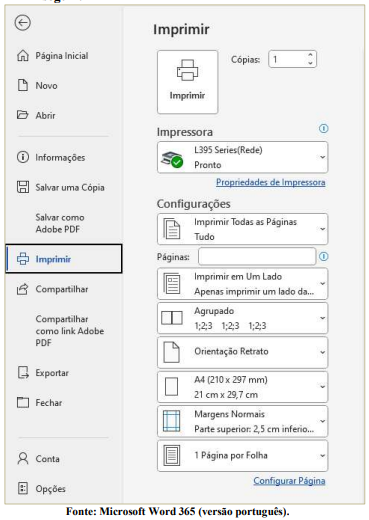
Considerando essas informações, informe se é verdadeiro (V) ou falso (F) para o que se afirma e assinale a alternativa com a sequência correta.
( ) A opção “Imprimir em Um Lado” indica que o documento será impresso apenas em um lado da folha, sendo necessário selecionar manualmente a opção de impressão frente e verso, quando essa funcionalidade for suportada pela impressora.
( ) O campo “Páginas” permite inserir intervalos e páginas alternadas, como 1,3,5 ou 2-4, não se limitando a números consecutivos.
( ) A configuração “Orientação Retrato” determina que o conteúdo será impresso verticalmente, podendo ser alterada para Paisagem conforme a necessidade do documento.
( ) O tamanho A4 (210 x 297 mm) não pode ser alterado pelo usuário, mesmo que a impressora ofereça outros formatos compatíveis.
Considerando essas informações, informe se é verdadeiro (V) ou falso (F) para o que se afirma e assinale a alternativa com a sequência correta.
( ) A opção “Imprimir em Um Lado” indica que o documento será impresso apenas em um lado da folha, sendo necessário selecionar manualmente a opção de impressão frente e verso, quando essa funcionalidade for suportada pela impressora.
( ) O campo “Páginas” permite inserir intervalos e páginas alternadas, como 1,3,5 ou 2-4, não se limitando a números consecutivos.
( ) A configuração “Orientação Retrato” determina que o conteúdo será impresso verticalmente, podendo ser alterada para Paisagem conforme a necessidade do documento.
( ) O tamanho A4 (210 x 297 mm) não pode ser alterado pelo usuário, mesmo que a impressora ofereça outros formatos compatíveis.
Provas
Questão presente nas seguintes provas
Cadernos
Caderno Container