Foram encontradas 50 questões.
Uma urna contém todos os anagramas distintos formados com as letras da palavra EINSTEIN. Sorteando-se aleatoriamente um anagrama dessa urna, a probabilidade de que ele termine com duas vogais é igual a:
Provas

Uma célula diploide apresenta o genótipo AaBb, cujos genes estão em diferentes loci de dois pares de cromossomos homólogos. Caso essa célula entre em meiose e somente em um dos cromossomos duplicados não ocorra a disjunção durante a meiose II, uma das células resultantes desse fenômeno poderá conter os genes indicados em
Provas
A figura ilustra de forma simplificada a síntese de um polipeptídeo, a qual ocorre no interior de uma célula.
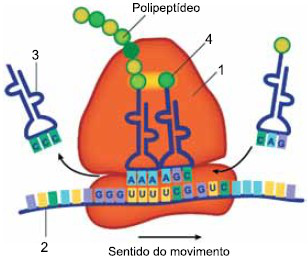
(https://socratic.org. Adaptado.)
Em relação à síntese de um polipeptídeo, o número
Provas
Na Revista Brasileira de Hematologia e Hemoterapia, Miriane L. Zucoloto e Edson Z. Martinez, pesquisadores da USP de Ribeirão Preto, referem que um dos motivos de algumas pessoas rejeitarem uma vacina é a fobia de injeção, caracterizada pela extrema aversão em ver sangue. Essas pessoas adiam ou evitam procedimentos médicos e não participam da detecção de doenças. Ao ver sangue, é desencadeada uma reação vasovagal em resposta à fobia, surgindo então sintomas como desconforto, náuseas, palidez e até desmaios.
(Julio Abramczyk. “A rejeição à vacina”. Folha de S. Paulo, 14.05.2021. Adaptado.)
Uma reação vasovagal tem relação com o nervo vago e com órgãos do sistema cardiovascular. O nervo vago faz parte do sistema nervoso , a partir do qual os axônios da divisão parassimpática inervam os músculos das vias respiratórias e dos órgãos do sistema digestório. Nesta divisão parassimpática, os neurônios pós-ganglionares liberam nas fendas sinápticas.
As lacunas do texto são preenchidas, respectivamente, por:
Provas
Em um experimento, secreções extraídas do tubo digestório humano foram testadas para verificar a digestão do amido presente no arroz em moléculas de glicose isoladas. A tabela indica cinco tubos de ensaio contendo, em cada um, uma solução de amido, em determinado pH, à qual foi adicionada uma secreção digestiva ou uma combinação entre secreções. Ao longo de todo o experimento, os tubos foram mantidos à temperatura constante de 37 ºC.
|
Tubos de ensaio |
Secreção adicionada à solução de amido |
pH |
| 1 | saliva | 7 |
| 2 | suco gástrico | 7 |
| 3 | bile + suco gástrico | 8 |
| 4 | suco pancreático + suco entérico | 8 |
| 5 | suco gástrico + suco entérico | 2 |
Houve digestão completa do amido em moléculas de glicose isoladas apenas no tubo de ensaio
Provas
De janeiro a outubro de 2020, os incêndios destruíram 4,1 milhões de hectares do Pantanal, de acordo com estimativas da Universidade Federal do Rio de Janeiro (UFRJ). O número espantoso corresponde a 28% de toda a área pantaneira e 32 vezes a cidade do Rio de Janeiro. Os focos de calor, que sinalizam os incêndios devastadores, quebraram recordes. Até novembro de 2020, foram 21000, mais do que o dobro do dado observado em 2019. Não se tem notícia de uma tragédia dessas proporções na região.
(Sabrina Brito. “Paraíso perdido”. Veja, 30.12.2020. Adaptado.)
Uma das consequências para o meio ambiente causada pela interferência antrópica descrita no texto é
Provas
Disciplina: Literatura Brasileira e Estrangeira
Banca: VUNESP
Orgão: FICSAE
Este movimento descobriu algo que ainda não havia sido conhecido ou enfatizado antes: a “poesia pura”, a poesia que surge do espírito irracional, não conceitual da linguagem, oposto a toda a interpretação lógica. Para esse movimento, a poesia nada mais é do que a expressão daquelas relações e correspondências, que a linguagem, abandonada a si mesma, cria entre o concreto e o abstrato, o material e o ideal, e entre as diferentes esferas dos sentidos.
(Domício Proença Filho. Estilos de época na literatura, 1978. Adaptado.)
O texto refere-se ao movimento
Provas
At a university in Northern California, a business professor uses an avatar to lecture on a virtual stage. Meanwhile, at a Southern university, students in an artificial intelligence (AI) course discover that one of their nine teaching assistants is a virtual avatar, Jill Watson, IBM’s question-answering computer system. Jill participated in student conversations and responded to all inquiries with 97% accuracy. At a college on the East Coast, students interact with an AI chat agent in a virtual restaurant set in China to learn the Mandarin language. These examples provide a glimpse into future teaching and learning in college.
The rise of artificial intelligence
According to a 2021 report on AI, many institutions find themselves more focused on the present limited use of AI — for tasks such as detecting plagiarism or student cheating — and not so much the future of AI. In my view, universities should broaden their use of AI and conduct experiments to improve upon its usefulness to individual learners. For example, how can colleges use AI to improve student learning of calculus or help students become stronger writers? However, most universities are slow to innovate. Some of the challenges to acquiring AI include lack of technical expertise, financial concerns, insufficient leadership, and biased algorithms.
Professors from the baby-boom generation are retiring, and I expect some of their jobs will not be filled. I believe the rising use of AI will contribute to this trend, with universities relying more on technology than in-person teaching.
The flipped classroom
The flipped classroom provides students with opportunities to learn at their own pace outside the classroom. In college, the flipped classroom involves prerecorded faculty lectures of course content, whether that be on the causes of the Civil War or the origins of white rice. In class, students build on the professor’s prerecorded lecture and work on activities to expand knowledge. The classroom becomes a place for social interaction and understanding course content. A human teaching assistant, avatar or chat agent conducts all in-class activities, tests and group work. No additional professors are needed to teach multiple sections of the same course.
These two trends illustrate a profession that I see as being on the cusp of radical transformation.
(Patricia A. Young. www.theconversation.com, 20.10.2021. Adapted.)
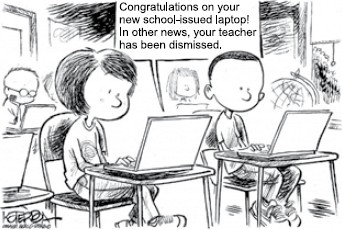
(https://larrycuban.wordpress.com. Adapted.)
The cartoon and the text
Provas
At a university in Northern California, a business professor uses an avatar to lecture on a virtual stage. Meanwhile, at a Southern university, students in an artificial intelligence (AI) course discover that one of their nine teaching assistants is a virtual avatar, Jill Watson, IBM’s question-answering computer system. Jill participated in student conversations and responded to all inquiries with 97% accuracy. At a college on the East Coast, students interact with an AI chat agent in a virtual restaurant set in China to learn the Mandarin language. These examples provide a glimpse into future teaching and learning in college.
The rise of artificial intelligence
According to a 2021 report on AI, many institutions find themselves more focused on the present limited use of AI — for tasks such as detecting plagiarism or student cheating — and not so much the future of AI. In my view, universities should broaden their use of AI and conduct experiments to improve upon its usefulness to individual learners. For example, how can colleges use AI to improve student learning of calculus or help students become stronger writers? However, most universities are slow to innovate. Some of the challenges to acquiring AI include lack of technical expertise, financial concerns, insufficient leadership, and biased algorithms.
Professors from the baby-boom generation are retiring, and I expect some of their jobs will not be filled. I believe the rising use of AI will contribute to this trend, with universities relying more on technology than in-person teaching.
The flipped classroom
The flipped classroom provides students with opportunities to learn at their own pace outside the classroom. In college, the flipped classroom involves prerecorded faculty lectures of course content, whether that be on the causes of the Civil War or the origins of white rice. In class, students build on the professor’s prerecorded lecture and work on activities to expand knowledge. The classroom becomes a place for social interaction and understanding course content. A human teaching assistant, avatar or chat agent conducts all in-class activities, tests and group work. No additional professors are needed to teach multiple sections of the same course.
These two trends illustrate a profession that I see as being on the cusp of radical transformation.
(Patricia A. Young. www.theconversation.com, 20.10.2021. Adapted.)
According to the fourth paragraph, the flipped classroom
Provas
At a university in Northern California, a business professor uses an avatar to lecture on a virtual stage. Meanwhile, at a Southern university, students in an artificial intelligence (AI) course discover that one of their nine teaching assistants is a virtual avatar, Jill Watson, IBM’s question-answering computer system. Jill participated in student conversations and responded to all inquiries with 97% accuracy. At a college on the East Coast, students interact with an AI chat agent in a virtual restaurant set in China to learn the Mandarin language. These examples provide a glimpse into future teaching and learning in college.
The rise of artificial intelligence
According to a 2021 report on AI, many institutions find themselves more focused on the present limited use of AI — for tasks such as detecting plagiarism or student cheating — and not so much the future of AI. In my view, universities should broaden their use of AI and conduct experiments to improve upon its usefulness to individual learners. For example, how can colleges use AI to improve student learning of calculus or help students become stronger writers? However, most universities are slow to innovate. Some of the challenges to acquiring AI include lack of technical expertise, financial concerns, insufficient leadership, and biased algorithms.
Professors from the baby-boom generation are retiring, and I expect some of their jobs will not be filled. I believe the rising use of AI will contribute to this trend, with universities relying more on technology than in-person teaching.
The flipped classroom
The flipped classroom provides students with opportunities to learn at their own pace outside the classroom. In college, the flipped classroom involves prerecorded faculty lectures of course content, whether that be on the causes of the Civil War or the origins of white rice. In class, students build on the professor’s prerecorded lecture and work on activities to expand knowledge. The classroom becomes a place for social interaction and understanding course content. A human teaching assistant, avatar or chat agent conducts all in-class activities, tests and group work. No additional professors are needed to teach multiple sections of the same course.
These two trends illustrate a profession that I see as being on the cusp of radical transformation.
(Patricia A. Young. www.theconversation.com, 20.10.2021. Adapted.)
It is an explicit opinion by the author in the subitem “The rise of artificial intelligence”:
Provas
Caderno Container