Magna Concursos

Foram encontradas 50 questões.

2288940 Ano: 2014
Disciplina: Inglês (Língua Inglesa)
Banca: UFG
Orgão: Pref. Caldas Novas-GO
Provas:
“Children are born with a specific innate ability to discover for themselves the underlying rules of a language on the basis of the samples of a natural language they are exposed to.”
LIGHTBOWN, Patsy M.; SPADA, Nina. How Languages are Learned. Oxford: Oxford University Press, 2006. p. 15.
Which language acquisition theoretical perspective does the above excerpt illustrate?
 

Provas

Questão presente nas seguintes provas
Segundo a LDB/1996, são modalidades da educação básica:
 

Provas

Questão presente nas seguintes provas
2288809 Ano: 2014
Disciplina: Inglês (Língua Inglesa)
Banca: UFG
Orgão: Pref. Caldas Novas-GO

Provas:
Read the opinion of a professor on the subject of reading aloud in class. Question is based on it .
“A lot of teachers I have worked with often ask their learners to read aloud. When a learner reads aloud, he often feels tense, and that can’t really help him grasp new language, can it? Besides, after he’s read aloud, he usually can’t even answer a basic question: he has to reread the passage silently to try to find the answer. So, I don’t think it’s helpful at all and I don’t do it anymore. I wish more of my colleagues agreed!”
TANNER, Rosie; GREEN, Catherine. Tasks for Teacher Education: a reflective approach. Harlow: Longman, 1998. p. 60. (Adaptado).
Quando a professora finaliza o relato dizendo “I wish more of my colleagues agreed!” significa que
 

Provas

Questão presente nas seguintes provas
2288763 Ano: 2014
Disciplina: Inglês (Língua Inglesa)
Banca: UFG
Orgão: Pref. Caldas Novas-GO
Provas:
Read the following excerpt from a seminal paper on matters of teaching and answer the question.
Read the following extract of a seminal article concerning teaching materials and answer questions 43, 44 and 45. In addition it seems necessary to take a preliminary look at two different approaches to the question of the role of teaching materials. On the one hand there is the DEFICIENCY view. According to this view, we need teaching materials to save learners from our deficiencies as teachers, to make sure, as far as possible, that the syllabus is properly covered and that exercises are well thought out, for example. This way of thinking might lead, at one extreme, to the idea that the ‘best’ teachers would neither want nor need published teaching materials. At the other extreme we would have ‘teacher-proof’ materials that no teacher, however deficient, would be able to teach badly with. On the other hand, there is the DIFFERENCE view, which holds that we need teaching materials as ‘carriers’ of decisions best made by someone other than the classroom teacher, not because the classroom teacher is deficient, as a classroom teacher, but because the expertise required of materials writers is importantly different from that required of classroom teachers - the people who have to have the interpersonal skills to make classrooms good places to learn in. For some this conception may seem to ‘reduce’ the teacher to the role of mere classroom manager. For others, it ‘frees’ the teacher to develop the expertise needed for dealing with practical and fundamental issues in the fostering of language learning in the classroom setting”.
ALLWRIGHT, Dick. What do we want teaching materials for? ELT Journal, vol. 36, n.1, October, 1981, p. 6.
The excerpt also suggests that
 

Provas

Questão presente nas seguintes provas
2288711 Ano: 2014
Disciplina: Inglês (Língua Inglesa)
Banca: UFG
Orgão: Pref. Caldas Novas-GO
Provas:
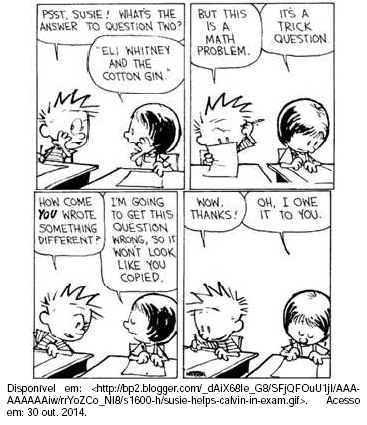
Leia os textos a seguir e responda à questão.
Texto 1
Enunciado 3201317-1
Texto 2
Se você tem medo ou desconfia de que os alunos possam copiar durante a elaboração das respostas, há aí um dado revelador de que a pergunta não vale a pena ser respondida [...] Se podem copiar tão facilmente, é porque a pergunta não desafiava o pensamento original e pessoal, nem precisava colocar à prova a própria inteligência. Menos ainda se se trata de uma inteligência crítica, que tem a capacidade e a habilidade de questionar o valor do conteúdo da pergunta que deve responder e o valor formativo da resposta que deve elaborar, ou simplesmente recordar, reproduzir ou copiar.
MÉNDEZ, Juan Manuel Álvarez. Avaliar para conhecer, examinar para excluir. Porto Alegre: Artmed, 2002. p.125.
No texto 1, analisando-se as atitudes e o diálogo das crianças, pode-se inferir que
 

Provas

Questão presente nas seguintes provas
2288553 Ano: 2014
Disciplina: Português
Banca: UFG
Orgão: Pref. Caldas Novas-GO

O primeiro beijo

Clarice Lispector

No dia seguinte fui à sua casa, literalmente correndo. Ela não morava num sobrado como eu, e sim numa casa. Não me mandou entrar. Olhando bem para meus olhos, disse-me que havia emprestado o livro a outra menina, e que eu voltasse no dia seguinte para buscá-lo. Boquiaberta, saí devagar, mas em breve a esperança de novo me tomava toda e eu recomeçava na rua a andar pulando, que era o meu modo estranho de andar pelas ruas de Recife. Dessa vez nem caí: guiava-me a promessa do livro, o dia seguinte viria, os dias seguintes seriam mais tarde a minha vida inteira, o amor pelo mundo me esperava, andei pulando pelas ruas como sempre e não caí nenhuma vez. [...] Peguei o livro. Não, não saí pulando como sempre. Saí andando bem devagar. Sei que segurava o livro grosso com as duas mãos, comprimindo-o contra o peito. Quanto tempo levei até chegar em casa, também pouco importa. Meu peito estava quente, meu coração pensativo. Chegando em casa, não comecei a ler. Fingia que não o tinha, só para depois ter o susto de o ter. Horas depois abri-o, li algumas linhas maravilhosas, fechei-o de novo, fui passear pela casa, adiei ainda mais indo comer pão com manteiga, fingi que não sabia onde guardara o livro, achava-o, abria-o por alguns instantes. Criava as mais falsas dificuldades para aquela coisa clandestina que era a felicidade. A felicidade sempre iria ser clandestina para mim. Parece que eu já pressentia. Como demorei! Eu vivia no ar… Havia orgulho e pudor em mim. Eu era uma rainha delicada.

Lispector, Clarice. O primeiro beijo. São Paulo, Ed. Ática, 1996. (Trecho).

Ao tomar posse do livro que tanto desejava, a personagem do texto demonstra um tipo de relação com esse objeto que pode ser explicitada por meio do seguinte trecho da letra de uma música:


Provas

Questão presente nas seguintes provas
2288377 Ano: 2014
Disciplina: Inglês (Língua Inglesa)
Banca: UFG
Orgão: Pref. Caldas Novas-GO
Provas:
Read the cartoon below about a conversation between a coordinator and a teacher and answer question.
Enunciado 3199223-1
Das afirmações da coordenadora pode-se inferir que o autor
 

Provas

Questão presente nas seguintes provas
2288323 Ano: 2014
Disciplina: Inglês (Língua Inglesa)
Banca: UFG
Orgão: Pref. Caldas Novas-GO
Provas:
Read the cartoon below about a conversation between a coordinator and a teacher and answer question.
Enunciado 3198841-1
Regarding the relationship among language, culture and society, the text suggests that
 

Provas

Questão presente nas seguintes provas
2288102 Ano: 2014
Disciplina: Inglês (Língua Inglesa)
Banca: UFG
Orgão: Pref. Caldas Novas-GO
Provas:
Read the cartoon below about a conversation between a coordinator and a teacher and answer question.
Enunciado 3148435-1
In the text, one could replace the subordinate conjunction 'while' for
 

Provas

Questão presente nas seguintes provas
2288073 Ano: 2014
Disciplina: Inglês (Língua Inglesa)
Banca: UFG
Orgão: Pref. Caldas Novas-GO
Provas:
Read the following excerpt from a seminal paper on matters of teaching and answer the question.
Read the following extract of a seminal article concerning teaching materials and answer questions 43, 44 and 45. In addition it seems necessary to take a preliminary look at two different approaches to the question of the role of teaching materials. On the one hand there is the DEFICIENCY view. According to this view, we need teaching materials to save learners from our deficiencies as teachers, to make sure, as far as possible, that the syllabus is properly covered and that exercises are well thought out, for example. This way of thinking might lead, at one extreme, to the idea that the ‘best’ teachers would neither want nor need published teaching materials. At the other extreme we would have ‘teacher-proof’ materials that no teacher, however deficient, would be able to teach badly with. On the other hand, there is the DIFFERENCE view, which holds that we need teaching materials as ‘carriers’ of decisions best made by someone other than the classroom teacher, not because the classroom teacher is deficient, as a classroom teacher, but because the expertise required of materials writers is importantly different from that required of classroom teachers - the people who have to have the interpersonal skills to make classrooms good places to learn in. For some this conception may seem to ‘reduce’ the teacher to the role of mere classroom manager. For others, it ‘frees’ the teacher to develop the expertise needed for dealing with practical and fundamental issues in the fostering of language learning in the classroom setting”.
ALLWRIGHT, Dick. What do we want teaching materials for? ELT Journal, vol. 36, n.1, October, 1981, p. 6.
According to the author, there are two views which explain the role of teaching materials and they lead us to comprehend that teachers
 

Provas

Questão presente nas seguintes provas
